
Listening to MAGA Politics within US/Mexico’s Lucha Libre


This series listens to the political, gendered, queer(ed), racial engagements and class entanglements involved in proclaiming out loud: La-TIN-x. ChI-ca-NA. La-TI-ne. ChI-ca-n-@. Xi-can-x. Funded by an Andrew W. Mellon Foundation as part of the Crossing Latinidades Humanities Research Initiative, the Latinx Sound Cultures Studies Working Group critically considers the role of sound and listening in our formation as political subjects. Through both a comparative and cross-regional lens, we invite Latinx Sound Scholars to join us as we dialogue about our place within the larger fields of Chicanx/Latinx Studies and Sound Studies. We are delighted to publish our initial musings with Sounding Out!, a forum that has long prioritized sound from a queered, racial, working-class and “always-from-below” epistemological standpoint. —Ed. Dolores Inés Casillas
—
This post is co -authored by Esther Díaz Martín and Rebeca Rivas
—
“Lucharaaaaaán a dos a tres caídas sin limite de tiempoooo!“
[“They will fight two out of three falls, with no time limit!”]
Announcer at Lucha Libre, El Paso, Texas
“This ain’t no sideshow.”
George Lipsitz on the role of popular culture
The announcer’s piercing “lucharaaaaaán” cries from the middle of the ring proclaims the constitutional two-out-of-three-falls rule of lucha libre. But before the famous cry rings out to set the stage for the spectacularized acrobatic combat between costumed warriors, their theatrical entrances set the all-important emotional stakes of the battle. The entrances are loud, campy, interactive exchanges between luchadores and spectators. An entrance song itself cues the luchador’s persona: a cumbia could signal a técnico (a good guy); a heavy metal song more than likely indicates a rudo (a bad guy) typically donning black, death-themed getups. Luchadores saunter into the arena, stopping to pose, high five their fans, and verbally heckle their opponents. The storylines of good versus evil, betrayal and revenge, or humility versus arrogance are some of the more standard plots that motivate spectators to adamantly cheer for the favorite and jeer for the foe.
The sonic exchanges between luchadores’ and spectators before, during, and after the fight positions lucha libre as much more than a sport. And while the term spectators, suggests the privileged act of watching or viewing; here, we expand spectators within lucha libre arena to mean “a call to witness” (á la Chela Sandoval). Put simply, lucha libre is a cultural phenomenon where contemporary cultural, social, and political anxieties are often tapped as fodder for theatrical plots. In the U.S./Mexico’s sister cities of El Paso, Texas and Ciudad Juarez, Chihuahua, the political realities of border enforcement, immigration politics, and racial tensions are loudly heard and placed on display. As part of Rebeca Riva’s ongoing research about the history of lucha libre at the border—which too often gets skipped over for Mexico City as the epicenter of the sport—we listen for the exchanges between luchadores and spectators as resonant participants in the ritual of this sport. Specifically, we tune into lucha libre and its accompanying mega-spectacle to analyze how fans scoff at lucha libre’s MAGA-spectacles. In Time Passages, George Lipsitz (2001) reminded scholars of popular culture decades ago that “this ain’t no sideshow.” In a similar vein, lucha libre directly engages in the larger social and political arena that contextualizes the sport.
In lucha libre, spectators are resonant participants in the construction of an essential “hi-fi” sonic ambiente. Like in football, as Kaj Ahisved notes, the “noise of the crowd” (building on Les Back’s concept) are essential to a “hi-fi” sound where a high degree of information exchange occurs between listeners and the sound environment.Or, as David Hendy describes Olympic arenas, “cauldrons of concentrated sound, [where] the roar of the spectators took on a collective force of its own – a volatile quality rich with cultural and political repercussions.” The crowd’s response, experienced by athletes as ambient noise, bolsters athlete’s spirits and develops an emotional plot for the contest. In certain cases, for instance in Algeria as Stephen Wilford documents, it is a venue for social critique; football stadiums served as “safe zones” where fans could dissent the Abdelaziz Bouteflika dictatorship through chanting political slogans and songs as an anonymous crowd (139).
By listening to lucha libre, we gain a deeper understanding of the embodied components of fan activism, collective identity, and political action. Visual spectacle, bodily gestures, and musical choices, coupled with verbal taunts and visceral grunts serve as interactive storytelling tools. Yet, the crowd’s noise and, importantly, the sonic memories evoked by visual parafenalia amplify a shared political consciousness and prompts the expression of their allegiance with and opposition to the symbolic representations staged.

* * *
The following audio was captured in November 2023 at a parking lot across from El Paso City Hall during a children’s fundraiser. We hear Chris Watson, a previous college wrestler from Oklahoma, make his debut appearance in lucha libre as a white supremacist character. Wearing a clichéd U.S. flag-themed bandana and waving a Trump 2024 campaign flag, he points towards the crowd and makes swimming motions with his arms to communicate the pejorative “wetback.”
Aligning these symbols of MAGA ideologies with Watson’s role as a rudo in the match positions him as a willing vessel for the scorn of the mostly Mexican American spectators. His red-white-and-blue echoes Trump’s xenophobic statements burned into Latinx consciousness: “they’re all rapists,” “bad hombres,” from “shithole countries” as well as renewed promises to “build a great wall… and Mexico will pay” and enact the largest deportation effort in U.S. history since Eisenhower’s “Operation Wetback.”
The reactions from spectators are visceral and cathartic, eliciting camaraderie, anger, or empowerment. They retaliate strongly: “Fuck you! Fuck Donald Trump!”‘ and “Fuera!”, a seemingly hateful exchange interjected with cheering and laughter. Spectators are amused by the insults and retaliations. Watson’s staged “gimmick” prompts spectators to playfully rage against the violence he embodies. Their taunting in Spanish represents both resistance as cultural pride and insider knowledge. The joke is on Watson, who (presumably) does not understand the double entendres hurled at him.
A MAGA luchador evokes the memory of violence carried out against Mexicans and African Americans in Texas since at least the mid 1800s by white enslavers, colonial settlers, Texas Rangers, border patrol, and the modern police force. White supremacist violence is not mere political rhetoric but an ongoing contemporary reality. On August 3rd, 2019 a white man motivated by the “Great Replacement” theory popular in MAGA circles, drove 9 hours from his home in Allen, Texas to a Walmart in El Paso, a majority Latino city, to carry out a mass shooting with the intent of discouraging immigration. He killed 23 people and left 22 injured. Listening and yelling at Watson and his MAGA symbols at the US/Mexico border vocalizes the cultural, political and humanitarian crisis propelled by neoliberalism, the militarized police, and the exploitation of White supremacist sentiments by a wannabe fascist dictator.

Watson comes from a line of “gringo” white supremacist luchadores such as Sam Adonis (Sam Polinsky) who sprays himself orange and waves a US flag stamped with a Trump portrait. El Migra (Gonzalo Garcia), a U.S.-born Mexican American border enforcer performed during the Bush/Clinton era, who threw tortillas while taunting “traguense estas tortillas frijoleros nopaleros” (“choke on these you cactus-eating beaners”) and growled the U.S. national anthem into the mic. Spectators jeered and threw their drink cups at him; an opportunity to retort white supremacist rhetoric.
In another instance from the 1990s, a major showdown between Love Machine (a gringo wrestler turned técnico) and Blue Panther (a tejana wearing feline-themed rudo) the crowd favor turned against the yankee when his neck-breaking illegal move prompted fans to reconsider their alliances in the context of massive Mexican emigration prompted by the devastating yoke of the country’s debt to the IMF and subsequent neoliberal economic reforms. Love Machine’s fake benevolence would seem to embody U.S. gleeful exploitation of Mexico’s expatriated campesinos while simultaneously introducing legislation to further marginalize them.

Unlike Karen Yamashita‘s staging of SUPERNAFTA vs. El Gran Mojado in her 1997 novel Tropic of Orange, or the masked Chicano poetry of the Rudo Revolutionary Front, MAGA-spectacles within lucha libre are not intentionally staged to politicize the public but tap into the raw political nerve of the moment. They allow fans to emotionally resolve social and political anxieties when excoriating the “bad guy,” be it an anti-social character or the symbols of the oppressor, even if only for dos de tres caidas.
—
Featured image by Flickr User C-Monster, taken in Ontario, CA (2017) CC BY-NC 2.0
—
Esther Díaz Martín is an assistant professor of Latin American and Latino Studies and Gender and Women’s Studies at the University of Illinois Chicago. Her book, Latina Radiophonic Feminisms: Sounding Gender Politics into the Digital Age, (forthcoming UT Press, Spring 2025) theorizes Chicana feminist listening attending to the political work of Latina voices in contemporary sound media.
Rebeca Rivas is a graphic artist and doctoral student in History at the University of Texas at El Paso. Her research examines the lucha libre and community building in El Paso, Texas and Ciudad Juárez, Chihuahua. She is currently conducting an extensive oral history and archival project documenting this spectacular sport at the border.
—

REWIND!…If you liked this post, you may also dig:
Xicanacimiento, Life-giving Sonics of Critical Consciousness—Esther Díaz Martín and Kristian E. Vasquez
Ronca Realness: Voices that Sound the Sucia Body—Cloe Gentile Reyes
Echoes in Transit: Loudly Waiting at the Paso del Norte Border Region—José Manuel Flores & Dolores Inés Casillas
Share this:

Sounding Out Tarima Temporalities: Decolonial Feminista Dance Disruption

 For the full intro to the forum by Michelle Habell-Pallan, click here. For the first installment by Yessica Garcia Hernandez click here. For the second post by Susana Sepulveda click here. For last week’s post by Wanda Alarcón click here,
The forum’s inspiring research by scholars/practioners Wanda Alarcón, Yessica Garcia Hernandez, Marlen Rios-Hernandez, Susana Sepulveda, and Iris C. Viveros Avendaño, understands music in its local, translocal and transnational context; and insists upon open new scholarly imaginaries. . .
Current times require us to bridge intersectional, decolonial, and gender analysis. Music, and our relationship to it, has much to reveal about how power operates within a context of inequality. And it will teach us how to get through this moment. –MHP
—
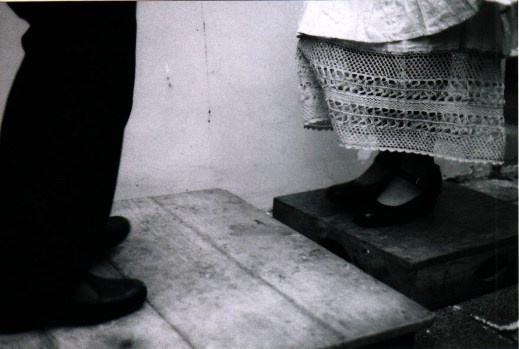
The knowledge presented in this piece is reflective of countless conversations, and the many interactions I have had with teachers, practitioners, and extended fandanguerx communities in Mexico and the U.S. In my scholarly work, I draw from these conversations and my personal experiences as a bailadora in the fandango tradition to illustrate the power of community music as a practice to generate and articulate knowledge in relation to personal and social change. My work centers the study of rhythmic synchronicity in the fandango tradition from Veracruz, Mexico embodied in Zapateado; the percussive sound of women rhythmically stomping their feet on wood.
I am particularly interested in conversations that approach the study of rhythm from a feminist perspective as it allows us to claim visibility to the gendered and racialized voices of resistance that are often absent in academic discourse. My analysis builds on the contributions of Martha Gonzalez, who through her term rhythmic intention explains in “Sonic (Trans)Migration of Son Jarocho Zapateado: Rhythmic Intention, Metamorphosis, and Manifestation in Fandango and Performance”: “[rhythms] processed by the body are not varying forms of making time in music practice, but they are indeed political acts rooted in a history of resistance” (60). To this, I theorize the ca-fé con pan––a polyrhythm cyclically played by women in the majority of sones in the fandango repertoire––to argue that rhythms embodied by the tarima speak of a learning practice that moves beyond the idea of individual knowledge to the concept of relational knowledge. The polyrhythmic zapateado that bailadoras sound out on the tarima is rooted in, and flourishes through interpersonal relationships among women as dancers, and through a more profound awareness and synchronized relationship with nature, all the plants, animals, and natural resources which comprise it as Shawn Wilson discusses on Research Is Ceremony : Indigenous Research Methods (4). The relational embodied knowledge of the bailaoras through zapateado, can thus be understood as a political act, one of decolonial resistance.
My approach to the study of this rhythm comes from the perspective of a bailadora. Although, I respect the work of scholars who capture the technicality of sound and rhythm, I do not offer an analysis of it from the perspective of a trained musician. I learned to dance and play music in informal settings, with my family and the people in the neighborhood. With a working class background, formal training in music or dance was a luxury enjoyed by the elites. Even though I lived in Veracruz for many years, I did not grow up within the tradition, but knew about the music through my dad who taught me some steps. My formation in community dances was primarily through family parties and the sonidos in Mexico City; block parties with huge speakers blasting a variety of tunes ranging from old cumbias, salsas, banda, merengue, and Mexican urban rock. Sonidos in the capital city are most popular in neighborhoods with high concentration of workers in informal economies, many of whom are migrants from states through the republic, who have been displaced due to neoliberal capital flows, various degrees of violence related to drug trafficking, and other socio economic devastation. I grew up going to sonidos in Iztapalapa, and “Neza’–Short for Netzahualcoyotl–a working class neighborhood outside Mexico City., where I lived before moving to Veracruz. From a young age, my ear became familiar to the sound of polyrhythms in family parties and sonidos dancing to cumbias and salsas.
Tlacotalpan, Veracruz, Festival de Son Jarocho, feb’13, image by Flickr User boerries nehe (CC BY-NC 2.0)
Even though I attended a few fandangos before I emigrated to the U.S. in 2004, I started to regularly practice them in Seattle with my mentor and friend Chicana artivista Gonzalez who co-founded the Seattle Fandango Project, a collective of students of the fandango tradition based in Seattle, WA. Martha was the first person who I heard using the term polyrhythm to describe the texture and rhythmic basis of fandango. With Indigenous, African, and European influences, amongst many elements in the fandango, the tarima is a notably polyrhythmic instrument that in its majority is played by women. It also carries the driven pulse of the fandango, where multiple bailadoras stomp with their feet fixed rhythms and syncopated improvisations. The basic fixed rhythm danced in the majority of sones is the ca-fé con pan composed of two independent rhythms of duple and triple meters playing simultaneously. This foundational understanding of polyrhythm as the simultaneous sound of two independent rhythms allows us to perceive the manner in which the cyclical repetition of the cafe con pan, embodied by bailadoras on the tarima, disrupts colonial logics of linear an individualized progress marked by the hegemony of the single bit of a clock. The dancer, processing and articulating rhythms through the body, engages in decolonial (learning) practices that generate a shift in consciousness from individual to relational knowledge.
This recording of “El Siquisiri” from a huapango (another name for fandango, most used in communities in the South of the state) in Michapan de Osorio, Vercruz with Colectivo Alteppe, from Acayucan gives us two in a half minutes of community soundscapes.
“El Siquisiri,” Chacalpa, Veracruz
.We can hear fireworks, the tuning of strings, “aganse para aca” (“como this way/come over here”) and “No se pongan atras” (“don’t stay behind”). Followed by the requinto’s call of the son, the jaranas join in, almost in unison, with the percussive footwork coming at last. In some cases bailadoras dance after the first verse is sung. With the sound of the footwork, in between taking turns to get on and off the tarima, you can hear dancers showing their skills in the afinque de su zapateado, their grounding of the step. By listening to the changes in style, rhythm, and force of sound of the zapateado, you can tell different bailadoras have taken their turn to get on the tarima. There are changes in the volume, intensity, and grounding sound in styles of stomping on the tarima. I say that these changes articulate through sound the inclusive nature of fandango, particularly the collective listening that makes space for each other’s rhythms.

Seattle Fandango Project. Photo credit: Scott Macklin.
Articulated by Gloria Anzaldúa, I often think of bailadoras as Nepantleras: boundary crossers, thresholders who initiate others in rites of passage, activistas who from listening, receptive spiritual stance, rise to their own visions and shift into acting them out, haciendo un mundo nuevo (making a new world). They encourage others to ground themselves to their own bodies and connect to their own internal resources, thus empowering themselves. Empowerment is the bodily feeling of being able to connect with inner voices/ resources (images, symbols, beliefs, memories) during periods of stillness, silence, and deep listening or with kindred others in collective actions.
The bailadora in fandango is an example of someone who listens with a decolonial ear. Bailadoras recognize that the rhythmic vibrations they collectively create on the tarima are potential spaces to embody Nepantla. Anzaldúa explains in Light in the Dark/Luz en lo Oscúro: “Nepantlas are places of constant tension, where the missing or absent pieces can be summoned back, where transformation and healing might be possible, where wholeness is just out of reach but seems attainable” (2). Nepantla is the space where change happens, the kind of change that requires more than words on a page: it takes perseverance, and creative ingenuity. In learning the percussive footwork in fandango one practices listening in relation to others. A good dancer has to be aware of the space and improvisations of other dancers.
As a bailadora myself, I have often been reminded by teachers,––Ruby Oseguera, Laura Rebolloso, Martha Gonzalez and Gemma Padua–– to always stick to the cafe con pan and improvise when a good moment in the son comes up. Zapateado fandanguero cares about the cadencia del son, the feeling in the fixed rhythm: the ca-fé con pan. To maintain the groove of the son, bailadoras engage with one another in a decolonial listening practice that extends to the rest of the fandango soundscape changing the focus from a personal to a collective awareness. When we are referring to a decolonial listening practice we must understand that we are talking about an active sensorium that has personal and collective implications. Best articulated by Chela Sandoval in Methodology of the Oppressed, a decolonial praxis “depends on the practitioner’s ability to read the current situation of power, and self-consciously choosing and adopting the ideological stand best suited to push against its configurations. This is a survival skill well known to oppressed peoples” (50). The conditions that people within communities create in polyrhythmic music practices extend beyond the musical experience. Fandango and polyrhythm are the materialization of ways of being center on the awareness of our relationships and the relationship one shares with reality.

Son Jarocho Band, Image by Flickr User ilf_ (CC BY-NC 2.0)
Collective rhythmic practices are potential spaces where alternative consciousness to the hegemony of coloniality can originate. They activate an epistemology of differential consciousness that relies on the integration of the self as tuning into reality through sound. These acts of knowing connect to notions of relationality situated at the center of indigenous epistemologies. As Walter Mignolo claims in “Geopolitics of Sensing and Knowing: on (De)Coloniality, Border Thinking and Epistemic Disobedience,” Relationality gives us the ability to think and do decolonially dwelling and thinking in the borders of local histories confronting global designs (277). Using music as a tool to organize collectively, fandanguerxs in Mexico, and the U.S. challenge global designs of social organization that continue to displace communities of color around the world. To exemplify this sentiment I share this video of el son de la morena, the Dark skin woman performed by Collectivo Altepee’s in one of their visits to the U.S. Before the beginning of the son, Sael Bernal shares:
There are many types of music. This music has to do with people’s hearts, and everyone is different and this is the reason why this music sounds different depending on where you are, but in our hearts we all have this characteristic of humanity based on our capacities to relate to one another. This is the reason why we can share space and live together… ¡y qué viva la diversidad!
Chicago, 2012. Mario Gervacio, Sael Bernal, Gema Padua, Luis Sarmiento, Alberto Alor, & Simon Sanchez.
Featured Image: “encuentro de jaraneros y decimistas, tlacotalpan, veracruz, enero/febrero ’14” by Flickr user boerries nehe (CC BY-NC 2.0)
—
Iris C. Viveros Avendaño was born and raised in Mexico. She is a Ph.D. Candidate and a McNair Scholar in the Gender, Women, and Sexuality Studies department at the University of Washington. Her academic interests emphasize the integration of third world feminist approaches to the analysis of colonial legacies and projects in present-day systems of violence. To this effect, she focuses on the role of social structures and state-mediated technologies of power and domination in perpetuating violence against Afro Indigenous [descent] women. In addition, Iris’s scholarly work focuses on study of decolonial cyclic temporalities embodied on the tarima, or platform drum center stage in fandangos as practices of resistance, recovery, and healing from trauma. A central idea throughout her scholarly work is the exploration of the rhythmic body in fandango–In its collective and individual manifestation–particularly on the tarima, where knowledge is produced, reproduced, and transmitted.
A major source of Iris’s academic and personal inspiration comes from her involvement as a bailadora/percussive dancer and active co-organizer in the Seattle Fandango Project, a community dedicated to forging relationships and social activism through participatory music, poetry, and dance.
—
 REWIND! . . .If you liked this post, you may also dig:
SO! Reads: Deborah R. Vargas’s Dissonant Divas in Chicana Music: The Limits of La Onda–Wanda Alarcon
SO! Amplifies: Sounding Board Curated by Leonardo Cardoso–Jay Loomis
Spaces of Sounds: The Peoples of the African Diaspora and Protest in the United States –Vanessa Valdés
Share this:


Current Top Posts





April 2021

January 2020

November 2019

October 2019

August 2019

April 2014

November 2017

March 2015

December 2017

October 2015
 Sounding Out!
Recent Comments