
SO! Reads: Danielle Shlomit Sofer’s Sex Sounds: Vectors of Difference in Electronic Music

Distance, therefore, preserves a European austerity in recorded musical practices, and electroacoustic practice is no exception; it is perhaps even responsible for reinvigorating a colonial posterity in contemporary music as so many examples in this book follow this pattern–Danielle Shlomit Sofer, Sex Sounds, 14.

Sex Sounds: Vectors of Difference in Electronic Music (MIT Press, 2022) by Danielle Shlomit Sofer brings a complex analysis for contemporary de-colonial, queer and feminist readers. This book did its best to sustain an argument diving into eleven case studies and strongly problematising the Western white cis gaze. Sofer offers readers a new perspective in both the history of music and the decolonisation of that history.
In a moment when discussions of consent, censorship, pleasure, and surveillance are reshaping how we think about media, Sofer asks: What does sex sound like, and why does it matter? Their analysis cuts across high art and popular culture, from avant-garde compositions to pop music to porn, revealing how sonic expressions of sex are never neutral—they’re deeply entangled in gendered, racialized, and heteronormative structures. In doing so, Sex Sounds resonates with broader critical work on listening as a political act, aligning with ongoing conversations in sound studies about the ethics of hearing and the politics of voice, noise, and silence

The main focus of Sex Sounds is the historical loop of sexual themes in electronic music since the 1950s. Sofer writes from the perspective of a mixed-race, nonbinary Jewish scholar specializing in music theory and musicology. They argue that the way the Western world teaches music history involves hegemonic narratives. In other words, the author’s impetus is to highlight the construction of mythological figures such as Pierre Schaeffer in France and Karlheinz Stockhausen in Germany who represent the canon of the Eurocentric music phenomena.
Sex Sounds specifically follows the concept of “Electrosexual Music,” defined by Sofer as electroacoustic Sound and Music interacting with sex and eroticism as socialized aesthetics. The issue of representation in music is a key research focus navigating questions such as: “How does music present sex acts and who enacts them? ” as well as: “how does a composer represent sexuality? How does a performer convey sexuality? And how does a listener interpret sexuality?” (xxiv & xxix). Moreover, Sofer traces: “the threats of representation, namely exploitation and objectification” (xxxvii) as the result of white male privilege and the historical harm and violence this means (xiix & 271).
By exploring answers to these questions, Sofer successfully exposes how electroacoustic sexuality has historically operated as a constant presence in many music genres, as well as proving that music and sound did not begin in Europe nor belongs only to the Anglo-European provincial cosmos. Sex Sounds gives visibility to peripheral voices ignored by the Eurocentric canon, arguing for a new history of music where countries such as Egypt, Ghana, South Africa, Chile, Japan or Korea are central.
Sofer further vivisects the meaning of sexual sounds as not only Eurocentric and colonial but patriarchal and sexist. What is the history behind sex sounds in the electroacoustic music field? Can we find liberation in sex sounds or have they only reproduced dominance? Which role do sex sounds play in the territories of otherness and racial representation? Are there examples where minoritized people have reclaimed their voice? Sex is part of our humanity. But how do sex sounds dehumanize female subjects? These are more of the fundamental questions Sofer responds to in this study.

I aim, first and foremost, to show that electrosexual music is far representative a collection than the typically presented electroacoustic figures -supposedly disinterested, disembodied, and largely white cis men from Europe and North America –Sofer, Sex Sounds,(xvi).
The time frame of the study ranges from 1950 until 2012, analysing four case studies. Sofer divides the book in two parts: Part I: “Electroacoustics of the Feminized Voice” and Part II: “Electrosexual Disturbance.” The first part contextualizes “electrosexual” music within the dominant cis white racial frame. The main argument is to demonstrate how many canonic electroacoustic works in the history of Western sound have sustained an ongoing dominance as a historical habit locating the male gaze at the center as well as instrumentalizing the ‘feminized voice’ as mere object of desire without personification and recognition as fundamental actor in the compositions. Under such a premise, Sofer vivisects sound works such as “Erotica” by the father of Musique Concretè Pierre Schaffer and Pierre Henry (1950-1951), Luc Ferrari’s “les danses organiques” (1973) and Robert Normandeu’s “Jeu de Langues” (2009), among other pieces.
Luc Ferrrari’s work from 1973 is one of many examples in which Sofer makes evident the question of consent, since the women’s voices he includes were used in his work without their knowledge, a pattern of objectivation that mirrors structures of patriarchal domination. Sofer “defines and interrogates the assumed norms of electroacoustic sexual expression in works that represent women’s presumed sexual experience via masculinist heterosexual tropes, even when composed by women” (xivii-xiviii). Sofer emphasises the existence of “distance” as a gendered trope in which women’s audible sexual pleasure is presented as “evidence” in the form of sexualized and racialized intramusical tropes. Philosophically speaking, this phenomena, Sofer argues, goes back to Friedrich Nietzsche and his understanding of the “women’s curious silence” (xxvii). In other words, a woman can be curious but must remain silent and in the shadows.
This is the case in Schaeffer and Henry’s “Erotica” (1950-1951), one of the earliest colonial impetus to electrosexual music in which female voices are both present and erased, present in the recording but erased as subjects of sonic agency, since the composers did not credit the woman behind the voice recordings. She has no name nor authorship, but her sexualized voice is the main element in the composition. This paradox shows the issue of prioritising the ‘Western’ white European cis male gaze. This gaze uses women’s sexuality as a commerce where only the composer benefits from this use. This exposes the problem of labor and exploitation within electroacoustic practice historically dominated by white men.
“Erotica” stands out for its sensual tension, abstract eroticism, and experimental use of the body as both subject and instrument. This work belongs to the hegemonic narrative of electroacoustic music with the use of sex sounds as aesthetic objects that insinuate erotic arousal as a construct of the male gaze.
Through examples like “Erotica” Sofer strongly questions the exclusion of women as active agents of aesthetic sonic creation since: “electroacoustic spaces have long excluded women’s contributions as equal creators to men, who are more typically touted as composers and therefore compensated with prestige in the form of academic positions or board dominations” (xxxix). This book considers: “the threats of representation, namely exploitation and objectification” (xxxvii). Here we navigate the questions of how something is presented, by whom, and with which profit or intention. In other words, how sounds: “are created, for what purposes, and in turn, how sounds are interpreted and understood” (xxxiii).These are problems rooted in both patriarchy and capitalism.
This book is a strong contribution to decolonize the history of music as we know it, although the citations here could be richer, including studies by Rachel McCarthy (“Marking the ‘Unmarked’ Space: Gendered Vocal Construction in Female Electronic Artists” 2014), Tara Rodgers (“Tinkering with Cultural Memory: Gender and the Politics of Synthesizer Historiography” 2015), and the work of Louise Marshall and Holly Ingleton, who used intersectional feminist frameworks to analyze the work of marginalized composers (including women of color) and the curatorial practices that shape electronic music history. Also, not to forget: Chandra Mohanty’s “Under Western Eyes: Feminist Scholarship and Colonial Discourses” (1988).
Musical artist Sylvester
I argue that, although many composers of color work in electronic music, the search term ‘electroacoustic’ remains exclusionary because of who declares themselves as an advocate of this music, and not necessarily in how their music is made–Sofer, Sex Sounds, (xiv).
After a deep dive into the genealogy of the patriarchal practices in electroacoustic music understood as electrosexual works (hence: “Sex is only re-presented in music p. xxix), Sofer moves to the territory of feminist contra-narratives. In the second part of their study, Sofer offers sonic practices and concrete examples that: “break the electroacoustic mold either by consciously objecting to its narrow constraints or by emerging from, building on, and, in a sense, competing with a completely different historical trajectory” (xlvi). Contra-narratives from the racialized periphery and underground landscapes appear in this book as case studies to hold the argument and expand the homocentric and patriarchal telos found even in the sonic archives as well as the Western theoretical corpus. These ‘Others’ reclaim their voices going a step further and gaining recognition.
After examining examples of racialisation and objectification, Sofer selects some case studies from 1975 to 2013 in the second chapter of this section titled: “Electrosexual Disturbance.” In this section, Sofer also points to new forms of exclusion and instrumentalisation via “racial othering,” specifically in the context of popular music such as Disco where we find an emphasis on the feminized voice. Disco, as a genre rooted in Black, queer, and marginalized communities, inherently grappled with racial and gendered dynamics. Donna Summer’s “Love to Love You Baby” (1975) exemplifies this tension.
The track’s erotic vocal performance (23 simulated orgasms over 16 minutes) became emblematic of the hypersexualization of Black women in popular music. Summer’s persona as the “first lady of love” reinforced stereotypes of Black female sexuality as inherently exotic or excessive, a trope traced to racist and sexist historical narratives. Simultaneously, disco provided a space for liberation: Black and LGBTQ+ artists like Summer, Sylvester, and Gloria Gaynor used the genre to assert agency over their identities and bodies, challenging mainstream exclusion. The tropes of sex and race are a paradoxical combination bringing both oppression as well as liberation.
Sofer argues that Summers was commercially recognized but her figure as a composer was destroyed, creating consequently a hierarchy of labor. She was acknowledged for her amazing sexualized voice and performance on stage, but not recognized as a musician or equal to music producers. Here we see the practice of epistemological discrimination and extreme racial sexualisation. On the positive side, Summer became the Black Queen idol for gay liberation. Nevertheless, she remained as the sexualized and racial voice of the seventies.
Sofer also presents the case of ex-sex worker, sex-educator and radical ecosex-activist Annie Sprinkle collaborating in a post-porn art video with the legendary Texan and lesbian composer Pauline Oliveros. For Sprinkle and Oliveros, Sofer offers a different phenomena at work, since both queer-women/Lesbian-women collaborated from the point of feminist independence and sexual liberation coming together for educational purposes.

Sluts & Goddesses (1992) is a porn film with an Oliveros soundtrack, produced by radical women– with only women–in a self-determined frame. The movie offers an example of collaboration moving from avantgarde sound composition expertise to trashy whoring and interracial lesbian power. This example was rare, but inspiring for the coming generations. Two lesbian Titans united for electrosexual disturbance from the feminist gaze, Sprinkle and Oliveros were a duo that broke silence.
This book revisits the acousmatic in its electronic manifestations to examine and interrogate sexual and sexualized assumptions underwriting electroacoustic musical philosophies.–Sofer, Sex Sounds, (xxi)
Sofer’s Sex Sounds enters into a vital and still-emerging conversation about how sound—particularly sonic expressions of sex and eroticism—shapes, disrupts, and reinscribes power. At a time when sonic studies increasingly reckon with embodiment, affect, and intimacy, Sofer brings a feminist and queer critique to the center of how we listen to, interpret, and culturally regulate the sounds of sex. Their book invites us to reconsider not only what we hear in erotic audio, but how we’ve been taught—socially, politically, morally—to hear it.
This book doesn’t just fill a gap—it pushes the field toward a more nuanced, bodily-aware mode of scholarship. For SO! readers, Sex Sounds offers both a provocation and a methodology: it challenges us to hear differently, to ask how power works not only through what is seen or said, but through what is moaned, whispered, muffled, or made to be heard too loudly.
—
Featured Image: “Stamen,” by Flickr User Sharonolk, CC BY 2.0
—
Verónica Mota Galindo is an interdisciplinary researcher based in Berlin, where they study philosophy at the Freie Universität. Their work goes beyond the academic sphere, blending sound art, critical epistemology, and community engagement to make complex philosophical ideas accessible to broader audiences. As a dedicated educator and sound artist, Mota Galindo bridges the gap between academic research and lived material experience, inviting others to explore the transformative power of critical thought and creative expression. Committed to bringing philosophy to life outside traditional boundaries, they inspire new ways of thinking aimed at emancipation of the human and non-human for collective survival.
—

REWIND!…If you liked this post, check out:
Into the Woods: A Brief History of Wood Paneling on Synthesizers*–Tara Rodgers
Ritual, Noise, and the Cut-up: The Art of Tara Transitory—Justyna Stasiowska
SO! Reads: Zeynep Bulut’s Building a Voice: Sound, Surface, Skin –Enikő Deptuch Vághy
Share this:

Robin Williams and the Shazbot Over the First Podcast
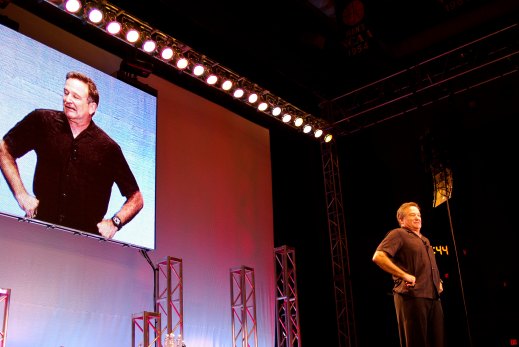
Histories of technology have politics. The way we discuss the emergence and development of media technologies implicates the priorities and interests of those telling the story, and how we understand a technology’s meaning and potential.
Among podcasters familiar with the history of the medium, Dave Winer– the developer behind the RSS feed –is usually credited as the progenitor of the form. This past summer, however, this narrative was challenged by Podnews editor James Cridland–(good naturedly, I presume)–who suggested that the comedian Robin Williams may actually have been the first podcaster, predating Winer’s RSS (“Rich Site Summary,” or “Really Simple Syndication”) distribution model by a few months. These origin stories have important technical differences that lead to political repercussions: the Winer narrative envisions podcasting as open and decentralized, and therefore theoretically an inherently emancipatory technology. The Williams narrative, in contrast, locates the birth of the medium within a closed, corporate-controlled platform – which just might mean there’s nothing inherrently open or democratic about internet-distributed audio content at all.
Though both perspectives are undoubtedly “great white man” visions of the medium’s history–or more precisely versions of Susan Douglas’s “inventor-hero”–what’s particularly interesting here is how both views implicate a politics of what podcasts are and what they ought to be. Although this quarrel was a dispute between colleagues that was ultimately abandoned, I argue it’s well worth a deeper examination, as the ideological conflict at its center isn’t just about the past, but rather competing visions of podcasting’s future – over the continued flourishing or gradual eclipse of RSS.
Indeed, debates over the technical definition of a podcast, and over who was—and who was not–the first podcaster based on that definition, reveal anxieties among long-time podcasters and developers about corporate consolidation in the industry as well as the apparent irrelevance of technical distinctions to listeners and creators who may not appreciate the way in which walled gardens negate the very thing that makes podcasting so special. Likewise, to suggest that podcasting may have first emerged as a proprietary form may retroactively justify corporate platform enclosures in the present. And, though I’m just as suspicious of corporate hegemony as the next person, nuancing the early history of the medium can help us think through the distinctions between technology and cultural form.
In the consensus version of podcasting’s history, the emergence of the medium is typically traced to software developer Dave Winer’s publication – with significant contribution from the former MTV VJ and Internet entrepreneur Adam Curry– of RSS (“Rich Site Summary,” or “Really Simple Syndication”) version 0.92 in December 2000, which allowed for the distribution of digital audio files. The first podcast feed followed in January 2001, and, with the launch of Curry’s iPodder podcast aggregator and his program Daily Source Code in 2004, podcasting began to coalesce as both technology and cultural form. In the 20-odd years since, the medium’s technical infrastructure has remained essentially unchanged: RSS continues to be the predominant format of podcast syndication.
So this past July, when Podnews editor James Cridland cheekily suggested that it was not Dave Winer, nor “the podfather” Adam Curry, but comedian Robin Williams who had actually been the world’s first podcaster, industry graybeards were quick to push back on his claim.
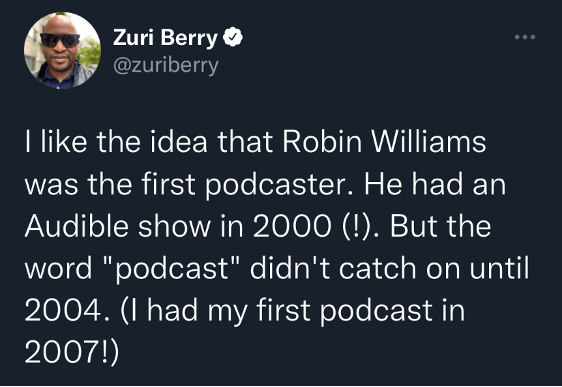
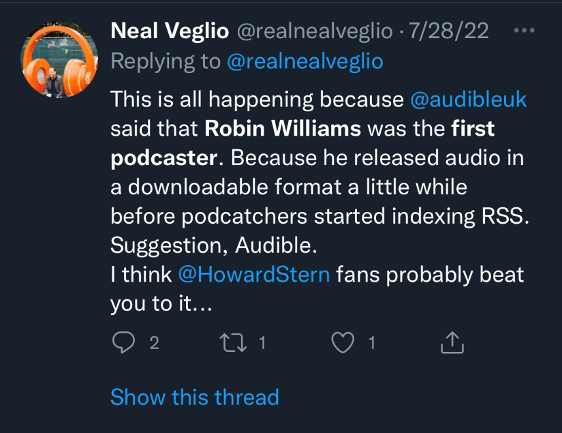
Cridland’s argument went like this: As an early investor in Audible.com, Williams launched a bi-weekly talk show called RobinWilliams@Audible in early 2000 (several months before Winer’s pioneering RSS), which listeners could download onto their mp3 players. Subscribers who owned an Audible Mobile Player could even have RobinWilliams@Audible automatically pushed to their device. “Of course, that’s what the first podcast was, too,” Cridland noted, “something you downloaded to your computer, then synched to your mp3 player.”
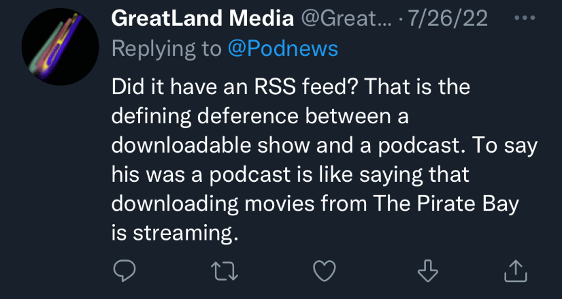
The crucial distinction, however, was that RobinWilliams@Audible was not distributed via RSS. For some, this meant that the show was definitively not a podcast – and Cridland’s claim patently absurd.
On The New Media Show, for instance, Todd Cochrane, founder-CEO of Blubrry, and Rob Greenlee, VP of Libsyn, spent nearly eighteen minutes on the subject, recounting the early history of online file sharing and concluding that a podcast could only be a podcast if it used RSS. For Audible to suggest that they had been the first in podcasting (Cridland’s post relied in part on Audible founder Don Katz as a source) was ego-driven revisionism.
On Twitter (an ancient social media app where people used to go to eviscerate each other), Cridland’s article provoked a squall of exceptions, which generally argued that downloadable audio without RSS does not a podcast make; and though Audible’s platform may have been innovative, and even shared some characteristics with podcasting, the fact that its programs were limited to the company’s proprietary platform meant that they were definitively not podcasts.
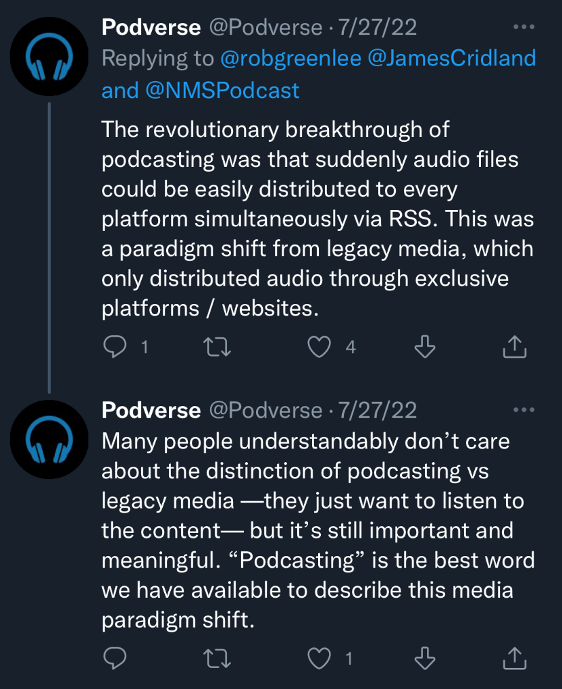
Rob Greenlee, for example, replied to Cridland’s article by clarifying that Audible was a precursor platform for RSS, but that its audio programs were definitively not podcasting. When Cridland pushed back, noting the automatic download feature on Audible, Greenlee’s co-host Todd Cochrane replied that this feature still did not make RobinWilliams@Audiblea podcast; and he insisted that he wasn’t going to budge on this point. A minor flap ensued, which ended with Cridland resignedly saying that he wished he had never written the article in the first place.In the end, even Dave Winer got involved, arguing that a piece of downloadable audio media had to have an RSS feed and be open to anyone, using any client, to qualify as a podcast.
To get a sense of the response to Cridland’s article on Twitter, and to let participants speak for themselves, I have selected a sampling of replies to Cridland’s original tweet teasing the article and reproduced them below. The conversation is arranged roughly in chronological order.
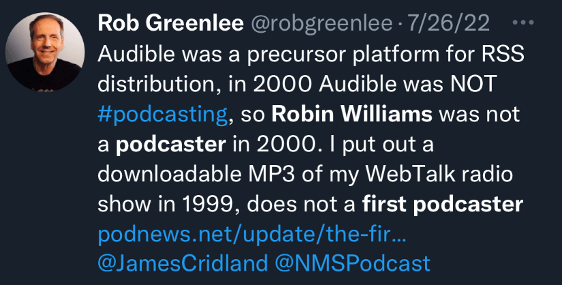
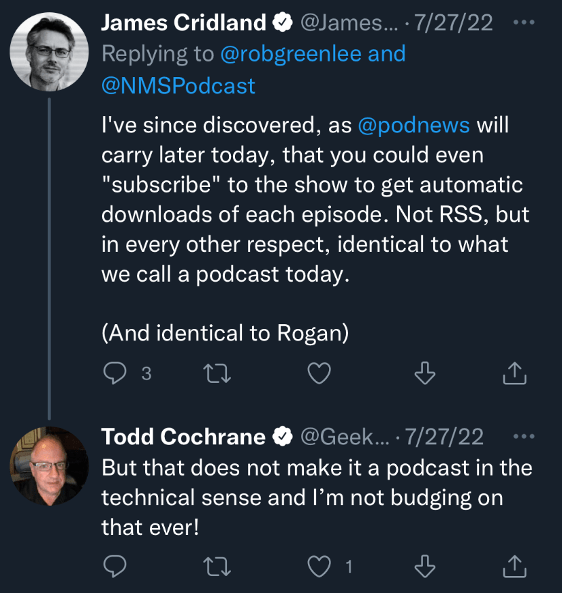
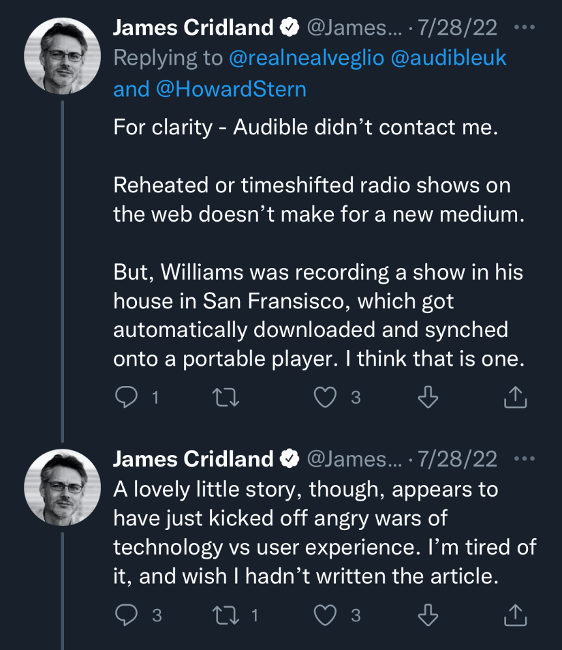
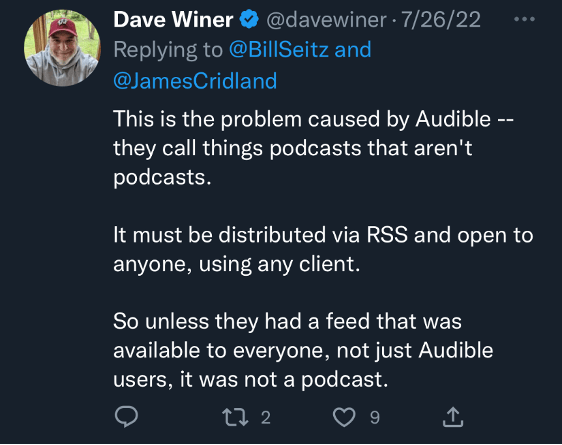
Admittedly, this was a very niche dispute – a handful of predominantly white tech dudes arguing over which white dude(s) had been the first podcaster. After a day or two, they all moved on.
But however minor (and however much Cridland may have wished he hadn’t written the article), the flap over RobinWilliams@Audible is a useful lens with which to understand contemporary debates over the future of podcasting: about whether the decentralized and open RSS-based ecosystem will long endure, or whether walled gardens—“limited set[s] of technology or media information provided to users with the intention of creating a monopoly or secured information system“—will prevail.
To better understand, however, let’s back up a bit.
By the fall of 2000, Dave Winer had earned a reputation as a pioneer of web syndication – he had been credited with launching the first blog – and someone who, according to the podcaster and author Eric Nuzum, “believed in making systems open, democratic, and easily accessible,” pushing back against the trend toward centralization and proprietary control of Internet infrastructures.

On a trip to New York that October, Winer met up with Adam Curry, who had been closely following his work. Over several hours in Curry’s hotel room, the entrepreneur attempted to convince Winer that web syndication technologies could be leveraged to distribute audio and video files – a vision of the Internet as “Everyman’s broadcast medium” – if only the so-called “last yard” problem of slow DSL connections could be resolved. By his own admission, Winer at first didn’t quite understand what Curry had in mind, but he was open experimenting with using RSS as “virtual bandwidth” that could deliver large media files during off-peak hours. In January 2001, Winer successfully used an RSS enclosure tag to distribute a single Grateful Dead song (it was U.S. Blues), inaugurating the first podcast feed – though what he had created wouldn’t become known as a “podcast” for some time.
Though interest in RSS-delivered audio files was slow to develop (indeed, even Winer and Curry pursued other projects for a time), “it was not lost on … early adopters,” as Andrew Bottomley has observed, adding “that the technology shifted power to the audience and also opened up opportunities for more democratized radio production” (111-112). The days of corporate gatekeepers exercising oligopolistic control over the production and distribution of audio content seemed numbered; no longer would broadcasting be subject to an economy of scarcity. Theoretically anyone with web hosting, a microphone, and an RSS feed could set themselves up in the radio business.
Since those early days, RSS has become “the currency of podcasting,” to borrow a phrase from Dave Jones, Adam Curry’s Podcasting 2.0 collaborator. Indeed, as Cridland himself wrote in his primer, “What is a Podcast?,” technically speaking, a “podcast” is comprised of an audio file, without DRM restrictions, that is available to download, and is “distributed via an RSS feed using an <enclosure> tag.”
But RSS is not without its detractors. Last July, for instance, Anchor.fm co-founder Michael Mignano argued that while technical standards like RSS (or HTTP, or SMTP, or SMS) provide a “common language” that allows for the rapid spread of new technologies, standardization inevitably stifles growth. “The tradeoff,” he wrote, “is that a lower barrier to entry means more products get created in a category, causing market fragmentation and ultimately, a slow pace of innovation.” The consequence of this “Standards Innovation Paradox” is that even as podcast listening apps proliferate, because they must conform to the RSS standard, the differences between them are superficial. Proprietary systems, Mignano argued, offer an alternative, allowing developers the flexibility to build – and rapidly improve – dynamic user experiences.
Naturally, Mignano pointed to Spotify – which acquired Anchor in 2019 – as an example of how closed systems could break the “curse” of standardization: When the company began to expand from music to other forms of audio content, he wrote, there was some speculation that the company would launch a dedicated podcast app. But, “if they had done so, they’d have to contend with the aforementioned ocean of podcast listening apps which were all offering users roughly the same features that were limited by the standard.” Instead, “Spotify used their existing music user base inside of the existing Spotify app to distribute podcasts to hundreds of millions of users.”

But this framing soft pedals Spotify’s aggressive attempts to steer podcasting away from RSS and toward platform enclosure. As John L. Sullivan argued in a 2019 paper, Spotify’s emphasis on exclusive releases (which has included the removal of content previously available via RSS, like The Joe Budden Podcast), and its $340 million acquisitions of Anchor and Gimlet are all part of an effort to control distribution and “maximize the ‘winner take all’ functions of platforms.” More recently, Anchor has stopped automatically generating an RSS feed at the time of publication, making it an opt-in function (meaning that creators have to know what RSS is to have their podcast distributed to directories otherthan Spotify). “We’ve been able to replace RSS for on-platform distribution,” noted one Spotify executive at a recent investor event, “which means that podcasts created on our platform are no longer held back by this outdated technology.”

Given the challenges that platform enclosure poses to RSS, its defenders’ insistence that “it’s not a podcast if it doesn’t have an RSS feed, and it’s not a podcast app if you can’t add your own RSS feeds,” as an episode title of Curry and Jones’s Podcasting 2.0 puts it, is understandable. Or, as Cochrane declared on The New Media Show, “until you tear my RSS feed through my dead hands, podcasts technically are podcasts that are delivered via RSS.”
And understandable, too, is the prickly reaction to Cridland’s alternate history: To claim that RobinWilliams@Audible may have been the first podcast is to suggest that RSS – and the open and democratic values which it represents – are inessential; and more troubling, that proprietary systems are deeply rooted in the history of the medium.

Of course, there’s also the sticky fact that RobinWilliams@Audible premiered before the word “podcast” entered the lexicon. But even this history is messy. In his original coinage, the technologist Ben Hammersley applied the term to a variety of different forms of downloadable audio media, including Audible originals like In Bed with Susie Bright. According to this early conception, in other words, podcasting described a cultural practice rather than a specific distribution infrastructure.
It is likely, too, that technological distinctions are irrelevant to listeners. Citing data from Edison Research showing that a significant percentage of listeners use Spotify and YouTube to access podcasts (even though content on these platforms don’t meet the strict technical definition of a “podcast”), Cridland has suggested that, for most people, podcasting is simply “on-demand audio. Like a radio show, but on-demand.”
Likewise, the question of whom the first podcaster was is of narrow interest. “Who cares?” an exasperated Cochrane finally concluded.
But reviewing the pre-2004 history of downloadable audio media can open up questions of the interpretive flexibility of technology (how technological artifacts come to have different meanings for different groups of users) and rhetorical closure (when the need for alternative designs diminish) that the late Trevor Pinch and Wiebe Bijker identified as key concepts in the Social Construction of Technology.
And so, rather than arguing about whether RobinWilliams@Audible – or, for that matter, Cochrane’s audio file sharing on FidoNet in the early 1990s – was the “first” podcast, further examination of this complex genealogy suggests the more interesting questions of how and why online distribution of audio files was such a desirable goal that there were severalpaths to its development.
The flap over Robin Williams and the question of the first podcaster also gives us much needed insight into current discourse about corporate influence in the podcasting space. Also It provided a way for proponents of the decentralized Podcasting 2.0 movement to make a technological distinction between a desire for freedom and a desire for control. While the scuffle itself was short-lived, its dust is far from settling.
—
Featured Image of Robin Williams (2008) by Flickr User Shameek (CC BY-NC-ND 2.0)
—
Andrew J. Salvati is an adjunct professor in the Media and Communications program at Drew University, where he teaches courses on podcasting and television studies. His research interests include media and cultural memory, television history, and mediated masculinity. He is the co-founder and occasional co-host of Inside the Box: The TV History Podcast, and Drew Archives in 10.
—
REWIND! . . .If you liked this post, you may also dig:
“I am Thinking Of Your Voice”: Gender, Audio Compression, and a Cyberfeminist Theory of Oppression: Robin James
DIY Histories: Podcasting the Past: Andrew Salvati
SO! Podcast #2: Behind the Podcast: Building Intimate Venues on the Internet – Andreas Duus Pape
Share this:


Current Top Posts





April 2021

January 2020

November 2019

October 2019

August 2019

April 2014

November 2017

March 2015

December 2017

October 2015
 Sounding Out!
Recent Comments