
They Do Not All Sound Alike: Sampling Kathleen Cleaver, Assata Shakur, and Angela Davis
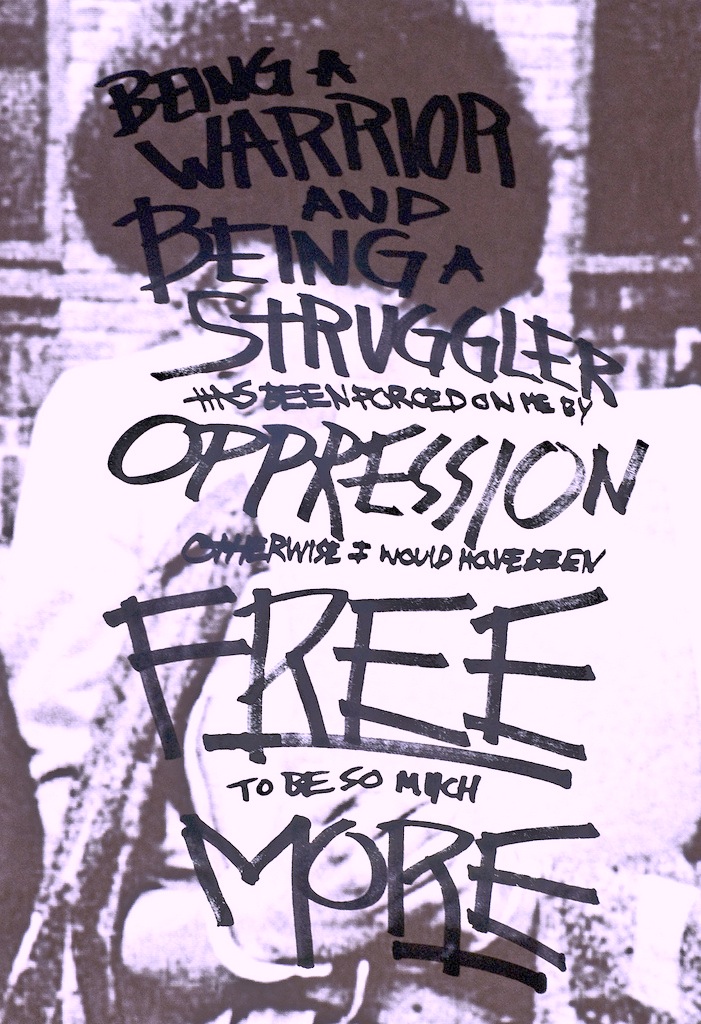

Welcome to week four of our February Forum on “Sonic Borders,” a collaboration with the IASPM-US blog in connection with this year’s IASPM-US conference on Liminality and Borderlands, held in Austin, Texas from February 28 to March 3, 2013. The “Sonic Borders” forum is a Virtual Roundtable cross-blog entity that will feature six Sounding Out! writers posting on Mondays through February 25, and four writers from IASPM-US, posting on Wednesdays starting February 6th and ending February 27th. For an encore of weeks one through three of the forum, click here. And now, Tara Betts drops some science, Sounding Out! style. –JS
—
DOI: https://doi.org/10.59350/mb38y-ty376
When underground hip-hop artist P. Blackk released Blackk Friday (2011), several reviewers insisted that he sampled political activist Angela Davis. Oddly enough, one of the reviews from The Meara Blog, featured the video for “Brainz,” the song in question–and the video clearly showed that the sampled track was in fact not Davis but activist and lawyer Kathleen Cleaver. Why the automatic assumption that any black woman sampled from the 1960s is Davis? Why the collapsing and erasure of so many distinct and powerful voices?
Davis, Cleaver, and Assata Shakur are arguably the three most iconic women of the Black Power Movement, but they largely go unrecognized in mainstream history. Erasure by omission represents how many historical sources are resistant to identifying their specific contributions to grassroots organizing, intellectual life, and politics, while the male leadership of the Black Power Movement is often mentioned by name. So, the inclusion of Davis, Cleaver, and Shakur in songs by hip hop artists P. Blackk, John Forté, and Common simultaneously amplifies the distinctiveness of their voices while signaling conscious choices by younger male artists to align themselves with the political thinking espoused by these radical women in politically-rooted, layered tracks–even as these samples inadvertently reveal the mainstream public’s tendency to treat black female activists as interchangeable. Both in their moment and in its sampled echoes, these women resist being grouped into an amorphous group of misconstrued black people, and these tracks highlight that.
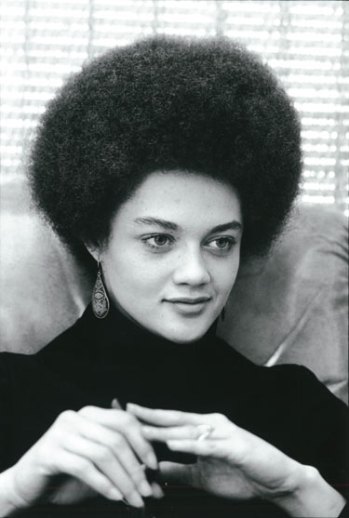
In “Brainz,” P. Blackk samples a 1968 speech by Cleaver. In the track, the basic bassline reverbs beneath the emcee’s repeated hook. He begins the song with the “huh” sound that many emcees use to amplify enthusiasm, start rhyming, and alert whomever is listening that the words are about to arrive. Blackk repeats certain phrases and utilizes internal rhyme as he makes observations about the choices people should make to care for themselves, their children, and their communities. The most original slant rhyme emerges in the second of two verses, replicated here:
It’s funny how we love chains and whips
when we were bound by em.
and we hate rock’n’roll and it was found by us.
You can’t hate what’s beautiful. I’m black and I’m proud,
but that ain’t got nothing to do with my pants sagging down.
Society is pimping you.
I’m just a man who’s a little more sensible.
I used to be invisible, now I’m invincible.
Not the stereotypical,
and I’m doing my thing in a game with no principles.
Knowledge and power, all I need, yeah, that’ll do.
The difference between me and my peers is gratitude.
Younguns is dumb too and too cool,
but it’s uncool living in a city that’s gun-ruled.
Here, P. Blackk most closely echoes how Cleaver expresses a sense of embracing and affirming black beauty while still acknowledging flawed educational systems, materialism, the origin of rock music, intergenerational disconnects, and gun violence. As a member of the Black Panther Party, wife of Eldridge Cleaver, attorney and professor, Cleaver has been a spokesperson for African American struggles. When the chorus simply repeats “real n-gga wit a brain,” P. Blackk is claiming the term that is still an affront to middle class people reaching for the civility of assimilation. He is insisting that some people are afraid of their intelligence and growing awareness as marginalized people and what actions that might entail. This fear of a nascent threat was at the root of resistance towards the slogan “Black is Beautiful” in the 1960s.
The Cleaver sample comes at the end of “Brainz,” and in the music video appears in its entirety on a projection screen and against P. Blackk himself, decked in a white shirt and bow tie, as he “lectures” students in a darkened classroom. As different black historical figures, including the likes of Marcus Garvey, Rosa Parks, Angela Davis, Ralph Abernathy, George Jackson, and James Baldwin, are projected on the screen behind Blackk, the instrumental audibly drops much lower so the only voice heard is Cleaver’s.
[Cue to 3:05 for Kathleen Cleaver]
The footage from which her sample is taken has background sound such as others talking and a chant with cadences that were often heard at black political protests; these can be faintly heard along with the audible buzz of varied speaking voices in the crowd that surrounding Cleaver. She was not onstage nor the main focal point of the larger event, but P. Blackk’s re-framing places her at its center. When one considers the position of Davis and Cleaver as esteemed and radical activists and professors, it’s not surprising that P. Blackk video positions him as an educator, like these women, to further reinforce the point of Cleaver’s words.

In “A Song for Assata,” from Like Water for Chocolate (2000), Common retells some of the events detailed in Assata: An Autobiography, but his sample reinforces why her activism was so important to Common and others like him. Her looped voice concludes his song, incredulously repeating the question, “You askin’ me about freedom?” In the sample Shakur explains how she knows more about what freedom is not, which is similar to a comment that Shakur made in Gloria Rolando’s documentary Eye of the Rainbow: Assata Shakur and Oya. Shakur then defines how freedom allows one to be one’s self, and the definition is faded down and the last of the soaring music rises slightly. When this fade occurs, we have a few examples of what Shakur imagines what freedom could potentially be, but it also leaves a sonic pause where listeners might contemplate how they define freedom for themselves.
The choice to fade out a sample says so much about not just the message that it (and Common) hopes to convey, but also reveals narratives that have been enforced consistently through institutions and time. I read the fade out as sonically emphasizing “the struggle,” rather than the intellectual present of an activist speaking; it limits her to the role of an representing the past. In dream hampton’s documentary Black August, Malcolm X Grassroots Movement organizer Meron Haile Selassie elucidates how women like Shakur are idolized:
Historically, the black liberation movement and actually all movements, let’s be honest, have fallen short of trying to incorporate the role of women, what women need, and how we incorporate anti-sexist theory and anti-sexist work in our general liberation movement. And when the woman that we put on the poster every single year, Assata Shakur, is someone that these artists revere and talk about yet but they’re somehow unable to see an Assata Shakur in the woman they’re dating that’s a painful realization.
In other words, even in black history and social movements, some women are canonized and celebrated and others are disregarded, which is not a far cry from the well-worn debate of using the word “b-tch” or “ho” and insisting that this namecalling does not address all women. Such overlooking and fading out is a subtler silencing of women.
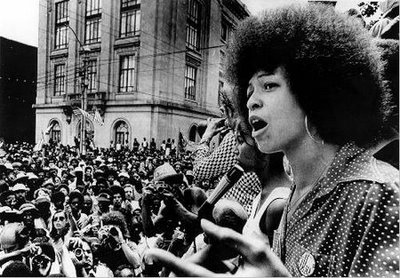
John Forte’s “Drift On” works against the narrative of the fade-out in “A Song for Assata.” In “Drift On,” from his album The Water Suite (2012), Forte lyrically articulates the feeling of being distant from someone; however, it is the brief sample of a few seconds from Angela Davis that reinforces the possibility of redemption during and after confinement. Forté begins singing the hook over a guitar-like loop that functions almost like a chord, and his soft singing of the chorus contrasts with his solemn rhyming lines and the firm solemnity of Davis’ brief sample midway through the song. A little more than a minute before “Drift On” ends, Davis speaks:
many people recognize that they can refashion themselves. They can rehabilitate themselves. They can live a life of the mind.
Davis stresses the words “they,” “refashion” and the third, final “can” spoken in this sample. Her tendency to stretch and soften particular nouns and verbs in speaking is a consistent pattern in Davis’ public speech, achieved by rhetorical devices such as metanoia– the immediate restatement of a phrase–and amplification. When Davis speaks in this manner, she makes listeners pay attention to the “they” whom she refers to as intellectually capable, but it also stresses “possibility” and redemption of the self.
It is important to note that the artists sampling these iconic Black women are men. Although women such as Me’shell Ndegeocello, and Terri Lyne Carrington and Diane Reeves have sampled Angela Davis on successful records, these records were not necessarily considered hip hop, which has consistently relied on men’s voices to create a radical impression in music, like Public Enemy’s “Fight the Power.” Public Enemy long relied on voices like Malcolm X and Martin Luther King, Jr., but happens to (and with) women’s voices? Including these voices in hip hop shows that women do exist as thinkers, activists, and speakers, even if the exposure is being exercised by artists who are men.
However, each song extends the narrative of each woman in a different manner than they constructed for themselves. P. Blackk stops admonishing, advising, and insisting on pragmatic Afrocentrism so he can to listen to Cleaver explain why black beauty was finally being embraced in the 1960s. Cleaver, in her 1968 speech, eschews white standards of beauty to embrace herself, which P. Blackk uses to connect self-hatred in the past and self-destructive behavior in the present. Common ends “A Song for Assata” with Shakur so she can share some of her thoughts on freedom after the song relates major events from her life based on details and paraphrased lines from poems in Assata: An Autobiography. Forté uses the sample of Angela Davis to further a narrative that reveals how the prison industrial complex diminishes perceptions of the humanity and the intellectual capacity of prisoners in “Drift On.”
These three hip hop songs align with a continuum of specific radical women during a time when there are few women getting consistent recognition in the genre of hip hop music, so it marks a curious point of departure where women can be part of conversations in a musical genre where they are not frequently prominent as vocalists. This sampling practice also places men and women in conversation–activists, artists, and listeners–in a manner that reflects strength, certainty, and a sense of coming together with specific political ideas in a manner that, importantly, does not erase intellectual, or sonic, difference.
—
Tara Betts is the author of the poetry collection Arc and Hue, a Ph.D. candidate at Binghamton University, and a Cave Canem fellow. Tara’s poetry also appeared in Essence, Bum Rush the Page, Saul Williams’ CHORUS: A Literary Mixtape, VILLANELLES, both Spoken Word Revolution anthologies, and A Face to Meet the Faces: An Anthology of Contemporary Persona Poetry. Her research interests include African American literature, poetry, creative writing pedagogy, and most recently sound studies. In the 1990s, she co-founded and co-hosted WLUW 88.7FM’s “The Hip Hop Project” at Loyola University while writing for underground hip hop magazines, Black Radio Exclusive, The Source, and XXL. She is co-editor of Bop, Strut, and Dance, an anthology of Bop poems with Afaa M. Weaver.
—
Share this:

Sonic Borders Virtual Panel: Theo Cateforis’s “No Control, or: How I Learned to Start Worrying about Sound” from IASPM-US
DOI: https://doi.org/10.59350/nc75e-gd545
In high school I was that guy. The one who spent every spare penny at the local record stores. The one who would make you a mixtape or tape a whole album to cassette for you. The one who would host listening parties around the stereo in his parents’ living room. Listening to music was a social activity, but it was also, I now recognize, a form of control. It was important, for instance, that I held those listening parties at my house because I was familiar with my records and stereo system, and I knew exactly how the music would sound. There would be no surprises. Likewise, to make a mixtape meant not only arranging a selection of songs, but ensuring that the recording levels and overall sound flowed from one song to the next. A good mixtape revealed not only an intimate knowledge of one’s record collection, but also the mastery of one’s tape deck.
My days of making mixtapes are long behind me, but I do construct course syllabi with a generous heap of listening assignments that function more or less the same way. And while I no longer host listening parties at my house, I do get to gather with my students every week in the classroom to listen closely to recordings. I guess the main difference is that I never gave my high school friends an exam testing them on what they had heard.
I am unsure if I gravitated toward musicology, and eventually popular music studies, as a way of validating or justifying my record collecting, but whatever the case may be recordings are central to the work that I do in my profession. I would like to think that the control that I wield over my collection is not as extreme as this memorable figure from Alan Zweig’s seminal documentary Vinyl, but if it is, I hope someone will tell me before I end up in an episode of Academic Hoarders (no, there is no such show, which is a true missed opportunity).
There are many ways that we exhibit our command of recordings in popular music studies. When we do musical analysis, for example, we control the recording through our use of descriptive language (as Barry Shank does with his wonderful break down of PSY’s “Gangnam Style” http://iaspm-us.net/sonic-borders-virtual-panel-barry-shank-on-popular-music-studies/ in the previous entry on this panel), we make transcriptions to cement soundwaves into notation, and we explain the significance of harmonic progressions and kick drum beats. Such analyses can seem especially authoritative when they focus on the music’s quantitative properties: its pitch and rhythmic structures. When we invoke sound, however, we generally do so in a more qualitative sense. It is the domain of timbre, texture, or in Barthes’s famous formulation “the grain of the voice,” for which there exists no sufficiently systematic explanation.
To be sure, pitches and rhythms are sounds, but in the vernacular or common parlance of popular music (the context I will take from this point on), sound generally refers to something else. Sound is the instrumental tone, performance style, or as Albin Zak deftly illustrates in I Don’t Sound like Nobody [link], the arrangements and production techniques that distinguish artists and their recordings from one another. Phil Spector’s Wall of Sound is, of course, a classic example. Sound in Spector’s recordings emerges from a blurry thickness of instrumental and vocal layerings, the ambient room space of Gold Star Studios and the reverberations of its echo chamber. Spector obsessively fought to control that sound, and that obsession is inseparable from his recordings’ sonic identity.
Producers are far from the only ones who anxiously fret over sound. As the past two decades have witnessed a deluge of CD reissues and remasters and a tendency toward increasingly louder recordings, music fans and recording engineers alike have increasingly voiced their concerns about the compromised quality of sound recordings. The “Loudness War,” as it has come to be called, is an impassioned rebuttal against the music industry’s attempts to define and control popular music’s sound. There are hundreds of clips on YouTube, such as this one (http://www.youtube.com/watch?v=3Gmex_4hreQ), that use audio samples to illustrate the terms of this contested terrain. And anytime a classic album reappears in a new deluxe form, fans are sure to weigh in on the sound quality (see, for example, the angry customer reviews accompanying Geffen’s “screwed up” 20th Anniversary release of Nirvana’s Nevermind http://www.amazon.com/Nevermind-2-CD-Deluxe-Nirvana/dp/B0057GYOA4/ref=sr_1_1?s=music&ie=UTF8&qid=1360492077&sr=1-1&keywords=nirvana+nevermind+deluxe).
I keep a keen eye on these debates, and not just as a music fan but as an educator who wants to select the most appropriate and representative recordings to load onto my Blackboard course page. The sound of these recordings is crucial, certainly for aesthetic reasons, but also because it is interwoven with the larger points, stories, and themes that I wish to communicate in the classroom. There have been times, however, when the sound and my stories refuse to synchronize, when I find myself in the middle of a lecture with a recording that throws a wrench into my carefully constructed lesson plan. Such moments can reveal just how relative sound is to what we expect or want to hear in the recording.
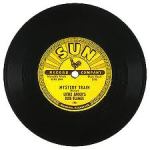
Consider Elvis Presley’s 1955 recording of “Mystery Train” for Sun Records, a song that I periodically teach in my History of Rock survey. The sound of “Mystery Train” is essential to the song’s significance. Producer Sam Phillips’ legendary “slapback echo” (aided by guitarist Scotty Moore’s newly acquired Echosonic amplifier) adds a spacious textural delay that converts the trio of musicians into a ghostly chugging train. Phillips’ innovative recording technique not only lends a poetic resonance to Presley’s vocals, it also serves a specific purpose within the narrative that I weave in my rock history class. It represents a moment of DIY recording studio ingenuity—a hallmark of small labels like Sun—and thus serves to distinguish the indies from the major labels whose domination they were beginning to threaten. It matters greatly that RCA tried to replicate that sound with Presley’s debut single “Heartbreak Hotel,” and failed.
When I taught “Mystery Train” in class a couple weeks back, I began by giving the students the background of Presley’s indie years and explaining the importance of the slapback echo. They were primed to listen for it. I decided to play them the version on the course website (the one they could access when listening on their own). But something did not sound right. One of the recording’s most alluring sonic properties is the patterns of propulsive rhythmic clicks that mysteriously emerge from the echoic aftershocks of the strumming string trio. On this particular day, those clicks did not sound at all mysterious. Rather they sounded like someone banging together two drumsticks. I always come to class equipped with a CD copy in case of some computer malfunction, and so I quickly apologized to the students and promised them a better realization of the slapback echo as I cued up the Sunrise Presley anthology. But the CD was just as bad, even worse actually. The clicks—now suffocatingly dry and wooden—sounded completely separated from the rest of the instrumental texture; I was struggling to explain how one could locate those clicks as part of the song’s recording process I had prompted the students to listen for just moments ago. I had a sinking feeling, like a used car salesman after a poor pitch, realizing a potential customer is about to leave the lot.
So, where did I go wrong? How did I manage to lose control? The answer occurred to me later that day. I recalled that when I was prepping for my class, I had been on the computer browsing YouTube and had decided to pull up a recording clip of “Mystery Train” from there just to get the song in my ear. The video that I chose was one where some fan had made a digital transfer from a “near mint” copy of the 1955 Sun 78 release (http://www.youtube.com/watch?v=XA5HErVE9oI). Listening to the clip a second time, I now heard how the rhythmic clicks were enmeshed in the texture, part of an all-consuming glorious wash of sound. When I had casually listened to the clip the first time around, I had unknowingly created a specific context for how I imagined and wanted slapback echo to sound, one that I could not reproduce in the classroom.
My point in sharing this anecdote is not to suggest that I have finally located the authentic “Mystery Train” sound. Rather, it is to acknowledge that in popular music studies, the main objects of our study, recorded songs, exist in liminal spaces, floating between different media, re-imaginations, and varying channels of communication. In my class I attempted to deploy the sound of “Mystery Train” as part of a strategic argument within the history of rock; I needed it to sound a certain way, but the song eluded my control. For those of us who interpret, analyze, and seek meaning in popular music, we constantly seek to control its sound. We often assume that our experience of popular music’s sound is a shared one, but sound can be more slippery than that. We can suggest and argue for ways of hearing, but those propositions come with no guarantees.
–Theo Cateforis–
Sonic Borders Schedule
1/21 – Liana Silva, Sounding Out! – “I’m on My New York Sh*t”: Jean Grae’s Sonic Claims on the City
1/28 – Regina Bradley, Sounding Out! – I Like the Way You Rhyme, Boy: Hip Hop Sensibility and Racial Trauma in Django Unchained
2/4 – Marcus Boon, Sounding Out! – One Nation Under a Groove?: Music, Sonic Borders, and the Politics of Vibration
2/6 – Barry Shank, IASPM-US – “On Popular Music Studies”
2/11 – Tavia Nyong’o, Sounding Out! – “Freedom Back: Sounding Black Feminist History, Courtesy the Artists”
2/13 – Theo Cateforis, IASPM-US – “No Control, or: How I Learned to Start Worrying About Sound”
2/18 – Tara Betts, Sounding Out!
2/20 – Shana L. Redmond, IASPM-US
2/25 – Art Jones, Sounding Out!
2/27 – Devon Powers, IASPM-US
—
Share this:




Current Top Posts





April 2021

January 2020

November 2019

October 2019

August 2019

April 2014

November 2017

March 2015

December 2017

October 2015


Recent Comments