
Sounding Out! Podcast #12: Animal Transcriptions: Listening to the Lab of Ornithology



CLICK HERE TO DOWNLOAD: Animal Transcriptions: Listening to the Lab of Ornithology
SUBSCRIBE TO THE SERIES VIA ITUNES
DOI: https://doi.org/10.59350/r0pw2-h0n40
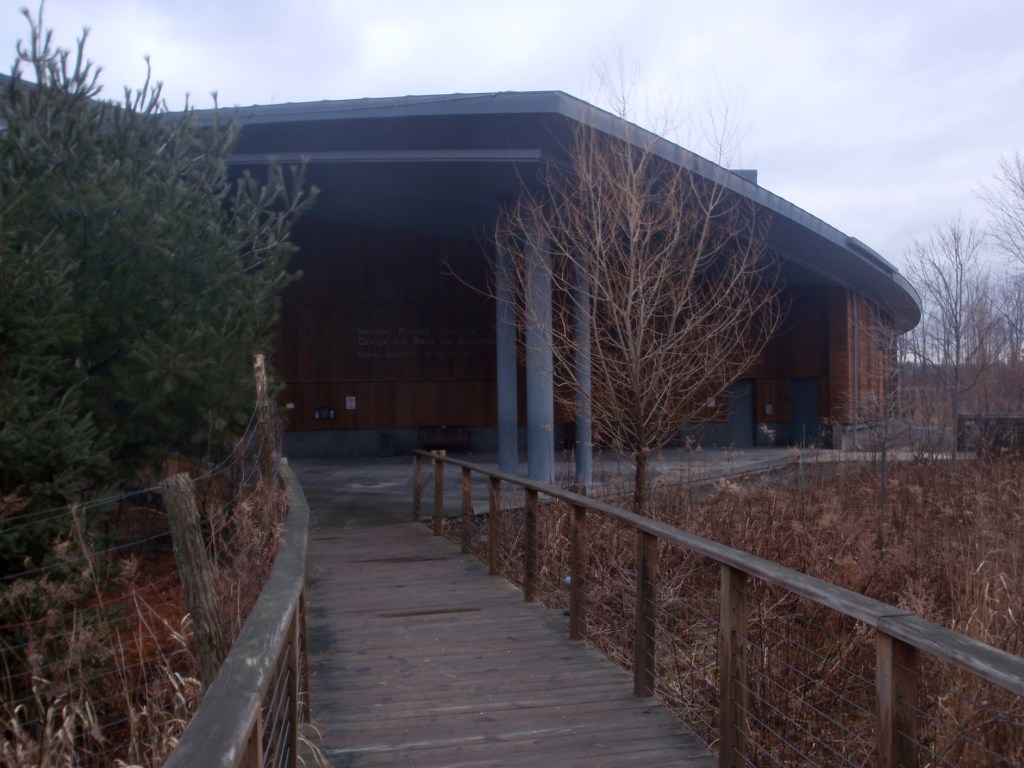
This podcast culls material from seven hours of interviews about sound and animal life with scientists, engineers, programmers, archivists and other staff working in the Bioacoustics Research Program (BRP) and in the Macaulay Library of Natural Sounds (LNS) at the Cornell Lab of Ornithology. The interviews were conducted as part of a research project situated at the intersection between sound in poetry (prosody) and environmental sound (soundscape), specifically focused on animal vocalizations.
Poetry might help us to use, study, and deploy animal morphologies in ways that hope to better, rather than merely exploit, the human relation with such life forms, if not to improve the welfare of the species themselves. As Katy Payne, Mike Webster and others suggest, when we speak of animal “song,” we bring metaphors from the arts of poetry and music to complement our limited scientific understanding of the intricacies of animal communication.
At the same time, the process of capture, practiced by poets and recordists alike, heightens ethical choice in a time of accelerated species extinction: many of the techniques and resources developed at LNS and BRP are currently used for basic monitoring of conflict between animal life and human industry. This podcast explores both why and how the Macaulay LNS collects animal sounds (which some of the archivists refer to as “specimens”), and how such a collection is conceptualized, deployed and situated within a matrix of concerns (philosophical, aesthetic, ethical, and political) about human relations to other-than-human life forms.
This article continues the work on “rendering” I began here at Sounding Out! last spring. My interest in the Macaulay LNS, directed by Mike Webster and Greg Budney, introduced me to the vital, cutting-edge, and often mind-blowing work being done in BRP, under the leadership of Chris Clark as well as of a pioneer in animal communication and conservation such as Katy Payne, who founded the Elephant Listening Project and has also contributed to the podcast. Although I did not get Chris’s voice on record, his groundbreaking research, activism and leadership on behalf of a “singing planet” nevertheless loom large behind much of the work featured here. I was fortunate to be able to speak with Tim Gallagher, of Ivory-billed Woodpecker fame, in the Lab of Ornithology. The podcast also explores the crucial work of audio engineers Bill McQuay and Karl Fitzke, and of software analysts and research specialists LIz Rowland, Ann Warde, Laura Strickland, and Ashakur Rahaman, amongst others.
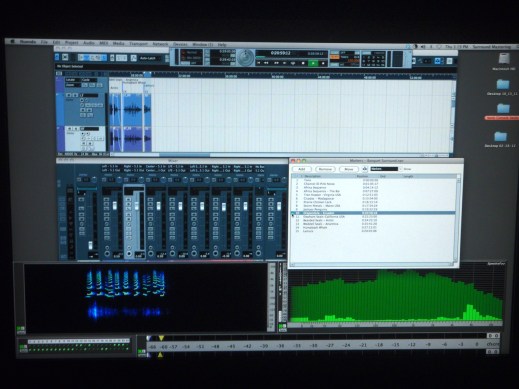
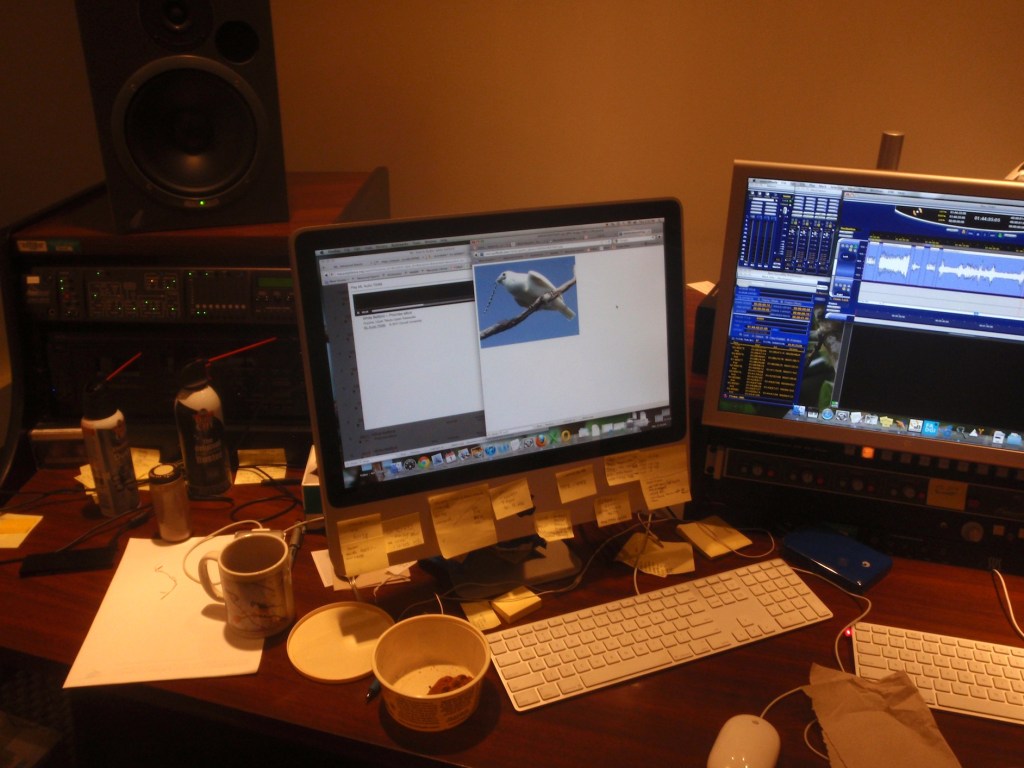
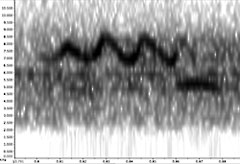
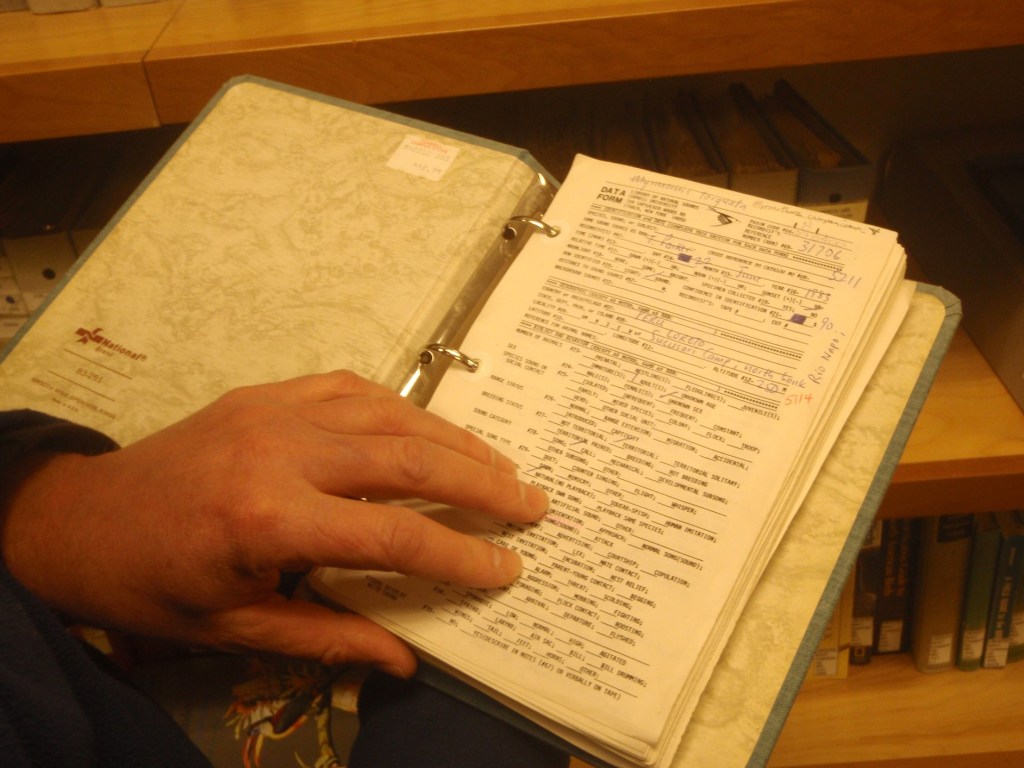
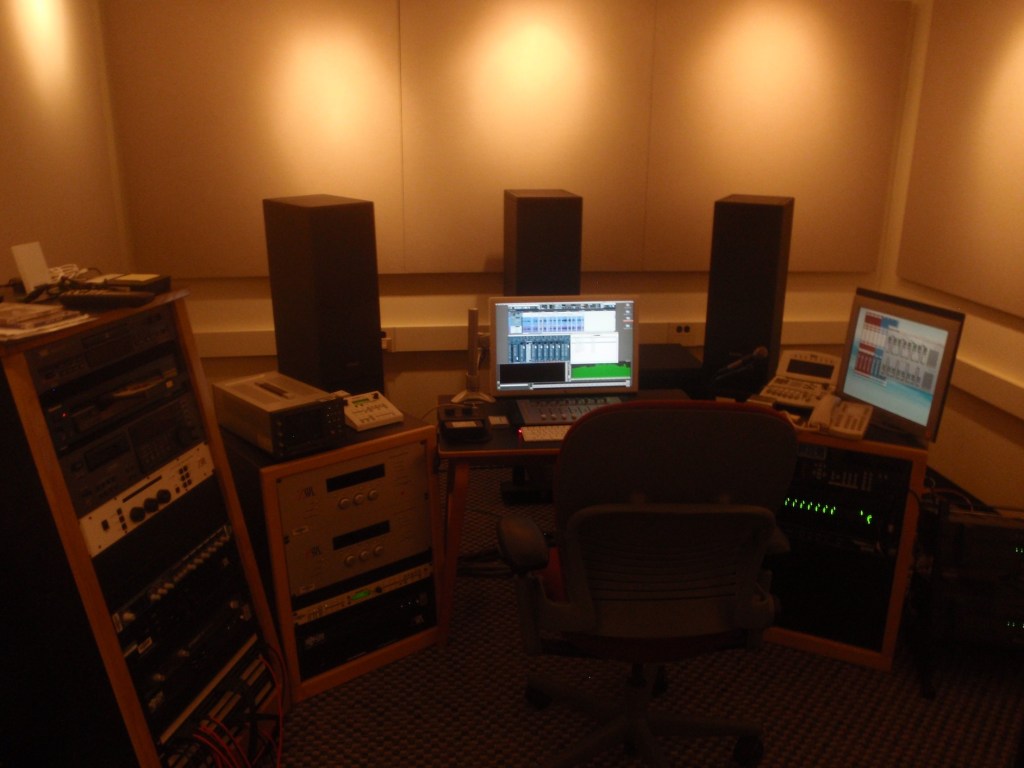
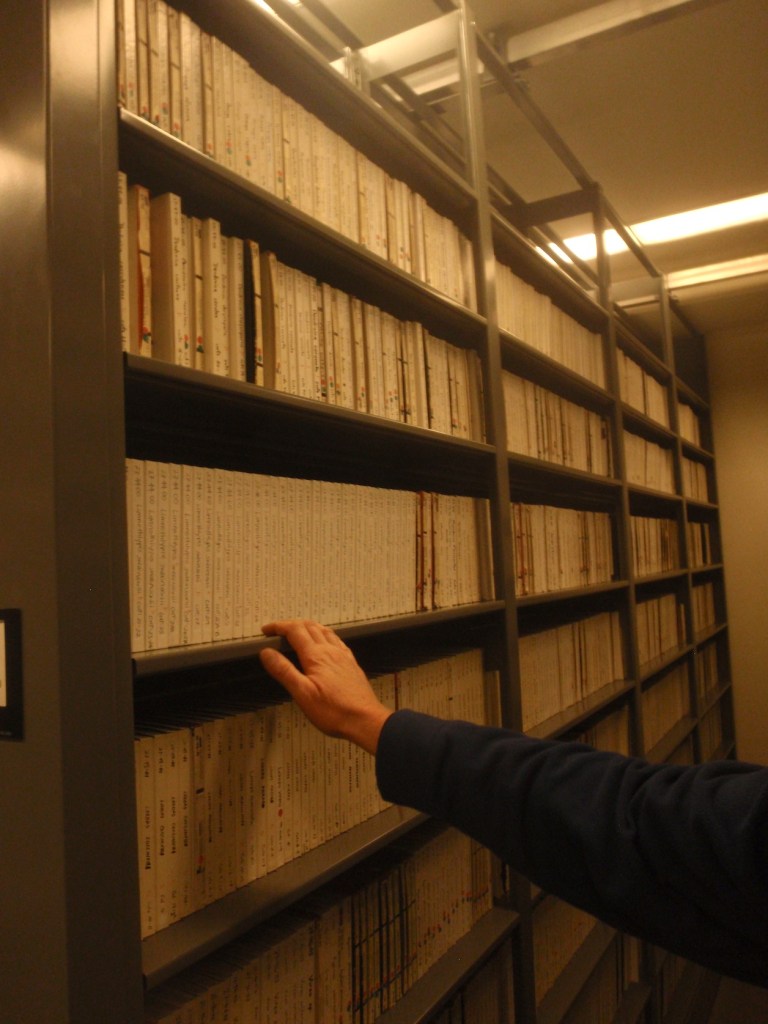
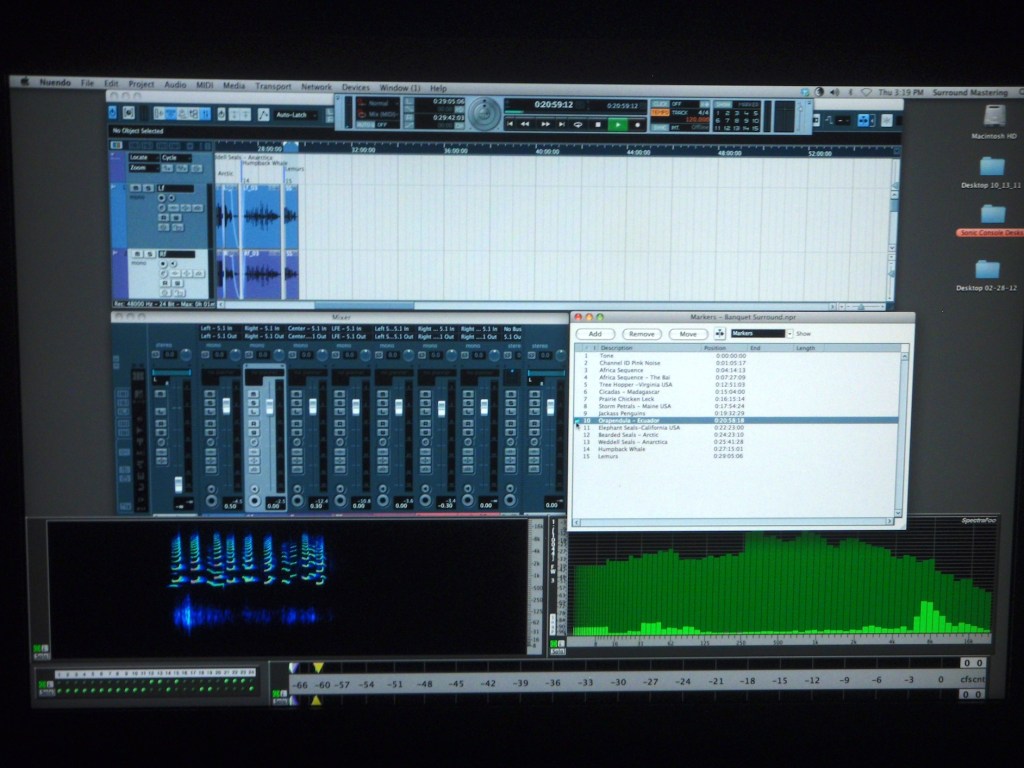
The staff at the Lab of Ornithology generously granted me a tour of their archive, showed me their gear, explained their sound visualization software, and sat me down in the surround sound listening room, where I heard some unforgettable recordings, which opened up my investigation to acoustic dimensions I had never before suspected. We sounded these dimensions in wide-ranging conversations about archiving, acoustics, field work, gear, communication, looking at sound, music, evolution, and conservation. This podcast offers, in a condensed form, some of the highlights of those conversations and experiences.
Thanks are due to the staff whose voices the podcast features: Mike Webster, Greg Budney, Bill McQuay, Liz Rowland, Alexa Hilmer, Ann Warde, Mary Winston, Tim Gallagher, Ashakur Rahaman, Katy Payne, Laura Strickland, and Karl Fitzke. Thanks are equally due staff who consented to be interviewed or otherwise helped out but whose voices didn’t make it onto the podcast: Chris Clarke, Christianne McMillan White, George Dillmann, Connie Bruce, Tammy Bishop. Thanks to Aaron Trammell for crucial editorial and technical help. Thanks finally to the Cornell Society for Humanities for the 2011-2012 research fellowship and the scholarly community that made this research possible.
Animal Transcriptions: Listening to the Lab of Ornithology – Contents and Credits
Intro
Mike Webster
Winter Wren, at normal and at one-half speed (Greg Budney, from The Diversity of Animal Sounds, Macaulay Library of Natural Sounds sampler CD)
Sound: Greg Budney and Musician Wren (Cyphorhinus arada, LNS 8897, Peter Paul Kellogg)
Archive 2:40
Mike Webster
Greg Budney
Bill McQuay
Sound: Ashakur Rahaman and Blue Whale (Balaenoptera musculus, played back at eight times normal speed, LNS 128263, Paul Thompson)
Acoustics 5:45
Liz Rowland
Bill McQuay, Greg Budney: Africa Sequence (The Bai)
Alexa Hilmer
Ann Warde
Sound: Greg Budney and Townsend’s Solitaire (Myadestes townsendi, LNS 50192, Geoffrey Keller) and Brown-backed Solitaire (Myadestis occidentals, LNS 136544, Michael Andersen)
Field 11:00
Bill McQuay
Greg Budney
Mary Winston
Tim Gallagher
Liz Rowland
Sound: Ann Warde and Beluga Whale (Delphinapterus leucas, LNS 126105, Donald Ljungblad)
Gear 14:30
Ann Warde
Ashakur Rahaman
Greg Budney: Beluga multi-array recording
Liz Rowland
Sound: Katy Payne (Humpback Whale)
Communication 20:05
Greg Budney: Madagascar lemur family group
Bill McQuay
Ann Warde
Laura Strickland
Bill McQuay: Treehopper sequence (NPR Radio Expedition)
Katy Payne
Tim Gallagher
Sound: Mike Webster and Crested Oropendola (Psarocolius decumanus, LNS 12830, Ted Parker), Common Potoo (Nyctibius griseus, LNS 59964, Paul Schwartz)
Looking at Sound 27:25
Liz Rowland
Laura Strickland
Alexa Hilmer
Ashakur Rahaman
Katy Payne
Sound: Alexa Hilmer and Humpback Whale (Megaptera novaeangliae, LNS 110847, Paul Perkins)
Music 36:05
Bill McQuay
Ann Warde
Laura Strickland
Katy Payne
Karl Fitzke
Alexa Hilmer
Sound: Laura Strickland and Wood Thrush (Hylocichla mustelina, LNS 11316, Arthur Allen; LNS 125223, Michael Andersen)
Evolution 40:10
Greg Budney (Spot-breasted Oriole duet, LNS 164045, David Ross)
Mike Webster (Black-throated Blue Warbler, LNS 27208, Randolph Little)
Katy Payne (Humpback whale group singing, LNS 118147, William Steiner)
Sound: Alexa Hilmer, Katy Payne with Common Loon (Gavia mimer, LNS 107964, Steven Pantle)
Conservation 47:05
Greg Budney: Attwater’s Prairie Chicken lek
Ashakur Rahaman
Tim Gallagher
Liz Rowland
Sound: Karl Fitzke and European Starling (Sturnus vulgaris, recording by Greg McGrath)
Recordings used with permission of Macaulay Library, Cornell Lab of Ornithology.
Starling recording used with permission of Greg McGrath.
–
Jonathan Skinner founded and edits the journal ecopoetics, which features creative-critical intersections between writing and ecology. Skinner also writes ecocriticism on contemporary poetry and poetics: he has published essays on Charles Olson, Ronald Johnson, Lorine Niedecker, Mei-mei Berssenbrugge, Bernadette Mayer, Cecilia Vicuña, translations of French poetry and garden theory, essays on bird song from the perspective of ethnopoetics, and essays on horizontal concepts such as the Third Landscape and on Documentary Poetry. Currently, he is writing a book of investigative poems on the urban landscapes of Frederick Law Olmsted, and a book on Animal Transcriptions in contemporary poetry. He teaches poetry and poetics in the Department of English and Comparative Literature at the University of Warwick.
—

REWIND! . . .If you liked this post, you may also dig:
Listening to Disaster: Our Relationship to Sound and Danger— Maile Colbert
Animal Renderings: The Library of Natural Sounds— Jonathan Skinner
Six Years in Nodar: Sound Art in a Rural Context— Rui Costa
—
Share this:

They Do Not All Sound Alike: Sampling Kathleen Cleaver, Assata Shakur, and Angela Davis
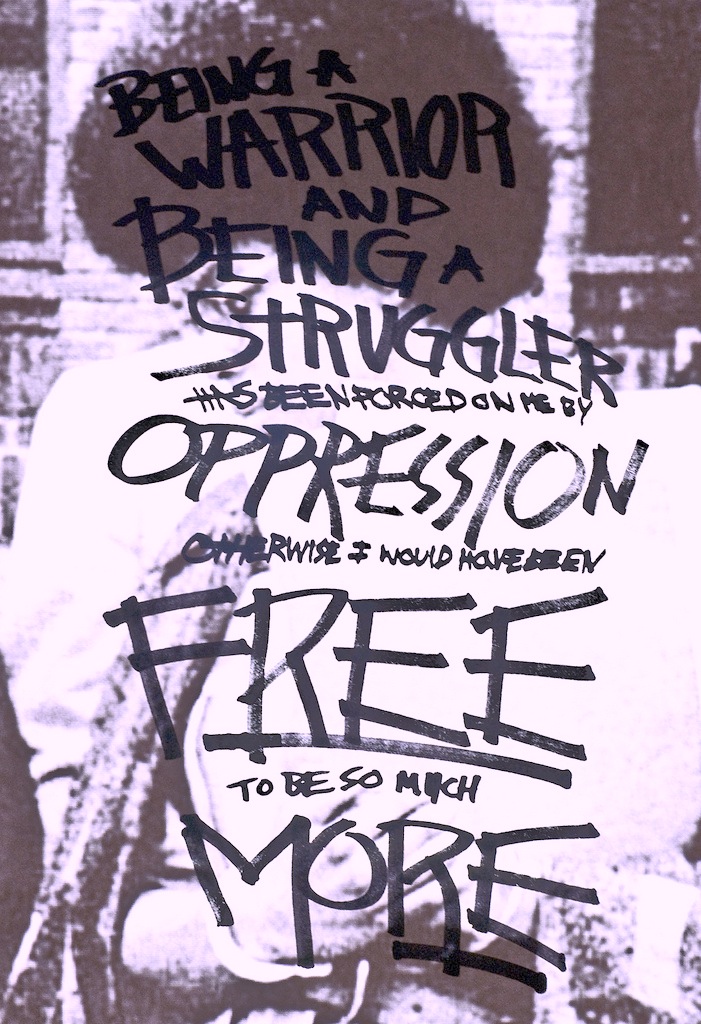

Welcome to week four of our February Forum on “Sonic Borders,” a collaboration with the IASPM-US blog in connection with this year’s IASPM-US conference on Liminality and Borderlands, held in Austin, Texas from February 28 to March 3, 2013. The “Sonic Borders” forum is a Virtual Roundtable cross-blog entity that will feature six Sounding Out! writers posting on Mondays through February 25, and four writers from IASPM-US, posting on Wednesdays starting February 6th and ending February 27th. For an encore of weeks one through three of the forum, click here. And now, Tara Betts drops some science, Sounding Out! style. –JS
—
DOI: https://doi.org/10.59350/mb38y-ty376
When underground hip-hop artist P. Blackk released Blackk Friday (2011), several reviewers insisted that he sampled political activist Angela Davis. Oddly enough, one of the reviews from The Meara Blog, featured the video for “Brainz,” the song in question–and the video clearly showed that the sampled track was in fact not Davis but activist and lawyer Kathleen Cleaver. Why the automatic assumption that any black woman sampled from the 1960s is Davis? Why the collapsing and erasure of so many distinct and powerful voices?
Davis, Cleaver, and Assata Shakur are arguably the three most iconic women of the Black Power Movement, but they largely go unrecognized in mainstream history. Erasure by omission represents how many historical sources are resistant to identifying their specific contributions to grassroots organizing, intellectual life, and politics, while the male leadership of the Black Power Movement is often mentioned by name. So, the inclusion of Davis, Cleaver, and Shakur in songs by hip hop artists P. Blackk, John Forté, and Common simultaneously amplifies the distinctiveness of their voices while signaling conscious choices by younger male artists to align themselves with the political thinking espoused by these radical women in politically-rooted, layered tracks–even as these samples inadvertently reveal the mainstream public’s tendency to treat black female activists as interchangeable. Both in their moment and in its sampled echoes, these women resist being grouped into an amorphous group of misconstrued black people, and these tracks highlight that.
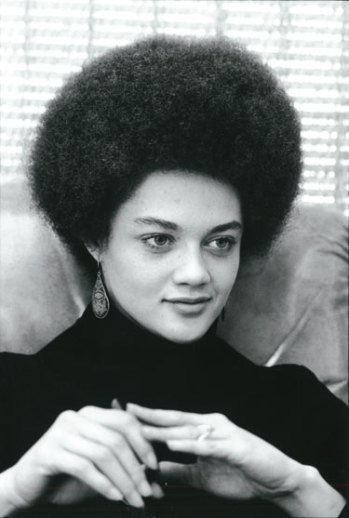
In “Brainz,” P. Blackk samples a 1968 speech by Cleaver. In the track, the basic bassline reverbs beneath the emcee’s repeated hook. He begins the song with the “huh” sound that many emcees use to amplify enthusiasm, start rhyming, and alert whomever is listening that the words are about to arrive. Blackk repeats certain phrases and utilizes internal rhyme as he makes observations about the choices people should make to care for themselves, their children, and their communities. The most original slant rhyme emerges in the second of two verses, replicated here:
It’s funny how we love chains and whips
when we were bound by em.
and we hate rock’n’roll and it was found by us.
You can’t hate what’s beautiful. I’m black and I’m proud,
but that ain’t got nothing to do with my pants sagging down.
Society is pimping you.
I’m just a man who’s a little more sensible.
I used to be invisible, now I’m invincible.
Not the stereotypical,
and I’m doing my thing in a game with no principles.
Knowledge and power, all I need, yeah, that’ll do.
The difference between me and my peers is gratitude.
Younguns is dumb too and too cool,
but it’s uncool living in a city that’s gun-ruled.
Here, P. Blackk most closely echoes how Cleaver expresses a sense of embracing and affirming black beauty while still acknowledging flawed educational systems, materialism, the origin of rock music, intergenerational disconnects, and gun violence. As a member of the Black Panther Party, wife of Eldridge Cleaver, attorney and professor, Cleaver has been a spokesperson for African American struggles. When the chorus simply repeats “real n-gga wit a brain,” P. Blackk is claiming the term that is still an affront to middle class people reaching for the civility of assimilation. He is insisting that some people are afraid of their intelligence and growing awareness as marginalized people and what actions that might entail. This fear of a nascent threat was at the root of resistance towards the slogan “Black is Beautiful” in the 1960s.
The Cleaver sample comes at the end of “Brainz,” and in the music video appears in its entirety on a projection screen and against P. Blackk himself, decked in a white shirt and bow tie, as he “lectures” students in a darkened classroom. As different black historical figures, including the likes of Marcus Garvey, Rosa Parks, Angela Davis, Ralph Abernathy, George Jackson, and James Baldwin, are projected on the screen behind Blackk, the instrumental audibly drops much lower so the only voice heard is Cleaver’s.
[Cue to 3:05 for Kathleen Cleaver]
The footage from which her sample is taken has background sound such as others talking and a chant with cadences that were often heard at black political protests; these can be faintly heard along with the audible buzz of varied speaking voices in the crowd that surrounding Cleaver. She was not onstage nor the main focal point of the larger event, but P. Blackk’s re-framing places her at its center. When one considers the position of Davis and Cleaver as esteemed and radical activists and professors, it’s not surprising that P. Blackk video positions him as an educator, like these women, to further reinforce the point of Cleaver’s words.
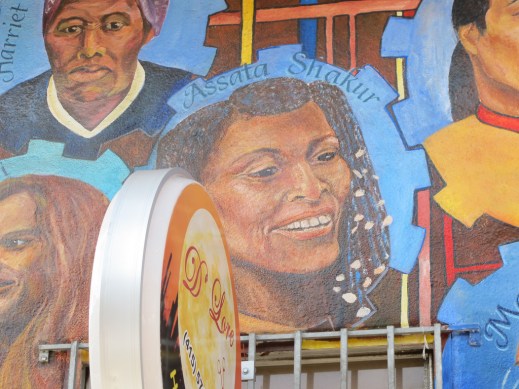
In “A Song for Assata,” from Like Water for Chocolate (2000), Common retells some of the events detailed in Assata: An Autobiography, but his sample reinforces why her activism was so important to Common and others like him. Her looped voice concludes his song, incredulously repeating the question, “You askin’ me about freedom?” In the sample Shakur explains how she knows more about what freedom is not, which is similar to a comment that Shakur made in Gloria Rolando’s documentary Eye of the Rainbow: Assata Shakur and Oya. Shakur then defines how freedom allows one to be one’s self, and the definition is faded down and the last of the soaring music rises slightly. When this fade occurs, we have a few examples of what Shakur imagines what freedom could potentially be, but it also leaves a sonic pause where listeners might contemplate how they define freedom for themselves.
The choice to fade out a sample says so much about not just the message that it (and Common) hopes to convey, but also reveals narratives that have been enforced consistently through institutions and time. I read the fade out as sonically emphasizing “the struggle,” rather than the intellectual present of an activist speaking; it limits her to the role of an representing the past. In dream hampton’s documentary Black August, Malcolm X Grassroots Movement organizer Meron Haile Selassie elucidates how women like Shakur are idolized:
Historically, the black liberation movement and actually all movements, let’s be honest, have fallen short of trying to incorporate the role of women, what women need, and how we incorporate anti-sexist theory and anti-sexist work in our general liberation movement. And when the woman that we put on the poster every single year, Assata Shakur, is someone that these artists revere and talk about yet but they’re somehow unable to see an Assata Shakur in the woman they’re dating that’s a painful realization.
In other words, even in black history and social movements, some women are canonized and celebrated and others are disregarded, which is not a far cry from the well-worn debate of using the word “b-tch” or “ho” and insisting that this namecalling does not address all women. Such overlooking and fading out is a subtler silencing of women.
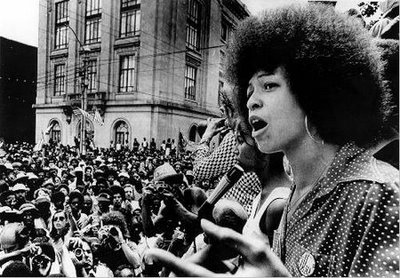
John Forte’s “Drift On” works against the narrative of the fade-out in “A Song for Assata.” In “Drift On,” from his album The Water Suite (2012), Forte lyrically articulates the feeling of being distant from someone; however, it is the brief sample of a few seconds from Angela Davis that reinforces the possibility of redemption during and after confinement. Forté begins singing the hook over a guitar-like loop that functions almost like a chord, and his soft singing of the chorus contrasts with his solemn rhyming lines and the firm solemnity of Davis’ brief sample midway through the song. A little more than a minute before “Drift On” ends, Davis speaks:
many people recognize that they can refashion themselves. They can rehabilitate themselves. They can live a life of the mind.
Davis stresses the words “they,” “refashion” and the third, final “can” spoken in this sample. Her tendency to stretch and soften particular nouns and verbs in speaking is a consistent pattern in Davis’ public speech, achieved by rhetorical devices such as metanoia– the immediate restatement of a phrase–and amplification. When Davis speaks in this manner, she makes listeners pay attention to the “they” whom she refers to as intellectually capable, but it also stresses “possibility” and redemption of the self.
It is important to note that the artists sampling these iconic Black women are men. Although women such as Me’shell Ndegeocello, and Terri Lyne Carrington and Diane Reeves have sampled Angela Davis on successful records, these records were not necessarily considered hip hop, which has consistently relied on men’s voices to create a radical impression in music, like Public Enemy’s “Fight the Power.” Public Enemy long relied on voices like Malcolm X and Martin Luther King, Jr., but happens to (and with) women’s voices? Including these voices in hip hop shows that women do exist as thinkers, activists, and speakers, even if the exposure is being exercised by artists who are men.
However, each song extends the narrative of each woman in a different manner than they constructed for themselves. P. Blackk stops admonishing, advising, and insisting on pragmatic Afrocentrism so he can to listen to Cleaver explain why black beauty was finally being embraced in the 1960s. Cleaver, in her 1968 speech, eschews white standards of beauty to embrace herself, which P. Blackk uses to connect self-hatred in the past and self-destructive behavior in the present. Common ends “A Song for Assata” with Shakur so she can share some of her thoughts on freedom after the song relates major events from her life based on details and paraphrased lines from poems in Assata: An Autobiography. Forté uses the sample of Angela Davis to further a narrative that reveals how the prison industrial complex diminishes perceptions of the humanity and the intellectual capacity of prisoners in “Drift On.”
These three hip hop songs align with a continuum of specific radical women during a time when there are few women getting consistent recognition in the genre of hip hop music, so it marks a curious point of departure where women can be part of conversations in a musical genre where they are not frequently prominent as vocalists. This sampling practice also places men and women in conversation–activists, artists, and listeners–in a manner that reflects strength, certainty, and a sense of coming together with specific political ideas in a manner that, importantly, does not erase intellectual, or sonic, difference.
—
Tara Betts is the author of the poetry collection Arc and Hue, a Ph.D. candidate at Binghamton University, and a Cave Canem fellow. Tara’s poetry also appeared in Essence, Bum Rush the Page, Saul Williams’ CHORUS: A Literary Mixtape, VILLANELLES, both Spoken Word Revolution anthologies, and A Face to Meet the Faces: An Anthology of Contemporary Persona Poetry. Her research interests include African American literature, poetry, creative writing pedagogy, and most recently sound studies. In the 1990s, she co-founded and co-hosted WLUW 88.7FM’s “The Hip Hop Project” at Loyola University while writing for underground hip hop magazines, Black Radio Exclusive, The Source, and XXL. She is co-editor of Bop, Strut, and Dance, an anthology of Bop poems with Afaa M. Weaver.
—
Share this:




Current Top Posts





April 2021

January 2020

November 2019

October 2019

August 2019

April 2014

November 2017

March 2015

December 2017

October 2015
 Sounding Out!
Recent Comments