
Speaking American
This is something you just don’t hear about in the history books.
–Alex Hutchinson, Creative Director, Assassin’s Creed III
DOI: https://doi.org/10.59350/47qgq-2yc08
What does it mean to speak American? According to Laura Amico, a teacher in the Cliffside Park school district in New Jersey, to speak American is the opposite of speaking Spanish. Students captured her saying this on Snapchat before they walked out in protest: to be American is the same as to speak American. Evidently, to speak American is to speak English, a historical curiosity, given that English was not spoken on the North American continent until the 17th century, preceded by many Native American languages and, ironically, Spanish. In simplest terms, “American English” is not a homogenous dialect either. What kind of “American English” does Laura Amico exalt as acceptable for patriotic conduct? How does an American patriot speak?
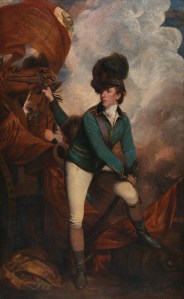
In The Patriot (2000), Mel Gibson plays Benjamin Martin, a hero of the French and Indian War, who is forced out of his South Carolina plantation-managing life to avenge the deaths of his sons at the hands of the British during the American Revolution. The main British villain of that film, the fictional Colonel Tavington,–played in sneering style by Jason Isaacs—is notable for his barbaric conduct (among other things, he traps civilians in a barn and burns them alive). British audiences were noticeably aghast at this characterization, which implicitly compared British command of the time period to Nazi atrocities in World War II. Tavington may in part have been based on Banastre Tarleton, a notorious and brutal, misogynist dragoon whose victory at Monck’s Corner was among the bloodiest battles in the dirty war fought in the south at the end of the Revolution, or Lord Rawdon, a serial rapist and generally unpleasant English officer.
Nevertheless, Tavington’s barn-burning exploits are more likely based on American General John Sullivan’s slash-and-burn campaign against British-allied Mohawks, Senecas, Onondagas, and Cayugas, a subject little discussed in American history. This culminated in a 1782 massacre at Gnadenhutten in Ohio, where white Americans murdered 96 Delawares who had converted to the Moravian faith (pacifists). Evidently, in The Patriot, the conflict was not a civil war, and character was constructed in part through dialect (as detailed below, dialect here refers to all the clues in the way a person speaks, not just his or her accent).
Although Tavington’s conduct in The Patriot manifested visibly onscreen, his dialect said much about him. As noted in a recent Atlantic Monthly article, entertainment—such as Disney cartoons—can “take [bias] and pour concrete over it.” Rosina Lippi-Green, a linguist, notes that such biases are then difficult to remove: “They etch it in.” Another linguist, Chi Luu, suggests that with English RP (see below), the effect is more subtle; such accents go beyond “pure evil” by shading villains as more educated and intelligent—but still bad. Relating these findings to The Patriot, viewers understand Tavington as educated, intelligent, and evil through his English RP dialect; moreover, in black-and-white terms, his dialect makes tangible that he is completely different from the rough-and-ready, courageous Benjamin Martin. An aural line is drawn between American “good guys” and British “bad guys.” The British are fighting just to be sadistic or greedy; the Americans are fighting to defend their way of life.
Compared to media about other American conflicts, there has been little recent dramatic depiction of the American Revolution. Historically, one reason dramatizations of the American Revolution have historically remained rare is the tradition of American reverence for the “Founding Fathers,” causing their depiction as human beings to be circumscribed. Just as visual conventions have been built up regarding the antagonists of the conflict, so, too, have aural conventions in audio-visual representations such as a general use of a Standard North American accent for American (patriot) characters (whether they hail from northern or southern colonies) and English RP for all (villainous) British characters. The effect of this is epitomized by the example from The Patriot above: “good guys” versus “bad guys.”
While the way characters sound is important in most creative works—from the written dialect of Dickens’s characters to the chilling, mask-assisted tones of Darth Vader—it is no more so than in audio drama. Richard J. Hand and Mary Traynor have argued in the The Radio Drama Handbook (2011) that the elements of audio drama are words, music, sound, and silence. Arguably the most important of these to the audio drama are words. Alan Beck’s work on radio acting further argues that to create character through words and sound, refinement of dialect is needed. In this context, dialect refers to more than just a regional pronunciation: it includes details on a character’s geographical region, social class, gender, age, style, and subgroup.
In terms of The Patriot, probably the highest profile pop cultural depiction of the American Revolution until Hamilton, accents mattered. “A well-educated British accent,” in American films at least, “had come to serve as a sufficient shorthand for villainy” as Glancy pointed out, or “British, upper class, and a psychopath, happily burning people alive,” as a 2010 Daily Mail article put it. Whatever his villainy, would a historical Colonel Tavington, have sounded the way he did as depicted in The Patriot? How did those on the North American continent in the 18th century sound?
Richard Cullen Rath has convincingly argued that sound was incredibly important in colonial America, but what role did speech in English have? David Crystal, in discussing the Globe Theatre’s 2004 production of Romeo and Juliet in original pronunciation (OP)/Early Modern English (EME), was most frequently asked one question: how do we know? How do we know what Shakespeare’s English sounded like? For EME, spelling, contemporary accounts of the language, and the use of rhythms, rhymes, and puns illuminate this area. Crystal noted that EME would not sound like any modern accent but would have the pronunciation of “rs” in common with “rural” accents, as in Ireland and the West Country (Somerset).
This is important because the association of Shakespeare with a certain kind of English accent—the RP referred to below—has long had the effect of making his works less accessible than they might have been. If Shakespeare’s actual working dialect had more in common with “rural” accents like Irish and West Country, the latter of which is often still designated as a shorthand for stupidity in common with American southern dialect, this has a liberating effect on Shakespeare in performance. It may sound “strange” at first, but it suggests that Shakespeare can/should be performed in a vernacular, at the very least to make it more accessible to a wide variety of audiences.
Crystal has suggested that, “It is unfortunately all too common to hear accents on stage or film in which—notwithstanding the best efforts of dialect coaches—accuracy and consistency throughout the performance leaves, shall we say, a little to be desired.” Sky 1’s recent big-budget effort in historical drama, Jamestown, set in 1619, is diverse and rich in dialect, with characters speaking with Irish, northern English, southern English, and Scottish accents—nor are they uniform in suggesting that one accent will signify the character’s goodness or badness (though it has to be said most of the southern English-speaking characters are, at the very least, antagonistic). Most of the Native American characters have so far not spoken English rather than racist “Tonto talk,” and white English-speaking characters must speak Powhatan (or use sign language) in order to communicate. As actor Jay Tavare points out, early Hollywood was not concerned with the accurate portrayal of indigenous languages, given that Navajo extras were most often used in Westerns (meaning the Diné language of the southwest was heard regardless of where the film was set). More recently, even such films as Dances with Wolves (1991), which has generally received praise for its accurate portrayal of Sioux/Lakota culture, included Lakota dialogue which was linguistically imprecise. Clearly, there is still a long way to go.
Suppose we decide we cannot ever know how such historical actors sounded, so we decide to depict 18th century English speakers based on other criteria. How do directors, actors, and voice coaches bring the viewer/listener as close to the author’s intent as possible in fictional depictions of the years surrounding the American Revolution? How is the 18th century made accessible through dialect? As Glancy suggests above, British officers in film, television, and radio depictions of the American Revolution are most commonly associated with Received Pronunciation (RP), though the term was not coined until 1869, and, as Crystal points out, the “best speech” heard in the English court of the 16th century was “nothing like” RP. In fact, it was probably influenced by the Devonshire accents of Sir Francis Drake and Sir Walter Raleigh (an English so far in Jamestown associated with servants . . .). As Edda Sharp and Jan Haydn Rowles point out in How to Do Standard English Accents, RP has almost disappeared in England, “now confined to a very small section of society, the older upper and upper middle classes, older actors and broadcasters.”
The officer class of the British Army in the 18th century was in fact largely composed of Scots (as per Stuart Reid and Paul Chappell)—though how much they retained their Scottish identity (including accent) is of course impossible to know. As Kevin Phillips in 1775: A Good Year for a Revolution points out, within England, support for the colonies during the American Revolution was generally strongest in the major cities and in the eastern and southern counties—the same places where during the Civil War, support had been strongest for Parliament and Cromwell. Support in Scotland was limited to a small fringe. By contrast, statistics from Revolutionary America 1763 to 1800: Almanacs of American Life on the ancestral origins of the white population of Virginia in 1790 make Scotch-Irish (11.7%) and Scottish (5.9%), the second-largest groups after English. References to the Scottish officer class are made in Cooper’s The Last of the Mohicans, where Colonel Munro is referred to as “the Scotsman” (played memorably in the Michael Mann film by Maurice Roëves). Beal suggests that guides to “correct” pronunciation in the 18th century were often written by and for Scots—to pass as “British.” The Scottish people have had a long history of wishing to disassociate themselves from rule by the English (as evident in the 2014 Scottish Referendum). The Wars of Scottish Independence in the 13th and 14th centuries were fought between English and Scottish forces, at the conclusion of which Scotland retained its status as an independent state. However, in 1707, the Act of Union unified England and Scotland under one government.
With these many regional British accents potentially to be heard in the British Army in America in the 18th century, and with approximately 92.2% of white colonists in Virginia hailing from the British Isles in 1790 (including England, Scotland, Ireland, and Wales), it is perhaps curious that there has been so little variation in dialect in media depictions such as films, TV, and radio. Traditionally, for example, George Washington has been depicted with a Standard North American accent and not a modern southern American accent. This is also true in the case of Colonial Williamsburg re-enactors.
Besides being generally a very sound depiction of the Revolutionary period, HBO’s John Adams (2008), based on David McCullough’s book, is also unusual as far as accents go. John Adams gives the British King George III, played by Tom Hollander, Standard Neutral English, but it does something very unusual with its American characters. Virginian characters (including Washington and Jefferson) have suspiciously Somerset-sounding accents. John Adams introduces a clear regionalism in Anglo-American accents that goes beyond the singling out of the Boston accent (which is generally personified in John Adams himself). It isn’t clear why this decision is made; the accent does not belong exclusively to Virginian characters, as it is also the accent of Benjamin Franklin, proudly Pennsylvanian, and Alexander Hamilton himself. Is the shorthand present to aurally distinguish between Loyalists, and American rebels? What affinity, one might ask, does the Somerset accent have with a depiction of the American character?
Standard North American speech is rhotic (people who say an ‘R’ whenever it is written), as is the Somerset accent (and, as Ben Zimmer explains, was associated with country speech in England from the 17th century). This contrasts with Neutral Standard English Accent, which is non-rhotic (people who only say an ‘R’ if there is a vowel sound spoken after it). Perhaps the filmmakers had in mind the best guesses about how “proper” Anglophones spoke in the 18th century, as in John Walker’s Critical Pronouncing Dictionary (1791), where he normatively condemns rhotic English. Then again, perhaps it is merely a storytelling expedient; look at the actors assembled to play Founding Fathers:
- Washington – David Morse, American, born in Massachusetts
- Jefferson – Richard Dillane, born in London
- Hamilton – Rufus Sewell, born in southern England of Welsh and Australian parents
- Franklin – Tom Wilkinson, born in Leeds, grew up in Canada
- Sam Adams – Danny Huston, American, born in Rome
Standardization may have made practical sense, but the use of the rhotic sends a subtly different message than North American Standard English, and perhaps hints at the influence of David Crystal’s work on OP/EME.
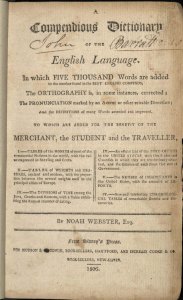
Even among linguists, North American 18th century English has not been examined to the extent that EME has, with Beal going no further than to suggest “the contact between the various regional dialects of the English-speaking colonists and the languages of the Native Americans and of other European colonists” would have influenced pronunciation, but she is not conclusive as to what extent. Noah Webster in 1789 envisioned “a language in North America, as different from the future language of England, as the modern Dutch, Danish and Swedish are from the German or from one another” (cited in Mühleisen). From the beginning, too, American fiction was concerned with pronunciations, with Cooper sensitive to those which “disclosed class or origins,” as Schachterle noted. The word “Americanism,” in fact, was coined by John Witherspoon in 1781. Its entry in Webster’s Compendious Dictionary (1806) is “a love of America and preference of her interest.” As David Crystal points out, this was the first dictionary written in English to include words like butternut, caucus, checkers, chowder, constitutionality, hickory, opossum, skunk and succotash. It was also the first dictionary to give now-familiar American spellings to words like color and defense.
It is probably not a surprise that many of the words above have their origins in Native American languages. Black and Native voices (and use of dialect) are somewhat rare in media depictions of the Revolutionary period, notable exceptions being The Last of the Mohicans, with its heroes (“Hawkeye,” Uncas, and Chingachgook, played by Daniel Day-Lewis, Eric Schweig, and Russell Means, respectively), as part of an extended, multi-racial family unit, speaking with a uniform Standard North American accent:
and Ubisoft’s smash video game, Assassin’s Creed III (2012).
The hero of this Xbox/Playstation game is Connor/Ratohnhaké:ton (Noah Watts), half-British, half-Mohawk, who speaks Mohawk as well as English (again, no Tonto talk here), as taught by the project’s language consultant, Akwiratekha’ Martin. However, again ignoring historical realities like the Sullivan campaign, the villains are British redcoats, echoing the storyline set up by The Patriot (Connor’s village is burned and his parents are killed by a British officer who sneers, “You are a nothing, living in the dirt like animals.”) In a making-of featurette, the creators of Assassin’s Creed III note that it has more than two hours of “cinematics,” a concept that suggests that the game will be a more potent window into history for its users than film, television, radio, or books. While it is positive that the game inaugurates a Native American action hero role model, it is disappointing that it recycles “the British are baddies” dialect trope.
In media like cartoons, video games, and audio drama, dialect supplies us with many clues about characters and what we should think and feel about them. Class is still very much implicit in accents in Britain, and every time we open our mouths we display characteristics about ourselves, whether feigned or not. When mass media-makers produce historical drama, they make choices. Despite the United States’ and the United Kingdom’s “special relationship,” the “British are baddies” trope remains. Its continued use and the future choices made by media-makers have much to say about Anglo-American relations and conventions in fiction today.
If, as suggested by several linguists identified in this article, children very quickly pick up conventions of who is “bad” via what they sound like, it behooves us to pay careful attention to the way mass media uses voices and what norms these establish, for listeners young and old. Also, what accents filmmakers use for past accents may profoundly influence who can hear themselves as “American” in the present moment–one important reason why Lin-Manuel Miranda’s Hamilton resonated with contemporary audiences. If teacher Laura Amico in the Cliffside Park school district in New Jersey has established that her pupils should “speak American,” what does this mean (besides the fact she expects them to speak English not Spanish)? Should they, for example, speak like President Trump, who uses a New York Queens accent which, according to Jeff Guo, connotes “competence, aggressiveness and directness” despite the fact its speaker comes from a privileged background? As Guo suggests, the way we speak is at least as important as what we say. In response to reports that Trump mocked the Indian Prime Minister, Narendra Modi, by imitating his accent, Congressman Raja Krishnamoorthi published a statement saying, “Americans are not defined by their accents, but by their commitment to this nation’s values and ideals.” That, perhaps, is speaking American?
—
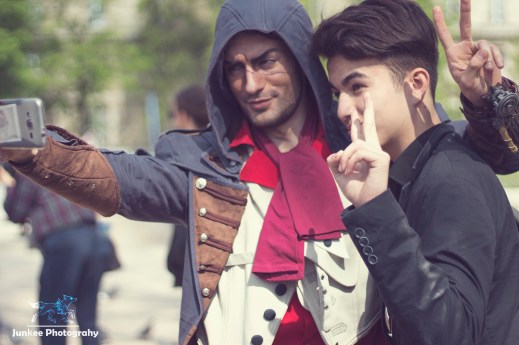
Featured Image: Arno Victor Dorian, Assassin’s Creed Unity: Leon Chiro Cosplay Art
—
With thanks to Kenneth Longden and Matthew Kilburn
—
Leslie McMurtry has a PhD in English (radio drama) and an MA in Creative and Media Writing from Swansea University. Her work on audio drama has been published in The Journal of Popular Culture, The Journal of American Studies in Turkey, and Rádio-Leituras. Her radio drama The Mesmerist was produced by Camino Real Productions in 2010, and she writes about audio drama at It’s Great to Be a Radio Maniac.
—

REWIND!…If you liked this post, you may also dig:
The Magical Post-Horn: A Trip to the BBC Archive Centre in Perivale–Leslie McMurtry
Speaking “Mexican” and the use of “Mock Spanish” in Children’s Books (or Do Not Read Skippyjon Jones)–Inés Casillas
Sounding Out! Podcast #40: Linguicide, Indigenous Community and the Search for Lost Sounds
Share this:

Riot Grrrl, Punk and the Tyranny of Technique

DOI: https://doi.org/10.59350/n5c86-2q829
For full intro and part one of the series click here. For part two, click here.
Our Punk Sound series implicitly argues that sound studies methodologies are better suited to understanding how punk works sonically than existing journalistic and academic conversations about musical genre, chord progressions, and/or genealogies of bands. Alexandra Vasquez’s sound-oriented work on Cuban music, for example, in Listening in Detail (2014) opens up necessary conversations about the “flashes, moments, sounds” in music that bear its meanings and its colonial, raced, classed, and gendered histories in material ways people can hear and feel. While retaining the specificity of Vasquez’s argument and the specific sonic archive bringing it forth, we too insist on “an ethical and intellectual obligation to the question: what do the musicians sound like” (12) and how do folks identifying with and through these musical sounds hear them?
In this series, we invite you to amplify varied historicized “details” of punk sound–its chunk-chunk-chunk skapunk riffs, screams, growls, group chants, driving rhythms, honking saxophones–hearing/feeling/touching these sounds in richly varied locations, times, places, and perspectives: as a pulsing bead of condensation dripping down the wall of The Smell in Downtown LA (#savethesmell), a drummer making her own time on tour, a drunk sitting too near the amp at a backyard party, a queer teenager in their bedroom being yelled at to “turn it down” and “act like a lady[or a man]”. . .and on and on. Today’s essay is by Tamra Lucid. Here, Tamra offers her thoughts on how both technique and expression reinforce a gendered understanding of music. When punk sound plays with extremes, how can artists who feel trapped by these polemics resist?
SOUND!
–Aaron SO! (Sounding Out!) + Jenny SO! (Sounding Out!)
—
“Don’t touch that!” a virtuoso guitarist had once told me when as a kid I reached for his guitar. The same phrase would later be delivered by a punk guitarist at a gig where I offered to replace a string broken during his performance. As noted in the book Girls Rock , women are often told not to touch these sacred instruments (18). I remember thinking that guitar was as complex as a car engine and as dangerous as a circular saw. Technique and theory are meant to liberate musicians (so that their dexterity can follow wherever imagination and inspiration may lead), but when experiencing gender discrimination from instructors and fellow instrumentalists, technique and theory can seem antagonistic. In this essay I show how the elite and virtuoso focus on technique and theory has catalyzed punk musicians to cultivate the raw, expressive, qualities of punk sound. Yet, paradoxically, I point out how movements toward a raw and visceral sound constitute a cage of their own, alienating an equally radical and virtuoso community of women in the punk scene. How do these sonic contours in the 1990s riot grrrl scene tell a story about injustice and community building through sound?
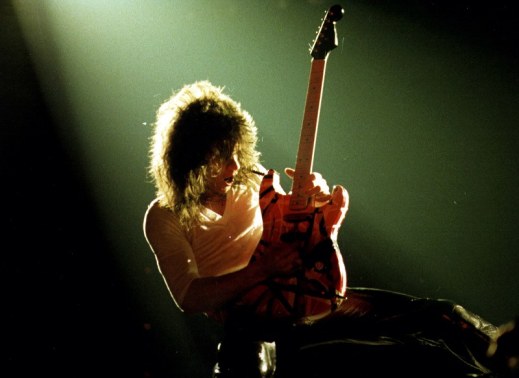
Theory and technique become a cage when they are used by sexist cliques, such as the heavy metal scene, which sought to maintain hegemony over local scenes and resources. For the gatekeepers, there are many benefits to this form of discrimination–women are encouraged to act as doting fans rather than joining bands. As a teenager I saw many young women told by male musicians that their only permissible roles were those of sex object or fan. Early in my musical career when I put out an ad searching for band mates some male musicians would call just to laugh at me.
In the late 1980s and early 1990s when canons of punk tone and composition ironically became defined by an athletics-like dedication to speed, precision and endurance, riot grrrl bands were criticized for their primitive skills. However, by removing the barriers to self-expression that this emphasis on technique and theory created, many people, not only female or female identified, were empowered to create music similar to performance art. As Liam S. Ruin of the Columbia, South Carolina hardcore band Shirley Temple of Doom (1993-1996) said in an interview I conducted with them for this essay: “I still think emphasis on technique is gross and ableist and boring and obvious.”
In this time of sonic reform, some scenes came to prize sincerity over skill. Here, a new canon of theory and technique evolved–another cage. Some related to the riot grrrl scene found themselves accepted by their community while receiving praise for abandoning a commitment to simplicity. For example Associated Newspapers News North West previewed a gig by Sleater Kinney in Manchester, UK by describing them as “too musically competent to be a Riot Grrrl band.” Likewise, the female hardcore bands Girl Jesus and Free Verse (though politically aligned with riot grrrl) found little support in a scene that viewed them as a threat. It was as if the language of technique and theory was the language of oppressors, and using it implied submission to the status quo. The directness of purpose which had liberated so many artists, became a new kind of cage for others.
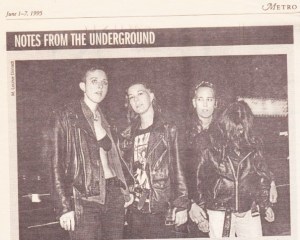
As a roadie for Girl Jesus, I witnessed the immediate dismissal (including groans of disappointment) they suffered when confronting male bands at gigs many times. Despite these jeers I also saw the way their ferocious music and performance, anchored by guitarist Gina Rush’s use of middle eastern scales, Shell Davina’s unique and unusual drumming style, and Grit Maldonado’s flamenco-like bass lines, reduced many male bands to discouraged silence and listless performances. I remember thinking that riot grrrl, or what was left of it in 1993, would welcome such a powerful example of female creativity. The feeling of competence I felt as Girl Jesus approached each gig with confidence in their music and technology helped me to reinvent myself, encouraging me to graduate quickly from roadie to musician.
Gina Rush carefully chose her amps and had them modded by an expert. Shell used a vintage drum-kit that would make any collector drool. But these distinctions were rejected by the riot grrrl audience who found them elitist and classist. Though Girl Jesus was a band of working class lesbians they were treated the same way as male bands in the scene. As Shell reported in an article entitled “Queercore: Ready to Face the Market” by Brent Atwood in the May 6, 1995 issue of Billboard Magazine: “As a female band, we expected a strong network of women in music to stick together. Instead we found a lot of competition.” She also pointed out: “We’ve had more club owners be sexist to us than homophobic.” Despite their embrace of technology and technique, two domains that code as masculine, Girl Jesus nurtured into existence two of the more popular riot grrrl bands in mid-90’s Los Angeles, Patsy and my own band Lucid Nation, which began by rehearsing in Girl Jesus’s garage using their equipment. The name of Girl Jesus’s first cassette demo succinctly captured the problem: “Afraid of Our Own.”
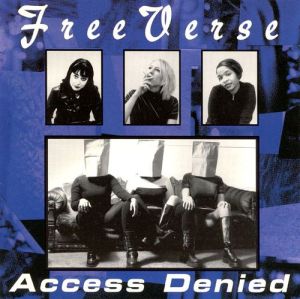
A similar trajectory was found by the all female hardcore band Free Verse, whose first record “Access Denied” was released by the indie label Brain Floss Records. Free Verse began in Lawrence, Kansas in 1995 and in 1998 relocated to Seattle. Lucid Nation toured nationally with Free Verse in the summer of 1998. The experience was similar to what I observed as a roadie for Girl Jesus. Male bands who looked down upon female musicians with disdain were stunned by their display of skill and ferocity. However, when we played in Olympia, Washington, the riot grrrl community cowered against the back wall, clearly uncomfortable. On the road we smiled ruefully over the irony of masculinist male bands becoming fans while female fans who shared our politics turned their backs. This created a conundrum for Free Verse. Although they were able to deliver a feminist message to scenes and individuals who were hostile to feminism, they could not enjoy the community of like minded women who identified as riot grrrl.
Over time, Free Verse earned enough respect that they were able to open for leading bands from a variety of scenes. From Hardcore bands like The Blood Brothers to indie stars like Sleater Kinney. From queer core bands like The Need and The Butchies to riot grrrl supergroup The Cold Cold Hearts. Though Free Verse were chosen to participate in the Northwest Coalition For Human Dignity’s anti-racism tour October 2002, a tour sponsored by Ms. magazine and featured in ROCKRGRL magazine, the band was never able to achieve the following or recognition of the bands they shared bills with, information about them is hard to find on the internet today.
Liam S. Ruin, now one of the guiding lights of the new Riot Grrrl Intersectional movement, provides a more intimate look at how the pressures of technique and theory influenced Shirley Temple of Doom: “Not really any RG [riot grrrl] activity in Columbia SC. Um, Slant 6 played there once. Our scene was extremely nuclear. We played with our friend’s bands, The Trema, Erector Set, Guyana Punch Line. We were pretty much all in each other’s bands or dating each other or whatever. Making it up as we went along. Jessica saw me in the halls at school wearing a Pearl Jam shirt and told me ‘you’re way too cool to be listening to shitty bands.’ She made me a mix cd that was mostly D.C. Emo and Hardcore but it had Bratmobile, Bikini Kill and L7, too. Then she lent me her bass. I practiced with Joy Division and Heavens To Betsy covers till I could play along. We started a band with her boyfriend. Half of our band were really into Straight Edge H/C and the other half were into Huggy Bear, Fugazi, NOU, etc.”
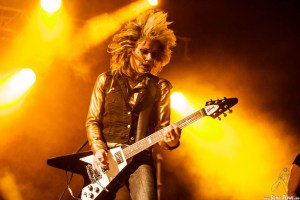
Shirley Temple of Doom, despite reflecting a riot grrrl like platform in their lyrics received little attention from the riot grrrl community. Eventually the band collapsed due to internal tensions regarding technique–as if the rhetoric of extremes around technique and expression had become an expertly baited, misogynist trap. As Liam informed me: “The guys in the band were very technical and pushed me to play more technical bass lines but honestly, I get bored with proficiency. I’ve heard what guitars are supposed to sound like. I wanna hear what they’re not supposed to sound like. We split because of ideological differences. I got really into visceral bass-feels and wanted to sound like a disaster, and they wanted to be on Victory Records.”
How did the cage of technique and expression, evolve in a style of music that advanced freedom as its guiding praxis? Early on, rock musicians were considered unskilled when compared to classical, jazz and country musicians. Later, virtuosity became central to rock music as bands like Yes, Led Zeppelin, and Pink Floyd, sought radical sounds to accommodate an aesthetic cultivated by Cannabis and LSD. As What’s That Sound? An Introduction to Rock and It’s History puts it: “Rock musicians now had a responsibility to create sophisticated music using whatever means were available.” Soon after this turn to virtuosity, guitarists like Eddie Van Halen became the Paganinis of their time, displaying jaw-dropping finger speed and impressive knowledge of scales and musical theory.
Later, punk rock crashed the party. First in the hands of the MC5 and The Stooges, and then the New York Dolls, The Ramones, the Sex Pistols and many other bands, rock music turned again towards primitive and cathartic sincerity. Musical virtuosity was literally spit upon. The Ramones famously told The Clash that they needn’t worry about improving their musicianship before playing live because “as you’ll see tonight, we suck.” Ferocity replaced dexterity. Nihilistic and cathartic lyrics displaced idealistic flights of fancy. Punk quickly developed its own criteria to indicate mastery of the genre. Bands like Fugazi and F.Y.P. typified a performance style that required frenetic motion while preserving the lockstep rhythm and hand speed, if not the musical knowledge and experimentation, of the earlier virtuosos. Then riot grrrl arrived, freeing a generation of punk women who were uncomfortable with the athletic performance style of these bands. For example, one of L.A.’s favorite riot grrrl bands Crown for Athena would perform at times with one member of the band sitting on the stage singing while clinging to the pant leg of another who stood immobile and emotionless. Frenetic performance and blazing chord speed was no longer a requirement for legitimacy on the punk stage.
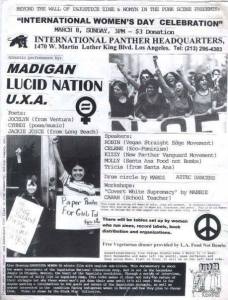
Riot grrrl liberated me from the odious trial of confronting sexist music teachers, store clerks, booking agents, and record companies. I learned from the movement that I could get by with simple barre chords. I could use cheap and borrowed gear and I didn’t have to worry about great tone. One of the bands I admired, Foxfire, a band of female high school students from Los Angeles, used an oven pan instead of a snare drum. Riot grrrl bands emphasized community by booking shows with each other and with activist groups like Food Not Bombs. We made our own labels to distribute each other’s records. When Lucid Nation opened for Bikini Kill at Terraza Jamay in Montebello, Kathleen Hanna took tickets at the door.
As my musical skills developed I found myself feeling restricted by the aesthetics of riot grrrl. Beginning with Lucid Nation’s DNA record (2000) we began exploring cliches of what we called “butt rock,” now more popularly known as classic rock. While we attempted to master the techniques of classic rock our intent was to deconstruct them by introducing unexpected twists of sound (like chaotic analog synth and noise pedals) and lyrics containing feminist perspectives. At this point, we had moved on to other scenes, for example, the melange of Peace Punks, Black Panthers, and riot grrrls at Koo’s Cafe in Santa Ana, CA. We played hemp rallies and non-riot grrrl political events like fundraisers for Big Mountain and other Native American causes.
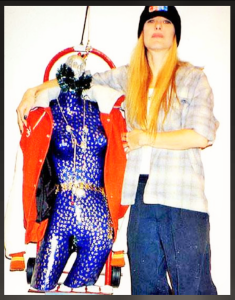
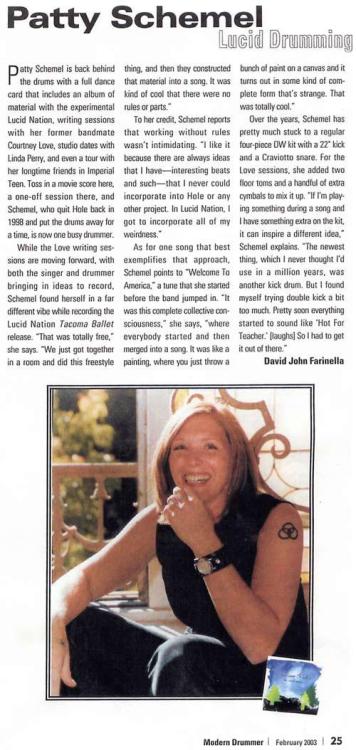
Eventually I developed a fascination with improvisation inspired by freestyle rap and augmented by the writing of Gertrude Stein and the recordings of Jack Kerouac. By the time our most successful album was released, the improvised Tacoma Ballet (2002), I prized musicianship and encouraged experienced collaborators, like Patty Schemel of Hole on drums and Greta Brinkman of Moby’s live band on bass, to bring to bear the breadth and depth of their musical knowledge. I was delighted that Rick King of Guitar Maniacs in Tacoma allowed us to use his highly valuable collectible gear such as a 1967 Gibson Flying V and an array of legendary vintage pedals when we recorded the album. I was proud when Patty said in an interview about Tacoma Ballet: “…there are always ideas that I have–interesting beats and such–that I could never incorporate into Hole or any other project. In Lucid Nation I got to incorporate all my weirdness.” Though Tacoma Ballet made it to #1 on the New Music Weekly Chart of College and Secondary Market Radio Stations in December 2002 it received very little attention in riot grrrl circles. I found myself silenced again, not by advocates of technique, but by a community who valued raw expression.
Of course, in 2002 riot grrrl was less popular than it had been a decade before–it mostly consisted of isolated zine writers and bands. Still, those who remained in the scene ignored Tacoma Ballet despite its success. When I asked them why, they explained that although they admired our work and the songs spoke to their experience, our band just wasn’t riot grrrl. I was told that the skills and awareness of musical history displayed on the record were too self conscious, that I had become ambitious, or as more than one zine writer said, I had sold out. Since I made no money on that record despite the attention it got, and we couldn’t tour behind it since the music was improvised, I found it hard to understand how such a purely artistic lark could be viewed as selling out. I didn’t sell out, my increased respect for theory and technique just felt wrong when viewed from the perspective of the riot grrrl canon.
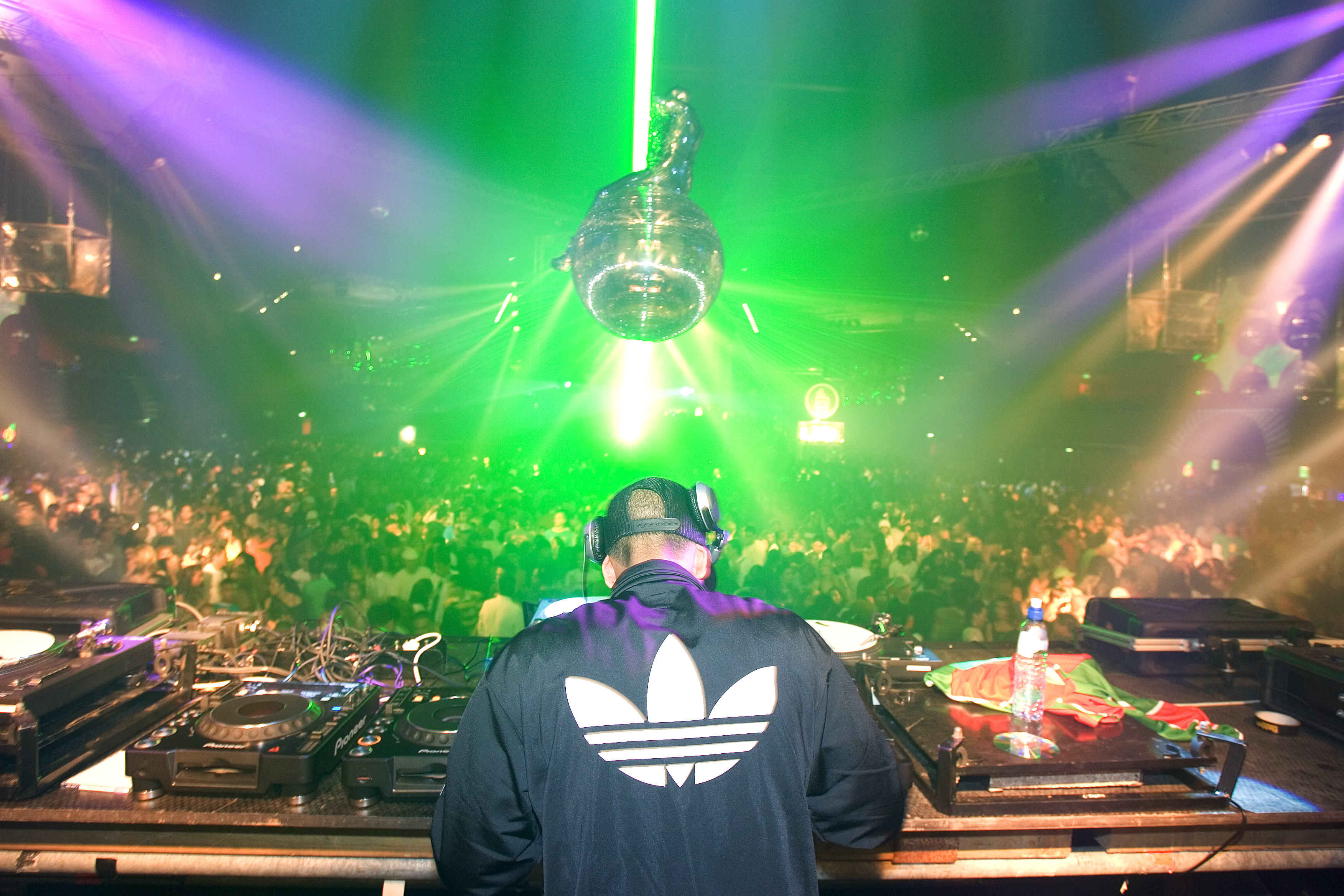
While new music hardware and software have helped level the field in ways that were not possible in the 90’s, the cage of expression and technique continues to govern a new world of highly individuated scenes. EDM continues to fetishize the drop. Live performers need no longer be concerned about vocal pitch or knowledge of vocal harmony. Hardware like the Digitech VLFX, available on Amazon for under $200, corrects pitch and provides easy and automatic harmony vocals. In this device, music’s ability to create unexpectedly cathartic experiences has been diminished, while the simple mimicry of technique has been elevated.
Perhaps new regimes of data are to blame. Specific canons of theory and technique function as points of data that help define marketing audiences. After all, bands often succeed by conforming to the sonic norms of their given scene. For this reason, there is a tension between conservation and innovation. An artist must conserve as much of their scene’s identity as possible while finding subtle ways to innovate. Today, anyone can share their music on the internet regardless of traditional criteria. Despite this, a desire for acceptance and success continues to pressure musicians into accepting limitations to their creativity like technique and expression.
–
Cover image is of Tamra Lucid and by TheInfinite314 @Wikimedia Commons CC BY-SA.
—
Tamra Lucid is an executive producer of Viva Cuba Libre: Rap is War the award winning documentary about Cuban hip hop legends Los Aldeanos, a producer of Edward James Olmos Presents Exile Nation: The Plastic People, and associate producer of The Gits documentary. Writing from her riot grrrl zines was reprinted in A Girl’s Guide To Taking Over The World: The Zine Revolution by Karen Green and Tristan Taormino,and in Hilary Carlip and Francesca Lia Block’s Zine Scene. Tamra blogs for Exterminating Angel Press and for Reality Sandwich where her most recent project has been a series of interviews with water protectors and filmmakers at Standing Rock. She’s a founding member and primary singer of Lucid Nation.
–

REWIND! . . .If you liked this post, you may also dig:
Listening to Punk’s Spirit in its Pre-, Proto- and Post- Formations – Yetta Howard
Feeling Through the Keen and Grind: Team Dresch’s Personal Best – Gretchen Jude
SO! Amplifies: Indie Preserves – Norie Guthrie and Scott Carlson
—
Share this:




Current Top Posts





April 2021

January 2020

November 2019

October 2019

August 2019

April 2014

November 2017

March 2015

December 2017

October 2015


Recent Comments