
Toward a Practical Language for Live Electronic Performance

Amongst friends I’ve been known to say, “electronic music is the new jazz.” They are friends, so they smile, scoff at the notion and then indulge me in the Socratic exercise I am begging for. They usually win. The onus after all is on me to prove electronic music worthy of such an accolade. I definitely hold my own; often getting them to acknowledge that there is potential, but it usually takes a die hard electronic fan to accept my claim. Admittedly the weakest link in my argument has been live performance. I can talk about redefinitions of structure, freedom of forms and timbral infinity for days, but measuring a laptop performance up to a Miles Davis set (even one of the ones where his back remained to the crowd) is a seemingly impossible hurdle.
Mind you, I come from a jazzist perspective, which means that I consider jazz the pinnacle of western music. My classicist interlocutors will naturally cite the numerous accomplishments of classical composers as being unmatched within jazz. That will bring us to long debates about the merits of Charles Mingus and Duke Ellington as a composers, which leads, for a good many, to a concession on the part of Duke at least, but an inevitable assertion of the general inferiority U.S. composers compared to the European canon. And then I will say “why are we limiting things to composition when jazz goes so much further than the page?” To which I will get the reply: “orchestral performers were of the highest caliber.” Then I will rebut, “well why was Europe so impressed by Sidney Bechet?” But I digress.
Why talk about classical music in a piece on electronic music, you, my current interlocutor, may ask? Well, in placing electronic music in a historical context, its current stage of development keeps pace with the mental cleverness found in classical but applies it to different theoretical principles. The electronic musician’s DAW (Digital Audio Workstation) file amounts to the classical composer’s score; the electronic musician’s DSP (Digital Signal Processor) parallels the classical composer’s orchestra. I could call electronic music “the new classical” and I’d have a few supporters. But. . .taking it to the level of jazz? Electronic music would have to include not only the mental cleverness, but the physical cleverness as well.
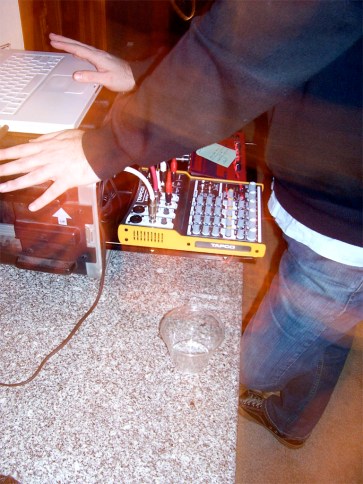
Electronic artist using Ableton 5 Live, Image by Flickr user Nofi
Let’s back up for a bit. A couple years back, I did a piece for Create Digital Music on Live Electronic performance. I talked to a diverse group of artists about their processes for live performance, and I wrote it up with some video examples. It ended up being one of the most discussed pieces on CDM that year, with commentary ranging from fascination at the presentation of techniques to dismissal of the videos as drug-addled email inbox management.
This was to be expected, because of the lack of a language for evaluating electronic music. It is impossible to defend an artist who has been called a hack without the language through which to express their proficiency. Using Miles Davis as an example–specifically a show where his back is to the audience–there are fans that could defend his actions by saying the music he produced was nonetheless some of the best live material of his career, citing the solos and band interactions as examples. To the lay person, however, it may just seem rude and unprofessional for Davis to have his back to the audience; as such, it cannot be qualitatively a good performance no matter what. Any discussion of tone and lyrical fluidity often means little to the lay person.
The extent of this disconnect can be even greater with electronic performances. With his back turned to the audience, they can no longer see Miles’ fingers at work, or how he was cycling breath. Even when facing the crowd, an electronic musician whose regimen is largely comprised of pad triggers, knob turns, and other such gestures which simply do not have the same expected sonic correspondence as, for example, blowing and fingering do to the sound of a trumpet. Also, it is well known that the sound the trumpet produces cannot be made without human action. With electronic music however, particularly with laptop performances, audiences know that the instrument (laptop) is capable of playing music without human aid other than telling it to play. The “checking their email” sentiment is a challenge to the notion that what one is seeing in a live electronic performance is indeed an “actual performance.”
In the time since writing the CDM piece, I’ve seen well over a hundred live sets, listened to days worth of live recordings, spoken in-depth with countless artists about their choices on stage, and gauged fan reactions many times over: from mind-blowing performances in barns to glorified electronic karaoke in sold-out venues, tempo locked beat matching to eight channel cassette tape loops, ten thousand dollar hardware to circuit bent baby toys. After all of that, I still don’t know that I can win the jazz vs. electronic music debate, but I will at least try.
*****
A while back, I was paging through the December 2011 edition of The Wire when I came upon a review of a Flying Lotus performance, the conclusion of which stood out:
On record, the music has the unruly liquidity of dream logic wandering from astral pathways down alphabet street, returning via back alleys on its own whims. Maybe the listening mind, presented with pretty straight analogues of those tracks, rebels, expecting something more mercurial, more improvised. The atmosphere in the venue reflected this upper-downer tension and constraint: the crowd noise was positive, but crowd movement was minimal – a strange sight in the midst of FlyLo’s headier jams. When the hall emptied there was a grumbling undercurrent as the tide of humanity was spilling slowly down the Roundhouse steps, whispers of it must have reached the upper levels. One casualty high above leaned over to berate them: “You don’t know, even understand, what you just FELT.” Sadly though, he didn’t stick around to enlighten anyone.
It should be noted that there are positive reviews of the show, and while not necessarily the best gauge, the videos from the event may seem to tell a different story.
What stood out for me from the review however, was that in trying to write about what the writer felt was a less than stellar performance, there was only one critique which could directly be attributed to the music, which was to say that Flying Lotus performed “straight analogues” of his tracks. Beyond that, the writer was left describing the feelings from the audience.
Feelings are tricky things. We all have them and they are the fundamental point of connection we seek when experiencing music. The message conveyed through the medium of music is meant to be an emotional one. But measuring those emotions is a task which cannot escape subjectivity. In a case like this when one writer is attempting to speak for the feelings of the whole audience, it becomes really tricky. Sure the writer may consider their analysis to have been objective, but it was still based on their perception of the audience, not the audience’s perception. Even more, this gauging of the audience dynamic does not tell us how the actual music performance was regardless of the varied perspectives from within the audience. I contend that this gap occurs because the language for discussing electronic performance has not yet been established.
Around the time I read The Wire review I was also reading Adam Harper’s Infinite Music, which offers variability as a primary factor of analysis in music. Instead of building on traditional music theory, Harper takes cues from those on the fringes of western music. He builds a concept of ‘music space’ by expanding John Cage’s “sound space,” the limits of which are ear determined. Furthermore, Harper’s non-musical variables and how they play into creating individually unique musical events, strengthens Christopher Small’s notion of musicking as a verb. In this way, Harper creates a fluid language for discussing music which might prove practical for these purposes.
It is helpful to use one of the central concepts of Harper’s music space, musical objects, as a means of distinguishing electronic performance.
Systems of variables constitute musical objects – Adam Harper
Going back to Miles Davis, his instrument is a monophonic musical object with a limited pitch and dynamic range in the upper register of the brass timbre. His musical talent is evaluated based on how he is able to work within those limitations to create variable experiences. His band represents another musical object comprised of the individual players as musical objects as well. The venue in which they are playing is a musical object, as is the audience and Davis’ decision to perform with his back to it. It is the coming together of all of these musical objects that creates the musical event (an alternate event includes the musical object which recorded the performance, and the complete setting of the listener as an individual musical objects upon playing the live recording). In a musical event comprised of these musical objects – Davis performing live in front of an audience with his back turned so he can face the band–it is possible to imagine a similar reaction to the above commentary about Flying Lotus, including a guy berating the audience for not making the connection.
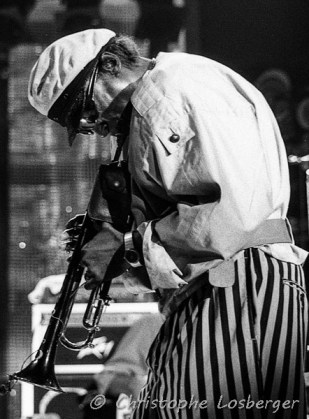
Miles Davis @ Montreux, 8.7.1984 Image by Flickr user Christophe Losberger
In this Davis example however, we could listen to the audio to determine whether or not it was a “good” performance by analyzing the musical objects which can be observed in the recording (note: this would be technical analysis of the performance, not the event or its reception). Does Davis’s tone falter? How strong are the solos? Is he staying in the pocket with the rest of the band? Evaluation of these variables would be a testament to his proficiency which could be compared to other performances to determine if it measures up.
Flying Lotus’s set however is a bit different. Yes, we could listen back to the audio (or watch the video) and determine if indeed it measures up to other sets he has performed, but unlike with Davis, we cannot translate what we hear directly to his agency. When we hear the trumpet on the Davis recording we know that the sound is caused by him physically blowing into his instrument. When we hear a bass in a Flying Lotus set, there isn’t necessarily a physical act associated with the creation of the sound. With all of the visual cues removed in the Davis example, we can still speak about the performance aspect of the music; the same is not necessarily so about an electronic set, even with visual cues. In many electronic sets, it is only when something goes wrong that actual agency in the music being performed can be attributed.
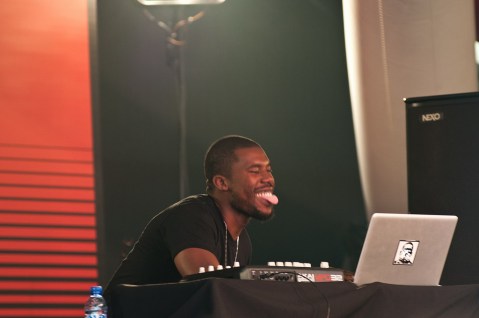
Flying Lotus,@ SonarDome, Sonar 2012, Image by Flickr user Boolker
Where the advent of the laptop and DSP advances for music have expanded creative possibilities, they only shroud what the performers using them are actually doing in more mystery. It’s an esoteric language, or perhaps languages, as ultimately each artist’s live rig configuration amounts to different musical objects, across which there may not be compatibilities.
However, in certain musical circles there are common musical objects. Perhaps the most common musical object for performance in electronic music right now is Ableton Live, which results in common component musical objects across performances by different artists. Further, an Ableton Live set can sound just like a Roland 404 set, which can sound just like a DJ set with a Kaoss pad, all of which can sound identical to a set not performed live but produced in the studio (or bedroom as the case may be) for a podcast. The reason for this is that much of the music is already fixed. What changes is the sequencing of these fixed pieces of music over time, their transitions and the variety of effects employed. The goal for these types of sets is a continuous flow of pre-arranged music, which parallels that of a DJ set.
In the past few years, the line between a live electronic set and a DJ set has been blurred extensively. Fans have become fairly critical of artists, to the point that it has become standard practice for promoters to list whether performances will be live or a DJ set. Even on the DJ end of the spectrum there’s a lot of questions, as artists have been called out for their DJ set being an iPod playlist. To qualify as a live set however, an artist must be doing more than just playing songs. How much more is debatable, but should it be?

Flying Lotus – Sónar 2012 – Jueves 14/05/2012, Image by Flickr user scannerfm
Nobody in their right mind would call Miles Davis a hack. Even if they didn’t like specific performances, few would question his proficiency with the instrument. The reason for this is that his talent rises above the standard performance, beneath which someone could be qualified as a hack. If a trumpet player spent a whole night performing only shrill notes of a C major chord around middle C, without properly qualifying that their performance would be so constrained as a stylistic choice, one might consider calling that artist out as a hack (I apologize in advance to the serious musician that fits in this description).
The rationale behind this assessment is based on knowing the potential variability of the instrument and realizing that the performer is not exploring any of that variability. Perhaps there could be other layers of variability (e.g. an effects chain) added to the trumpet to make it interesting musically, but it can be objectively said that they don’t measure up to a standard quality of a trumpet player. If we say that the trumpet has an extensive dynamic range, a tonality which can go from smooth to harsh and a pitch range of just over three octaves, we can see how the player in our example is exhibiting quite a low proficiency.
This goes across all styles of trumpet playing. Were a style to impose limitations on a player, it could be said that the style did not allow for the full expression of proficiency on the instrument. A player within that style could be considered proficient in that context, but would require a broader performance to be analyzed for general proficiency. So the player in our example could be a master of “Shrill C” trumpet, but in order to compare with a Miles Davis they would have to perform out of style. Conversely, Miles Davis may be one of the world’s greatest trumpet players, but possibly the worst “Shrill C” trumpet player ever.
From this we can see that the language of variability provides a unique way to objectively speak on the performance of musical objects, while fully taking into account the way styles can play into performance. Using this language we open the world of electronic performance up for analysis and comparison.
—
This is part one of a three part series. In my next installment, I will use some of the language here to analyze the instruments and techniques used in electronic performance today. Once we have a fluid language for describing what is being used, I believe we will be better equipped to speak about what happens on stage.
—
Featured Image by Flickr User Scanner FM, Flying Lotus – Sónar 2012 – Jueves 14/05/2012
—
Primus Luta is a husband and father of three. He is a writer and an artist exploring the intersection of technology and art, and their philosophical implications. He is a regular guest contributor to the Create Digital Music website, and maintains his own AvantUrb site. Luta is a regular presenter for the Rhythm Incursions Podcast series with his monthly showRIPL. As an artist, he is a founding member of the live electronic music collectiveConcrète Sound System, which spun off into a record label for the exploratory realms of sound in 2012.
—
 REWIND! . . .If you liked this post, you may also dig:
Experiments in Agent-based Sonic Composition–Andreas Pape
Evoking the Object: Physicality in the Digital Age of Music–-Primus Luta
Sound as Art as Anti-environment–Steven Hammer
Share this:

Sound as Art as Anti-environment

When I performed at the 2012 Computers and Writing Conference in Raleigh, North Carolina, I looked around during my fairly abstract 10-minute long improvisation featuring feedback loops, glitches, silences, and circuit-bent instruments, and I noticed the audience’s sometimes visible restlessness, discomfort, and even anxiety. This is a fairly common occurrence when I perform experimental sound art, particularly in contexts in which audiences expect “music” (you can hear my work at 38:30 in the video below). However, for an experimental sound artist to take offense to such reactions is, in my estimation, missing the point of the exercise. That sound art disrupts, agitates, and even offends is a powerfully reaffirming reminder that sound art transcends music and sound; it is a method of revelation, an act that surpasses logical communication, instead challenging the very nature of sound and perception.
.
As an artist, scholar, and fan, I am drawn toward sound and music that lures me into a new world, an unfamiliar way of being and knowing. Like Lewis Carroll’s Alice, I learn that the rules of my world no longer apply. This happened when I heard J Dilla’s Donuts album, and when I heard Madlib’s Medicine Show #3: Beat Konducta in Africa, when I heard Miles Davis’ Bitches Brew. An artist that continually draws me down the rabbit hole is Walter Gross, an experimental sound/beat artist out of Los Angeles. His work changes the way I usually interact with sonic art, both in terms of his sound and in his approach to physical collage and handcrafted cassette packaging, Gross departs from the comfortable and familiar listening imparted by polished hi-fi 3-minute tracks with definitive beginnings and ends and discernible melodies. Gross instead propels listeners into very unusual (and pleasantly discomforting) soundscapes that demand attention. Almost counter-intuitively, Gross’s visual representations of his work intensify that experience. Consider his 2010 work, Dopamine:
Dopamine is likely a challenging piece for audiences, at least in terms of violating the dominant structures of music. The piece opens with disorienting use of panning, deliberately obscuring degraded audio, largely indiscernible movements and patterns, and so on. His video work likewise presents a fitting yet relatively unusual juxtaposition of youth and destruction, celebration and danger. In terms of both sound and sight, Gross’ work disrupts dominant musical sensibilities, challenging the very patterns and structures within which we can express ideas. He violates tradition, shakes off the canonical baggage carried by prevailing paradigms of Art and Music, and plunges audiences into unfamiliar sensory experiences that require metacognition, reflection, and examination of what sonic art is, and more importantly, what sonic art can be. Gross, in other words, seems to transcend the musician moniker and reach something else entirely. In what follows, I’d like to explore a (very brief) history of such artists, and begin to think about how to frame sonic art as immersion in what Marshall McLuhan called anti-environments: the unconscious environment as raised to conscious attention.
Sound as Art
There exists a strong tradition of experimental noise and sound art, particularly in 20th-century Western avant-garde movements. Futurists were arguably the first to consider noise as music in the European tradition, and were certainly influential in asking artists and audiences to become more aware of the changing social and sonic surroundings . In his 1913 manifesto-of-sorts titled “The Art of Noises,” Italian Futurist Luigi Russolo proposed an orchestral configuration that more aptly represented the range of sounds available to contemporary listeners, namely those sounds that accompanied industrialization and urbanization. The sounds of the Futurist orchestra would include “rumbles, roars, explosions, and crashes.” Russolo built devices called intonarumori to mechanically achieve and manipulate these sounds. His brother, Antonio Russolo, also enacted this new philosophy of modern found sound and composed Corale and Serenata.

Luigi Russolo and Ugo Piatti with the Intonarumori, 1913
Any inquiry of art as anti-environment would be incomplete without a discussion of the great anti-art movement, Dada. Like the Futurists before them, Dadaists used found sound and technology-as-art to violently disrupt conventions of art, beauty, and authorship within the white avant-garde community. Marcel Duchamp’s famous work, “Fountain,” is likely the most familiar Dadaist artifact to contemporary readers, yet the sound poetry of Kurt Schwitters and other Dadaist and Dada-inspired sound pieces such as Erwin Schulhoff’s 1922 work In Futurum (the middle movement of which contains only a rest and the notation “with feeling,” an undoubtable precursor to John Cage’s 4’33”, written 30 years later) created sonic spaces of innovation and strangeness that changed the way audiences listened to both voices and silences. The Russian Cubo-Futurists, especially zaumniks such as Alexei Kruchenykh, made similar ventures into anti-environments. Kruchenykh developed the sound art zaum, which he understood as a transrational language that undercut existing language systems in which the “word [had] been shackled…by its subordination to rational thought” (70). Zaum was a sort of linguistic anti-environment, one rooted in the notion that meaning resided first and foremost in the sound of a word rather than the denotative symbol system that emerged alongside the proliferation of print/visual culture. One could also not underemphasize the work of John Cage, from his prepared piano to his work with organic instruments.

John Cage and His “Prepared Piano,” Image courtesy of Flickr User William Cromar
The list of artists, genres, and movements engaged to some extent in the enterprise of anti-environment architecture could go on and be debated indefinitely: Free Jazz, Turntablism/Nu Jazz, Experimental Hip-Hop,Fluxus, Circuit Bending, Prepared Guitar, ProtoPunk, Punk, Post-Punk, New Wave, No Wave. . . in all of these diverse movements, the sonic artists share the tendency to create strange new worlds via sound; worlds that reveal social and technological environments that most people seem unaware of in the moment. This is why media theorist Marshall McLuhan called the artist “indispensible,” because the artist can tell us something about ourselves that we cannot know via ordinary means of perception. Sonic artists expose audiences to auditory phenomena, structures, juxtapositions, etc. that are to various extents hidden, obscured, or ignored as “noise.” The sonic artist is more than just a clever selector and (re)arranger of sound; s/he is a revelatory agent, exposing what is inaudible.
Art as Anti-environment
Anti-environments, however we might define and classify them, are vital not only to artistic communities themselves, but they are also vital to a society of fish in water. In his 1968 text, War and Peace in the Global Village, McLuhan asserts (among other things) that humans remain largely unaware of their new environments, likening them to fish in water: “one thing about which fish know exactly nothing is water, since they have no anti-environment which would enable them to perceive the element they live in” (175). In other words, humans seldom possess or practice a sense of awareness regarding their surroundings because there’s nothing against which surroundings may be contrasted. The “water” to McLuhan represented the various environments (physical, psychological, cultural) shaped by technological innovation, but we can—and should—extend the water metaphor to a range of hegemonic frameworks: constructions of gender, race, ability, and so on.
This essay is certainly not an attempt to generate some sort of evaluative rubric by which to judge artistic or sonic expression objectively. Rather, we might use the concept of anti-environments as a way to frame our subjective experiences and encounters with all sound, and begin listening to unfamiliar sounds as psychedelic (from Greek psyche- “mind” + deloun “reveal”) keys to illuminate the patterns and structures in which listeners exist. We must work to understand our environments and our place in them; if we are to engage critically with our culture, we must first understand existing (yet invisible) patterns and structures that surround us. And we are aided in this effort, in great part, by humanity’s great seekers of pattern recognition, the sonic-psychonautical messengers: the sonic artists.

Sound Artist Performing at Circuit Bending Workshop in Dayton, Ohio in 2009, Image Courtesy of Flickr User Vistavision
To return to the sound that inspired this meditation, Walter Gross (among others) is in many ways participating in and propelling the discourse of Leary and McLuhan, Schwitters and Schulhoff, Kruchenykh and Cage,Davis and Sun Ra, Madlib and J Dilla. Gross performs the sonic anti-environment, enacts the revelation of obscured sonic paradigms. For me, Gross can act as a sort of lens through which ordinary sonic patterns and structures become visible. I hear Flying Lotus, Bob Dylan, and The Minutemen differently after Gross. I hear my office, my home, my family’s voices differently after Gross. I hear patterns that weren’t audible before. After Gross, I become aware of how I am continuously trained to expect certain things from the sonic world: compartmentalized units of meaning, clearly stated origins of utterances, linear narratives, repeated/repeatable melodies, and so on.
Likewise, my own sonic art/scholarship approaches the use of sound to reveal the inaudible assumptions present in Western frameworks surrounding sonic production. I will conclude with an illustration of my own work and why sonic anti-environments are so central to my philosophy and method. One of my sonic works, “Toward an Object-Oriented Sonic Phenomenology,” was recently part of an exhibition titled Not For Human Consumption, curated by Julian Weaver of CRISAP in London. I recorded the sounds of a high mast lighting pole using contact microphones. Contact microphones do not “hear” like humans typically hear. Typical (dominant) notions of human hearing (and therefore of sound itself) involve the reception and interpretation of vibrations present in air. Contact microphones instead only interpret the vibrations in solid objects.
By listening through an object–through alien “ears,” so to speak– we can begin to critique the ways that we privilege listening via air, a listening that places humans at the center of the universe. We can consider the ways that sound has very real effects on humans with atypical hearing abilities and nonhuman objects. It is difficult to have such conversations if we never explore sonic anti-environments, if we never break through dominant epistemological models, if we never expose the limits of our own environments.
—
Featured Image: Beatrix*JAR in Dayton, Ohio, September 9, 2009, by Flickr User Vista Vision
—
Steven Hammer is a Ph.D. candidate in Rhetoric, Writing, and Culture at North Dakota State University in Fargo, ND, USA. His research deals with various aspects of sonic art, from exploring glitch and proto-glitch practices and theories (e.g., circuit bending), to understanding and producing sound from an object-oriented ontology (e.g., contact microphones). He also researches and facilitates trans-Atlantic translation collaborations between American, European, and African universities. He has multimedia publications with Enculturation, Sensory Studies, as well as forthcoming book chapters with Wiley/IEEE press, and IGI Global Publishing, and has performed creative and academic work at several conferences across North America, including the national Computers and Writing Conference and the Council for Programs in Technical and Scientific Communication. He performs experimental circuit-bent and sampler-based music under the moniker “patchbaydoor,” and has constructed and documented a number of hardware modification projects for his own artistic projects and for other artists in the upper Midwest United States. You can read/hear more atstevenrhammer.com
Share this:


Current Top Posts





April 2021

January 2020

November 2019

October 2019

August 2019

April 2014

November 2017

March 2015

December 2017

October 2015
 Sounding Out!

Recent Comments