
SO! Reads: David Novak’s Japanoise: Music at the Edge of Circulation

 We are living in strange times. Our experiences, especially our musical experiences, have become fragmented and odd. The album has been declared dead, live concerts are now silent, listened to on headphones, and some of our favorite performers exist in a faux-holographic space between life and death. The fragmentation of our musical experiences is indicative of a larger set of changes that encourage sound studies to pay attention to fragmented, outlying, and diffuse sonic phenomenon. In his new book Japanoise: Music at the Edge of Circulation, part of Jonathan Sterne and Lisa Gitelman’s “Sign, Storage, Transmission” series at Duke University Press, David Novak pays attention to one such fragmented and outlying realm, Noise music. Novak’s contribution to sound studies is to encourage us to deal with the fragmented complexity of sonic environments and contexts, especially those where noise plays a crucial part.
The past decade has seen growing public attention to noise as pollution, as problem, and as a poison. Examples of noise as a social issue needing immediate response abound, but one letter to the editor from the Wisconsin Rapid Tribune epitomizes the way that noise is sometimes read as a problem to be overcome. Novak’s book is one a few recent books, including Eldritch Priest’s Boring Formless Nonsense, Greg Hainge’s Noise Matters, and Joseph Nechvatal’s Immersion Into Noise, that complicate the idea of noise as problem. What sets Novak’s book apart from these is how his ethnographic approach allows him to approach Noise music from both the macro-perspective of its historical context and the micro-lens of his personal relationship to it.
 For Novak, Noise music is a trans-cultural, transnational interaction that is both material and abstract. His analysis of it works to blur the boundary between both large-scale networks of exchange and the highly individuated experience. Novak relates the story of Noise music as originating in Japan in the 1980s. Noise musicians working separately caught the ears of American fans. Some of these fans were well-known musicians themselves, who brought Noise recordings and eventually the performers themselves to a wider U.S. audience. At the time, Noise was generally understood as taking one of two binary positions. Either Noise music was understood as a uniquely Japanese cultural expression, or it was instead theorized as a product of the Western imaginary motivated by the production of Japan as the anti-subject within modernity (24). Novak wisely recognizes the limited nature of these two positions, and seeks a more sophisticated method of understanding the circulation that creates Noise music, contributing, ultimately, a theory of feedback. Here the transnational circulation of materials, ideas, and expressions constitutes a culture itself, one that is not distinct from either the Japanese or the U.S. manifestations of Noise music (17). This a welcome contribution to compositional and intersectional perspectives on cultural exhange.
If Noise music is a circulation, a set of experiences and contexts, flows and scapes, ecologies and environments, then genre boundaries can not adequately describe the contextual and historical exchange of sound. Though genre must be considered, Japanoise does not find Novak searching particularly rigorously. He chooses two key Noise musicians, The Nihilist Spasm Band from Canada and Merzbow from Japan and describes their historical context, reception, and influence. But other than those descriptive basics, he is unsuccessful in finding anything new to say about Noise as genre. Concluding the chapter, he casually states that the existence of Noise threatens the boundaries of other musical genres. Though this fascinating statement would have been worthy of a chapter, and certainly foundational to his central idea (that Noise music is diffuse), Novak misses an opportunity to better support these connections in his chapter on genre.
Most interesting, however, is Novak’s focus on the material conditions of the production of Noise music. In describing the diffuse flows and scapes of Noise music, he addresses a plurality of experience: from the technological to the spatial to the private dimensions of listening. These concerns put him in conversation with Louise Meintjes’ Sound of Africa and Julian Henriques’ Sonic Bodies. Like these scholars, Novak refuses to locate the material conditions of production as solely economic, technological, or cultural. Instead, Noise music results from of an assemblage of conditions and possibilities. This is best exemplified by how Novak distinguishes the live music experience from the recorded. Here, Novak resists the neat distinction, long established in musicology, that hears the live experience as collective and interactive, and recorded music as individuated and passive. Instead, Novak suggests “liveness” and “deadness.” Liveness and deadness are not bounded to the dichotomy of the live performance with the recording, but rather two qualities that float through and with both experiences. “Liveness is about the connection between performance and embodiment… deadness, in turn, helps remote listeners recognize their affective experiences…” The experience of live Noise music, according to Novak, often challenges the boundaries of what is often expected when hearing live music. I have seen this in my own experiences standing in an audience surrounded by shrieking, booming, droning noises.
Truth be known, I’m as taken with Noise music as Novak. If his book confesses to being written by a critical but vehement fan, then I ought to confess the same of the music which I love so dearly. I had the chance to see Merzbow perform in Raleigh in August. He strummed obviously homemade instruments, turned fader pots, and concentrated intently on his laptop. A fan was crawling through the crowd on their hands and knees; occasionally they stood to sway, then returned to crawling. I thought that this behavior might seem odd, but in the context of Merzbow’s performance, it was as legitimate as any other. Through these odd behaviors, the fan demonstrated Novak’s conception of individuation within Noise music. The material conditions of the performance, the screeching Noise, made it impossible for me to ask the person what they were doing or feeling. I experienced the fan and the Noise in a tension from which there is no resolution. We were both uncomfortably located in a multiplicity of experiences. These experiences don’t resolve to a whole, but rather pulsate and echo and feed back into each other, intertwining with expectations of behavior, material conditions, and embodiment(s).
Japanoise raises many important questions. What social processes lead us to foreground the sonic experiences in our lives? And further, how does a critical understanding of these processes help to advance the work of understanding the power and politics of sound? But, for me, Novak’s work serves best to remind me of how much value is found in fragmented, diffuse, outlier experiences, like Noise music. Because sound occupies a crucial role in our social and political lives, Novak encourages us not to resolve tensions, rather to exist amongst them and hear them as lively and productive.
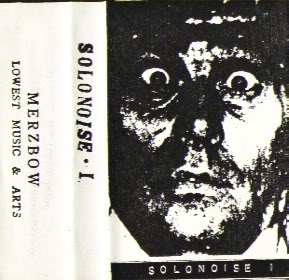
For those readers who might be unfamiliar with the music Novak describes, the book’s website has a fantastic collection of supplemental media for you to enjoy: http://www.japanoise.com/media/.
–
Seth Mulliken is a Ph.D. candidate in the Communication, Rhetoric, and Digital Media program at NC State. He does ethnographic research about the co-constitutive relationship between sound and race in public space. Concerned with ubiquitous forms of sonic control, he seeks to locate the variety of interactions, negotiations, and resistances through individual behavior, community, and technology that allow for a wide swath of racial identity productions. He is convinced ginger is an audible spice, but only above 15khz.
—
 REWIND! . . .If you liked this post, you may also dig:
Tofu, Steak, and a Smoke Alarm: The Food Network’s Chopped & the Sonic Art of Cooking–Seth Mulliken
SO! Reads: Jonathan Sterne’s MP3: The Meaning of a Format–Aaron Trammell
The Noise of SB 1070: or Do I Sound Illegal to You?–Jennifer Stoever-Ackerman
Share this:

Musical Encounters and Acts of Audiencing: Listening Cultures in the American Antebellum

 Editor’s Note: Sound Studies is often accused of being a presentist enterprise, too fascinated with digital technologies and altogether too wed to the history of sound recording. Sounding Out!‘s last forum of 2013, “Sound in the Nineteenth Century,” addresses this critique by showcasing the cutting edge work of three scholars whose diverse, interdisciplinary research is located soundly in the era just before the advent of sound recording: Mary Caton Lingold (Duke), Caitlin Marshall (Berkeley), and Daniel Cavicchi (Rhode Island School of Design). In examining nineteenth century America’s musical practices, listening habits, and auditory desires through SO!‘s digital platform, Lingold, Marshall, and Cavicchi perform the rare task of showcasing how history’s sonics had a striking resonance long past their contemporary vibrations while performing the power of the digital medium as a tool through which to, as Early Modern scholar Bruce R. Smith dubs it, “unair” past auditory phenomena –all the while sharing unique methodologies that neither rely on recording nor bemoan their lack. The series began with Mary Caton Lingold‘s exploration of the materialities of Solomon Northup’s fiddling as self-represented in 12 Years a Slave. Last week, Caitlin Marshall treated us to a fascinating new take on Harriet Beecher Stowe’s listening practice and dubious rhetorical remixing of black sonic resistance with white conceptions of revolutionary independence. Daniel Cavicchi closes out “Sound in the Nineteenth Century” and 2013 with an excellent meditation on listening as vibrant and shifting historical entity. Enjoy! —Jennifer Stoever-Ackerman, Editor-in-Chief
—
“To listen” is straightforward enough verb, signifying a kind of hearing that is directed or attentive. Add an “er” suffix, however, and “listen” moves into a whole new realm: it is no longer something one does, an attentive response to stimuli, but rather something one is, a sustained role or occupation, even an identity. Everybody listens from time to time, but only some people adopt the distinct social category of “listener.”
And yet listeners have emerged in diverse historical and social contexts. Arnold Hunt, in his recent book The Art of Hearing, for example, points to the congregants of the Church of England in the late sixteenth and early seventeenth centuries, whose sermon-gadding and intense repetitive listening to preachers became a form of popular culture. Shane White and Graham White, in The Sounds of Slavery, argue that early nineteenth-century black slaves adopted listening, or “acting soundly,” as a way of being that gave everyday sounds—conversation, cries of exertion, hymns—multiple layers of meaning and a power unknown to white overseers. Jonathan Sterne, in The Audible Past, describes the post-Civil War culture of sound telegraphy, in which young working class men trained themselves to employ “audile technique” for bureaucratic purposes, rendering their hearing objective, standardized, and networked.

Physical manifestations of the growing standardization of listening, Dodge’s Institute of Telegraphy, circa 1910 – Valparaiso, Indiana, Image by Flickr User Mr. Shook
We might add our own contemporary iPod era to these examples. We live in a time, after all, when it entirely acceptable to appear alone in public, ears connected to an iPod, head bobbing to the grooves of a vast archive of recorded music. Sampling, playlists, streaming–thanks to playback technologies, the U.S. has become a nation of obsessive listeners, and the power to “capture” a sound and re-hear it, something that began with the phonograph, remains a time-bending drama that can awaken people to their own aurality. Technologized listening, in fact, has spawned many of the icons of music discourse in the past 100 years: Edison’s tone testers in 1910s, record-collecting jitterbugs in the 1930s, audiophiles of the Hi-Fidelity era in the 1950s, Beatles fans with their bedroom record players in the 1960s, the “chair guy” in Memorex’s famous ad campaign of 1980, dancing listeners silhouetted in iPod posters since 2003.
But I think also that phonograph-centric narratives have obscured earlier, equally powerful cultures of listeners. The focus of my recent research, for example, has been the world of antebellum concert audiences. Between 1830 and 1860, the United States developed concentrated population centers filled with boosters and recent migrants eager to embrace a life based on new kinds of economic opportunity. Shaping much of the urban experience was a growing commercialization of culture that generated new and multiple means of musical performance, including parades, museum exhibitions, pleasure gardens, band performances, and concerts. Together, these performances significantly enhanced the act of listening: for people used to having to make music for themselves in order to hear it, a condition common to most Americans before 1830, access to public performances by others provided an opportunity for working and middle-class whites (women, African Americans, and the poor were another matter) to stop worrying about making music and, with the purchase of a ticket, to solely, and at length, assume an audience role.
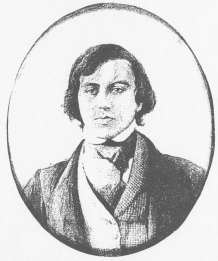
A young George Templeton Strong, Image from CUNY Baruch
The odd circumstance of purchasing the experience of listening provided class-striving urbanites with new possibilities for self-transformation. For many young, rural, white men, for example, arriving to the city for the first time to take clerking jobs in burgeoning merchant houses, being able to hear diverse performances of music was associated with a cosmopolitanism that brimmed with social possibility. Thus, for instance, Nathan Beekley, a young clerk, recently arrived in Philadelphia in 1849, found himself attending multiple performances of music several nights a week, including more and more appearances at the opera as a way to avoid “rowdies.” In New York City during the 1840s, George Templeton Strong, a young lawyer in Manhattan, derided his own musical abilities and instead attended every public musical event he could find, carefully chronicling his listening experiences and analyzing his reactions in a multi-volume journal. Walt Whitman, a young man on the make in Brooklyn and New York between 1838 and 1853, regularly attended every sound amusement he could, including the Bowery Theatre, dime museums, temperance lectures, political rallies, and opera, writing in Leaves of Grass, “I think I will do nothing for a long time but listen/And accrue what I hear into myself.”
This culture of listening was, in many ways, very much unlike ours. Despite an expanded access to performance, for instance, professional concerts before the mid-1850s were often understood as part of a wider ecology of sound. Very few listened to music in ways that we might expect today–focused on a “work,” in a concert hall, without distraction. Listening, in fact, was as much a matter of local happenstance as personal selection—a passing marching band, echoes of evening choir practice at a nearby church, an impromptu singing performance at a party. Such experiences were marked by the momentary thrill of spontaneity and discovery rather than the studied appreciation of familiarity; in any moment of hearing, it was difficult to know how long the encounter might be, or even what sounds, exactly, were being heard. Cities like Boston and New York were especially rich with such surprise encounters.
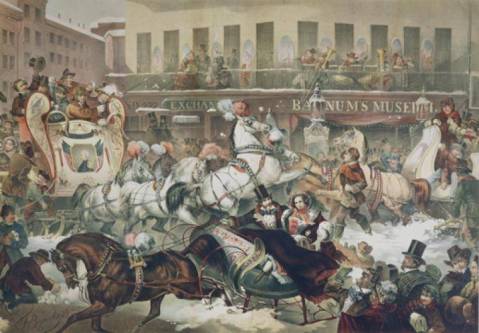
Thomas Benecke’s lithograph “Sleighing in New York” from 1855, which, among many other sounds, depicts musicians performing on the balcony of Barnum’s Museum on the corner of Broadway and Ann Street.
Francis Bennett, a young arrival to Boston in 1854, for example, encountered, in his first night in the city, a band concert and the “cries” from a “Negro meeting house,” and within weeks became enamored of fife and drum bands, often leaving work to follow one and then another as far as he dared. Young writer J. T. Trowbridge was more stationary but equally enthusiastic about what he heard from his New York rooming house in 1847: “The throngs of pedestrians mingled below, moving (marvelous to conceive) each to his or her ‘separate business and desire;’ the omnibuses and carriages rumbled and rattled past; while, over all, those strains of sonorous brass built their bridge of music, from the high café balcony to my still higher window ledge, spanning joy and woe, sin and sorrow, past and future….”
Music listeners were also often listeners of other forms of commercial sound, especially theater, oratory, and church services, which, together, comprised a complex sonic culture. This was especially reinforced by the physical spaces in which they shared such diverse aural experiences. In a rapidly-growing society, there often was not time or immediate resources to construct buildings dedicated to specific uses; instead, existing structures–typically a “hall” or “opera house”–served mixed uses.

Metropolitan Hall in New York City, where concert singer Elizabeth Taylor Greenfield debuted in 1853. It also hosted abolitionist meetings, talks on women’s rights, and various other activities.
As historian Jean Kilde noted in When Church Became Theater, evangelists in the Second Great Awakening often rented urban theaters for services; and congregations, in turn, rented churches to drama troupes, ventriloquists, and musicians to raise money. This “mixed-use” of buildings was reinforced by hearers, who often engaged in their own “mixed-use” understandings of what they heard. They evaluated sermons as they would a theatrical performance or found church choirs thrillingly entertaining rather than piously inspirational. Conversely, they listened to symphonic concerts with a religious solemnity.
This culture of antebellum, middle-class urban listeners didn’t last long, succumbing to the class sorting by post-Civil War social reformers, who mocked the indiscriminate over-exuberance of antebellum listeners as a kind of “mania” and a form of social disorder. As Lawrence Levine explains in Highbrow Lowbrow, over the course of the nineteenth century, developing a “musical ear” became increasingly paramount, reverence for great works of art shaped audience response, and listening became a specific skill to be learned. Music became something to appreciate not simply hear. By the 1890s, a true listener was someone who, in the words of critic Henry Edward Krehbiel (in his enormously popular How to Listen to Music, from 1897), “will bring his fancy into union with that of the composer” (51).

“Man With the Musical Ear.” Arthur’s Home Magazine (September 1853): 167.
In many ways, the controlled silent listening favored by reformers directly paved the way for music technologies, like the phonograph, that similarly sought to control and manipulate listening. But it was the urban music listeners of the 1840s and 1850s who were responsible, in the first place, for identifying and accentuating the joys and possibilities of “just listening.”
—
Featured Image: Etching of Jenny Lind Singing at Castle Garden in New York City, 1851
—
Daniel Cavicchi is Dean of Liberal Arts and Professor of History, Philosophy, and the Social Sciences at Rhode Island School of Design. He is author of Listening and Longing: Music Lovers in the Age of Barnum and Tramps Like Us: Music and Meaning Among Springsteen Fans, and co-editor of My Music: Explorations of Music in Daily Life. His public work has included Songs of Conscience, Sounds of Freedom, an inaugural exhibit for the Grammy Museum in Los Angeles; the curriculum accompanying Martin Scorcese’s The Blues film series; and other projects with the Public Broadcasting System and the National Park Service. He is currently the editor of the Music/Interview series from Wesleyan University Press and serves on the editorial boards of American Music and Participations: the Journal of Audience Research.
—
 REWIND! . . .If you liked this post, you may also dig:
“Como Now?: Marketing ‘Authentic’ Black Music,” –J. Stoever-Ackerman
Hearing the Tenor of the Vendler/Dove Conversation: Race, Listening, and the “Noise” of Texts –Christina Sharpe
How Svengali Lost His Jewish Accent––Gayle Wald
Share this:


Current Top Posts





April 2021

January 2020

November 2019

October 2019

August 2019

April 2014

November 2017

March 2015

December 2017

October 2015
 Sounding Out!
Recent Comments