
Blog-O-Versary #Flawless 5.0!

Click here to download our free Blog-O-Versary 5.0 Mix!
.
HAPPY 5th BLOG-O-VERSARY! Parabéns!
As I write this, I am sitting on the return flight from Portugal, where I spent an utterly transformational four days at the Invisible Places, Sounding Cities conference (deftly organized and elegantly curated by Raquel Castro), a sensory torrent that still has me buzzing. While there, I was thrilled, provoked, taken, shaken, intrigued, pleased, taught, energized, exhausted, re-energized, puzzled, lifted up. . .all of the things I hope a truly great meeting will do (and then some). What I wasn’t prepared for—and when going to a conference featuring sound artists and performers, I imagine myself ready for anything—was the flood of gratefulness and gratitude that I felt every time I had a conversation about Sounding Out!, every time all of our stickers disappeared off the registration table, every time I introduced myself and there were nods of recognition from people I had never met—people located thousands of miles from my home IP address—and every time my scouting attempts were met with enthusiasm that matched (and often rivaled) my own.
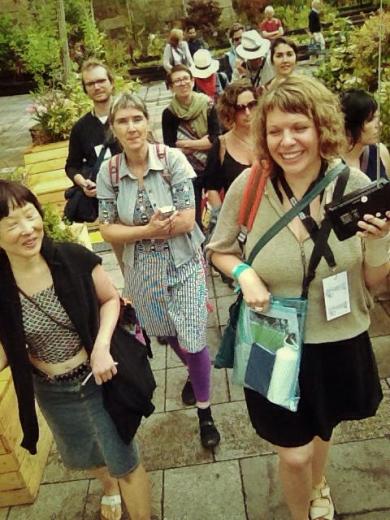
Multimedia artist, SO! Regular Writer, and Portugal resident Maile Colbert leading Invisible Places attendees on the Radio Terramoto soundwalk co-created with her partner Rui Costa (of Binaural/Nodar).
And, while I cannot deny that I my work on Sounding Out! has generated personal pride—speaking honestly, sometimes I go to soundstudiesblog.com just to LOOK at it—but the feeling I enjoyed in Viseu was different from “accomplishment.” I felt grateful for the support of our editors, writers, and podcasters—sharing the best of themselves, tirelessly and without compensation other than mad props and ‘nuff respect—for our readers, ever stretching across the globe, sharing, liking, and ReTweeting, until this endeavor became a networked community, and for our fans—Yes! We have received fan mail!—whose enthusiasm always seems to arrive at the right time, the Hail Mary eleventh hour when the editors are fighting sleep and/or needing another reason to allow Dora the Explorer to play a little longer to steal time to finish a piece. I also felt gratitude for the diverse and full-bodied sound studies community, particularly its rigorous but generous, inviting embrace, which extended to the fledgling Sounding Out! experiment five lightning-quick years ago.
In that time, I hope we have expressed our gratitude in return, by deepening and extending our mutual community, binding us in new and unexpected ways, showcasing our best and giving air to our challenges, and, most importantly, enabling us to greet each other as familiar colleagues—in Viseu, Berlin, Toronto, San Juan, Los Angeles, Copenhagen, New York, Sao Paolo. . .—even if we had never before met “In Real Life.” Know that as we continue to grow and renew the site that the function of community will always remain a prime directive of SO!. I welcome the responsibility we have collectively invested in Sounding Out!; it makes my decisions both more contemplative and surefooted. Thank you, everyone, for the last five years—lets raise a glass of Grão Vasco Dão Tinto toward many more together!
As we sip, let’s also partake in the annual SO! tradition of taking stock of the last action-packed year, with soundtrack supplied by another artist having a #flawless year, Ms. Beyoncé Knowles herself. . .
 “Irreplaceable” (Goodbye, Liana): I write this first update completely under protest. I know I am not supposed to admit to affective reactions, especially in cyberspace and especially as a woman with her feet in several male dominated fields, but when Liana Silva-Ford, our stalwart and smoothly bad-ass Managing Editor and Co-Founder, told me she was considering leaving SO!, my eyes welled up instantaneously. Okay, so she very straightforwardly told me she was leaving—even now I still have to sneak in the modifier “considering.” Liana was recently named Editor-in-Chief of the longstanding publication Women in Higher Education (now on Wiley-Blackwell)—read her first “Editor’s End Notes” here—and she is embarking on a book project on her not-so-secret passion, postcards. Liana has, rightly and deservedly, decided to bestow more of her time on these two *amazing ventures. Even though none of us has yet to successfully visualize SO! without her, we know this is right and we wish her all and only the best. Thank you, Liana for your steady hand but light touch, your sharp yet generous editorial eye, and the intelligence, professionalism, and enthusiasm you brought to every meeting, every challenge, and every writer. Working (and SO!-hiveminding) with you has been an exquisite pleasure. And thank you for letting me twist your arm into a permanent “Editor-at-Large” position (whew!).
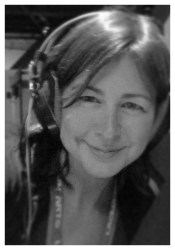 “Green Light” (Welcome Cara, Neil, Will): On the other hand, I am pleased to announce that the O.G. SO! triumvirate has happily expanded to a sextet. Media scholar Neil Verma (Visiting Assistant Professor in the Department of Radio/Television/Film at Northwestern University) our new ASA/SCMS Special Editor, came on board in late 2013, curating our new Thursday stream that launched in January 2014. Neil has already proved himself to be a skilled editor, an intuitive curator, and a natural at the brand of humor and enthusiastic tomfoolery we thrive on behind the scenes. We initiated our “L.A. Office” in December with the addition of William Stabile, our new Assistant Visual Editor, who is responsible for many of the mighty fine layouts that that you have seen this year. He is flexible, patient, and extremely gifted in the visual arts, with a wit dryer than Riverside, California this time of year. We value his work and presence immensely. And, drum roll please (especially with our crowd), we are pleased to announce right here today, that Cara Lynne Cardinale is our new Managing Editor, coming to us live from the East Bay in Northern California with a soaring collection of great ideas and her feet firmly planted on the ground of spreadsheets, calendars, and deadlines. Cara graduated in 2010 with her Ph.D. in English from the University of California, Riverside, with a brilliant dissertation that I am constantly telling my graduate students to seek out: “‘Through the Eyes’: Reading Deafened Gestures of Look-Listening in Twentieth Century Narratives.” A unanimous selection for her intensity, sharpness, and style-for-miles, Cara will undoubtedly turn this mother out!.
 “Upgrade U” (Thursday Stream!): You may have noticed that there has been twice the SO! to love in 2014, thanks to Neil Verma’s work on the Thursday stream, with his cadre of guest editors and an array of media-related subjects that has greatly expanded and deepened the site’s threshold. The year is only a little more than half-over and already we have been treated to forums on Cuban radio history (Tom McEnaney’s “Radio de Acción”), Lou Reed’s voice and sonic influence (NV’s “Start a Band”), and Justin Burton’s rumbling “The Wobble Continuum” of dubstep sounds and scholarship. Jump on the most current series of the stream, “Sculpting the Film Soundtrack” (guest edited by Katherine Spring), a collection of posts that re-frames the cinematic soundtrack to to be heard anew. The media stream + our monthly podcast series + SO!’s monthly pass-the-mic “Sound Off! // Comment Klatsch” = vibrant sounding Thursdays. We like this new math.
 “Check on It” (“SO! Amplifies”) b/w “Schoolin’ Life” (Book Reviews): Sounding Out!, by design, is not a clearing house for any-and-all sound-related events [however, you CAN get all that information by following us on Twitter, liking us on Facebook, and Tumbling with us too]. BUT, we realized this year that relationships are built and connections are made through support of one another’s work, and, more often than not, it takes more than 140 characters to properly accomplish this important task. So, in 2014, we launched two new ongoing series, “Sounding Out! Reads,” reviewing the latest monographs of interest to Sound Studies peeps, and a curatorial series called “SO! Amplifies” that enables selected makers, artists, authors, researchers, designers, and other creative/creating folks to introduce their work and tell SO! readers how/why it is important to them (and should be to us). In addition to amplifying the signal sent out by our featured works, we also hope to enable the production of new research, art, and other types of projects and connections through the introduction of these new tools, models, information, and archives. At the very least, we will be hipping your ears and eyes to some seriously cool new ish.
 “Satellites” b/w “Rocket” (War of the Worlds collabo extravaganza): Neil Verma came to the SO! team last summer in search of a site to host observations on the occasion of the 75th Anniversary of Orson Welles’ 1938 broadcast of War of the Worlds. Knowing the brilliance and exceptional quality of Neil’s work—please buy and devour his 2012 Theater of the Mind (University of Chicago Press, SCMS First Book Award Winner) ASAP—I automatically said an enthusiastic “YES.” BOOM. Just like that, an international multimedia fandango was born. On the ground, or since we are talking radio, terrestrially, #WOTW75 sounded like a three-hour radio broadcast on Binghamton University’s WHRW 90.5 with 2 hours of original content produced by Team SO! (one of them live!) bookending a re-broadcast of Welles’ original at the precise date and time of its debut, 8:00 PM EST, October 30th [1.5 hours are available via our podcast series: EPISODE XXII: Remixing War of the Worlds presents an original creative sound composition by Monteith McCollum and his Performative Processes class at Binghamton University that re-imagined act three of WOTW and EPISODE XXIII: War of the Worlds Revisited, the new 60-minute audio documentary featuring interviews with top media scholars engineered by our very own Multimedia editor Aaron Trammell]. BUT, out in the aether and Twittersphere, #WOTW75 looked like so much more: simultaneous listening parties dotting the globe—a special shout out to Jake Smith’s event at Northwestern U in Chicago—a months-long supergroup collabo between the
  Sounding Out! crüe and the University of Wisconsin-Madison’s Antenna—mad props to Andrew Bottomley—a real-time Twitter conversation using the hashtag #WOTW75 that sparked myriad reactions from excitement to snark—NV has curated the best of these for the upcoming sound special issue of Velvet Light Trap—academic panels, radio interviews, podcasts—thank you Aca-Media!—TV interviews, live dramatic radio performances—you rock, Charles Berman and the WHRW drama dept—a live collaging project put on by Toronto’s Collage Collective at the Textile Museum of Canada, martian-themed cupcakes, commemorative T- shirts by artisanal screen printers Muckles Ink, a theme-song (!!) written and performed by Binghamton’s finest ambient surf-noise band The Short Waves, and, we dearly hope, renewed excitement for the experience of “liveness” in the twenty-first century, an experience greatly changed since 1938, but no less vital in importance and thrilling in affect.
- “Run the World” (Citations, Reposts, and Writer Updates): It has been a great year for our writers, who have found their work cited and re-blogged in many venues including The Society Pages, The Feminist Wire, Twentieth Century Music, The New Inquiry’s Sunday Reading, Radio Survivor, Repeating Islands, Past and Present, About Place Journal’s 1963-2013 Civil Rights Retrospective, and American History Now [for the full bibliographic details see our SO! Media page].
We also congratulate our writers on their recent news and updates!
- Kaj Ahlsved is working hard on his PhD dissertation “Music and sport: soundscape, identity, context and function.” He published his first article in the 2013 Yearbook for the Finnish society for Ethnomusicology. His second article, “Let’s Play Hockey,” is currently under peer review. He is also part of a research project called Kiekkokansa that will publish a book on Finnish ice hockey culture in April 2015. For this project he and a few other researchers had the opportunity to do ethnography in Minsk during the 2014 World Ice Hockey Championships.
- Regina Bradley released her video dialogue series called Outkasted Conversations. She has a chapter titled “Kanye West’s Sonic [Hip Hop] Cosmopolitanism” in the collection The Cultural Impact of Kanye West. She also has an article forthcoming on Edward P. Jones’ The Known World and the Hip Hop Imagination in Southern Literary Journal.
- Dolores Inés Casillas was promoted to Associate Professor with tenure at the University of California at Santa Barbara.
- Kariann Goldschmitt will be a Visiting Lecturer in the Faculty of Music at the University of Cambridge this upcoming October. Her essay on mobile tactics in the Brazilian independent music industry has been published in The Oxford Handbook of Mobile Music Studies, Volume 1.
- Carter Mathes saw the release of his new book this year, titled Imagine the Sound: Experimental African American Literature after Civil Rights.
- Jonathan Sterne is co-organizing, with Nick Mirzoeff and Tamar Tembeck, the first-ever sound studies-meets-visual culture studies conference. Called Sound, Vision, Action, it puts scholars and artists in dialogue across sonic and visual traditions. They are especially interested in how each field addresses questions of power. The lineup is still being confirmed, but it will be hosted by Media@McGill in Montreal, 14-15 November 2014. Sterne is teaching a graduate seminar in conjunction with the conference in the Fall. More details will be available at http://media.mcgill.ca.
- Jennifer Stoever was promoted to Associate Professor with tenure at the State University of New York, Binghamton where she was also awarded a 2014 Chancellor’s Award in Teaching.
 And now. . .because this is how we do year after year, roll up your rug or roll down your partition, please, it is time to celebrate our #flawless 5.0 blog-o-versary, ‘Yonce-style. –JS, Editor-in-Chief
—
Jennifer Stoever is co-founder and Editor-in-Chief of Sounding Out! She is also Associate Professor of English at Binghamton University.
—
Click here for Sounding Out!‘s Blog-O-Versary #Flawless 5.0 mix with track listing
(Just in case you missed last year’s 4.0 celebration and mix click here; 3.0 click here; for year two, click here; and for our first Blog-O-Versary party mix click here)
—
Share this:

Fear of a Black (In The) Suburb

 Editor’s Note: This month Sounding Out! is thrilled to bring you a collection of posts that will change the way you hear cities. The Sounds of the City series will prompt readers to think through ideas about urban space and sound. Are cities as noisy as we think they are? Why are cities described as “loud”? Who makes these decisions about nomenclature and why?
We kicked things off two weeks ago with my critical reading of sound in Lorraine Hansberry’s A Raisin in the Sun, a play about African Americans in Chicago that still rings/stings true today. Guest writer Linda O’ Keeffe took readers last week on a soundwalk of Smithfield Square in Dublin, Ireland and specifically of the Smithfield Horse Fair, in order to illustrate how urban renewal disrupts city soundscapes and how sound reclaims those spaces. Next week CFP winner Lilian Radovac will share with us a photoessay on the sound installation Megaphóne in Montreal.
Today’s post comes from regular writer Regina Bradley whose post reminds us of the recent verdict of the Michael Dunn case, the “loud music case” when he shot 17-year-old Jordan Davis at a gas station. She discusses the dichotomy of urban and suburban in the context of sound (noisy versus quiet) and hip hop.
Edited on Feb 17, 2014 at 9:35 am EST: the first published version of this post did not acknowledge Nina Sun Eidsheim as the coiner of the phrase “sonic blackness.” We have added a reference in the post to recognize the work Eidsheim has done in theorizing this concept.–Managing Editor Liana M. Silva-Ford
***
In a recent Chase credit card commercial a white woman pulls up to a gas station and pumps gas into her minivan while blasting loud music. Her windows rattle and the toys of her children vibrate to the beat. After pumping gas, the woman hops into her car, puts on a pair of shades, and bounces to the beat like a “cool mom.” In the context of the commercial, the white suburban mother is not threatening. The commercial reminds me that Jordan Davis’ life ended at a gas station in Jacksonville, Florida. His loud hip hop music was not cool; in fact, he and the music are perceived to be threatening.
The woman in the Chase commercial borrows what is instantly recognizable as sonic black (masculine) cool. Nina Sun Eidsheim, in her article “Marian Anderson and ‘Sonic Blackness’ in American Opera”, theorizes sonic blackness as the racialization of sounds that listeners perceive to be coming from a black body. Borrowing from her concept, I extend sonic blackness as the sound that are perceived as black that enter spaces where physical blackness could be readily refused. Of particular interest for this essay is the connection between black mobility, urban space, and sound. I focus particularly on hip hop as a mobile form of sonic blackness whose origins are based in the city. Hip hop reinforces conceptualizations of contemporary blackness as urban. In this context, sonic blackness collapses the absolute binaries in which blacks are frequently forced to exist, i.e. urban and rural, working class and middle class, silence and noise. Yet when it is situated in hip hop, sonic blackness can also be considered a disruption of suburbia, a dominant trope of white privilege at the end of the 20th century. Using examples from the contemporary cartoon show The Boondocks, I posit that the show’s use of hip hop underscores how the white suburban soundscape is constructed in contrast to black urban sounds.

Screen Shot Leave It to Beaver ending credits
America’s popular imagination portrays the suburbs as white, middle class, and quiet. Constructions of the suburbs in recent history have not strayed far from the idealistic neighborhoods of the 1950s and 1960s portrayed in shows like Leave It to Beaver. Take for example the inclusion of gated communities as the upper echelon of suburbs and white privilege seen in The Real Housewives of Orange County (which opens with the viewer ‘walking through’ opened gates into the Orange County community). I’d like to emphasize the connection between whiteness and quiet, as privilege in these types of spaces is present but often not visible or audible. Suburbs are the result of urban industrialism, anxiety of close association with an increasing minority community, and the need to sustain a romantic ideal of the American dream. A suburb’s physical parameter is a middle-class manifestation of manicured lawns, gates, and homeowner associations. At the level of sound, the suburbs’ class privilege is represented as the hum of lawn mowers, chirping birds, and screeching breaks of school buses. As Steve Macek points out in Urban Nightmares: The Media, The Right, And The Moral Panic Over The City, suburban sensibilities cling to an idealistic notion of a physically and sonically constructed white ambivalence to racial and class anxieties associated with cities. Any dysfunction associated with whiteness is quietly tucked away from public view.
White suburbia sustains its desirability because it is a physically and sonically segregated space. Yet white suburbia is also the site of black Americans’ most recent migratory efforts. In ways that northern cities signified opportunity for blacks in the early 20th century, the ideals of racial progress and class in the late 20th century have shifted to U.S. suburbs. Thoughts of the middle class in the black imagination amplify the suburb as a utopic space because of its initial lack of access. The suburb becomes the mountaintop of racial access and privilege.

“A Raisin in the Sun 1959 2” in the public domain via Wikimedia Commons
Consider the premise for Lorraine Hansberry’s 1959 play A Raisin in the Sun. Hansberry examines in the play the high stakes of home ownership in a ‘good neighborhood.’ The Lee family leaves the Southside for the opportunity at a better life and more space for their growing family. As Liana Silva-Ford pointed in her discussion of A Raisin in the Sun two weeks ago, the Lee family’s decision to move into the Clybourn Park neighborhood disrupts the suburb as a space of white privilege and annotates the cusp of the emerging Civil Rights Movement. Additionally, visual demonstrations of black protest that reach suburban areas are annotated by sonic markers of struggle i.e. the sound of attacking guard dogs, police officers screaming at protestors, spraying fire hoses, and screams and moans of black bodies under attack. The audio-visual representation of the struggle of integration collapses the notions of white suburbia as a site of ‘perfect peace.’ The above referenced sonic markers also destabilize classifications of black trauma as restricted to urban spaces like the inner city, which is believed to embody blacks’ realities.

“Damen – Boondocks” by Flickr user Ian Freimuth, CC BY-NC-ND 2.0
Where Hansberry’s interrogation of space and access in Raisin in the Sun is an initial foray into constructions of white privilege vis-à-vis suburban communities, Aaron McGruder’s 21st century suburban space of The Boondocks pivots on the romanticized ideas of blacks in middle class spaces derived from the 1950s and 1960s. The show introduces viewers to patriarch Robert (Grandad Freeman) and his two grandsons, Huey and Riley Freeman, who have left the south side of Chicago for the white suburb of Woodcrest. McGruder incorporates sonic markers of race and class that collapse suburbs as white only spaces. Aside from lighthearted lounge music style piano riffs during dialogues that indicate whiteness, McGruder incorporates sonic elements of hip hop that interrupt white suburbia. Elements of sonic registers of hip hop, like heavy bass kicks and songs like “Booty Butt Cheeks” or “Thuggin’ Love,” disrupt the quiet of the Woodcrest community.
The clash of hip hop’s loudness with Woodcrest’s quiet demeanor is best demonstrated in the episodes “The Story of Thugnificent” and “The Block is Hot.” In “The Story of Thugnificent,” rapper Thugnificent decides to move to Woodcrest. His presence is heard before it is seen, a caravan of cars with bass systems playing “Booty Butt Cheeks” before he actually appears on screen. Thugnificent’s arrival is striking as he introduces hip hop as a literal and sonically disruptive element of black working class cultural expression. The disruption is celebrated, however, because of Thugnificent’s allure as a rapper. He gets a pass that Grandad Freeman questions because he sees Thugnificient as a threat to what he perceives to be as a delicate existence of his blackness in a white community.
Grandad Freeman’s vehement opposition to embrace “the homie” Thugnificent destabilizes notions of policing as a one-sided scare tactic by whites. Yet to repel Thugnificent’s physical and sonic presence, Grandad resorts to hip hop and records a diss record that demands Thugnificent to leave Woodcrest. The diss record parodies the sonic notes of a rap battle: Grandad starts the track with ramblings of “yeah” and “uh.” Where these terms are used in a rap battle to try to “catch the beat,” Grandad’s use of these words is an offset attempt to try to find something to say. The result of Grandad and Thugnificent’s rap battle on wax is a rise in physical violence against senior citizens in Woodcrest. The awkwardness of Grandad’s diss track parallels not only a generational dismissal of hip hop as an outlet of protest but the sonic awkwardness of hip hop being the voice of protest for a suburban space.

“Fight the Power” single cover, by fair use under US copyright law
In the episode “Block is Hot,” a nod to rapper Lil Wayne’s same titled track (although he nor the song are mentioned anywhere in the show), Huey Freeman blasts rap group Public Enemy’s pro-black and anti-police brutality anthem “Fight the Power” to remind his neighborhood he is a black nationalist. He is also dressed in a black hoodie and black timberland boots. Huey is undeniably hip hop in a privileged white space. Huey’s physical apparel, a nod to the Black Panther party and the hip hop fashion affinity for wearing the color black is amplified by “Fight the Power.” Huey’s posturing can also be read as a homage to Radio Raheem from Spike Lee’s 1989 film Do the Right Thing because like Radio Raheem, Huey lugs around a large boombox to play “Fight the Power.” Particularly striking is the overlap of the urban hip hop masculinity Raheem signifies with Huey’s own hip hop posturing in Woodcrest. While Raheem remains in the ‘hood, Huey doubly signifies hip hop’s migration from the city into suburban areas as well as his own migration to Woodcrest from Chicago. Huey uses hip hop as a site of social-political resistance and as a way to remain attached to his urban roots. Blasting “Fight the Power” shows how Huey remains conscious of white privilege in Woodcrest. He recognizes the need to identify black agency – even if it is only emphasized through sound – while reflecting on the “new” suburb as a racially ambiguous space.
The most jarring use of sound to reflect on the racial politics of the new suburb is the shooting of Uncle Ruckus by police officers. The ricochet of the bullets can be heard against cars and other inanimate objects but the bullets miss their target, Ruckus. The gun shots mark an interruption of the suburban soundscape. Gun shots, sonic signifiers of power, death, and trauma, are also markers of black violence as an urban phenomenon. However, negotiations of power shift to speak to reclamation of white privilege in sonic and physical spaces . The gun shots inflicted upon black bodies in suburban spaces could also be read as a subversion of gun shots heard in hip hop. While the sound of a firing gun in the hip hop imagination is expected and acceptable, gun shots in white suburbia are disruptive and displaced because they contest its appearance as a quiet and respectable space. Further, the sonic significance of the bullets riddling everything around Ruckus is the messiness of the hit-or-miss surveillance of black bodies, particularly black men, as necessary in privileged white spaces.

“Jacksonville Florida Sheriff’s Office Impala” by Flickr user Dfirecop, CC BY-NC-ND 2.0
The policing of black bodies in suburban spaces, especially over the past two years, begs the question of how suburban soundscapes serve as backdrops of 21st century racial anxieties and whiteness. The centrality of sound in the deaths of Trayvon Martin, Renisha McBride, Jordan Davis, and Jonathan Ferrell,– i.e. 911 tapes and banging on house doors – is critical in identifying race and space. Sonic markers of racial anxiety in their deaths devastatingly reemphasize the connection of race and sound in white privilege spaces. For example, Davis’ killer Michael Dunn stated to his girlfriend that he “hate[d] that thug music.” Unlike the suburban mom in the Chase commercial, Dunn is threatened by the sonic blackness and hypermasculinity associated with loud [hip hop] music. The negative connotations of hip hop as “thug music” and Davis’ mere presence as a young black man trigger a devastating response to the disruption of white privileged space.
As I work through my visceral response to Michael Dunn’s not guilty verdict for the actual slaughter of Jordan Davis, I think about the frivolity of the suburban mom in the Chase commercial and her enjoyment of loud music. The overlap of her whiteness, gender, and status as a suburbanite protect her from any inclinations of being a menace. She uses loud music as a sense of liberation – a premise for the Chase Freedom card being promoted in the commercial. Unlike Chase’s suburban mom, Jordan Davis’ use of loud music is not freeing – it contextualizes him in a rigid space of hypermasculinity and pathology that is all too often associated with hip hop culture. As I discuss previously, the traumas associated with black bodies that cannot be literally articulated take place in nonliteral spaces like sound. Utilizing sound is particularly useful in situating blackness in privileged white spaces like suburbs that displace their agency and significance because of racial anxieties associated with space and class.
—
Regina Bradley recently completed her PhD at Florida State University in African American Literature. Her dissertation is titled “Race to Post: White Hegemonic Capitalism and Black Empowerment in 21st Century Black Popular Culture and Literature.” She is a regular writer for Sounding Out!
—
Featured image: “Dead End in the Burbs” by Flickr user Vox Efx, CC BY 2.0
—
 REWIND!…If you liked this post, you may also dig:
“Death Wish Mixtape: Sounding Trayvon Martin’s Death”-Regina Bradley
“From Illegitimate to Illmatic: On Tiger Mothers, Ethnoburbs, and Playing the Violin While Dreaming of Nas”-Christie Zwahlen
“Sound Off! // Comment Klatsch #7: #RachelJeantel asks: Are you Listening?”
Share this:


Current Top Posts





April 2021

January 2020

November 2019

October 2019

August 2019

April 2014

November 2017

March 2015

December 2017

October 2015
 Sounding Out!
Recent Comments