
SO! Reads: Zeynep Bulut’s Building a Voice: Sound, Surface, Skin

.

Voice and sound theorist Zeynep Bulut’s Building a Voice: Sound, Surface, Skin (Goldsmiths Press, 2025) is a remarkable work that reconfigures the ways we define “voice.” The text is organized into three sections—Part 1: Plastic (Emergence of Voice as Skin), Part 2: Electric (Embodiment of Voice as Skin), and Part 3: Haptic (Mediation of Voice as Skin)—each articulating Bulut’s exploration of the simultaneously personal and collaborative ways voice evolves among various sonic entities and environments. Through analyses of several artistic works that experiment with sound, Bulut successfully highlights the social effects of these pieces and how they alter our expectations of what it means to communicate and be understood.
It’s easy to reduce one’s understanding of voice to the purely spoken, the dialogic, the linguistically communicative, but Bulut’s conception of voice reaches beyond these forms. In her introduction, she states that she represents voice as something that “…evolves, through varied sounds, senses, bodies and technologies. In other words… distributed forms and instances of voice, which underlie the making of a voice, instead of giving a voice to something or someone, or being given a voice” (1). Whereas it may be easy to consider voice as something insular and complete, Bulut argues that it is in fact highly contestable, and shifts based on various environmental/social circumstances—this she aptly labels the “plasticity of voice.” Since Bulut envisions voice as something malleable, this unearths its responsive potentials, and eventually leads us to the image that Bulut will repeatedly return to over the course of the text—”voice as skin.”

Initially, “voice as skin” may seem perplexing, as these two elements appear in direct contrast to each other. However, I believe that the blending of these assumedly divergent facets is what makes Bulut’s work and scholarship so strong. None of her arguments complacently subsiston the known, the expected, and so when she presents voice as skin, it makes sense that she has formed this concept in order to continue extending her readers’ understandings of how we embody and experience sound.
Voice as skin is meant to illuminate the responses and sonic productions that often go unnoticed. It is a dynamic presence that defies static restrictions desperate to make it only one thing. It is “…imagining voice as a multisensory interface, a tactile and haptic affect across bodies of all kinds, without being limited to the human body, to human audition or the labels of verbal language” (234). As you proceed with Bulut’s argument, voice as skin repeatedly arises in different, somewhat surprising iterations throughout the chapters, continuously reframing the ways one may consider the experiential potentials and qualities of sound. “Voice is already a plural phenomenon” (218) Bulut states, “Each one of us carries another’s voice” (218). Everyone is in possession of their own sonic productions, but because we exist within a shared sonic landscape—Bulut regards this through Bruce Odland’s concept of the “sonic commons”—we have to become more sensitive resonant sources for the sounds that are directed at and emerge from this voice as skin.
Bulut makes it clear that there is a consequence to sound. Even when an individual is not engaged in dialogue or aurally responding to some other sonic stimuli, there is a voicing—a reaction, a sensing, a renegotiation of the body within the shifting soundscape—that occurs. Bulut analyzes a myriad of experimental sound artworks throughout Building a Voice, but her analysis of Pauline Oliveros’s Environmental Dialogue is where she really drives home the various ways in which one may “respond” to sound: “You listen to the sound attentively, and may respond to it or not… Regardless of a vocal or instrumental articulation of a pitch, therewould be a mental reinforcement in the process” (68). In later chapters, specifically those in Part 3 that discuss gesture as voice and biosensing musical interfaces, Bulut states that “Bodies constantly talk” (173)—that is, they inherently articulate something that either represents themselves or a reaction to another sonic production.
What Bulut’s readers receive throughout Building a Voice is a work of scholarship that strives against the possibility of sonic apathy. Even while attempting to not respond to a sound or pitch, one still notes—pun intended—the impact of these sonic productions on themselves and the space around them. Not saying anything is still a statement, Bulut reveals. It still “voices.”
Bulut’s diversification of voicing is astounding to read, but what I admire most about Building a Voice is that it underscores the importance of hearing. When Bulut discusses the ways we do or do not listen, I believe her scholarship becomes especially timely. In Part 2, Chapter 6: “Sharing a Skin,” Bulut describes the limits of empathy when it comes to fully hearing another individual: “We hear one another through our own wounds and then only partially” (134). She doesn’t make this claim to invalidate others’ efforts to show empathy. In fact, I think there is significant care contained in this specific argument. Rather than believe one is innately endowed with the skills to hear someone, or assume someone has the ability to fully hear us, Bulut encourages her readers to approach these experiences with humility:
We may be frustrated with the fact that no one truly understands or hears us, or that someone imagines that they understand us when they don’t. There is no full translation or hearing of anything. We can only connect in parts. We can only be a sounding board that both echoes and diffracts (134).

We are living in a time where several historically vulnerable communities face daily antagonization at home and abroad. Simply opening social media will present you with multiple posts pleading for allies to speak out for those facing ridicule, abuse, and even annihilation. For individuals who elect to answer those calls—who feel compelled to take on the profound commitment of assuming a “voice” for these communities—Bulut’s book provides some necessary food for thought. If we cannot fully hear nor understand those we wish to advocate for or protect, how might we renegotiate our current styles of activism away from the idea of “giving voice” (or, for that matter, considering anyone to be “voiceless”)? How might we honor the differences between individuals without viewing this as a move toward disconnection, an acceptance of inaction?
Building a Voice is an exciting text because it presents one with so many beautiful examples of experimental sound art, but I believe it becomes asocially integral work when Bulut indicates why revolutionizing the way we execute our methods of hearing and voicing is so important. By this, she doesn’t just illustrate the ways in which one builds a voice, she also reveals how one builds a kind of sonic and social consciousness. To read Building a Voice is to have one’s understanding of their own and the world’s resonant capabilities irreversibly transformed. This is writing about sound on another frequency—it’s time to tune in.
—
Featured Image: “Plantar Aspect,” by Pekka Nikrus, CC BY-NC-SA 2.0
—
Enikő Deptuch Vághy is a poet, artist, and editor. She is currently a PhD candidate in the Program for Writers at the University of Illinois at Chicago. Additionally, she is the Founding EIC of the literary and arts journal Lover’s Eye Press.
—

REWIND! . . .If you liked this post, you may also dig:
SO! Reads: Steph Ceraso’s Sounding Composition: Multimodal Pedagogies for Embodied Listening–Airek Beauchamp
Deep Listening as Philogynoir: Playlists, Black Girl Idiom, and Love–Shakira Holt
Listening to and through “Need”: Sound Studies and Civic Engagement–Christie Zwahlen
“Listening to the Border: ‘”2487″: Giving Voice in Diaspora’ and the Sound Art of Luz María Sánchez”-D. Ines Casillas
Share this:

Deejaying her Listening: Learning through Life Stories of Human Rights Violations

 **Co-authored by Emmanuelle Sonntag and Bronwen Low
Are you listening?
Because sound specialist Julian Treasure argues, “We are losing our listening” due to the invention of multiple methods of recording and with the world being “so noisy . . . with this cacophony going on visually and auditorily, it’s just hard to listen, it’s tiring to listen.” In response, Treasure claims that we need to improve our conscious listening skills; he suggests teaching the skill of listening in school.
As co-directors of the “Education and Life Stories” working group of a large oral history project, we have been thinking a good deal about listening and pedagogy. The project is entitled “Life Stories of Montrealers Displaced by War, Genocide, and other Human Rights Violations,” shortened here as “Montreal Life Stories project.” From 2007 to 2012, a team of university and community-based researchers in the frame of the Canadian Community-University Research Alliances (CURA) Program recorded life story interviews with approximately 500 Montrealers who experienced mass violence and displacement. Members of the survivor communities (Tutsi, Haitian, Cambodian, and Holocaust) were key partners in both the research and the diffusion of the project, fundamentally shaping the project’s philosophy, activities and outcomes.
One of the Education Working Group’s principle accomplishments was developing an educational package called We Are Here, containing five Learning and Evaluation Situations (LES), the curricular units in the Quebec Education Program. The units are designed for “cycle two” secondary school, where the students are generally 14 to 16 years old. As of yet, these have not yet been piloted, but we plan to do so.
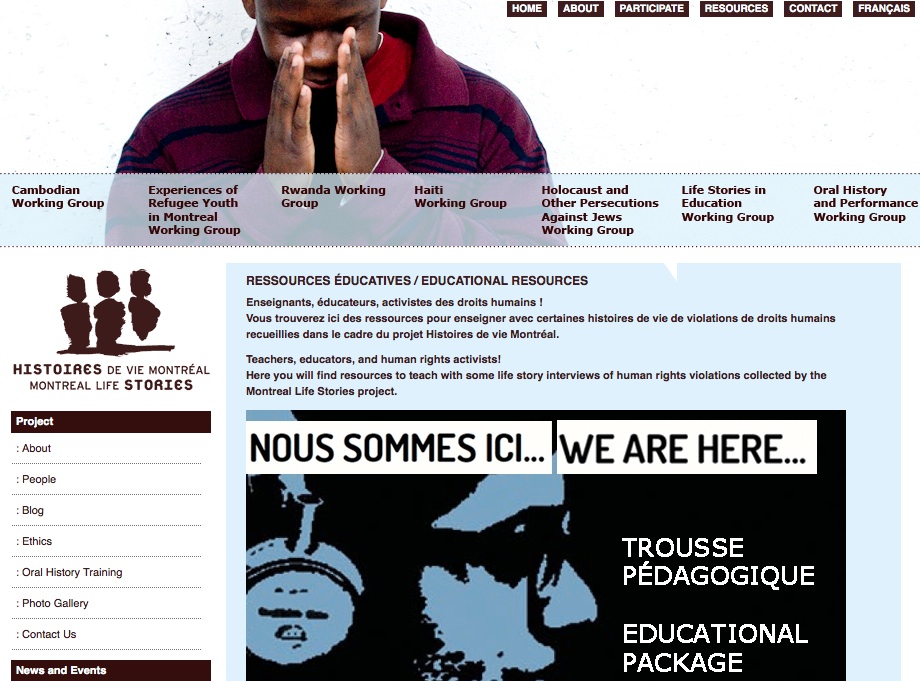 Our goal while designing “We Are Here” was to have teachers and students engage with the life stories of human rights violations, in order to foster a more inclusive cultural memory that would develop “le vivre-ensemble,” our capacity to live well together. Featuring the stories of immigrants and refugees to the province, the curriculum offers students a more complex understanding of human rights violations. First-person accounts bring world history and politics to life, helping us to understand the processes and human costs of violence and war, and expand our awareness of our fellow residents and citizens. At the same time, we recognized that the difficult stories of human rights violations make particular demands upon their listeners. We needed to consider how to ethically support students and teachers in engaging with the stories of people who have survived traumatic experience—while, importantly, respecting the interviewees themselves.
We sensed from the beginning that these goals and commitments would require us to develop our own “pedagogy of listening” to support teaching and learning from the life stories, and we foregrounded listening in all of the materials. For instance, each unit begins with the students listening to one or more project interviews, in the form of digital stories edited collaboratively by the interviewees and the editor. These digital stories tend to be under 10 minutes and bring together video, images, sound, and text (see for example, Bracha Rosenblum’s digital story). They are much more accessible than the original video interviews, which can be many hours long.
There is an irony in building a case for listening in schools. Students are commanded daily to “be quiet and listen to the teacher.” Despite the long history in educational theory of critiquing this model, the student-who-listens-in-silence versus the teacher-who-speaks-loudly is still regularly invoked in practice as an ideal relation. The demand for silence is in part a pragmatic response to the inherent noisiness of schools filled with people. At the same time, the listening imperative is also a key tool in the establishment of teacher authority and power.
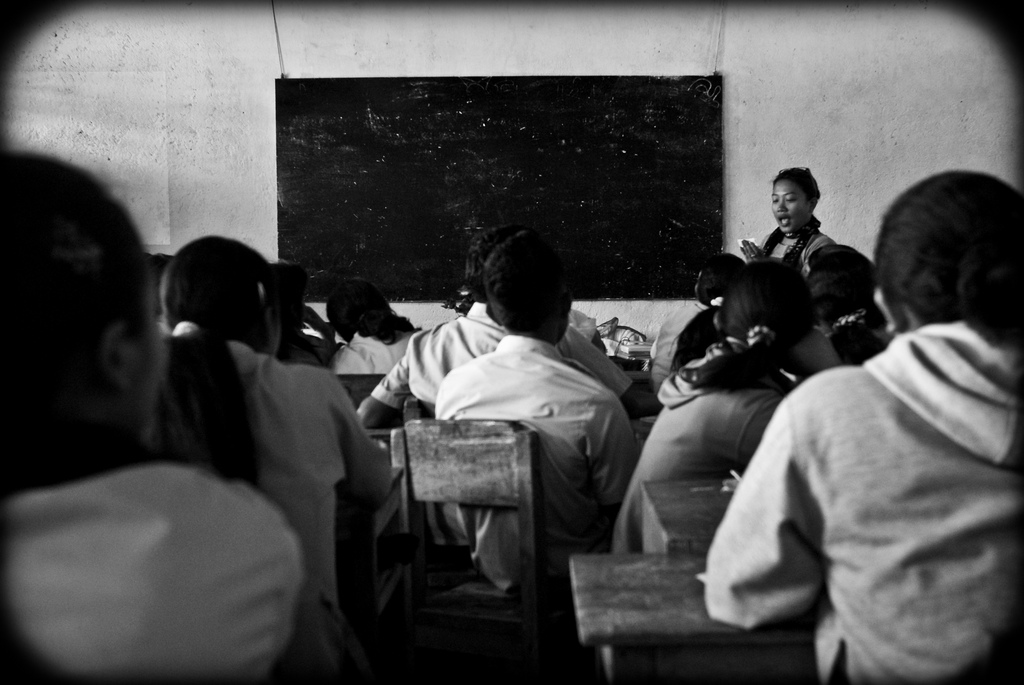
Image by Flickr User I Am Rudy
We wanted to rethink the process of listening in our curricular design beyond these traditional power dynamics. Our pedagogy of listening draws on concepts of testimony, communities of memory, dialogue, and the principle of shared authority in oral history, which we describe in detail elsewhere (forthcoming in the Journal of Curriculum Studies). In this blog post, we explore our pedagogy’s indebtedness to philosopher and musicologist Peter Szendy’s work on listening and its potential in the public school classroom.
Listening begins with the desire to be signed and addressed
The address is a central notion in Peter Szendy’s Listen: A History of Our Ears. The early 2000s, as Szendy explains, saw the birth of the peer-to-peer file sharing service Napster (created by Shawn Fanning in 1999), where listeners exchanged and circulated music. Through the lens of file sharing, Szendy began reflecting on the rights of listeners and the nature of musical listening more generally. He argues that sharing shapes the listening act: while listening can be passive–I am listening to you, receiving what you are saying–we also offer up what we are listening to. Rather than envisioning listening as a two-way engagement, Szendy triangulates it, structuring listening around a listening subject, the sonorous object the subject is listening to, and the addressee (le destinataire) of the subject’s listening. In Szendy’s theory of address, as we listen to somebody or something, we also address our listening to an “other” (who might be another beside me, or in myself).
That students would address and engage with “an other” through their listening appeased, in part, our concerns about having students listen to difficult stories of mass violence. If listening is akin to a peer-to-peer sharing system, students were somehow not “alone” anymore in the experience; listening is a building of relation.
Closely related to the concept of listening as address is Szendy’s idea of signature, especially through the digitalization of sound where “listeners become authors” (136) naming, tagging, and classifying the files that they share with others. Szendy describes this process in terms of the singularity of listening:
It is more simply as a listener that I want to sign my listening: I would like to point out, to identify, and to share such-and-such sonorous event that no one besides me, I am certain of it, has ever heard as I have (3).
While all listening necessarily involves an appropriation of what has been listened to, we wanted to amplify the process of students “signing” or marking their listening, and so making it their own. We would deepen students’ engagement with the video interview and the “other” by having them actively edit, rework, even remix, and so adapt the original. We gave students the right to enter into the difficult stories from the survivors interviewed in the Montreal Life Stories project, responding as individuals and as members of a classroom community. While the dynamic of students listening to and making something in response to the life stories takes many forms in our curricular units (including timelines, maps, and audio-tours), we here share the unit which most explicitly embodies the remixing in Szendy’s notion of listening.
What a Story!
What a story!: Life stories and digital storytelling, is designed for senior students in the English Language Arts, and asks students to work in groups to create their own digital story version of a segment from one of the life story interviews.
In the preparation phase, the students listen to a 5 minute digital story of a Holocaust survivor living in Montreal that enables them to discover the multimedia elements and narrative structure of a digital story.
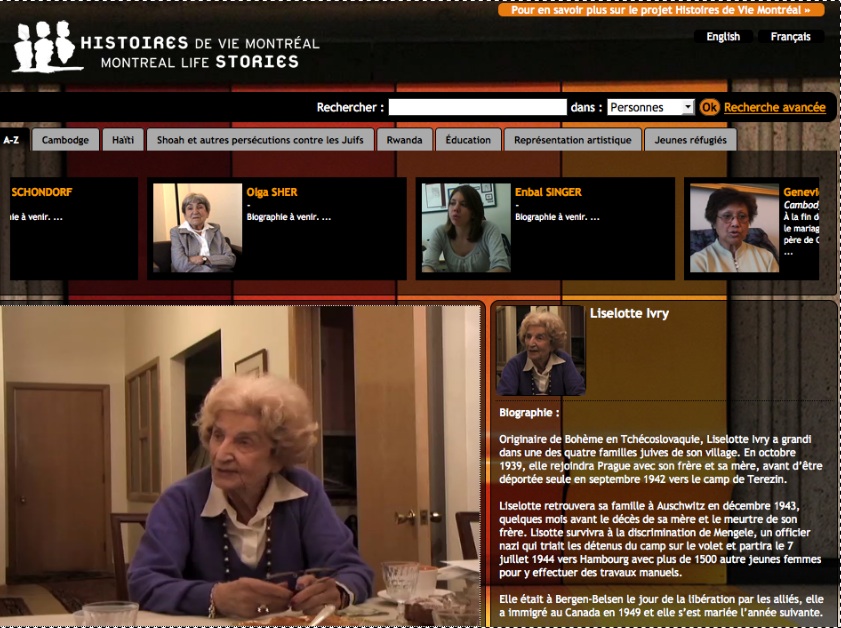
In the production phase, students approach their main task: producing a 5 minute digital story from a 34 minute life story interview with another Holocaust survivor. The phase begins with “deep listening” exercises where students work in groups to summarize the story and decide which parts of the larger interview they would like to keep in their edited versions. In doing this, they reflect on their experience as “listener“ vs. ”reader” and their responsibilities as listeners of difficult stories.
While the expression “deep listening” recalls the work of the composer Pauline Oliveros, in the Montreal Life Stories project the concept stems more directly from the notion of “shared authority,” a phrase coined by oral historian Michael Frisch (1990) to describe the process of co-creating an interview. The community-university model was collaborative at all levels, and researchers and the researched were partners in dialogue. In turn, we frequently used “deep listening” (as in the profound listening between interviewers and interviewees) as an expression during our working sessions. The concept also draws on the work of oral historian Martha Norkunas on interview techniques and deep listening exercices; her visit to the project shaped our curriculum design process, and students are encouraged to engage in dialogue and sharing, and to “Listen with close attention and deeply, in an empathetic and respectful manner.“(13). These appeared, to our eyes, to be consistent with Szendy’s notion of listening as address and signature.
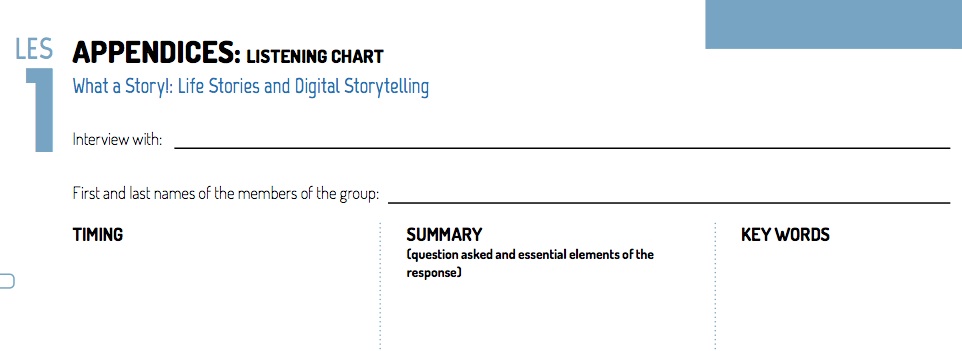
The production phase continues with the creation of the digital story, the editing and the montage. Students then reflect on the ethics of the process of cutting and reworking another’s story, exploring the way narratives can be modified, the meaning built into the digital story vs. the meaning of the interview, and the question of narrative form.
Peter Szendy chooses the deejay, or of the musical arranger, as a figure for the contemporary listener. Indeed, we imagined the students in groups, headphones on, in front of computers, slowing down the cadence, augmenting the sound, rewinding or fast-forwarding, cutting, pasting, annotating. We thought of them as highly skilled listeners, intervening in what they were listening to and interpreting their listening for the “other” ( in the manner of composition theory in which students are asked to write for real audiences for real purposes). As deejays of their listening!
Having students edit the life stories of others, especially stories of violence and war, brings with it risks of misinterpretation and manipulation. However, the unit asks students to think carefully about these risks, and unlike projects which use testimonies in the service of someone else’s argument, this editing assignment has students select from the larger interview in order to craft a narrative that respects the original. As Norkunas says, “When Michael Frisch coined his now famous phrase, “a shared authority,” he wrote of the shared responsibility of listener and narrator for creating the interview document, for interpreting it and for sharing the knowledge created.”(2) If editing and interpreting are critical to the process, adds Norkunas, “the first moment of creation takes place in the interview, in the act of listening.” Hence, the ethical issues raised by the editing assignment–and more generally by having students and teachers engage with personal stories of human rights violation–are addressed by considerable attention to the act of listening (13), and by the cultivation of trust, dialogue and sharing. In short, an attention to the “other.”
Rather than deciding that this content is too challenging for students or reproducing a passive listening dynamic in which students listen to the interviews in reverential silence, we work to support student engagement — as both an attention and response — with these stories as part of a community of listeners. And while listening to these stories can be difficult work, we hope that through our pedagogy of listening, students will gain a greater awareness of the lives of those Quebecois who are not often part of the national narrative, and grapple with some of the difficult knowledge of human pain and survival.
—
Bronwen Low is an Associate Professor in the Department of Integrated Studies in Education at McGill University. She researches the implications of popular culture for education, curriculum theory, and adolescent (multi)literacy practices. Areas of interest include hip-hop and spoken word culture; informal, arts-based and participatory education with youth; and community media and participatory video programs.
Emmanuelle Sonntag defines herself as a “knowledge organizer.” She offers consultancy services in communication, education, curriculum design, information management and knowledge mobilization while pursuing her PhD in Sociology on… Listening at Université du Québec à Montréal. She tweets on listening, sounds, stories and other noises @lvrdg.
—
 REWIND! . . .If you liked this post, you may also dig:
Audio Culture Studies: Scaffolding a Sequence of Assignments–Jentery Sayers
The Sounds of Writing and Learning— Liana Silva
Listening to #Occupy in the Classroom–– Travers Scott
Share this:


Current Top Posts





April 2021

January 2020

November 2019

October 2019

August 2019

April 2014

November 2017

March 2015

December 2017

October 2015
 Sounding Out!
Recent Comments