
Garageland! Authenticity and Musical Taste

First show with The Carpetbaggers! @The Manor.
Today’s post is a bit of a confessional. Reflecting on Andreas Duus Pape’s post a few weeks back, Building Intimate Performance Venues on the Internet, I can not help but admire how closely Andreas relates podcasting with intimacy, and therefore; authenticity. Although it would be simple to critique this point as a case of circular reasoning (Podcasts are intimate because they are authentic. Podcasts are authentic because they are intimate.), I cannot help but wonder if there is something deeply honest and deftly earnest about this claim. Speaking as a musician, I believe that authenticity is a quality that cannot be conjured. It, like a feedback loop or proof of will, seeks only itself. But, how does the desire to be authentic shape performance? Does it affect what we listen for and who we listen to?
My adventures as a musician started in high school with a second hand guitar and a lot of free time. It only took a year before my pastime became something more like an obsession. First was my high school band: The Nosebleeds. The Nosebleeds played revved up versions of 50s and 60s rock and roll while all the other kids were covering Blink 182 and Operation Ivy. We were cool – really! Even at this early stage it was clear to me, authentic rock bands played old-school rock music. Even my punk guitar heroes from the 1970s like Mick Jones and Captain Sensible knew how to cop a Chuck Berry riff and Little Richard groove. After 3 years of humid Jersey shore dive bars and fluorescent high school talent shows we called it quits. Honestly, we just got bored. Also, our ace repertoire of fifteen songs was beginning to wear a little thin. . .
After The Nosebleeds came The Carpetbaggers. This was a sea-change in compositional direction. Instead of playing punky renditions of Twist and Shout, we affected a country twang and sang songs about travel and broken hearts. If you caught us on a good night, we would even throw a bit of Sonic Youth into the mix and evoke a wall of feedback out from silence. We played in New Brunswick basements and central Jersey bars and recorded an EP on an abandoned Tascam 1” reel to reel. Buzz words being thrown around at the time were: rootsy, alternative and raw. I had pulled the covers back from a revved up Chuck Berry only to find a wonderland of Americana – washboards, harmonicas, and acoustic guitars – waiting. This was, of course, what those rocker’s back in the day were inspired by – right? If The Carpetbaggers weren’t the real thing, who was?
When The Carpetbaggers broke up I joined one last band, The Acid Creeps. At this point, there would be no turning back from my descent into nostalgia. We aimed to resurrect the late sixties go-go bar house band. Taking care to acquire vintage Fender amplifiers, vintage reissue guitars, and even a knockoff Vox Continental organ. If that wasn’t enough, my sister sewed us matching orange paisley shirts which complimented our skinny black ties and sunglasses. We imagined ourselves as a period perfect garage band, exactly the sort we had seen in movies. We covered everything from Iggy Pop’s, I Wanna Be Your Dog, to The Sonic’s, Psycho, and the Detroit Wheels version of Little Latin Lupe Lu (which we all preferred). Only in our mid-twenties, we were experts (or snobs, depending on your perspective) at defining and defending what authentic garage music was, and what it was not. Before breaking up, we created a yellow 7” vinyl tomb to forever keep our music. It was named “The Bananna Split EP,” and at the moment it all seemed perfect. Authenticity, sold for five dollars at a show.

Bananna Split EP w/ Full of Fancy.
Reflecting, five years later, on these three epochs of music making – it is hard not to blush. Not only did I, for at least a year, consider each band the singular most authentic band ever; authenticity, as an ideal, began subtly to change the way I viewed myself. I transformed from Aaron the Weird Al Yankovic fan to Aaron, the garage rock expert in about 8 years. Wherever I looked for authenticity, I found it, and it was real. Not only that, but at the bar, we convinced ourselves and our friends of this notion. Conversations about which bands got it, and which did not, were frequent – if not mandatory. The answers became standard too: The Exploding Hearts, The Murder City Devils, The Misfits? They all got it. Bands like Metallica; for the most part, they did not. These conversations forever led us to equate the authentic with the obscure; a rabbit hole that twists and darts endlessly.
Authenticity in music is like feedback: powerful, seductive and dangerous. It is a very real, yet elusive concept that invites imitation and when left unchecked, can spread like a contagion. Although I love revisiting the music of my old bands, I cannot help but hear them now as a set of key moments in a greater life narrative. Iterations of myself left behind in an ongoing dialogue about authenticity. A dialogue, which, to this day, affects what music I choose to listen to, and what music I choose to avoid. Although none of my bands were truly “the real-deal,” it would be odd to claim that any were not authentic. Rather, this concept, authenticity animated each band – it kept us all going, and brought our music to life. My bands were authentic because I believed in them. I believed in my bands, because they were authentic.
AT
–
Aaron Trammell is co-founder and multimedia editor of Sounding Out! He is also a Media Studies PhD student at Rutgers University.
Share this:

Sounding Out! Podcast Episode #2: Building Intimate Performance Venues on the Internet
 The podcast is (or, can be) an intimate performance venue on the internet because it allows you to whisper into the ears of your fans. It allows you to grow close to communities of listeners. And podcasts also do one last thing, to be revealed at the end of this piece, after we’ve seen how far I can take you. For now, I will quote podcasters I admire to help explain these ideas in their own words. I also quote these podcasters in an audio format. I have recorded this essay as an episode of the Sounding Out! podcast. You can listen right here, and I suggest you do. Go ahead, press play:
The podcast is what’s happening if you’re listening to these words. Are you? Because remember: my central claim is that a podcast is an intimate performance venue on the internet. Keep that in mind.
I am a podcaster, musician, and assistant professor of Economics. I have released six episodes of my own podcast, The Lion in Tweed.

Me. (Photo by Hadassah Head)
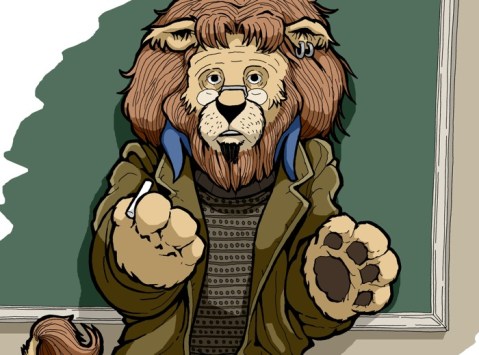
The Lion in Tweed. (Drawing by Winston Rowntree)
My podcast is primarily a narrative, with music and sound effects interwoven. It is about a character, The Lion in Tweed, and his experiences as a musician and professor of economics. He is also a lion. The second half of each podcast episode is a references section where I cite my sources and leave the fictional Tweedoverse canon to discuss real things.
I am not the first podcaster to remark on the ability of podcasts to traffic in intimacy. Chris Hardwick, of the Nerdist podcast, has claimed that, due to their intimacy, podcasts are the best medium going. He stressed: “you’re talking directly into the ears of your listeners.” There is no doubt that Hardwick was referring to those white iPod earbuds, which are a primary method of listening to podcasts. Part of a podcast’s intimacy comes from the closeness of the earbud to the membrane in the ear. Listening to earbuds evokes the intimate, and physical, closeness of someone whispering in your ear. Hardwick’s style of podcast is also intimate: vocal storytelling, mostly three comedians talking about the funniest things that have happened recently. The fact that it is not visual accentuates the intimacy of “whispering in your ears.” Although I would like to argue that the visual always reduces a sense of intimacy, I may simply prefer the sonic over the visual. Nevertheless, I believe that, the intimacy to which Hardwick is refers, is tied to the fact it is only sonic.

Chris Hardwick.

The Nerdist Podcast.
COMMUNITY
Podcasts as performance have a strange kind of liveness, episode-to-episode interactivity. By this I mean that they are not immediate; they lack the urgency of a theater-goer’s applause, or a heckler’s retort. Though not immediate, they are still dynamic, with their episodic pacing. And, unlike heckling, almost completely positive. This sense of long-term interactivity provides a foundation for understanding a second way that podcasts are intimate: they can cultivate intimate and interconnected communities of listeners.
They [Stop Podcasting Yourself, hosted by Graham Clark and Dave Shumka] have a really good community of people, community interaction: people send them stuff, sometimes people send them stuff unprompted. And they have a phone number [for people to call in messages that they play].
To illustrate how interconnected this community is, let me describe to you where this quote came from. It is a clip of Dan Sai, recorded by Davin Pavlas at MaxFunCon (the annual convention of the MaximumFun.org podcast label). I know Davin because of our mutual love of MaxFun podcasts. When I brought The Lion in Tweed into the world, I advertised it on podcasts in the MaxFun network. When Davin heard the description, he began to listen to my podcast. Now we are collaborating on an episode of The Lion in Tweed, which will quote these very words when it comes out two weeks from now. Similarly, UK resident Will Owens and I exchanged tweets after he started listening to my podcast and I found out he reviewed various narrative media on his website, and now he has written a review of my podcast, which we both promote. Ours is a community in which a feeling of value comes with a sense of connectedness. The podcasts give a shared culture.
SO IN PODCASTS, WE FIND A MEDIUM that is both sonic and vocal. They provide a platform for intimate and interconnected communities, which are rooted in an alternative kind of interactivity (long-term liveness), to grow. The whisper-in-the-ear quality of podcasts, as well as the feeling of community, all but completely explain why podcasts are so intimate.
AUTHENTICITY
Podcasts may be hip and modern, but they are not ironic. Podcasts represent a distillation of what the podcasters genuinely love, and in that they find their authenticity. According to Paul F. Tompkins, a comedian and podcaster:
It’s very freeing to be able to say: “Here are all the things that I like; I’m going to put them all into this [podcast].”
That was at minute 50:32 of Nerdist podcast ep 33 hosted by Chris Hardwick, with Paul F. Tompkins as a guest.

Paul F. Tompkins
The Pod F. Tompkast
Here is Jesse Thorn, mastermind behind the aforementioned MaximumFun.org, in an interview by Neiman Labs:
I can mostly just do things that I am interested in, and so I don’t have to do something that is false to me, and I can let my guiding light be, “Do I like this and think it’s worth doing?”

Jesse Thorn.

The Sound of Young America.
And we see that authenticity completes the puzzle: podcasts are intimate because they feel so real. In podcasts it feels like you are listening to a real person because you are listening to the things that a real person loves…and interacting with real people is much more intimate than feeling like you are interacting with a marketing department (as you may when listening to a CD, or radio-show).
This is how I construct intimate performance venues: Audio-only, voice/storytelling focused, in which I try to build and exploit supportive, interconnected communities of fans with a shared culture (the podcasts). And, in doing so, I try to remain true to what I truly love. This authenticity, I believe, deepens the intimacy.
.
In the background of this podcast episode, Andreas plays an instrumental cover of “Bound for Hell” by Love and Rockets.
Share this:


Current Top Posts





April 2021

January 2020

November 2019

October 2019

August 2019

April 2014

November 2017

March 2015

December 2017

October 2015
 Sounding Out!
Recent Comments