
What We Talk About When We Talk Girl Talk

Girl Talk by Justin Davis, 12 September 2008
Gregg Gillis, the mash-up artist who records and performs as Girl Talk, is always being talked about by someone. My co-author, Kembrew McLeod, and I risked adding to the overexposure by featuring Girl Talk as the star in the introductory section of our new book, Creative License: The Law and Culture of Digital Sampling (Duke: 2011). And yet, I still have more to say about Girl Talk. His latest release, All Day (2010), came out too late for us to cover in our manuscript, but it reflects some aesthetic and legal developments that are worth understanding. But first, I should explain sampling, mash-ups, and what makes Girl Talk so musically and legally interesting to talk about.
Sampling means using existing sound recordings as part of new sound recordings. I leave musical quotation, allusion, and other forms of musical borrowing (or appropriation, if you prefer) out of this definition. In other words, sampling means using sound waves recorded at an earlier time—perhaps (1) editing or manipulating them, (2) combining snippets of multiple existing recordings, and/or (3) adding sounds generated by the sampling artist herself—but using the literal sound waves as basic material nonetheless.
Mash-ups, in my parlance anyway, are a sub-category of sample-based music. A mash-up artist usually does not distort the samples too much; mash-up artists tend to combine just two or three samples at any one point in time—the samples remain recognizable to the listener. And mash-up artists tend to add very few (if any) sounds generated originally by themselves.
Many mash-ups juxtapose only two or three existing recordings for the duration of a typical pop song. Some versions of this approach involve a comical or unexpected juxtaposition, like Britney Spears versus Metallica. Other versions of this approach sound like the sort of thing you’d hear at a club; in other words, it describes something live DJs have done for a long time. Mash-up artists The Hood Internet, for instance, recently released a mash-up of rap artist Nicki Minaj and indie-dance group Hercules and Love Affair by DJ STV SLV (pronounced “deejay steve sleeve,” which I’m pointing out because I think it’s fun to say).
What is unique about Girl Talk is that each of his tracks involves a string of overlapping samples. In an average song like “Like This” from Feed the Animals (2008), he moves from group to group of sampled sources, from Beyonce versus LL Cool J versus Soul II Soul, to the Jackson 5 versus the Beastie Boys, to Pras (featuring Mya and Ol’ Dirty Bastard) versus Yo La Tengo, and so on. Girl Talk’s live performances feature Gillis with his laptop in the middle of an insanely sweaty dance floor. A friend who recently caught a Girl Talk set noted that sweat was condensing on the ceiling of the venue and then dripping back onto the crowd. In short, Girl Talk is high-energy club music.
After the release of Feed the Animals, Village Voice reviewer Tom Breihan famously labeled Girl Talk as “music for people with such severe ADD that they get bored listening to thirty-second song-samples on iTunes.” Breihan also denied that Girl Talk’s music had any “internal dynamics,” which I take to mean that Breihan thinks the music has no narrative arc of, say, loud versus soft or intense versus calm. In both these statements, Breihan’s position is that the samples that make up Girl Talk’s music are disconnected from each other. The samples provide amphetamine doses of nostalgia or energy, but they have no intertextuality or deeper meaning. Girl Talk’s samples are just rapid-fire collections of pop-culture references. Call this line of argument as the name-that-tune critique.
My view, however, is that there are patterns and meaning in Girl Talk’s selection and arrangement of samples. He consistently pairs rap vocals with retro music of the 60s, 70s, 80s and 90s, along with the occasional indie-rock and/or iTunes-commercial hit. Why are his groupings of samples interesting?
One answer is that the backing tracks in hip-hop songs have become stale. In the commercial music industry, sample licensing is required but prohibitively expensive. So Girl Talk is creating a collage in the background with the samples that rappers’ labels wouldn’t pay for or, even more likely, couldn’t have licensed from the copyright owner. This effect of copyright law on creativity is something that Kembrew and I detail in our book, especially Chapters 5 and 6.
Another answer is that Girl Talk finds the lyrical content of hip-hop far more interesting (or at least more provocative) than what’s being said in the classic-rock song. A similar point would apply to The Hood Internet, too, whose twist is that their pairing is almost always very contemporary hip-hop vocals mashed up with very contemporary indie rock. I can’t help thinking that one thing The Hood Internet is suggesting with their compilations is that some hip-hop backing tracks are too boring and some indie-rock vocalists have poor voices or nothing to say—so let’s mash-up the best parts of both.
So what to make of Girl Talk’s hallmark freneticism, the jumping from one group of samples to another group roughly every 20 or 30 seconds? No matter what, the point is that meaning—an argument over interpretation—emerges from the groupings of juxtaposed samples. First of all, meaning emerges when the transitions happen more slowly. The new album, All Day, begins with a two-minute-long pairing of Black Sabbath’s “War Pigs” against Ludacris’s “Move Bitch” (featuring Mystikal and I-20) and a few short snippets of various Jay-Z raps. The extra time to digest what’s happening tells the listener that the new album is more relaxed, at least at the start. Rather than a sprint, the new album has a longer narrative arc. Gillis may be responding to the name-that-tune critique, adding another dimension to the mathematical complexity of his recordings by varying the speed of his transitions.
 More than a response to critics like Breihan, my observations about selection and arrangement as the source of Girl Talk’s musicality relate to his legal stance with respect to using unlicensed samples. Girl Talk and his label, Illegal Art, assert that using samples, transforming them, and placing them in a new context is “fair use.” Briefly, fair use is a doctrine in copyright law that allows certain uses without permission. For instance, a book reviewer can quote from a book without infringing copyright, at least up to a certain amount. Educators can use at least some portion of copyrighted works in the classroom. Transformative use is yet another category of fair uses. We know this category includes parody, thanks to a 1994 Supreme Court decision involving 2 Live Crew’s parody of Roy Orbison’s “Pretty Woman.” But the courts haven’t told us what else the “transformative” category includes. This is why Girl Talk and Illegal Art garner so much attention from the copyright law community.
The website for the new album has the following legal language at the bottom of the page:
All Day by Girl Talk is licensed under a Creative Commons Attribution-Noncommercial license. The CC license does not interfere with the rights you have under the fair use doctrine, which gives you permission to make certain uses of the work even for commercial purposes. Also, the CC license does not grant rights to non-transformative use of the source material Girl Talk used to make the album.
Creative Commons licenses are ready-made online licensing contracts. A Creative Commons license is a deal creators choose to make with the public, in which the creator gives the public certain freedoms but also requires certain responsibilities. It represents a less generous choice than simply leaving something in the public domain, no strings attached. But it is much more generous choice than asserting one’s copyrights in full.
So what can other people do with Girl Talk’s music under the particular flavor of a Creative Commons license? The short answer is that they can share and remix whatever he owns without getting advance permission. But wait a second. If Gillis’s music is comprised almost entirely of samples of other people’s music (which themselves can be sample-based)—in copyright-speak, if it is a “derivative work”—what exactly is he licensing to the public?
Derivative works created without permission, without being fair use, or without avoiding infringement through some other copyright exception, give their creator no copyright in the parts of the derivative work that include illegally used material. Section 103 of U.S. copyright law punishes people who make unlawful derivative works by denying them any rights. By asserting a compilation copyright, Girl Talk and his label are expressing confidence in their fair use argument. They are at least acting as though they would not be subject to the punishment of Section 103 because they claim copyright for All Day via compilation: Girl Talk’s particular selection and arrangement of samples. Compilations are a special type of derivative work. In other words, compilation copyrights inhere in the “thin slice” layer of creativity that represents the ordering, grouping, and timing of the music.
Meanwhile, Girl Talk is sampling hugely high-profile artists, and listing them on the website: the Beatles, Prince, U2, all of whom are known for asserting their copyrights. Take this together with Girl Talk’s confidence that he won’t lose his “thin slice” copyright under Section 103. We can see that Girl Talk is aggressively claiming fair use. He’s daring people to sue him. And this strategy seems to have made copyright owners less likely to sue.
Interestingly, the “thin slice” the law is concerned with is the same thin slice music critics worry over. My closing point is that the copyright analysis of Girl Talk’s work depends heavily on interpretation of his selection and arrangement of samples. Humanists, including those in sound studies, have a great deal to offer to this discussion. Does Girl Talk’s selection and arrangement rise to the level of “transformative” work? Do we need to settle the debate of the aesthetic value of Girl Talk’s “thin slice” before we can answer the legal question of fair use?
Consider the meta-observation that there are plenty of arguments to be made back and forth about whether Girl Talk’s selection and arrangements are good or bad, original or unoriginal, and so on. Does that observation in and of itself mean that something transformative has occurred? Or is that too cute—setting up a test that no mash-up could ever fail, since it takes only two listeners to have an argument over the quality of a piece of music?
It is a truism that copyright law fails to mesh well with creative practices. But copyright isn’t going away anytime soon. I hope this brief discussion has illustrated how crucial it is to have a continuing conversation among legal scholars and humanists.
Peter DiCola will be reading at RiverRead Books in Binghamton, NY (5 Court Street in Downtown) on Thursday, 4/21 at 6:30 p.m. in support of Creative License. Following DiCola’s reading there will be a roundtable conversation featuring several Sounding Out! writers: Jennifer Stoever-Ackerman (Editor in Chief), Andreas Pape and Osvaldo Oyola along with Daniel Henderson.


Share this:

Como Now?: Marketing “Authentic” Black Music
With all the excitement over the new release of Mavis Staples’s You Are Not Alone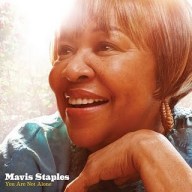 (Anti-, produced by Wilco’s Jeff Tweedy), I can’t help but be skeptical of the outpouring of Indie love for the album, even as I have been spinning (and enjoying) it myself. It isn’t the positive reaction to Staples’s talent that is surprising—at 70-plus years, Mavis has been exquisite for quite some time now—but rather the way in which critics have freighted her newest record with the “uplift” (AV Club) of a whole lot of souls that haven’t ever been to church (at least not in a good long while). Her voice is described as alternately “raw” (Paste) and full of a “depth, power, and warmth that seem increasingly rare in music today” (hear ya); Consequence of Sound, who cites Tweedy’s hand at the boards as the reason for all the current music blog attention, calls her voice “empathetic. . . powerful. . .soulful. . .touching” and “wise.” If the blogosphere is to be believed, Staples’s voice, “as authentic as it gets” (buzzine), could really save us all in these tough times. Come to think of it, the fervor of (white) faith in “authentic” black music shouldn’t be that surprising either, given the way in which race has always been entangled with popular music history in the United States.
Authenticity and the immediacy of experience it implies, have had a long history in the music industry—especially in reference to black artists—stemming back at least to the Fisk Jubilee Singers in the 1870s, an all-black acapella troupe celebrated for  powerful live performances whose breakthrough concert also happened to be for a crowd of hipsters: the wealthy congregants of Henry Ward Beecher’s Brooklyn church in 1871. Beecher gave the band his enthusiastic support, namely because he felt their sound gave listeners direct access to “the inner lives of slave hearts expressed in music” even after slavery had formally ended.
While the sound of You are Not Alone differs greatly from the Jubilee Singers, the reviews of the record belie and inflame a similar desire for unmediated access to the emotive qualities (a)historically associated with black life and sound in the U.S.: namely suffering, faith, and catharsis. And Staples’s record is indeed not alone in this. Many of the sentences from the Staples reviews could easily have been lifted from those of another recent gospel record to capture the indie imagination, Daptone Records’s 2008 release Como Now. Starkly different from the breezier, countrified sounds of You Are Not Alone, Como Now is an acapella gospel recording made in a small town in Panola County, Mississippi. The record was a risky release for Daptone, a Brooklyn-based label that has consistently produced new funk and soul records since its inception in 2002 by the likes of Sharon Jones and the Dap-Kings and The Budos Band. Although old school sound has always been a part of the label’s ethos—its engineers use primarily analog equipment, for example, a major reason Amy Winehouse recorded her throwback Back in Black album at Daptone studios in 2006—marketing stripped-down gospel to its audience of predominately white hipsters would nonetheless prove a daunting task. Treating Como Now as a labor of love and a paying of dues, Daptone attempted to spark interest in the release by relying on the familiar marketing strategies of immediacy, authenticity, and nostalgia.
 While Como Now’s tagline boldly proclaims that the music was “Recorded Live at Mt. Mariah Church on July 22, 2006”—and, thus, emphasizing the Now of the title—the cover’s vintage civil-rights era design evokes the Como of yesterday, or more accurately, encourages listeners to hear Como now and Como yesterday as one and the same through the vehicle of “raw gospel testimony.” Como Now’s depiction of the sounds of the past as echoes within the present is as ambiguous as it is uncanny, a sonic window thrown open to simpler times happening somewhere out there, “deep in the heart of Mississippi” right now.
The introductory promotional video from Como Now’s website (also uploaded on Youtube) represents the record as an aural time machine to a land and a people isolated from and largely unchanged by technology, modernity, and history.
Producer Michael Reilly’s voiceover locates rawness, emotional release, and “real religion” in the sound of black voices, in no small part because the video places his measured Yankee pacing in sonic tension with the song that accompanies it, Mary Moore singing “When the Gates Swing Open.” Over Moore’s impassioned singing, Reilly assures listeners in a muted deadpan that they will hear “no pretty piano playing or clever guitar picking, just voices. Pure soul stirring fire from the heart.” Reilly’s sentiments not only evoke the gushing Jubilee Singers’ press, but also the ethos of the infamous folklorist John Lomax, who made field recordings in Southern prisons in the 1930s because he sought “negro singers untainted by white musical conventions” (as he wrote in 1934’s “Sinful Songs of the Southern Negro”); singers in Como were actually recorded by John’s son Alan in the 1940s. Reilly’s voiceover goes on to frame the Como singers as practitioners of what the senior Lomax called “the real art of simplicity,” as stripped-down, natural singers who are artful mainly in their artlessness. While Reilly’s webcopy mentions how “children and grown folks alike have been living and breathing gospel for as long as they can remember,” for example, he fails to mention how the residents of Como have also been writing, rehearsing, and performing it.
Thus, Como Now’s marketing disavows the real artistry of the Como singers, even as it seeks to celebrate it. The simple, natural quality endowed to the singers of Como is visually accentuated by stark imagery representing the town as a down-at-the-heels, living museum of the black life of yesteryear. In the youtube clip, Moore’s soaring and spirited singing animates stills of blooming cotton fields, vintage RCA microphones, and splintering upright pianos.  Save for the album cover and one blurry still of a child, there are no shots of the people of Como in the introductory promo, effectively isolating Moore’s voice from her corporeal and historical body. This isolation allows listeners to supply their own fantastic imagery and forces them to rely on historical stereotypes about the naturally sonic qualities of black people. By choosing to disembody Como’s voices, the promotional video represents the album’s music as emanating from, and even haunting, Panola County’s lush green fields and battered strip-malls rather than showing it to be a hard-fought creation of the residents themselves. To quote Lomax again: “[The Negro’s] songs burst from him, when in his own environment, as naturally as those of a bird amid its native trees.”
Although the impulse to make the album reflects a progressive desire to respectfully pay tribute to the black gospel tradition in American popular music—and to provide quality artists like The Como Mamas with critical renown and monetary compensation—Como Now relies on well-worn racial tropes to do so. It also points to the continued presence in American culture of an essentialized “black voice” that is naturalized as more emotive, truthful, and soulful than other voices. While this phenomena is socially constructed and the sounds thought of as “black” have shifted considerably—when I play early recordings of the Jubilee Singers my students consistently tell me that they sound “white” like a “glee club”—I find it fascinating that the language used to describe them has largely remained the same. While Como Now’s producer at least acknowledges that, in Como, “no one has to pick up cotton anymore, thankfully,” the marketing trades on the possibility that, while slavery and sharecropping have ended, its sonic labors have not only endured, but are readily available for download.


Share this:


Current Top Posts





April 2021

January 2020

November 2019

October 2019

August 2019

April 2014

November 2017

March 2015

December 2017

October 2015
 Sounding Out!
Recent Comments