
Listen to the Word: Deafness and Participation in Spiritual Community
Managing Editor’s note: This post is the first in a three-part Sounding Out! series on deafness, Sound Studies, and Deaf Studies during February 2012.–LMS

"Church" by Flickr user silent short under Creative Commons license
Growing up I attended many religious services. As an adult I attend church services less often, but it still stands out to me that sound is an essential part of the traditional Christian religious service. Participation depends upon listening, responding, and singing. If the service (or mass, as I knew it growing up in the Catholic faith) reminds us we are a community of people with common religious beliefs, our participation in the rituals is a manifestation—a ratification if you will—of our belonging to that community. (Last month David B. Greenberg talked in our podcast series about how sound—specifically listening to religious services while on the road—allows Christian truck drivers to feel like they are a part of a community of faith.) In addition to singing and responding, there are several sound metaphors that imbue the experience of being a churchgoer: the references to the Word of God, discussions of how God will listen to our prayers, the insistence that we need to listen to what God was trying to tell us, even a parent’s admonishment that one sit still and be quiet while the preacher talks…in sum, to be a practicing Christian requires a lot of listening.
However, in Deaf culture (defined by music researcher Alice Ann Darrow in her article “The Role of Music in Deaf Culture: Implications for Music Educators” as “composed primarily of congenitally deaf adults who communicate through sign language rather than speech” but is not limited to them) this takes another shape. When I visited the Deaf International Community Church, located in Olathe, Kansas, I realized that deafness complicates what it means to listen, especially in terms of religious services.
The Deaf International Community Church (DICC) has been holding services in Olathe since 2010, according to journalist Dawn Bormann from Olathe News. They emerged from a deaf ministry at a local Baptist church, but are nondenominational. At the moment the DICC holds services at the Center of Grace, a rented space. The services are open to the deaf, the hearing impaired, and those who hear; however, the services are geared toward the deaf community.
 As I walked into the Center of Grace in late January, I was surprised to be welcomed by sound. I heard and saw people talking and signing—sometimes at once. Music played loudly from within the temple, and parishioners milled about. I was not sure if I should walk in and not talk to anyone or if I should just act casual. I suddenly felt very subconscious about my sense of hearing. I found an empty pew toward the back—after all, I would be taking notes and didn’t want to interrupt—and sat there, observing my surroundings. Shortly after, Pastor Debbie Buchholz, one of the spiritual leaders of the DICC, walked over to me and introduced herself, putting me at ease.
When the service started, the same woman who had just spoken to me stood in front of the congregation, signing her words. In front of the crowd a voice interpreter spoke for Pastor Debbie. The effect was unexpected: the hands gave life to words, to sounds, to language while the disembodied (from my angle) female voice translated into sound what Pastor Debbie signed to the crowd. It took me a while to get used to the new sound of the pastor. I had only spoken briefly to Pastor Debbie, yet it seemed surreal to hear another voice speaking for her.
I meditated upon the fact that language is conceived in terms of the arbitrary relationship between signs and sounds. A letter sounds a certain way. Put letters together and you put sounds together. Letters (and their sounds) make words (a compilation of sounds) that designate an object. In this sense, sound is closely connected to making sense of the world. Even though we can create sounds with objects, our bodies are constantly creating sounds as well. The sounds of words come from our lungs out through our mouths and to our ears as they designate people, places, things, and ideas.
At the DICC service, sound—something that we conceive of as naturally emanating from bodies—was disconnected from language. In the Deaf culture language is transformed into hand gestures. Swinging a finger, shaking a hand, pushing down a palm, these small gestures stand in for sound— or stand apart from sound. Even though for me, growing up Catholic, participation came in the guise of listening to the priest, singing along with the congregation, and repeating the prayers, here participation came through hands. They sang with their hands, they prayed through their hands. Being in the DICC service reminded me of how natural and normal we take sound to be. In that space, I was suddenly very conscious of the sound of my voice, and of sound’s relationship to language.
This brings me to PhD student and Sound Studies scholar Steph Ceraso’s HASTAC blog post on listening with your whole body. In her post she uses an interview with percussionist Evelyn Glennie as a way to reflect upon listening practices and the ability to listen with more than one’s ears. Evelyn Glennie, according to Ceraso, engages in a restrictive sound diet where she sometimes, voluntarily, eliminates sound from her environment in order to become more aware to sound. Ceraso’s words on multimodal listening resonate with me, and put my visit to the DICC in perspective. The DICC service showed how deafness can make sound studies scholars reflect upon the role of sound in our society—and more importantly, how we listen and communicate.
Also, Ceraso’s ideas about multimodal listening make me think about what other ways the deaf congregation at the church listens. If listening is a form of spiritual/religious participation, multimodal listening accounts for how the parishioners participate in the service. The body, including the eyes, become a gateway into absorbing the message (the Word of God) and in that way demonstrate alternate ways of listening.
For this spiritual community, the need to worship in their own language brings them together, but so does the Deaf culture. During the service they prayed together for an end to discrimination against deaf people and hoped that God would help those newly born in deafness. As I prayed with them, I realized that the congregation comes to DICC not just for religious guidance but also for affirmation of their humanity and their culture. The space of the church is a place to recharge spiritually but also become socially empowered.
—
Liana M. Silva is co-founder and Managing Editor of Sounding Out! She is also a PhD candidate at Binghamton University.
Share this:

‘Corn-ing’ the Suburbs on Halloween, a Sonic Trick and Treat
It was a crisp Saturday night in late-October. I was probably seven or eight. My brother and I were sitting on the couch watching “It’s the Great Pumpkin, Charlie Brown” for the zillionth time.
And then we heard it.
To our stunned ears, it seemed as though my parents’ bay window, situated directly behind us, had shattered to pieces. But, mysteriously, it was still there, in tact.
Our tiny nervous systems were not prepared for this sonic assault, especially because it didn’t make sense. We stared in disbelief at the window for a minute, waiting for it to spill its shards. When we got enough courage to get up and peer out the front door, we saw the lanky silhouettes of teenagers running away into the dark of the trees. Piles of dried out corn kernels were scattered all over the porch like empty shells. We had been corned.
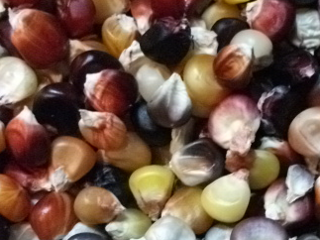
“Corn-ing,” a longstanding Halloween tradition in the suburbs of western Pennsylvania, is a popular prank in which kids sneak up to houses after dark and throw pre-hardened corn kernels at their windows, producing a truly startling sound effect. Corn-ing’s treat lies in the sonic trick—corn is able to convincingly sound like something else entirely. Thinking back on my experiences as both a victim of and participant in corn-ing, it occurs to me that this prank is sonic through and through—from listening for farmers in the corn fields before snatching husks from their crops, to locating one’s corn-ing partners in pitch black environments by the sound of the kernels bouncing rhythmically in their backpacks.
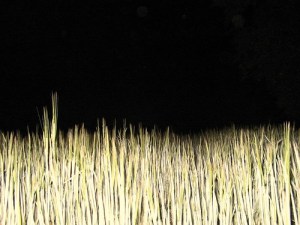
When early October rolled around each year, it was like an alarm went off in the heads of the kids that lived in my neighborhood. October meant it was time to procure ears of corn from the farms located on the outskirts of our Wonder-Years-ish suburb. In the days before we had our drivers’ licenses, this was an arduous task. We’d have to ride our bikes on the hilly back roads in mid-day (night time was too scary after we’d seen Children of the Corn), ditch them in the woods near the fields, and listen carefully for any signs of life in the corn—farmers, animals, blood-thirsty fundamentalist Christian children named Malachi, etc.
We couldn’t rely on our sight in these instances because the corn was so tall. We had to stop filling our backpacks every so often and listen for sounds of danger—for the rustles and crunches of stalks.
After our backpacks were filled to the brim, the preparation process began. The corn would sit for weeks in our garage, getting harder and harder. Once it became pebble-like in consistency, we’d shuck it back into our backpacks, listening to the pinging sound as it accumulated. On Friday afternoons, anxiously waiting for the sun to go down, we’d talk strategy. We decided that corning old people was out of the question. Even in our pseudo-delinquent state, we realized that sound had consequences—that spooking someone could give them a heart attack. So we mostly stuck to mean neighbors like old man Haybee, who was notorious for the unsightly cursive green “H” that was bolted to his chimney like a garish fast food sign. He never gave out candy to trick or treaters, so he was basically asking for it. Once a plan of attack was developed, it was time to suit up in all-black clothing and put on our packs. As soon as the streetlights came on, we were off.
My memories of these adolescent adventures are predominately sonic—the crunch of the fallen leaves, pounding hearts and nervous breathing, barely muffled laughter, and of course the sound of corn making contact with glass. Indeed, the success of the prank was measured in sound. The louder the sound the corn produced, the louder the aftermath tended to be. It was a true victory if dogs barked, or if people came out of their houses to yell. “You damn kids better run!” they would scream, sometimes only half seriously. And we did. We ran for our lives, despite the oppressive weight of the corn on our backs.
Click for the sound of sorn-ing: corn-ing
I wanted to capture the sounds of a real corn-ing experience to include here, but I quickly realized what an incredibly stupid idea that would be (what you heard, by the way, was the sound of me and my neighbor corning our own apartment building). As an almost 30-year-old Pittsburgher living in a fairly rough neighborhood, sneaking up to people’s houses at night in order to produce startling noises would most likely result in an encounter with police or violence of some kind. In the suburban environment of my adolescence, the sound of corn-ing was associated with a silly prank. Neighbors came to expect (and even get a kick out of) this Halloween tradition. In an urban environment in which the corn-ers are no longer in their teens, however, the sound of corn-ing would most almost certainly be interpreted as an aggressive or threatening act.
This just goes to show that different configurations of sound, spaces, and bodies (particularly raced and classed bodies) can result in vastly different understandings about what it means to share sound in a community. In Pittsburgh, I find myself constantly bombarded with the sounds of emergency and panic—police and ambulance sirens, firetrucks, helicopters. In my community’s soundscape, loud, startling noises are definitely not associated with fun and folly. Rather, they are a constant reminder of the looming danger that apparently surrounds me, as well as the incessant surveillance and policing of the city. This does not leave much room for sonic play.
This is not to say that there was no danger in corn-ing the burbs. For instance, this recent tragedy, in which a corn-er accidentally was hit by a car, happened in a suburb not far from the one where I grew up. Back when I was pitching corn, my best friend Courtney was once tackled by a man who thought she was slashing the tires of his truck (she was really just hiding behind a tire with a fistful of corn). And my brother Matt and I often found ourselves taking cover in the neighbors’ shrubbery waiting for the town patrolman to finish his watch. But I’d imagine that these war stories would not even come close to the dangers of corn-ing in the city. It is clear that the effectiveness of corn-ing as a prank is contingent upon the specific time, season, location, and culture in which its sounds occur.
Perhaps the real trick of sound, then, is that the context of its sounding can completely transform its effects and affects. But if you can get the sounds in sync with the right context, well, then you’ve got yourself a real treat.
—–
Steph Ceraso is a 4th year Ph.D. student in English (Cultural/ Critical Studies) at the University of Pittsburgh specializing in rhetoric and composition. Her primary research areas include sound and listening, digital media, and affect. Ceraso is currently writing a dissertation that attempts to revise and expand conventional notions of listening, which tend to emphasize the ears while ignoring the rest of the body. She is most interested in understanding how more fully embodied modes of listening might deepen our knowledge of multimodal engagement and production. Ceraso is also a 2011-12 HASTAC [Humanities, Arts, Science, and Technology Advanced Collaboratory] Scholar and a DM@P [Digital Media at Pitt] Fellow. She regularly blogs for HASTAC.
Share this:


Current Top Posts





April 2021

January 2020

November 2019

October 2019

August 2019

April 2014

November 2017

March 2015

December 2017

October 2015
 Sounding Out!
Recent Comments