
Sound at IASPM-US 2014

For the second weekend in March, the U.S. chapter of the International Association for the Study of Popular Music (IASPM-US) will be holding its annual meeting at the University of North Carolina, Chapel Hill. Like sound studies, popular music studies is fueled by an interdisciplinary spirit, and many of the questions that currently occupy the popular culture corner of sound studies have much in common with those of us who take the study of music seriously. This year’s conference offers a unique theme, “Music Flows,” that centers around questions of water, flows, and liquidity. The conference theme also offers more expansive ideas to flows, including mobility, embodiment, sonic materialities, and ecology. While the theme may strike some as unconventional, it ends up being an excellent metaphor for those of us who study musical flows in fields that prefer static works and communities over transient ones.

The James Taylor Bridge over Morgan Creek in his native city of Chapel Hill, North Carolina
Since this is a popular music conference, many of the papers at this meeting take musical texts as their focus (including mine); however, there are still many panels and individual papers that might interest scholars from a sound studies perspective. After all, sound travels better in water than in air, and following that logic, water and sound both feature waves. Indeed, there are papers that take the water waves and sound waves as their inspiration. Compare, for example, SO! guest writer Mack Hagood’s discussion of an early popular recording of water waves against Robin James’s philosophical theorizing about sound waves and Neo-Liberalism in the music of Ludacris. Similarly, many papers take their inspiration from the sounds that come from water or are performed in it: Peter Schultz specifically tackles the sound-design of watery environments in video games, while SO! guest writer Josh Ottum investigates the sounds from the floating garbage island in the middle of the ocean. These papers offer attendees the opportunity to consider the large theoretical consequences of changes to the water and waves in recordings.
Some papers approach water from a perspective focused on materiality and mediation. Craig Eley’s paper offers a historically grounded study of the hydrophone and underwater recording. Peter McMurray’s paper analyzes the problem of making music for watery environments and the challenges of water’s sonic conduciveness. For an athletic perspective on hearing music in the water, Niko Higgins talks about the music that swimmers use in their athletic training. These perspectives on liquid mediation offer a tremendous opportunity to expand sound studies beyond its general dependence on sounds that happen in the open air.
Beyond the more literal takes on the water in music flows, a large portion of the papers have taken their inspiration from the metaphor of social mobility, liquidity, and trade. There are panels and papers that emphasize transnational sonic flows, such as the panel “In and Out of Africa,” and Jason Robinson’s work on recording challenges in a transatlantic jazz collaboration. Two papers in particular deal with the role of African Americans in U.S. diplomatic relations: Darren Mueller’s paper on Dizzy Gillespie as a jazz ambassador, and Kendra Salois’s work on hip-hop diplomacy. Along a similar vein, Yvonne Liao specifically considers ports and their relationship to musical trade in Shanghai’s jazz scene. There is also a paper on the role of music as a social lubricant by Luis-Manuel Garcia that promises to be a real treat.
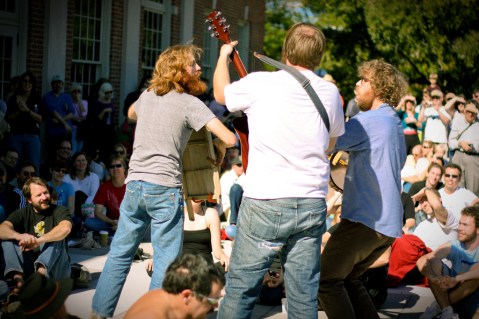
Megafaun serenades a Chapel Hill, North Carolina crowd, Image by Flickr user abbyladybug
Finally, it is worth mentioning how many papers address sound studies’ long-standing relationship with soundscapes, ecomusicology, and the environment. There is a panel called “Ecologies of Place” with papers on ecologically-minded music from places as far flung as India, Iceland, Appalachian Ohio, and Canadian parks. There is also a panel on “Urban Soundscapes,” including Robert Fry’s paper on sound, music, and branding at a hot spring resort and Mathew Robert Swiatlowski’s paper on the boom box and the Walkman in urban space.
Many in sound studies cite Jonathan Sterne’s critiques of ocularcentrism in cultural criticism. This conference encourages us to think beyond the air and stasis and shift our focus to the possibilities of liquid metaphors in cultural change.
—
Featured Image: One of Chapel Hill’s many ponds, at the Outdoor Education Center, Image by Flickr User Kat St Kat
—
Kariann Goldschmitt is an Adjunct Assistant Professor at New College of Florida and Ringling College of Art and Design. She holds a Ph.D. in Musicology from UCLA (2009) and was the 2009-2011 Mellon Fellow of Non-Western Music at Colby College in Maine. Her scholarly work focuses on Brazilian music, modes of listening, and sonic branding in the global cultural industries. She has published in The Journal of Popular Music Studies, American Music, Yearbook for Traditional Music, and Luso-Brazilian Review and contributes to the South American cultural magazine, Sounds and Colours.
—
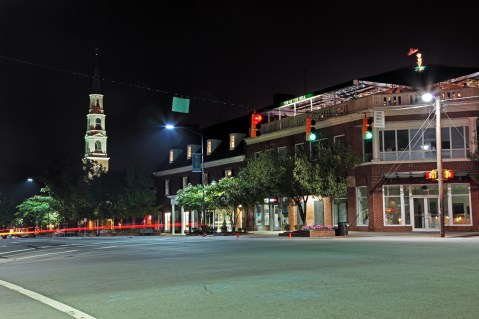
“Franklin Street, Chapel Hill” by Wikimedia user Caroline Culler, CC BY 3.0
Friday, March 14

So nice we put it twice, The James Taylor Bridge, Public Domain
.
Saturday, March 15

“Cheerleaders, UNC, 1989” by Flickr user North Carolina Digital Heritage Center, CC BY-NC-ND 2.0
.
Sunday, March 16
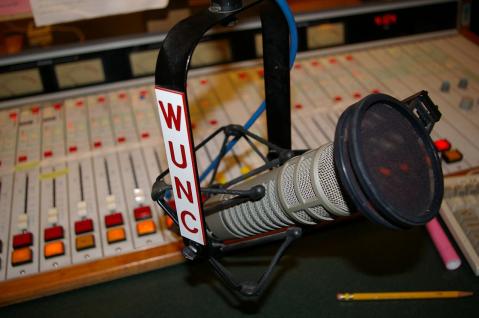
Chapel Hill’s finest, WUNC, image by Flickr user Keith Weston
Share this:

Experiments in Aural Resistance: Nordic Role-Playing, Community, and Sound

 Editor’s Note: Welcome to Sounding Out!‘s fall series titled “Sound and Play,” where we ask how sound studies, as a discipline, can help us to think through several canonical perspectives on play. While Johan Huizinga had once argued that play is the primeval foundation from which all culture has sprung, it is important to ask where sound fits into this construction of culture; does it too have the potential to liberate or re-entrench our social worlds? SO!’s Multimedia editor Aaron Trammell reflects upon using sound in role-playing games as a form of resistance. Ready, players?
—
When we play with sound, how does it influence the ways in which we understand, configure, and experience the world? I have already argued that non-diegetic sound can produce a visceral and emotive effect when connected to player interaction within a game world, that sounds are often structured within games to construct a sort of feedback between player and system, and that often within this feedback loop the narrative voice perpetuates problematic tropes of sexism and racism through its scripting. While I focused on the often dystopic production efforts of large and middle sized game companies in those prior essays, here I will be focusing on autonomous and grassroots examples of how sound is used as a way to stage social experiments which resist these often hegemonic ways that these dominant narratives constrict our views of the world.
Role-playing games, the focus of my post today, offer a more viable path of social resistance than better-known video games. Nordic larp style-games, for example, are written and played within not-for-profit communities, and they utilize themes of social inequality, transformation, and activism within their very scripts. Second, role-playing games, unlike computer games, do not require that their developers are able to code. Instead, games are often circulated by word-of-mouth, or in script format through player communities. In this sense, the genre itself is untethered from many of the problems of consumer capitalism. Many underground role-playing games are designed both around social issues and for local community needs as opposed to the market demands that necessitate big budgets, big programming teams, and few risks in the video game industry today. Finally, because role-playing games necessitate neither big budgets, the ability to code, nor mass audiences, they are an ideal site wherein game designers and referees can stage social experiments that speak to the unique wants and desires of the communities within which they are run.
In The Larpfactory Book Project, a forthcoming book containing several ready to play examples of Nordic larp (a big shout out to Lizzie Stark for hooking me up with an advance copy of this portion of the manuscript!), larpwrights Matthijs Holter and Fredrik Hossmann propose a game entitled “Before and After Silence,” focused on thinking through the collective experience of silence. From the game description:
In a world of more and more sound, silence is becoming more valuable. Before and After Silence is about limitations and listening, and about doing almost nothing. It is non-verbal and uses silence as its starting point. It is about shifting the point of view from “what is” to “what is not,” about shifting the focus from “the sounds” to “the spaces between the sounds,” from “the actions” to what is “between the actions,” and to “what is not done.” Rather than playing characters, we examine how we look at ourselves and how different filters can change how we see ourselves and others.
The game is structured as a social experiment for five to twelve players who are made to select two cards, one of which prompts players with an action they must complete only once during the hour of silence (one example reads “Go over to someone and whisper something in a language you don’t know”), and another which prompts players with a setting through which they should interpret the actions of the other players in the room (one example suggests a player imagine themselves in a community of prisoners, another makes a player imagine themselves as one in a society of telepaths). Before the game there are a set of workshops aimed at orienting players to the scope and silence of the game, and afterward there is a debriefing session where players compare their experiences of silence during the game.

Tons of great examples of work in the Nordic larp genre are in this book. Image borrowed from FransBadger @Flickr.
Unlike American larps, which often take place in high-fantasy settings and direct their action around combat scenarios, Nordic larps often focus on the everyday and comparatively mundane, and as such tend to be more concerned the problems of the everyday as well. Even those that take place in more exotic environments, such as System Danmarc, a game set in the cyberpunk future of Copenhagen, engage players in real issues regarding class and poverty. After living in a shanty-town simulating the future streets of Copenhagen for a week of game-time (In Nordic-style larps, game-time is often equivalent to real time, and so a week in-game is equivalent to a week out of game) players are shown a documentary about the actual slums of Copenhagen where they realize that their experience within the space of play was made to mirror the experience of those struggling with the these very issues in the real world.
In the case of “Before and After Silence,” it is interesting to consider the ways in which the game designers here play with sound, and how these experiments in sonic game design might provoke new modes of subjectivity. As described earlier, players are both given a particular action and or noise to perform, but also are prompted with a way to imagine the actions that the rest of the players in the room are performing. The resulting group performance is an acid dream of sorts wherein each player is made to imagine the room’s soundscape in a very different way. Is the setting a long-lost silent film, or are you drifting through an ether of emotions and past romances? The game focuses on playing with silence in a way that makes the din of communication an unfamiliar and distant memory. The game affords players an opportunity to imagine the world sound. In doing this, “Before and After Silence” displaces the dominance of the voice as a mode of communication and through this questions the ways in which we imagine the world.
Not all is perfect, however, in this utopia of resistance. As Lisa Blackman (2009) argues in her essay “Embodying Affect: Voice-hearing, Telepathy, Suggestion and Modelling the Non-Conscious,” play with the exchange of subjectivities and sound marks an ontological shift from a praxiology of what bodies are to what bodies can do (p. 170). Moving forward from her work in understanding the ritual practices of voice-hearing communities, Blackman explains that similar forms of sonic play (including play with silence) allow for the experience, embodiment, and trade of desire, fear, and trauma. In the context of “Before and After Silence,” this means that as players sculpt and adjust the sonic space of the room, they run the risk of also shaping and altering each others psychic conditions, in unpredictable and perhaps dangerous ways.
The conflation which occurs between these spaces of real emotion and play emotion is, in fact, well documented, and referred to in larp communities as “bleed.” As role-playing scholar Sarah Bowman (2013), explains in her essay “Social Conflict in Role-Playing Communities: An Exploratory Qualitative Study,” even though bleed does occasionally create rifts in relationships (some participants that she has interviewed reported in-game events disturbing their out of game relationships), others seek it out as a form of extreme play. For this reason Nordic larps require ethical behavior on the parts of their players, and because of the nature of the psychic and social sculpting which can occur within the play spaces of the game, the possibility exists that a single unethical player could create a negative and perhaps concerning experience for many others. That said, there are several ways the community mitigates the possibility of this problem including meticulous casting processes, before-game workshops, after-game debrief sessions, and safe words for use during play.

Players debrief after a game. Image borrowed from Fiezi @Flickr.
“Before and After Silence” is a valuable cultural artifact that lies at the intersection of scholarship on sound studies and serious play. At the same time that it promises several new ways to think through how sound, communication, and silence influence the how we frame and approach the world, it also raises deeper questions regarding the nature of social control and the viability of autonomous modes of organization. As silence allows players to explore and interact with a world where the soundscape takes on an increased prominence, do sexist, racist, and homophobic modes of socialization still manage to creep into the play space? And does the voice, along with its physiological and cultural embodiment of race, class, and gender, offer an escape from these experiments in silence if and when they turn dystopic?
—
Featured image: “Larp” by Flickr user marten vaher, CC-BY-NC-SA 2.0
—
Aaron Trammell is co-founder and Multimedia Editor of Sounding Out! He is also a Media Studies PhD candidate at Rutgers University. His dissertation explores the fanzines and politics of underground wargame communities in Cold War America. You can learn more about his work at aarontrammell.com.
—
 REWIND! . . .If you liked this post, you may also dig:
Goalball: Sport, Silence, and Spectatorship— Melissa Helquist
GLaDOS, The Voice of Postfeminist Control— Aaron Trammell
Video Gaming and the Sonic Feedback of Surviellance: Bastion and the Stanley Parable— Aaron Trammell
Share this:


Current Top Posts





April 2021

January 2020

November 2019

October 2019

August 2019

April 2014

November 2017

March 2015

December 2017

October 2015
 Sounding Out!
Recent Comments