
The “Tribal Drum” of Radio: Gathering Together the Archive of American Indian Radio

Over the next few weeks, Sounding Out! is proud to offer a new Thursday series spotlighting endangered radio archives across the United States, the kind of resources whose recognition and preservation could not only change media history, but also how we conceive of media history – and the voices that belong in it.
Our writers are part of an effort that is historic in its own right, the Radio Preservation Task Force (RPTF), part of the National Recording Reservation Plan at the Library of Congress. Over the past six months, under the guidance of Christopher Sterling (George Washington University) and Josh Shepperd (Catholic University), the RPTF has drawn together more than 120 faculty researchers and advisors from across the country who in turn have spread the word to create a network of more than 270 archives that hold recordings of broadcast radio, with the goal of creating a national inventory of finding aids and encouraging preservation and modernization through digital access.
If you’ve got archival broadcast radio that can’t be got online and maybe nobody even knows about — in any format or genre, national or local, high-powered or low, commercial or college, in a display or a shoebox – then we want you.
The coming months will see a second campaign of archive recruitment – I’ve taken on a role as Network Director to help coordinate that – as the RPTF rolls out a new working association with the American Archives of Public Broadcasting and gears up for a conference at the Library of Congress in early 2016, for which radio historian Michele Hilmes will be the Program Director.
Drawing on this vast effort, SO! will be bringing you stories of gaps in the record, voices we’ve long missed and need to recover, and some we are in danger of losing for good. We begin with a post by Josh Garrett-Davis, a PhD Candidate at Princeton University pursuing unique research into the long-unrecognized and uncatalogued history of Native American broadcasting.
Pursuing that history requires hard work and persistence; it also requires reimagining what counts as an archive in the first place.
— Special Editor Neil Verma
—
Despite dire poverty across most of the archipelago of semi-sovereign Native American land often called “Indian Country,” radio receivers had become a normal part of life there by the Great Depression. For example, as contemporary publications and later memoirs and oral histories reveal, after work hours in the camps of the Indian Emergency Conservation Work program (the Indian CCC) from northern Minnesota to the Southwest and the West Coast, many men and women listened to the wider world—even following Admiral Richard Byrd’s broadcasts from as far away as Little America, Antarctica.
Listeners, yes. But when did Native people take up the means of production, so to speak, and generate broadcasts themselves? In his history of Native radio, Signals in the Air, Michael C. Keith quotes several sources suggesting little sustaining programming existed until the first Native-owned and -oriented station appeared in New Mexico in 1972. As a sort of internal colony of the United States, Indian Country heard only imperial broadcasts for half a century. The “right to establish their own media in their own languages” in addition to “access to all forms of non-indigenous media without discrimination”—as described in the U.N.’s 2007 Declaration on the Rights of Indigenous Peoples—arrived remarkably late, and are still not fully granted to Native people. Quite recent are the 53 stations catering to Indian communities, and vital national programs like Native America Calling.
But Native people did speak and sing over the airwaves in earlier decades. In some cases a direct or indirect archive even exists, and undoubtedly more will emerge as radio archives more generally are preserved and cataloged through efforts such as the Radio Preservation Task Force of the National Recording Preservation Plan. The trouble is that the cumulative archive of early Indian radio has not been identified as a valuable record or really as a coherent archive at all, perhaps due to compounded misconceptions of radio as an inconsequential documentary record, and of American Indians as technological naïfs. In this post I call attention to the scattered fragments of this archive, which should be recognized as an important heritage for the recent progress in Indigenous media, echoing the various ways Native people seized limited opportunities once broadcast technology appeared.
Here is an initial attempt to quilt a few of those pieces into a pattern:
Widespread broadcasting started at about the same moment—the 1920s—as the first agitation toward tribal political sovereignty in the (constrained) twentieth-century sense. In March 1925, the Cayuga statesman Levi General, who held the ceremonial title Deskaheh, delivered an address from a Rochester, New York, studio. As transcribed in the Haudenosaunee (Iroquois Confederacy)–produced book A Basic Call to Consciousness, he began, “Nearly everyone who is listening to me is a pale face, I suppose,” and went on to appeal to those palefaces for Iroquois sovereignty on land that, like his radio signal, straddled the Canada–U.S. border (18). He urged his listeners to write to representatives in both governments and “ask them to tell you when and how they got the right to govern people who have no part in your government and do not live in your country but live in their own” (22). General certainly grasped the democratic and transnational possibilities of the new medium as he spoke directly to the citizens of two newcomer nations and plainly described to them a Haudenosaunee sovereignty that must have seemed radical.
Around the same time, the Yakama/Cherokee singer Kiutus Tecumseh (aka Herman Roberts) used his celebrity to perform on radio stations across the country, adding political commentary on Indian policy between songs. Often the songs he performed were Indianist compositions by non-Indian composers; Tecumseh was, in historian John Troutman’s words, “‘playing Indian’ with a pointed, political message” (250). Ojibwe bass singer Chief Roaring Thunder (aka George LaMotte), meanwhile, performed on KVOO from Tulsa in the 1920s, as mentioned in the contemporary press.
So far no audio transcriptions of any of these pioneering broadcasts have turned up, though in the 1970s the publication Akwesasne Notes produced a reenactment of General’s address and sold it on reel-to-reel, cassette, and cartridge.
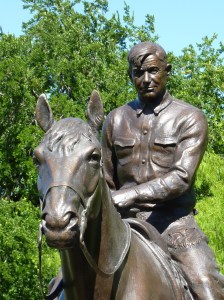
“Soapsuds and Will Rogers” by Flickr user Granger Meador, CC BY-NC 2.0
One Native radio voice of whom an audio archive remains is the humorist Will Rogers (Cherokee). Historians Lary May and Amy M. Ware have convincingly argued that Rogers espoused Cherokee values—which informed his communitarian politics—and sometimes advocated directly on Native issues. Part of the task of creating and preserving an Indigenous media archive is to recognize Rogers’s place in a genealogy: He united oratory like Levi General’s with the vaudeville sensibility of Kiutus Tecumseh and Chief Roaring Thunder. (Rogers could also stand in for a number of mainstream performers whose Indian heritage was not widely recognized, from Lee Wiley to Hank Williams to Jimi Hendrix.)
World War II brought about vast changes in Indian Country, including increased exposure on the air. Great numbers of Native people served in the war effort—notably, in terms of radio, the Navajo and Comanche “code talkers.” But back home, the first sustained radio program, aptly named the Indians for Indians hour, began in 1941 on WNAD in Norman, Oklahoma. Don Whistler (aka Kesh-Ke-Kosh), the first Sac and Fox chief elected under the reforms of the “Indian New Deal,” created the show as a model of participatory programming and (fortunately for later generations) recorded more than a hundred programs on acetate discs before he died in 1951. Indians for Indians, which served and drew performers from perhaps twenty tribal communities and several Indian boarding schools in Oklahoma, persisted in various forms until the 1980s. The only show available online is one from 1976.
I have listened to most of the extant shows from the first decade—which are not endangered except insofar as they have been ignored—and it is a remarkable institution that adopted Will Rogers’s humor and brio while also foreshadowing the vibrant Native radio networks of today.
Archives are more scarce from elsewhere in Indian Country, but traces endure in archives and history books: The renowned Chiricahua Apache artist Allan Houser performed on the air in New Mexico as “the Apache Kid.” In the 1930s and ’40s, students from Santa Fe Indian School and Flandreau Indian School performed on radio shows in Santa Fe and Omaha, respectively. I have not found any recordings of any of these instances, but a few audio archives suggest transcriptions yet to surface: A Tuscarora farm family can be heard singing “By the Waters of the Minnetonka” on Major Bowes and His Amateur Hour on NBC in 1935. NBC also covered an American Indian Exposition and the Flagstaff All-Indian Powwow in the ’30s, which gave Native singers and speakers a national hearing. A non-Indian couple recorded Hopi and Zuni singers on an unidentified station in 1955 and 1956 from Parks, Arizona, a tape which was dubbed by an anthropologist and deposited in the Archives of Traditional Music at Indiana University.
There must be many other fragments, and we can hope that broad efforts like the Radio Preservation Task Force—as well as archival efforts originating among Indigenous organizations like Native Public Media, Koahnic Broadcast Corporation, Native Media Resource Center, and Vision Maker Media—could turn up records of them.
Marshall McLuhan once wrote ominously of the “tribal drum of radio” leading the masses to totalitarianism. But that message, like the medium itself, could be interpreted in a much more constructive sense. When we gather together the early history of Native radio and assemble the intertribal quilt proposed above, the product seems to squarely refute the racial logic McLuhan implied. We may find instead that Indian people themselves recognized right away the importance this “drum” could and would have for maintaining vibrant language, musical, and oral traditions in the face of colonialism.
The Red Power movement is generally thought to begin with the occupation of Alcatraz Island in 1969–71. Part of that action was the Santee Dakota poet and activist John Trudell’s creation, “Radio Free Alcatraz” on KPFA in Berkeley, California. We might hear these programs (preserved in the Pacifica Network’s archives) as heralding a new era of reservation stations and media advocacy by Native people. We could also hear them as descending from efforts—still unrecognized and uncatalogued—by Native innovators over the previous half century.
—
Josh Garrett-Davis is a PhD candidate in history at Princeton University. His dissertation, “Resounding Voices: American Indians and Audio Technology, 1890–1969,” examines Native American use of phonograph and radio technology from the earliest ethnographic and commercial phonograph records to the founding of Indian-run labels and radio shows in the mid-twentieth century. He is the author of Ghost Dances: Proving Up on the Great Plains (Little, Brown, 2012), and a member of the collective M12, which promotes and creates art in rural places.
—
 REWIND! . . .If you liked this post, you may also dig:
A Tribe Called Red Remixes Sonic Stereotypes— Christina Giacona
Chicana Radio Activists and the Sounds of Chicana Feminisms — Monica De La Torre
Radio de Acción: Violent Circuits, Contentious Voices: Caribbean Radio Histories— Alejandra Bronfman
__
__
Special thanks to Daniel Murphy for the RPTF Logo.
Share this:

The Hell, the High Water, and the Funk of It All: Sounding Power in Scandal
Editor’s Note: Here’s installment #3 of Sounding Out!‘s blog forum on gender and voice! Last week I talked about what it meant to have people call me, a woman of color, “loud.” The week before that we hosted Christine Ehrick‘s selections from her forthcoming book; she introduced us to the idea of the gendered soundscape, which she uses in her analysis on women’s radio speech from the 1930s to the 1950s. In the next few weeks we’ll have A.O. Roberts with synthesized voices and gender, Art Blake with his reflections on how his experience shifting his voice from feminine to masculine as a transgender man intersects with his work on John Cage, and lastly Robin James with an analysis of how ideas of what women should sound like have roots in Greek philosophy.
This week regular writer Regina Bradley puts the soundtrack of Scandal in conversation with the agency of the show’s protagonist, a black woman in manages crises for a living. So, lean in and close your eyes, but keep your ears open for any spies creeping in. –Liana M. Silva, Managing Editor
–––
9:00 pm (Eastern). The quick shutter of an invisible camera calls the attention of the viewers to Scandal. The clicking re-emphasizes the show’s title, bringing to mind paparazzi and their capturing of scandalous behavior. The shuttering also signifies the literal and sonic fast paced timing of Shonda Rhimes’ most popular ABC prime time show: quickened plots, fast talks, and blink-and-you’ll-miss-something-important visual details. Scandal’s central character, Washington D.C. crisis manager Olivia Pope (portrayed by Kerry Washington), is known mostly for her sharp professional outfits and no-nonsense approach to work. In Olivia, Rhimes has created a black female character that is perfectly flawed, a symbol of both the potential power and victimization of black women. Olivia Pope is neither just the savior nor is she solely a victim.
 Scandal evokes intense debate about race and power because of its visual politics, but rarely is Scandal’s scoring prominent in those discussions. The soundtrack acts as an indicator of contemporary black women’s agency in popular culture. As both Rhimes and Scandal music director Alexandra Patsavas reveal, Scandal’s ‘vintage’ soundtrack is an opportunity to buoy the plot and add a unique alternative perspective to the action taking place on the show. The soundtrack’s nods to yesteryear artists – including Stevie Wonder, The Ohio Players, The O’Jays, Sam Cooke, Earth, Wind, and Fire, and Nina Simone sonically narrate additional layers of agency and identity on the show. Are these tracks giving Olivia a voice? What does Scandal’s scoring suggest about race, place, and power scripts for black women in contemporary popular culture?

“Inauguration Day – White House” by Flickr user Justin Brown, CC BY-NC-SA 2.0
Scandal takes place in Washington D.C., a location full of physical and sonic significance in national lore and the black popular imagination. In a national narrative D.C. is the epicenter of political agency, power, and the visibility of whiteness as a form of power. It is America’s city. Yet D.C. in the black imagination is the Chocolate City, a space that serves as a living archive of black folks’ attempts to intervene into a national narrative that would rather overlook the contributions of black bodies and culture. Washington, D.C. is the home of the Moorland-Springarn Research Center and multiple black cultural archives, Howard University and its place as the black mecca of Black Greek Letter Organizations, GoGo Music, and (embattled) social-political policies and endeavors for black people. It is a site of black identity that goes much farther than the place where everyone saw how a certain somebody had an American Dream. On the other hand, the increasing gentrification of the city raises questions of whether or not the nickname “Chocolate City” is applicable.Thus, Washington, D.C. exists at the crux of the romanticization of Americanness as a form of worldly power and the reality that (white) Americanness does not include all Americans.
 Yet Washington D.C. as a site of complex and rich black experiences does not alone buoy Scandal’s use of Washington, D.C. as a site where a black woman “handles” the hustle and bustle of American power and its upheaval. This type of work takes place in the scoring, particularly because the show is not culturally recognizable as a “black show.” Its inherent blackness is sonic, using black music to revisit tropes of power and racial politics.
One possible and albeit slightly heavy handed approach for thinking through Scandal’s leaning on funk and soul music is to point out how the show uses black cultural forms to invoke power. For example, soul songs like Otis Redding’s “Mr. Pitiful,” Edwin Starr’s “War,” and Sly and the Family Stone’s “Everyday People” are not only used to accentuate the action in a scene but the possibility of Olivia as a power figure. The use of black men’s voices as they yell, scream, and moan sonically allude to power as a masculine concept. Yet Olivia’s connection to these songs signifies her potential to wield power in unorthodox ways not associated with black women. For example, the crescendo of music before Olivia delivers a demand to her team sets up her agency as a political figure. Her blackness is amplified and earmarked by the music. This pairing amplifies the question of race and power in a useful way. The dominantly black musical script offers the critique and engagement with Olivia Pope’s blackness that many viewers and critics complain are lacking. (See the brilliant synopsis presented by Dr. Jessica Marie Johnson about Shonda Rhimes’ portrayal of black women and popular culture that took place at Duke University last month.)
Scandal serves vintage musical scoring as a double entendre: the sound of black music from previous eras evokes ‘vintage’ scripts of race, gender, and power from that era that seep into this present moment. Scandal’s use of soul, funk, and disco sonically allude to larger questions lingering from the Civil Rights Movement: integration as an equalizer of power and privilege, the hypermasculinity of the Civil Rights Era, its cultural producers, and the immediate aftermath of these scripts on (black) American society in the late 1960s and 1970s. We frequently annotate black agency through the men creating (singing?) the music. This is equally true for the black cultural productions of the era, as they aesthetically supplemented the understanding that black folks mattering connected to the uplift and healthy presence of black men. Even with soul and funk music, which stand as antithetical responses to the problematic expectations of classist respectability politics, black women’s agency was associated with the sexual, emotional, or physical agency of black men.
The blackness and “maleness” of the funk and soul used in Scandal’s score subverts the power that Olivia Pope exerts in her dealings with her clients, her lovers, and team. For example, in season two Olivia and President Fitz’s sex tape is threatened to be leaked to the public. It is important to note that the tape is an audio tape, suggestively alluding the absence of physical and visual rhetoric to address the interracial relationship. As Olivia gives the word to leak the sex tape, The Ohio Players’ track “Love Rollercoaster” begins to play. It sonically stabilizes Olivia’s decision to “leak” her sexuality as a power move while also leaving room to question the deeper implications of how the viewer navigates her blackness and womanhood using physical, aural, and cultural markers of sexuality. Using male funk and soul artists allows Pope to ‘codeswitch’ between cultural scripts of power as masculine and womanhood as opposite power. It amplifies her authority and agency while signifying that her physical appearance and voice may not have the ability to confer her worth to the audience.
This tug-and-pull of power and agency is most amplified in Olivia Pope’s dealings with her father Rowan Pope, played by Joe Morton (who plays the HELL out of this role, by the way). Rowan Pope is a literal and figurative double agent: He is Elijah Pope, a curator of antiquities at the Smithsonian, and Rowan Pope, head of the top secret and lethal U.S. organization called B613. His fragmented life speaks to the constant negotiation of “safe” black masculinity. He also embodies the anxieties about black men as violent and bloodthirsty. Rowan/Elijah encapsulates all of the swagger and vitriol associated with conceptualizations of black power and black men from the Black Liberation Era. He is cold and calculating, and he complicates the rhetoric of racial uplift and expected from the Civil Rights/Black Power movements. He speaks in hardened, hushed tones with conviction, while snarling his words with spite for white authority. Not to mention, his is the character that brings up race overtly in the show.
This balance between hushed tones and snarled words comes through in Rowan’s early interaction with Olivia during Scandal’s season three premiere. Olivia, on the run because her name is leaked as the President’s mistress, is recovered by her father and told to flee the country. Rowan is not a doting and concerned father in this scene. Rather, he is disappointed by her lack of prowess and failure to aspire to higher forms of power and authority than “first lady.” Rowan recognizes there is no power in being the wife of the President, especially as a black woman, and he criticizes her for not following the first rule of black folks’ survival: “You need to be twice as good to get half of what they have.” “They” is a collective noun for white folks, often spoken behind closed doors as a means to inspire young black folks to do better. Rowan demands she state out loud what they need to be twice of. Olivia’s voice cracks and is breathless as she whispers “twice as good to get half of what they have.” Rowan exaggerates a “yes” and dismisses Olivia as “mediocre.” It is a painful and powerful scene where multiple dichotomies take place: a father scolding his daughter, a black man undermining black women’s agency, and the fear/anxiety about black women’s sexuality as a sign of weakness and lacking privilege. The wavering volume of Olivia’s voice signifies her quickly plummeting ability to voice her power. Olivia’s loss of words amplifies Rowans’ own authority, embodied in his voice when he adamantly declares “I am the hell and the high water!” No soundtrack can save her here.
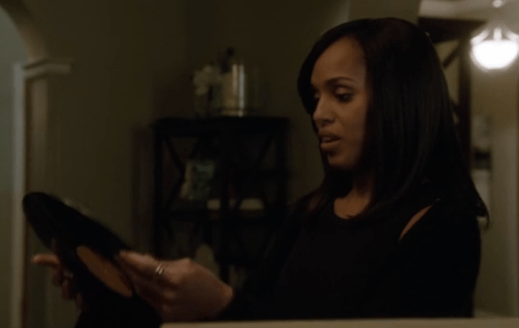
However, Rowan does have human moments, reaching out to his estranged daughter Olivia with wine and music, specifically Stevie Wonder. Her record collection is filled with Stevie Wonder. It is important that she has a record collection instead of a collection of CDs or playlist. Not only does this detail speak to the trope of “vintage” that runs through the show but also gives credence to how Olivia establishes her power. Her major moments are annotated by Stevie Wonder: when her name is leaked “Higher Ground” plays in the background. When she is kidnapped at the end of the episode for past December’s Winter finale “Don’t You Worry Bout a Thing” takes center stage. Again, the sounds of a man, her father in this instance, are the soundtrack to her work. The choice of music subverts the gender balance of power. Through male artists, the show gives Olivia her authority.
The most prominent sonic signifier is the instrumental accompaniment from the artist The Album Leaf titled “The Light.” Also known as Olivia and President Fitz’s “song,” the track plays each time the two characters interact and share intimacy (physical and otherwise).
Notes from what sounds like an electric piano playing a scale are short and sweet to the ear. The track lends its innocence and vulnerability to Olivia and Fitz’s affair and offers a possibility that their love for each other can be read as star-crossed instead of in bad taste.
Scott Poulson-Bryant offered an intriguing read on his Facebook page on “The Light” as an allusion to the Civil Rights’ theme song “We Shall Overcome.” This reading of “The Light” as the context to Olivia and Fitz’s relationship makes room to complicate how Olivia’s agency as a black woman is historically and politically bound to women before–she alludes to her similarity to Sally Hemmings in one episode. Olivia’s Sally Hemmings reference uses Hemmings as the genesis point for understanding the complexity of Olivia’s sexual encounters as well as how to navigate black women’s sexual agency – and pleasure – in popular spaces. Sally Hemmings’ relationship to President Thomas Jefferson lends historical credence to Olivia and Fitz’s Scandal but also signifies the gray area of historical memory, cultural expectations, and consent as a form of power for African American women. “The Light” instrumental is not only a sonic accompaniment of Olivia as she relates to Fitz but her own struggles to recognize and balance her public and personal agency.
The soundtrack of Scandal gives a voice to not just Olivia’s authority in a place where race and power are intertwined but also a voice on national television to how whiteness and political power operate. Scandal’s controversial protagonist/anti-hero Olivia Pope is often central to recent discussions of race, gender, and popular culture. But the soundtrack to the show asks viewers to not just watch closely but also listen closely. Tune out and you might miss something.
—
Regina Bradley recently completed her PhD at Florida State University in African American Literature. Her dissertation is titled “Race to Post: White Hegemonic Capitalism and Black Empowerment in 21st Century Black Popular Culture and Literature.” She is a regular writer for Sounding Out!
—
 REWIND!…If you liked this post, you may also dig:
SO! Reads: Shana Redmond’s Anthem: Social Movements and the Sound of Solidarity in the African Diaspora—Ashon Crawley
Freedom Back: Sounding Black Feminist History, Courtesy the Artists–Tavia Nyong’o
They Do Not All Sound Alike: Sampling Kathleen Cleaver, Assata Shakur, and Angela Davis—Tara Betts
Share this:


Current Top Posts





April 2021

January 2020

November 2019

October 2019

August 2019

April 2014

November 2017

March 2015

December 2017

October 2015
 Sounding Out!
Recent Comments