
Unsettling the World Soundscape Project: The Bell Tower of False Creek, Vancouver

 Welcome back to Unsettling the World Soundscape Project, a series edited by Randolph Jordan that looks critically and creatively at early acoustic ecology along with the writings and subsequent compositions of WSP members, assessing its continuing role for sound studies today. This series follows strongly in the spirit of “Sound Studies 2.0,” a running theme here on SO! this year that Editor-in-Chief Jennifer Stoever has described as “the movement of the field beyond the initial excitement for and indexing of sound toward new applications and challenges to the status quo.”
In the first article of the series, Mitchell Akiyama unpacked the WSP’s monumental ten-hour Soundscapes of Canada of 1974, situating the broadcast’s innovative work historically while also pointing out problems of diversity and representation that could inform how we might listen and create in the future. In this second article, Guest Editor Randolph Jordan offers some of his own highly innovative research, drawing on the notion of “unsettled listening” that he described so vividly here last summer, and focusing on how sound calls attention to territorial boundaries and contested land appropriation from Native peoples of Vancouver.
—
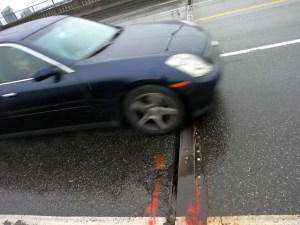 For a few months in 2013, an intense clanging sound emanated from Vancouver’s Burrard Bridge spanning False Creek. A pothole on the surface had opened up next to the metal connector sitting directly atop of the southwest concrete pillar on the shore, activated by passing traffic and intensified by the hollow concrete structures below.
By coincidence, the pothole’s acoustic profile, the “area over which it may be heard before it drops below the level of ambient noise,” was roughly equivalent to the east/west boundaries of Kitsilano Indian Reserve at its peak acreage established in 1877.

Detail of Vancouver map by Shell Oil, 1951, courtesy of the David Rumsey Map Collection
In the century to follow, the reserve would be carved up for a variety of uses and by 1965 it was gone. But in 2013, 100 years after the government – without securing official title to the land – paid the reserve’s residents to leave, the sound of the pothole set the past resonating as the rhythmic clanging reached out to draw the surrounding acoustic environments together while sounding out their roles in contesting indigenous claims to the area. Fitting, then, that the hole sounded loudest directly under the bridge on the south shore, site of newly restituted reserve lands awarded to the Squamish Nation in 2002 after the decommissioning of the railway passage that marked the original reserve’s first transgression in 1899.

People on Kitsilano Indian Reserve beach by Burrard Street Bridge, 1932. Photo credit: City of Vancouver Archives, Item AM54-S4-: Park N9.6
The sound of bridge traffic calling attention to contested land use challenges stereotypical notions about indigeneity in the modern city by upending biases against urban noise pollution typical in early acoustic ecology and exemplified by the work of the World Soundscape Project (WSP). The pothole sound became the locus of my investigation into the value of thinking longitudinally across the Vancouver archive of the WSP, the first assignment given to me by original member Barry Truax as supervisor of my postdoc at Simon Fraser University from 2012-14. I argue that if we use urban noise as a tool for mapping out uncomfortable and subordinated histories, we can rethink the effects of such urban noise on the articulation of cultural space across the WSP archive and imagine new possibilities for future iterations of the project’s Vancouver research.
First question: what documentation of traffic noise around Burrard Bridge exists in the WSP’s three major sets of documentation in Vancouver from the ‘70s, ‘90s and 2010s? Using the Google Map I created to plot recording locations across the archive, I listened to those from which bridge traffic might have been audible. Sure enough, the sound of bridge traffic is present on the original ’73 tapes recorded nearby. In fact, the ‘73 release of The Vancouver Soundscape LP addresses these bridge recordings in a conversation between project director R. Murray Schafer and the recordists, who describe this traffic noise as a source of frustration while attempting to capture the sound of tinkling masts from the boats in the marina beneath.
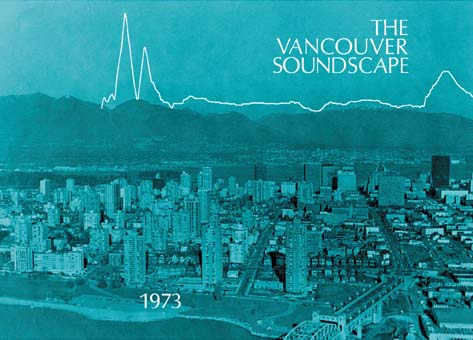
Here the message seems clear: traffic noise is blight upon more valued sounds in and around the city. This position is corroborated by the very cover of the LP that features a graphic representation of a soundwave from a recording of chirping frogs interrupted by a passing car, the example of urban imbalance with which Schafer concludes the final side of the album.
 A few years after the ’73 release, however, Hildegard Westerkamp and Bruce Davis wrote the catalog page for the original set of tapes in which they refer to the traffic sounds as a “noisy, broad wash” that “frames the delicate rigging tinkle of the moored boats.” This is a more aesthetically motivated take on urban din that Westerkamp explores to creative effect in her 1986 piece Kits Beach Soundwalk. A decade after that, Robert MacNevin wrote in the catalog notes for his recording under the bridge that the rhythm of the traffic was part of the “very beautiful” fabric of this sonic tapestry that included the masts swaying in the breeze. This shift in attitude also played into the presentation of the archive on the ’96 Soundscape Vancouver CD. Now under the direction of Barry Truax, this second release featured a selection of soundscape compositions that celebrated all manner of urban sounds as interesting in their own right.
It was very difficult to ascertain whether or not the traffic sounds in these recordings were in any way connected to potholes on the surface. Yet hearing Vancouver’s urban sound through the shifting perspectives of the WSP’s contributing members provided a framework for assessing the value of their work. So I turned to the next question: how might hearing urban noise like bridge traffic, as “staged” by the WSP, contribute to listening to the area in a way that can unsettle its appearance of stability and reveal the tense histories of contestation that have defined it since the time of first contact through to the present day?
On the issue of cultural politics we find less progress across the two official Vancouver releases. Both make some mention of indigenous presence in the land and tie these references to their concerns over urban noise pollution. The ’73 LP opens with the sound of the ocean primordial, lapping against the shore, with wind and birds following in short order. Amidst these, the voice of a Squamish man begins speaking in his native tongue, soon interrupted by an emerging seaplane flying low overhead, ushering in the era of Vancouver’s incorporation as a city and the ensuing industrial development. Only someone who understands the spoken language here will know if the WSP’s narrative runs counter to the story being told by the Squamish man, for no translation is offered either in the grooves or within the jacket.

Display Table for the British Columbia Indian Homemakers Association at Vancouver’s Pacific National Exhibition, 1971. Photo credit: City of Vancouver Archives, Item AM281-S8-: CVA 180-6851
Well-intentioned though they were, the WSP’s problematic construction of machine noise as despoiler of the wilderness is made worse by putting the only voice given to indigenous peoples in the service of this didactic construction. In so doing they contribute to relegating urban indigenous presence to a thing of the past rather than accounting for the consistent and continuing presence of First Nations communities in the city – a luxury they afford to the Greek and Chinese communities later on the disc when these are presented as vibrant and living parts of Vancouver’s modern fabric in a track entitled “The Music of Various City Quarters” (a multicultural gesture they would move away from on the trip across Canada that Mitchell Akiyama unpacked in the previous post in this series).
Similarly, in a brief documentary about Vancouver’s changing sounds on the ’96 release, Westerkamp comments on the intrusive presence of the air conditioning system in the Museum of Anthropology on the U.B.C. campus, marring visitors’ experience of “some of B.C.’s most fascinating Native artifacts.” Westerkamp’s respect for indigenous culture comes through clearly enough. Yet the WSP’s presentation of local indigeneity takes a step backward here as the living voice speaking a dying language heard in ’73 has given way to just plain old dead people in ’96, best contemplated in the quietude of Arthur Erikson’s high modernist design for the building.
 The WSP might just as easily have critiqued this space as an example what Schafer has called the “glazed soundscape” in which sound is cut off from the world visible through large windows, an architectural situation that emphasizes the disconnection between the indigenous culture on display within and the living Native presence in the city outside the museum walls. The fact that the building’s design heightens the perception of the ventilation sound is, like the pothole on the bridge, an example of how urban noise can be heard to mark out indigenous displacement in the city.
Standing under the bridge on the 40th anniversary of the 1973 recordings, and the 100th anniversary of the reserve payouts of 1913, I imagined the pothole as a recasting of the church bell as marker of territorial boundaries, sounding out the colonial encroachment of municipal infrastructure upon 19th Century reserve lands well into the 21st. And so in a multimedia work on the site, I dub the bridge the “Bell Tower of False Creek” for its power to unsettle ideas about the role of urban noise in articulating culture in the modern city, and I wonder what shape the next WSP release might take.
The key lies in deeper consideration of the intersection of soundscape composition and the WSP archive as mutually enriching sites of practice. The positive move on the ’96 release came in actively putting the ‘90s archival recordings in dialogue with the ‘70s material, creatively exploring longitudinal relationships in ways that move in the direction of the post-Foucauldian thrust for artists and researchers to “use archives in a more self-conscious way” as Jaimie Baron puts it (3). Yet they stopped short of “actively promot[ing] a critical attitude towards [the materials] and their uses within the institutions” from which they originate, a key characteristic of archival collage identified by William Wees (47).
The time is right for a critical investigation of the ways in which the WSP’s own construction of the archive itself has delimited its possible uses and how they have controlled the staging of its content these past four decades. In so doing, they might also become more culturally astute in assessing how their biases against certain kinds of urban sound have shaped their presentation of the cultures that live within earshot.
—
Randolph Jordan wanted to be a rock star. Now he teaches cinema and the humanities at Champlain College and Concordia University in Montreal. Draw your own conclusions. After completing his Ph.D. in the interdisciplinary Humanities program at Concordia in 2010 he took up a two-year postdoctoral research fellowship in the School of Communication at Simon Fraser University. There he investigated geographical specificity in Vancouver-based film and media by way of sound studies and critical geography, research that will inform the last chapter of his book An Acoustic Ecology of the Cinema (now under contract at Oxford University Press). If you can’t find him hammering away at his manuscript, or recording his three young children hammering away at their Mason & Risch, look for him under Vancouver’s Burrard Bridge where he spends his “spare time” gathering and shaping film and sound material for his multimedia project Bell Tower of False Creek. Or visit him online here: http://www.randolphjordan.com
—
All images provided by the author, unless otherwise noted.
—
 REWIND! . . .If you liked this post, you may also dig:
SO! Amplifies: Cities and Memory — Stuart Fowkes
Listening to Disaster: Our Relationship to Sound in Danger — Maile Colbert
Unsettled Listening: Integrating Film and Place — Randolph Jordan
Share this:

The Screech Within Speech
 Welcome back to SO!‘s Sonic Shadows series, which focuses on what it means to “have a voice.” In the first post in the series, I considered the role of the novel in sound studies, and how, paradoxically, this led us back to the embodied voice of the writer. In Joseph Conrad’s prose, traces of accent and translingualism shape the sonic space of difference, but also reframe the novel as a social, yet ambiguous act of communication.
This week, I’m happy to welcome Dominic Pettman, who picks up the question of the embodied human voice as it brushes up against the animal in what he calls the “voice of the world.” Next week, the series will conclude with uncanny mechanical sounds of early recording that trouble the voice of the human from within.
— Julie Beth Napolin, Guest Editor
—
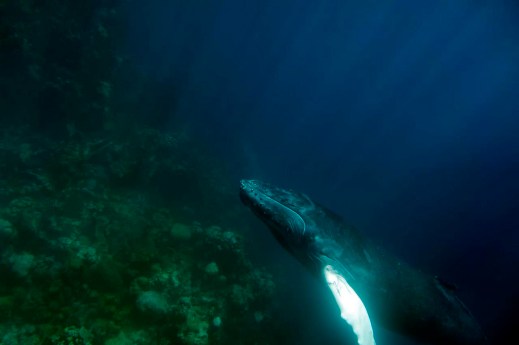
This is the sound of “the loneliest whale in the world.”
Scientists have tracked this mournful creature for several years, intrigued by the melancholy songs, which go unanswered. The call of this singular cetacean, an Internet cult figure of unidentified species, registers at the unusual frequency of 52hz, much higher than that of all other types of whale.
These days, in general, whales have been forced into relatively tiny sonic boxes because of the din created by ship engines and various audio probings of the marine environment by military and industry alike. As bio-acoustician Christopher Clark, suggests, this assault and subsequent diminishment of the whale’s soundscape must be extremely traumatic for the animal, whose overall umwelt has shrunk from large swathes of the watery planet to barely a mile or so in any given direction. The noisier the ocean becomes the lonelier whales are likely to become.

“anim1083” by Flickr user NOAA Photo Library, CC BY 2.0
The 52hz whale is a bit like an outsider artist, offering personalized songs to the sub-aquatic world, only to be snubbed by the more “vocal” members of whale community. Cetaceans could arguably be considered the first instance of global communication, many millions of years ago, since their calls could travel astonishing distances – up to 500 miles under water. Songs of the humpback, for instance, can “sweep across the Pacific in just a few years,” as biologists from the University of Queensland explain. “In any given year, all the males in a population sing the same song, but the songs change from year to year. The changes are more than incremental; they represent whole new repertoires.”
Can we really, however, speak of singing in such cases? Many would argue that simply using the organ of vocalization does not equate to singing in that it lacks the element of self-reflection necessary for true expression; for artistry. Others have conversely argued that humans were likely taught to sing by other creatures, especially the birds. These perspectives on the question of the interspecies voice have a long and complex history, crisscrossing epochs, as well as those divergent orientations to the natural world crudely divided into “East” and “West.” In this post, I focus on what it means to try to hear the animal beyond or through human terms, to explore the question of who or what can rightly claim to have a voice – is it a property or capacity that belongs to a subject, even a nonhuman subject? Might we consider voice to include “expression” of the elements themselves? Might the world itself, whatever such a grand phrase might denote, have a vox mundi – a voice of the planet?

“Angry” by Pixabay user PublicDomainPictures, public domain
Such questions deserve long and careful consideration, [and SO! has housed a series of reflections on acoustic ecology and a singing planet.] But in this brief context, I focus on the historically contested existence of a creaturely voice – one which describes a plurality of vocal expressions, distributed among those species blessed with the capacity to make sounds with their bodies. As Tobias Menely explains in a wonderful new book, the creaturely voice, like the human one, forms the vector of sympathy; and is thus suspended between the individual producing the sound, and the one listening to it. Through “the voice of nature” we understand our essential “creaturely entanglement” with other animals. This perspective pushes Mladen Dolar’s psychoanalytic theory that voice ties self to other to include the nonhuman experience of the animal realm.
Menely argues for a condition of social identity in “creaturely voice,” which is a way of testing the world, and one’s location, role, and value in it. In other words, monkeys, birds, whales, and so on, test their own existence when they emit non-symbolic equivalents of, “I’m here.” “Where are you?” “Are you really there?” “Who are you?” “Marco.” “Polo.” These are the unspoken – and yet at least partially communicated – messages woven into the ever-vanishing, yet always returning, medium of the voice.
Take, for instance, the parrot or cockatoo. We humans have been fascinated by these birds, largely by virtue of their perceived organic capacity to “record” our own voices, and throw these back at us, like trickster ventriloquists, long before the invention of the phonograph. Certainly, this can create an uncanny effect in the human listener: hearing our own voice echoed back from the larynx of a creature so different from ourselves – a creature that may or may not have its own mind or soul. Historically speaking, many people who had their figurative feathers ruffled by the impertinence of parrots deflected the discomfort they felt, upon hearing their own words screeched back at them.
This pet parrot, who had clearly been in the room when its owner was watching X-rated material, recently became famous. The instant mirth, and/or discomfort, that this clip produces is a function of hearing ourselves, as humans, echoed back by an animal. Our words are “rebroadcast” back to us by an entity that has no sense of irony or decorum. It is literally obscene. It is as if the world were engaged in objective parody of the planet’s most arrogant animal: revealing one of our most sacred activities (“making love”) to be little more than a kind of crude ventriloquial trick. This parrot is not deliberately lampooning us, yet, the refrain created by the bird’s imitative tendencies means that we are lampooned nevertheless.
Another famous pet cockatoo was given to a new couple after a bitter divorce obliged it to find a new home. The details of the break-up remain obscure to the second owners. However, this (traumatized?) cockatoo re-enacts the tone, pitch, and vehemence of the arguments that it was obliged to witness in its previous life. While most of the “words” the cockatoo screeches are not clear enough to be translated, the emotions that initially launched them are obvious to all within hearing distance. The bird even bobs its head, and spreads its wings, in imitation of the angry body language of a wife scorned, spurned, or otherwise so aggrieved that she can only incessantly shriek at the man who made her so miserable. Whose voice is this, then?
Parrots are like children, some might claim, squawking back syllables they will never comprehend. One might as well yell into a cave, and be astonished that the words return as a consequence of physics. Bird songs, according to such a concept, create what Gilles Deleuze and Felix Guattari call “a refrain,” which in turn generates a territory through the act of sonically diagramming it. This operation is not limited to the natural world, however, since we may say the same about television sets or saxophones.
Consider how children, or lovers, playfully imitate the speech of the other. In doing so, they assert their own identity, while also putting such an identity under erasure. Many animals (including humans) may thus be creatures who continue to flesh themselves out in(to) this territory. But instead of the animal echoing back the human, what about the reverse? As a final example, consider one famous instance of simulated human suffering, “devolving” into a creaturely register; namely, the old literature professor, Dr. Immanuel Rath, who experiences a nervous breakdown when he succumbs to intense jealousy and a broken heart, at the climax of Josef von Sternberg’s classic film, The Blue Angel (1930).
Just as the full weight of his rejection, at the hands of Lola Lola (Marlene Dietrich) is being registered in his psyche, the professor – who has quit teaching to follow his beloved in the cabaret world – is ushered out onto the theatrical stage, dressed as a clown. The audience waits in skeptical anticipation of an amusing performance, but the haunted ex-professor can only unleash a torrent of repressed anguish at his broken heart, and his humiliation at the hands of the vulgar mob. The horrible sound he releases, silencing the crowd, is part spurned lover, part rooster, and wholly abject. The professor seems to lose almost all his humanity, which was once verifiable in his composed and authoritative teaching voice, but is now some kind of demonic bird, screeching in misery, fury, and defeat. As this seemingly mindless force of vengeance tries to strangle his romantic obsession backstage, and as he continues to struggle against those who restrain him, the ex-professor has become creaturely: a supposedly subhuman status signified more by his inhuman voice than by anything else.
And yet, as we have seen, there is no simple hierarchy here, where the human occasionally – in times of great distress – finds themselves, by this logic, reduced to being “an animal.” We might call this the vox mundi – the voice of the world—in which, like the shadowy depths of the ocean, there is a swath of sound shared by human and animal. The creaturely voice can be sweet, like the nightingale. Or it can be harsh, like the traumatized cockatoo or the green-eyed professor-clown. There is an intimate link between the voices of animals and those of humans, which cannot be reduced to a concept like “communication,” but which nevertheless impacts and influences all those in hearing distance.

“Humpback Whales” by Flickr user Christpher Michel, CC BY 2.0
That is, unless one happens to be a whale, singing at 52hz. In which case, we are likely to keep singing into the inky darkness, without any reply.
—
Dominic Pettman is Chair of Liberal Studies, New School for Social Research, and Professor of Culture & Media, Eugene Lang College. He is the author of several books, including Look at the Bunny: Totem, Taboo, Technology (Zero books), and the forthcoming Infinite Distraction: Paying Attention to Social Media (Polity).
—
Featured image: “Humpback Whales” by Flickr user Christopher Michel, CC BY 2.0
—
REWIND! . . .If you liked this post, you may also dig:
Animal Renderings: The Library of Natural Sounds — Jonathan Skinner
Sounding Out! Podcast #34: Sonia Li’s “Whale” — Sonia Li
Sounding Our Utopia: An Interview With Mileece — Maile Colbert
Share this:


Current Top Posts





April 2021

January 2020

November 2019

October 2019

August 2019

April 2014

November 2017

March 2015

December 2017

October 2015
 Sounding Out!
Recent Comments