
Within a Grain of Sand: Our Sonic Environment and Some of Its Shapers
“It devolves on us now to invent a subject we might call acoustic design, an interdiscipline in which musicians, acousticians, psychologists, sociologists, and others would study the world soundscape together in order to make intelligent recommendations for its improvement.”
–R. Murray Schafer
The Soundscape, Our Sonic Environment and the Tuning of the World
With those words, and with that book, Canadian composer, writer, educator, and environmentalist R. Murray Schafer introduced the concept of the soundscape…a sound, or combination of sounds, that forms or arises from an immersive environment. What follows is an exploration of how several key field recordists define and explore the notion of soundscape.
1. What do you do?
I capture moments.
I explore environments & structures using conventional & extended field recording methods. I also use instruments & small objects. Sometimes I perform live intuitive compositions, sometimes I install work & often I compose photographic scores.
For me it is the emotive impulse that most inspires.
I listen.
2. What can that tell us?
I believe passionately that one of the most important results of an exploration of overlooked detail in daily life (in terms of sound as well as visual elements) is how it can enhance ones life. It can allow us to engage with our surrounding in different ways & appreciate what remains & what has gone before or indeed is in danger of disappearing.
it can tell us that listening is a much, much broader vista than we all understand & one can spend a lifetime exploring.
photo: carina martins
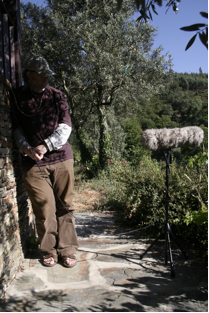
The study of the soundscape, called Acoustic Ecology, focuses on the relationship between living beings and their environment through sound. It’s a unique field in its interdisciplinary nature and beginnings, an interconnectivity between scientists, sociologists, anthropologists, and artists.
1. What do you do?
I am part of the organization Binaural/Nodar, which organizes educational and artistic creation events focused on a rural region in northern Portugal. Our creative focus is on sound and media arts that work with the natural and human environment of the region. As part of our activities, we organized a program of artist residencies dedicated to the river than passes through our region (Paiva river), which culminated in the Paivascapes festival, which took place in March this year. This was a multidisciplinary event that included a series of site-specific sound installations, a retrospective exhibition of sound and audiovisual works at a local museum, conferences on anthropological and environmental issues and nature walks. The festival had an itinerant nature, as it’s program was conceived to happen in several locations from the source to the mouth of the river.
2. What can that say?
The rural environment where we develop our activities has been inhabited for at least tens of thousands of years and each generation left their mark on the territory. So, we understand it as a infinitely complex, stratified and fragmented reality that most of the times cannot be fully comprehended if the approach is superficial, limited in time, based purely on a ‘naturalistic’ view of it that manifests itself for example on experiencing and recording the bucolic sights and sounds. It requires a more ‘relational’ approach, where what we see and listen to is mapped against other elements, stories, individual and collective memories, place names, old and new usages of the space, etc., which requires time, attention and empathy. We take these concerns on every aspect of our work such as which art projects to select, how and where to publicly present the works, how to mediate the relationship between the artists and the local communities.
-Rui Costa of Binaural/Nodar
photo credit: Binaural/Nodar
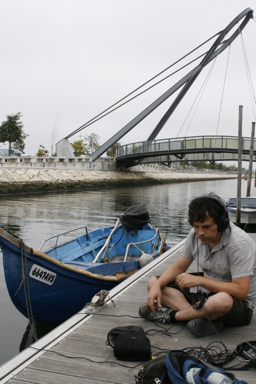
Acoustic Ecology has branched out to give birth to a movement in sound art called phonography, a neologism referring to the art of field recording. It’s also shown a spotlight upon our changing sonic environment, and has become an important tool in bioacoustics and biomusicology, which help us to understand what these changes can mean. Birds communicate mainly with sound. When their calls cannot be heard, their reproduction decreases. Scientists are working with acoustic ecologists to record and study environments in which this is happening. Some of these bird calls may someday only survive on these recordings.
1. What do you do:
I am interested in the common, the everyday and the ordinary in my art practice; and in the unnoticed, the trivial and the repetitive that constitutes daily life. The birds I am interested in have ambiguous reputations and are considered pests or nuisances but they are also loved and respected. Seagulls, crows/corvids and pigeons are all very sociable species and are often much more audible than visible and they proliferate in the favorable conditions we have provided in urban centers.
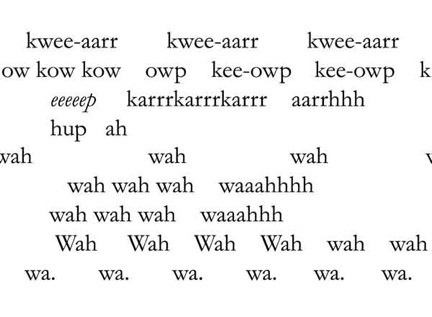
‘birdbrain’ focuses on our relationship with crows (corvids) and seagulls through voice (animal/human) and ideas about language (animal/human), including the spoken and written word. There is little philosophical discussion about animal voice, although the potential for animal language parallels current neurobiological research, which has identified that certain ‘motor and perceptual abilities’ essential for language in humans, also exist in birds.
2.What can that tell us:
The project has a number of components including an artist’s book that is posing as a mock field guide. The field guide comprises written texts of exchanges between a group of Little Ravens that I have transcribed over the course of a year using the phonetic words from conventional field guides.
The audio works consist of field recordings, mimicry and texts spoken by people with different accents. Scientific research tells us that birds also have regional accents and dialects, and that birds change their song according to place. Birds in cities sing more loudly to cope with urban noise and these songs tend to be simplified. Also, birds that have been introduced into different countries sing a song that is a variant from their brethren back in the homeland.
still from birdbrain, catherine clover
Cymatics is the study of sound waves made visible. Sound frequencies vibrate a surface and create distinct patterns. Sound needs a medium to vibrate, and the characteristics of the medium and sound wave will inform the shape. If you place a metal plate upon a speaker head, place sand upon that plate, and play certain frequencies through the speaker, you will see the sand vibrate into different patterns. If we could see sound around us, we would see expanding spheres with a kaleidoscopic-like pattern on its surface, effecting each other and all molecules in its path.
The interconnectivity of our world is often over looked, often not thought about. It is human nature to categorize, this is part of how we think and communicate. But what is lost when we consider our categories as islands, instead of a part of a whole, a pattern of overlapping systems? There is a saying that the whole of earth and ocean is found within one grain of sand.
1. What do you do?
I am an artist and composer who focuses on listening and the environment in my work. I am often recording my life and my travels, and the recordings or my observances from the recordings end up in my compositions, art installations, and soundwalks. In 2004, I was fortunate enough to find other people interested in sound and the environment and together, we formed The New York Society for Acoustic Ecology (NYSAE), a chapter of the World Forum for Acoustic Ecology. Through various organizations like the Whitney Museum, the Electronic Music Foundation, and free103point9, we have held events, panel discussions, and performances relating to sound and urban ecology. I am often asked how I “got into sound” and I usually don’t know how to answer it as it feels like I never got out of an interest in acoustics and space. I think that my interest in sound began when I carried around a tape recorder instead of a doll as a child. Perhaps not much has changed as I feel like my compositions reveal a layer of personal narrative conveyed through field recordings that describe how I relate to my environment. Often, my soundwalks do not include sounds that I have recorded; they are about sharing with others what I discovered about listening to the acoustics of a particular place. Points of interest are carefully arranged in guided tours with conceptual elements that emerge as sub-themes.
2. What can that say?
I am mostly interested in the relationship between people the sounds of the urban environment, particularly on how nature is defined by those who live in urban environments. When we slow down to listen to all that is in-between point A and point B, I think that we can begin to enjoy the fine details, even in a noisy city environment. I’ve worked with both children and adults in educational settings in cities who didn’t realize that they had birds living on their street until they were encouraged to listen. And I’ve discovered things like some people don’t like the sounds of birds at all, and they may prefer listening to the sounds of the subway. Sound can be just as subjective and adaptable of an art material as paint.
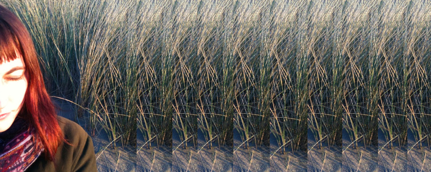
A drop of water falls into a puddle and creates a wave. A wave is a disturbance that travels through time and space. It affects everything it touches, it creates other waves, it continues colliding and transferring energy to molecules that do the same in turn to other molecules. It can be water, it can be light, it can be sound. It can be many things that collide into our molecules, and our system translates. The water is cold, the light is bright, the sound is loud. This is passive information. But when we actively feel how cooling the water is on a very hot day, when we actively consider how strong that sun is, and when we actively enjoy how the crash of an ocean wave makes our heart race…our world becomes so much richer.
1. What do you do?
Soundscape compositions, soundwalks, listening workshops, lectures, writing, editing, some mentoring of composition students, organizing as part of the World Forum for Acoustic Ecology (WFAE) and so on…
2.What can that say?
Everything I do seems to be focused on understanding the world through the act of listening and on the desire to share this understanding with as many people as possible. I believe that every sense perception gives us valuable and important connectedness to and information about the world in which we live. Our hearing sense has been underutilized (certainly in my lifetime, in our societies, nowadays) and a re-balancing of our senses may mean a re-balancing of how we approach life, environment, culture, politics and ideas. Experience in listening and composing has shown me ever new, changing and deepening approaches to space and time. And I wish this for everyone who learns to connect more consciously and deeply to his or her listening. What can that say: listening means noticing means inspiration means energy to do and act.
Hildegard Westkamp, Photo by Peter Grant
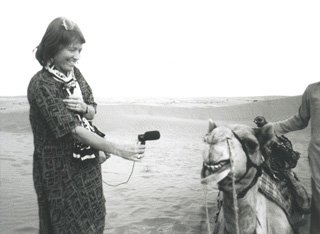
World Listening Day is July 18th. You can participate through the World Listening Day organization. Or just take the time, whatever you are doing, to stretch your ears and focus them on the rich acoustic world around you.
1. What do you do?
The World Listening Project maintains a website and online forum about its artistic and educational activities, including public workshops, forums, and lectures, as well as participating in exhibitions, symposiums, and festivals. Phonography and Acoustic Ecology inspired all of this. In the Chicago area, where we began, we formed the Midwest Society for Acoustic Ecology, a regional chapter of the American Society for Acoustic Ecology. We’re busy now inviting people to participate in the 2011 World Listening Day on July 18, the date of R. Murray Schafer’s birthday. If you visit our website you can learn how to celebrate. It’s quite open and last year the response was phenomenal.
2. What can that say?
Hearing tells us where to look. Wherever we are, every place on the planet has its own soundscape. From moment to moment the soundscape is always changing, often unpredictably. Depending on the time scale, dynamics, and frequency range we can choose to focus attention on. The World Listening Project suggests that listening is active, not passive: that listening means paying attention to the world. And when we do that we can begin to change it in a way conscious way. Bernie Krause has been a supporter. He’s making waves in the field of soundscape ecology. This is what Bernie says: “Western society bases most of what it knows on the visual. We actually ‘hear” what we ‘see.’ The World Listening Project aims to transform that perception in our otherwise urban centric and abstracted lives. At a time when we are facing not only a silent spring, but a silent summer, fall and winter, as well, it is clear that where a picture is worth a thousand words, a soundscape may soon be worth a thousand pictures.”
T


Share this:

“Sensing Voice”*
*a longer version of this piece is forthcoming in Senses & Society 6 (2), July 2011.

Bathroom Recital 2007
In 2007, I received an invitation to a recital that would take place in my bathroom; the artist offered to present an underwater concert in my tub. My reaction? “Crazy,” I thought. “Why go to the trouble of singing in an element so far from ideal?” After a year of mulling it over, though, I finally realized that what I had dismissed for its hopeless impracticality might—precisely because it was impractical—offer fresh perspectives on singing and listening by resituating these familiar activities in vastly unfamiliar territory.
The underwater singing practiced by contemporary American soprano and performance artist Juliana Snapper challenges audiences to confront their unexamined assumptions about the relationships between the voice and materiality, the sensed and the singular. How do the physical and sensory properties of singers’ and listeners’ bodies affect and participate in the music we create and the sounds we hear? How do the physical space within and the matter through which sound travels shape what we hear? And how do the relations between these aspects affect what it feels like to sing, and what it is possible to hear?
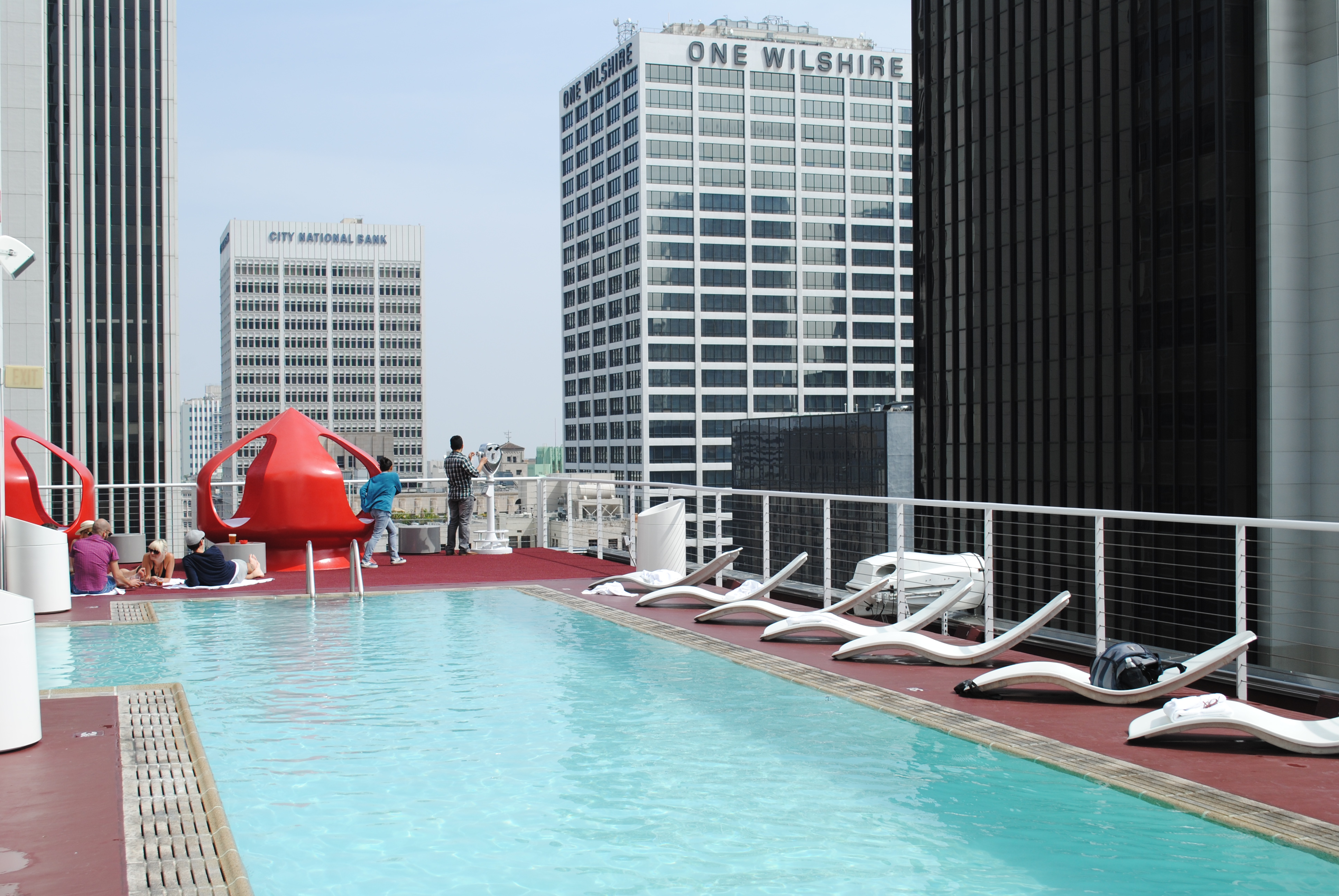
The rooftop bar at the Standard Hotel, downtown LA
During the spring of 2010, while I was working on an article about Snapper’s project and teaching a seminar on the multi-sensory aspects of music, Snapper offered to mount a participatory version of her project for my class. She took us through some exercises in a large swimming pool in downtown Los Angeles. The first exercise paired us up; one person gently held the other under water, while the person underwater made sounds. I was paired with Natalia, who shouted––but with my ears above the water I couldn’t hear her voice.

The author with Natalia Bieletto (under water). Aquaopera #4/Los Angeles, 28 April 2010.
So we tried another strategy: one person made sounds underwater while the rest of us put our heads and ears in – and then we could hear her. We found that the deeper into the water we descended, the more difficult it was to sing high notes. Fast tempi were also difficult to maintain; Natalia’s attempt resulted in muddled sounds.
We found that the deeper into the water we descended, the more difficult it was to sing high notes. Fast tempi were also difficult to maintain; Natalia’s attempt resulted in muddled sounds. Surprisingly, while sung sounds didn’t seem very loud, small internal throat sounds were incredibly powerful. These exercises demonstrate how much the medium through which sound waves flow affects their characteristics: their speed, direction and so on. It also shows that in order to register sound, the listening body (including the head) must be immersed in the material through which the sound flows.

The next exercise linked the six of us together
The next exercise linked the six of us together by the arms; three participants stood in a line, with their backs against three others. We sang in a drone-like manner, playing with our voices above the water, at its surface, and then slowly sinking into it. We felt the sonic vibrations largely through direct contact with each other’s bodies. Of course sound also passed through the air and water, but because the most immediate path was from one body to another, this was the sensation that overpowered us.
At the end of the day, gathered around the poolside fireplace, we discussed how different singing felt in a liquid environment. We’d discovered that aural experience is predicated on physical contact with sound waves through shared media, in this case water and air, flesh and bone. We noted that the shared medium makes a great differenceto how we experience the voice, and that the sound we ultimately hear depends partly on what is sung, and partly on the medium through which it passes (and how our bodies interact with that medium). In other words, in Snapper’s workshop we discovered that sound is a multi-sensory experience, tactile as well as aural. It also became clear that sound and music involve much more than traditional theories and notation can capture. (For a more thorough discussion of the differences between singing and sound underwater and in air, please see my forthcoming article.)
-

- At the Standard poolside fireplace.
-

- Hyunjong Lee and Zachary Wallmark.
-
- Sam Baltimore and Alexandra Apolloni.
-

- Jill Rogers.
I would like to underscore here that the character of a given sound source is not stable. Instead it is dependent on specific material conditions, and on particular relationships between the elements involved. A sound signal will move with a given speed depending on the material––air, water, metal, glass, etc.––through which it is propelled. As humans register the sound it will move more or less directly through the ear drum or bones (and then transfer to the inner ear) depending on the relationship between the material through which it is propelled and the materiality of the ear. The part of the body that registers sound also plays a role in its apparent directionality.

Juliana Snapper.
For example, our ability to hear in “stereo”––two distinct signals, left and right––is the result of sound entering our bodies from two directions (two ears). Because we most frequently deal with sound as it is propelled through air, we take this as a given and adjust our musical and acoustic research (and thus our concert halls and (performance spaces accordingly).
By highlighting the material aspects of sound and their reception, Snapper reminds us that what we hear depends as much on our materiality, physicality, and cultural and social histories as it does on so-called objective measurements (decibel level, soundwave count, or score), which are themselves mere images. Our experience of sound is a triangulation of events in which physical impulses (sonic vibrations), our bodies’ encultured capacity to receive these vibrations, and how we have been taught to understand them are at constant play, and subject to negotiation. In the experience of sound, what becomes clear is not a stable explanation of what sound or music is. Instead we are led to understand that each such account is a composite manifestation of our perception of sound at a given moment in time and place.
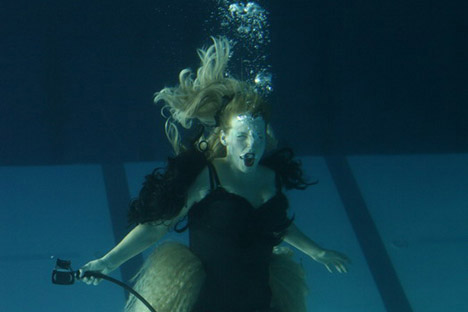
Juliana Snapper
Share this:


Current Top Posts





April 2021

January 2020

November 2019

October 2019

August 2019

April 2014

November 2017

March 2015

December 2017

October 2015
 Sounding Out!
Recent Comments