
The Plasticity of Listening: Deafness and Sound Studies

“Listening Post” by Flickr User Theory
Editor’s Note: Steph Ceraso‘s post wraps up Sounding Out!’s three-part February forum on the intersection of deafness, Deaf Studies, and sound studies. However, SO! would like this series to open an ongoing conversation. If you would like to respond to these posts and/or pursue your own avenue of inquiry, please direct your pitches to jsa@soundingoutblog.com. We’d love to hear from you. By the way, if you missed (or want to re-read) Liana Silva‘s “Listen to the Word: Deafness and Participation in Spiritual Community” click here and C.L. Cardinale‘s “my mother’s voice, my father’s eye, and my other body: the sound of deaf photographs” click here.
There is no difference in being deaf or hearing—one will always appreciate the subtleties of sound because of the ability to feel things in greater depth to what the ear alone will allow us to hear. -Evelyn Glennie from Shirley Salmon’s Hearing—Feeling—Playing: Music and Movement with Hard-of-Hearing and Deaf Children
DOI: https://doi.org/10.59350/jqk23-5t005
I am not deaf, nor am I someone who is affiliated with the scholarly field of disability studies. However, I am someone who is very interested in expanding notions about what it means to listen. For my dissertation research, I have been working on developing a theory of what I call “multimodal listening.” Rather than understanding listening as something that is dependent upon the ears, “multimodal” listening refers to the various ways in which sound is felt throughout the body (via vibration), and to the multiple senses in addition to the auditory sense that are employed during a listening event.
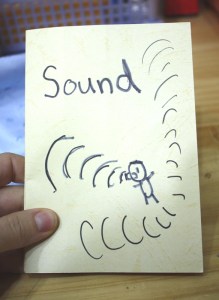
Because of my interest in moving beyond ear-centric models of listening, I really appreciated Liana M. Silva’s recent post on the Deaf International Community Church (DICC). I was especially struck by how her experience as a hearing individual attending a Deaf church service suddenly defamiliarized her own relationship to sound and voice. The visual nature of this service, which was conducted through the use of American Sign Language (ASL), prompted her to consider listening practices that do not rely on a fully functioning auditory system.
I wonder, though, if swapping the ears for the eyes is still too limiting—too dependent on a single mode. For instance, if a non-signing deaf person was attending a service similar to the one Silva described, visual listening (in a discursive sense) would not be a possibility. My use of “deaf” (with a small “d”) is a strategic choice here. The descriptor “Deaf” (with a capital “D”), as Silva uses it in her discussion of the church, is almost always employed to refer to the Deaf Community as a cultural and linguistic entity, whereas “deaf” refers to an audiological deficiency. Since the use of ASL is most often associated with individuals in the Deaf community, those who do not sign would most likely avoid churches like the DICC. However, depending on the acoustics and the material features of the church, a non-signing deaf person might be able to experience the sound of music through vibration in a more full-bodied kind of listening practice.
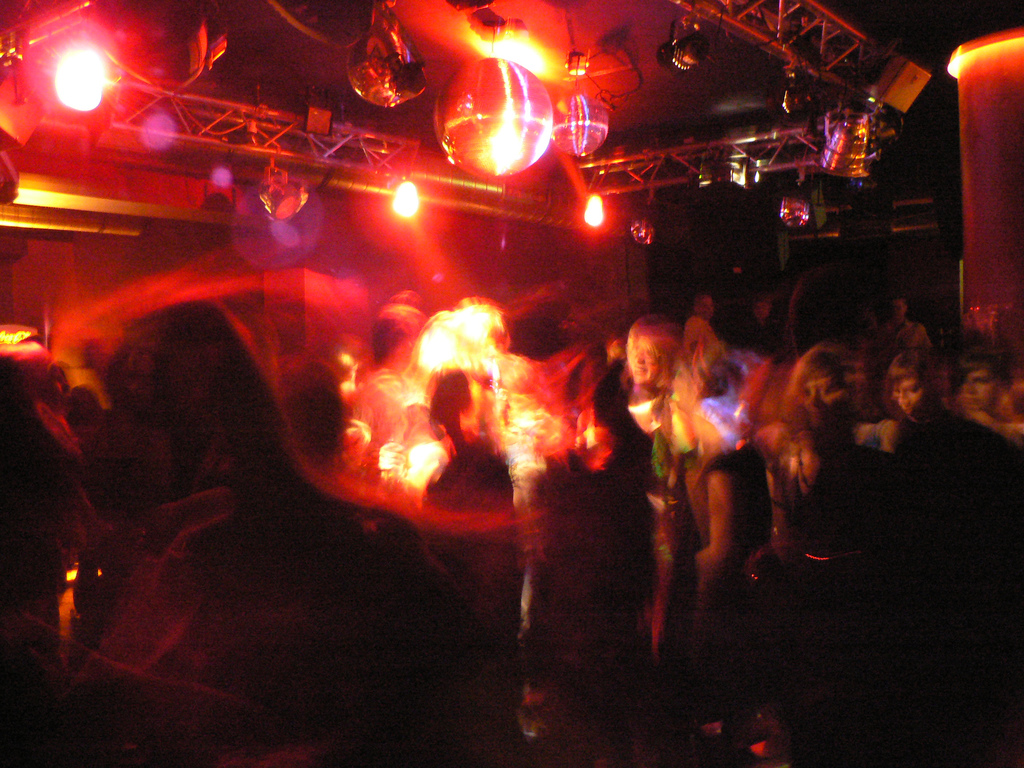
Listening via vibration is something that Cara Cardinale Fidler writes about in her poetic account of growing up with deaf parents. She remembers,
In high school, I went to a dance at the Fremont School for the Deaf where my parents were chaperones. It was easy to find the dance; you could hear the throbbing bass from across campus. It was so loud, it hurt. When I walked in, I wasn’t surprised to see a wall full of uncomfortably dressed teenagers holding balloons to feel the sound and bobbing their heads in tempo.
In this passage, Cardinale Fidler amplifies the tactile experience of sound—the ability of all bodies to listen-feel through the force of vibration. Sometimes we feel sound in our guts or throats or teeth, but this is not usually an aspect of listening that most people with a working auditory system meditate on, or try to refine in any way.
I think it is important to acknowledge, as Silva and Cardinale Fidler do by example, that the labels “deaf” and “hearing” are not as clear-cut as they may seem. There is a whole range of auditory function among people who are given these labels, or who fit somewhere between them. Sound scholars might think of deafness, then, not as a uniform lack, but as a range of listening practices in which sensory modes other than the ears are employed. Some people rely more on one mode than others, and some might develop synesthetic listening practices.
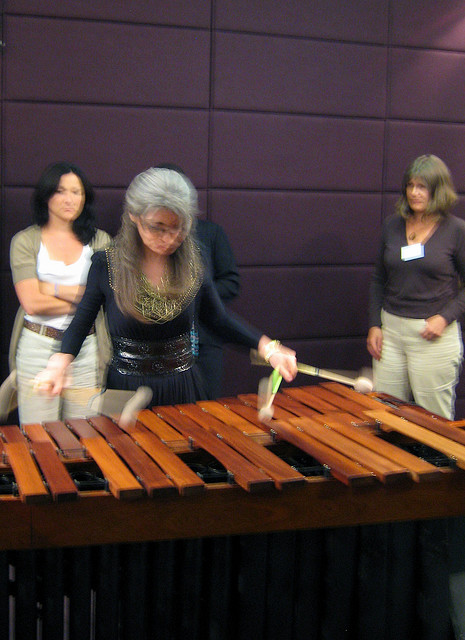
For instance, in the documentary Touch the Sound, percussionist Evelyn Glennie uses the convergence of sound, sight, and touch in her own listening training. We need to start thinking about listening less in terms of binaries (e.g. you either have the capacity to listen or you do not), and more in terms of possibilities. The fact that bodies can be retrained to experience listening via multiple modes highlights the extremely flexible, plastic nature of listening habits and practices. In considering this diverse range of listening possibilities, I wonder how we might design more listening experiences that are truly multimodal—that require or at least present the possibility of listening with more than one sensory mode. How might we expand the listening capacities of all bodies?
Deaf space and architecture is one area that is beginning to take up such questions. Based on the concept of universal design, which emphasizes the production of products and environments that are accessible to both so-called “disabled” and “able-bodied” individuals, deaf architecture considers the ways in which deaf listening bodies move through and communicate within space. These spaces seem particularly well-designed for visual and tactile listening situations. For example, according to blogger Scott Rains, some key principles of deaf architecture include: the use of partial walls or open concept spaces, no sharp angles and curved corners to increase visual range, no sources of glaring light that might impede vision, and wooden floors for more pronounced vibration. Bodies, spatial and material configurations, and the senses were all taken into account in this kind of design. The visual and tactile elements in these spaces accommodate particular bodies and communication practices, but there would be no need for such spaces without the existence of those particular bodies and communication practices. The design of deaf architecture is based on the reciprocal relationship between cultural and physiological needs, which in turn broadens the listening possibilities of the inhabitants of deaf spaces.
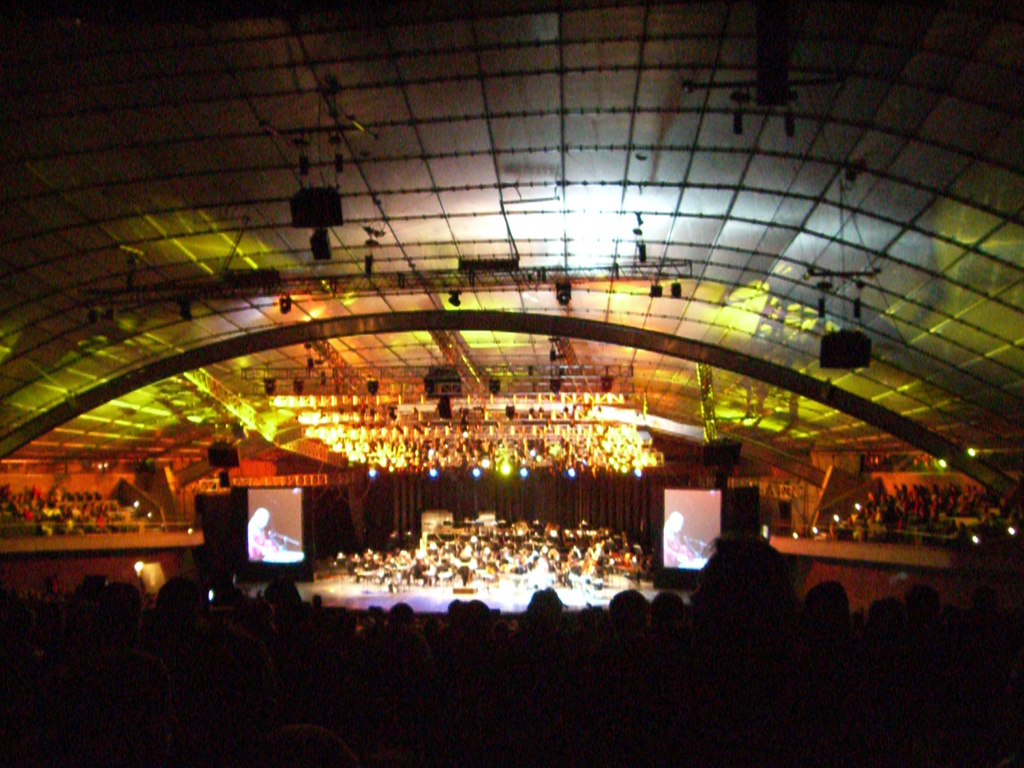
Deaf studies and deaf scholars have much to contribute to sound studies. Expanding ideas about what it means to listen, coming up with new ways to extend the capacities of all listening bodies, and developing more dynamic and complex theories of listening will require sound studies scholars to think about listening not only in terms of the ears, but in terms of bodies, affects, behaviors, design, space, and aesthetics. In this sense, deafness may be one of the most significant and generative areas of research in the continuing development of sound and listening studies.
Conversely, sound studies can offer deaf studies fresh ways to think about how sound shapes/enhances/disrupts deaf cultural practices. As we have seen from the examples above, sound plays a powerful and sometimes complicated role in deaf contexts. Using sound studies approaches and methodologies, then, could help to augment the ways in which sound figures into deaf culture–a subject that has received very little attention thus far. Collaborations between these seemingly contradictory areas of study have the potential to enliven and enrich each other in mutually beneficial ways. Sound studies and deaf studies have a lot to say to each other. They just need to start listening.
__
Steph Ceraso is a 4th year Ph.D. student in English (Cultural/ Critical Studies) at the University of Pittsburgh specializing in rhetoric and composition. Her primary research areas include sound and listening, digital media, and affect. Ceraso is currently writing a dissertation that attempts to revise and expand conventional notions of listening, which tend to emphasize the ears while ignoring the rest of the body. She is most interested in understanding how more fully embodied modes of listening might deepen our knowledge of multimodal engagement and production. Ceraso is also a 2011-12 HASTAC [Humanities, Arts, Science, and Technology Advanced Collaboratory] Scholar and a DM@P[Digital Media at Pitt] Fellow. She regularly blogs for HASTAC.
—
Share this:

“I didn’t say look; I said listen”: The People’s Microphone, #OWS, and Beyond
DOI: https://doi.org/10.59350/ks1pf-z7v73
On a Tuesday right after Valentine’s Day in 2011 thousands of people marched on the Wisconsin capitol and good-naturedly, but firmly, took over the building. They came for a hearing scheduled by the state government’s Joint Finance Committee, and as crowds swelled out on the snow-covered lawn a long line of citizens formed indoors, waiting their turn to address the Committee and give brief remarks about proposed changes to the state budget.
Up for discussion was the Governor’s proposal to cut public employees’ benefits and eliminate their collective bargaining rights, and having gotten word of widespread outcry, the co-chairs of the Committee had released this statement:
We welcome public participation in our representative democracy. Unlike two years ago when Democrats did not hold a public hearing for the last budget repair bill, we want to listen to individuals’ concerns. Due to the large number of participants, each person will be given up to 2 minutes to address the committee. This will ensure that everyone has their voice heard.
Late that night, the Committee cut off public testimonies in spite of a line still stretched down the hall. One group refused to leave and staged an occupation of the capitol building in protest of both the bill and the foreclosure of public input.

Over the next few weeks, people slept overnight on the marble floor while bigger groups assembled there each day, reportedly in numbers reaching between 70,000 and 100,000. Many carried signs backing public sector workers, but the overall majority showed their solidarity with the protest simply by wearing bright “Badger red” hats, coats, sweaters, and shirts, University of Wisconsin memorabilia now transformed into signs of political support for all of the state’s public institutions. The view from upper levels of the capitol rotunda struck a dramatic portrait as people ringed the center of the room facing inward. One person who spent a lot of time there told me he liked to call it the “eye of the storm.”
Domed spaces tend to be noisy. Sound bounces off of the curvature of the ceiling at so many different angles that what’s audible on the floor quickly takes on so many threads of reverberation that a single voice gets easily obscured. In the Wisconsin capitol, handheld electric bullhorns became instrumental for leading chants and making announcements, but people found they didn’t always do the trick. In one reported instance, a megaphone still wasn’t enough for one woman’s voice to be heard across the rotunda, and so she broke her announcement into fragments and waited in between them as people standing near her repeated each one in loud unison. “State Senator Dale Schultz [repeated]…has withdrawn his vote for the bill [repeated].”
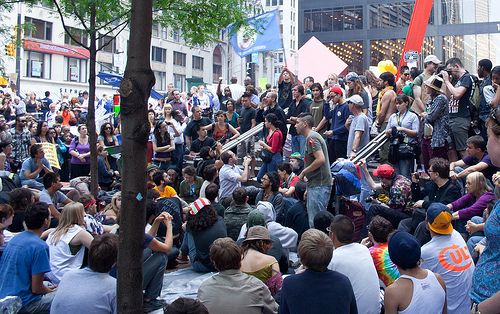
Today that variation of call and response is widely regarded as an iconic feature of the Occupy Wall Street campaign, where it has been likened to liturgy, to brainwashing, to a game of “telephone,” to Garrett Morris’s “News for the Hard of Hearing” bit from Saturday Night Live, and to Monty Python’s Life of Brian.
.Yet also, as the practice was manifest at lower Manhattan’s Zuccotti Park, it has attracted great interest and variety of comment regarding how it might reflect the values and objectives of those gathering in downtown New York City. It was purported to unite a crowd; it helps ensure that “no one is left to feel isolated and alone;” it accelerates the exchange of information because it “forces everyone to edit group public speech down to the essentials;” it slows the campaign and gives it valuable time to develop; it is “a lesson in the obstinacy required for intentional, durable citizenship.”
Although one need only consider the depth of history stretching out prior to the invention of electric amplification to be certain that the method of communication isn’t new to this year nor even to this century, the question of its recent emergence remains important for identifying possible affinities across boundaries that might otherwise divide protest actions. Last winter in Wisconsin, after transmitting the message about Senator Schultz, the demonstrators apparently didn’t carry on with it the way people did in lower Manhattan, but one need not stop at noting that this proves the technique wasn’t invented this fall in New York. In the capitol building, members of the Wisconsin public instituted a different audio innovation that reflects a shared sense of purpose between the two protest actions. And if one follows a similar connection recently posited in Rolling Stone Magazine between Occupy Wall Street and factory takeovers in Argentina, one might bring into focus a call and response operating across even broader stretches of time and space.
In Wisconsin, the civil disobedience broke out immediately after lawmakers ended the budget hearing with citizens still waiting to speak, and in the following days an alternative system of public testimony took shape on the floor of the capitol rotunda. According to one member of the collective who facilitated its operation, the forum emerged in conjunction with a circle of drummers, who, during pauses in their playing, invited individuals to sequentially address all those gathered using megaphones carried in by the public. Soon after moving up to a single-speaker amplifier that had been provided on friendly loan, some of the drummers pooled their money and purchased a 70-watt (RMS) portable public address system, an additional extension speaker, and a Shure SM58 for, according to one, “whomever wanted to speak, ensuring their voices were heard, never cutting anyone off or denying anyone the right to speak.” With what I submit as telling coincidence, they called the apparatus “The People’s Mic.”
Here is a clip that came up when I used Google to search with the terms “people’s microphone Wisconsin video.”
.
.
There are important contrasts between this platform for testament and the call and response technique that has garnered recent notoriety under the same name. In its Zuccotti Park incarnation, the people’s microphone is often celebrated as a clever workaround designed in response to the prohibition against using electric sound amplifiers in public without a permit. However, its key feature is the reciprocity it demands between the person speaking “into” the microphone and others gathered in the space. In this way it not only attenuates the hierarchy usually exerted by one amplified person over the soundscape, but it also fosters the pursuit of accord within the group overall, because the method’s very functioning relies so heavily on the crowd’s ongoing willingness to participate:
.
.
In Wisconsin, the People’s Mic did provide citizens a platform otherwise reserved for government and union officials (and the celebrities of their choosing), but individual testimonies were still unidirectional and the system proceeded without the same means of direct and immediate exchange, at least in the realm of sound. As we see in these clips, in Wisconsin, the People’s Mic required the largest number of people to keep quiet for the longest amount of time. Sometimes people had to keep especially quiet because the sound of chanting from outside was bleeding into the space.
.
.
However, while much of the discussion of the people’s microphone constructed in Zuccotti Park centers on its horizontal, consensus-oriented nature, why reduce the method’s oppositional potential to a matter of challenging government’s increasing control over the audible city? Fortunately, as though taking a more direct cue from the People’s Mic as it was instigated in Wisconsin, people have recently begun pushing the call and response version adopted in New York past the confines of community building, realizing its practical potential to channel a message and grab the attention of leaders far too often unavailable, unwilling, or uninterested in taking time to—as the Wisconsin Joint Finance Committee had grandly promised—“welcome public participation in our representative democracy.”
The following clips show how the people’s microphone in its new iteration has been used to satisfy the goal more explicitly associated with its Wisconsin variation—that of getting heard. The first comes from an October 25,2011 meeting of the New York City Panel for Education Policy, where a crowd packing a public forum forced board members to relinquish control of the proceedings and allow a statement conveyed on behalf of parents and teachers.
.
.
And here in a clip from a November 3, 2011 breakfast meeting at the upscale Union League Club in Chicago, people used the technique as it is now most widely associated with the New York City campaign and directly reconnected it to the efforts in Wisconsin, not only in the sense that they focused their amplifying echo at a particular intended audience, but also by virtue of whom they chose to address:
.While some might take exception to these two examples as uses of the people’s microphone without enough reciprocity in mind, I have some confidence that viewers will look upon the second clip, especially, as an overdue carriage bearing a bit of just that. But more importantly to the issue of how the different iterations fit together—Madison, New York City, and beyond—both of these scenes are peaceful, attention-grabbing, and they appear to stem from no more seditious an effort than to urge democratically elected leaders to entertain the voices of their constituents even, and especially, if they aren’t using a “corporate microphone” to speak. Now, with New York police having cleared Zuccotti Park and thrown the Wall Street campaign into yet another bout with uncertainty, it will be especially interesting to find out where, how, and by whom, the people’s microphone is picked up and repurposed again. In Wisconsin, a drive to recall Governor Scott Walker just got underway, and if demonstrations break out again at the capitol, I expect the portable PA will be back up and running. How will people use the people’s mic this time? How will they speak to those recently evicted from Zuccotti Park?
—
Ted Sammons is completing a doctorate in anthropology at the Graduate Center, CUNY.
—
Share this:




Current Top Posts





April 2021

January 2020

November 2019

October 2019

August 2019

April 2014

November 2017

March 2015

December 2017

October 2015


Recent Comments