
Making His Story Their Story: Teaching Hamilton at a Minority-serving Institution
In the summer of 2016, optimistic about a full-time teaching position at a minority-serving institution, yet unsure about what the U.S. election would mean for immigrants’ rights, I played the Hamilton soundtrack daily. Lin Manuel Miranda wrote the Pulitzer-prize winning musical inspired by Ron Chernow’s biography on the United States’ founding father because, he believed, Alexander Hamilton’s life embodied hip hop. My repeated listenings urged me to assign the musical as homework in my courses.
Colleagues with whom I engage on Twitter provided resources with which to begin. A public historian, Lyra Monteiro, wrote an important review for Public History,“Race-Conscious Casting and the Erasure of the Black Past in Lin-Manuel Miranda’s Hamilton,” which provide one key angle of critique. Latinx Theater scholar and SO! writer Trevor Boffone created an online syllabus, #Syllabus4Ham, that provided important critiques of the musical, news coverage of its growing popularity, and initial scholarly analyses of the cultural historical significance of the musical’s popularity. Pedagogically, Miranda’s archival research in addition to his belief that Hamilton’s life embodied hip hop sparked an interest to bring the production to my gender and interdisciplinary studies classrooms. While colleagues works’ inspired ways to discuss the musical in class, post-election coverage and the release of the Hamilton Mixtape provided more material to discuss. Teaching children of hip hop whose lives embody the struggle that Miranda made the central force behind his re-writing of Hamilton’s contribution to United States’ history, I wanted to develop lessons drawing on those relations.
By the spring 2017, I had done preliminary reading on the syllabus Boffone provided and replaced the musical with the Mixtape as my car ride soundtrack. When organizing my syllabus, I assigned tracks from the mixtape against the musical’s soundtrack with the intent of assigning students excerpts in both both my introductory Gender Studies course and Interdisciplinary Research Methods courses, but with a unique twist for each class. Gender Studies engaged with the content contextualized by discussions of immigration and citizenship. I assigned my Research Methods course Monteiro’s critique of race-consciousness of the musical against the mixtape and the musical. While students were in solidarity with Montiero’s argument, I invited them to consider Miranda’s original intent, the mixtape, which may have informed the themes Miranda prioritized.
Few of them had heard of the musical before my class and less had heard of the mixtape. Their limited exposure necessitated historicizing both Miranda’s career and the evolution Hamilton’s, which begins with 2009 Miranda’s White House performance. Miranda, invited by President Obama to perform a song from his previous hit In the Heights, instead decided to introduce his new project, a mixtape based on Alexander Hamilton.
Through discussion, I proposed that the students consider that the production, in 2009 envisioned as an album, served as a strategic catalyst to bring attention to his forthcoming mixtape. That attention evolved into encouraging Miranda to produce the musical; it would take a few more years till the intended mixtape was produced. Even though produced later, I speculated that the mixtape thematically benefited from the popularity of the musical because the musical’s focus on Alexander Hamilton rewrites the context of the mixtape.
Teaching Hamilton the musical and the mixtape felt politically necessary at a minority serving institution in this historical moment of anti-immigrant, and anti-black sentiment. Having, in the past, worked with other youth to mobilize youth empowerment through hip hop, Hamilton provided an avenue in which I could discuss its political potential because of its popularity not only in spite of it. In breaking down Miranda’s cultural and political significance, I summarized the evolution of awards he and the musical’s cast had won as well as the preliminary cast’s reflections on participating in Hamilton, along with what it means to have the success of the musical produce a wider audience for the mixtape.
After more than a semester working with students who grow frustrated with the traditional research paper and because of my own work producing research-based fiction and poetry, teaching the musical and mixtape provided an important example of research-based art. Because some students approach interdisciplinary research methods not understanding the possibilities of the relationship between art and research and some students are unsure of how to connect learning outcomes to their aspiring performance careers, I find teaching Miranda’s work remains necessary. Further, Miranda provides an avenue through which I could relate to students because of our shared interest in music as well as our conflicted relationship with consuming hip hop.
Teaching a student population that is 25% Latinx and who are either directly or indirectly affected by immigration policies, my students related, often quite deeply and intimately, to the message of the song. I watched their faces as they listened, particularly to “Immigrants (We Get the Job Done),” and their kinesthetic responses showcased what many of us ache for our students to experience: wonder, appreciation, and the illumination of insight.
I then guided them to hone in specifically on Puerto Rican rapper Residente rapping about the Mexican immigrant struggle in Spanish, emphasizing how he sonically and rhetorically urges a Latin pan-ethnicity while using his U.S. citizenship privilege to historicize border crossing Mexicans. Residente’s lyrics create an opportunity to discuss Puerto Ricans’ cultural reality of being perceived as immigrants while being legally defined as citizens, all the while calling back to the lyrical connection to the “Battle of Yorktown” from the musical.
I highlighted Miranda’s rhetorical strategy in building a song around one line that contexts changes across either song. The “Battle of Yorktown” centers on the contributions of immigrants to gaining freedom. During the lecture, I drew connections between the lyric that would become a song and the lyric subtly referencing the lack of freedoms for black people who were enslaved in the U.S. I asked about the parallels before explaining them, using the intentionality behind creating and compelling a racially diverse cast to script a narrative about who could and who had built the United States. What does it mean to hear these voices emanating from this cast, telling this story?
Pedagogically, teaching music in either course served the intent of reimagining the purpose and potential of sound, whether from a musical or a mixtape, as a site of critical thinking. Popular musicians’ cultural authority slowly decenters the white fragility I have come to expect from difficult conversations such as the ones Hamilton and The Hamilton Mixtape allow me to have. Furthermore, the call-and-response between the mixtape and the musical work address the silence of the unrecognized, exploited, and/or enslaved labor that continues to build this country. For my students, hearing musicians they like or who perform in their favorite genre, speaking truth to power about poverty, struggle, and not being thought of as good enough shifted not only our classroom energy, but many students’ perspectives.
Teaching the Hamiltons helped my student population make sense of their “invisible” status in the U.S. and want more than what’s expected. They gained something in being able to hear their stories in the classroom—not just read them on the page—but hear them from people who look and sound like them. Hungry for more material that speaks to their disenfranchisement, my students wondered why more songs that sound the complex beauty of our resilience and struggle are not on the radio. They wanted to know how they can ask for more.
—
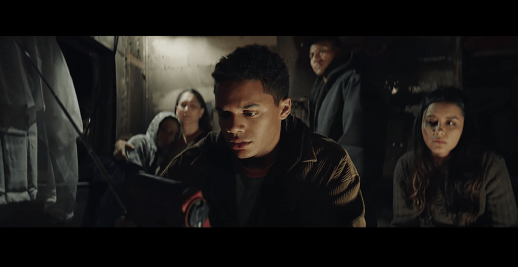
Featured Image: Screen capture from “Immigrants (We Get the Job Done)” remix video
—
Erika Gisela Abad, Ph.D, is a Queer Latina poet, born and raised in Chicago. She received her PhD in American Studies in 2012. Since completing her degree, she has worked as: a customer service associate and a scheduler at a phone interpreter call center, head counselor for a caddy program affiliated with a high school scholarship fund, field director for an education policy campaign, an oral historian and ethnographer. Since August 2016, she has been a full time assistant professor teaching gender studies. Twitter: @lionwanderer531; @prof_eabad
—
 REWIND!…If you liked this post, you may also dig:
“Don’t Be Self-Conchas”: Listening to Mexican Styled Phonetics in Popular Culture*–Sara V. Hinojos and Dolores Inés Casillas
“Ich kann nicht”: Hearing Racialized Language in Josh Inocéncio’s Purple Eyes (Ojos Violetas)–Trevor Boffone
Moonlight’s Orchestral Manoeuvers: A duet by Shakira Holt and Christopher Chien
The Sounds of Anti-Anti-Essentialism: Listening to Black Consciousness in the Classroom- Carter Mathes
Share this:

“Ich kann nicht”: Hearing Racialized Language in Josh Inocéncio’s Purple Eyes (Ojos Violetas)

In Spring 2017, I brought Houston-based playwright/performer Josh Inocéncio to my campus—the University of Houston—to perform his solo show Purple Eyes (for more on the event, see “Campus Organizing, or How I Use Theatre to Resist”). Purple Eyes is what Inocéncio calls an “ancestral auto/biographical” performance piece which explores his upbringing as a closeted gay Chicano living in the midst of the cultural heritage of machismo. Following a legacy of solo performance storytelling aesthetics seen in John Leguizamo’s Freak and Luis Alfaro’s Downtown, Inocéncio plays with memory to understand how the United States and Mexico have influenced his family and his own identity formation. Moreover, Purple Eyes explores the intersections of queerness and Chican@ identity alongside the legacy of machismo in his family (For more on the play, see “Queering Machismo from Michoacán to Montrose”).

Still from Purple Eyes (Ojos Violetas), with permission from Josh Inocencio who retains copyright.
During my Intro to LGBT Studies course following the performance, students discussed issues of representation and how many of them had never seen a queer Latin@/x play or performance, with some of them having never seen a live play. Many students picked up on how Purple Eyes foregrounds the intersections of race, ethnicity, gender, and sexuality. While these discussions were indeed fruitful, what struck me most was how both classes harped on Inocéncio’s use of different linguistic registers. Put simply, what stayed with them was how the performance sounded. My students obsessed over the Spanish in the play, leading me to question why this group of students at a Hispanic-Serving Institution in a city that is over 40% Latin@ had so much trouble whenever Inocéncio spoke Spanish, or the sounds of Latinidad.
In what follows, I discuss how my students heard Purple Eyes. While the play is predominately in English, Inocéncio often code-switches into Spanish and German to more accurately embody particular family members. This blog adds to previous research by Dolores Inés Casillas, Sara V. Hinojos, Marci R. McMahon, Liana Silva, and Jennifer Stoever on the relationship between the Spanish language and non-Spanish speaking Americans. Indeed, my students racialized the Spanish in Purple Eyes while completely disregarding the German in the play. Why?
Drawing from sociology, racialization is the process of imposing racial identities to a social practice or group that might not have identified in such a way. Typically, the dominant group racializes the marginalized group; i.e. Latin@s in the U.S. become racialized by the mainstream. Even so, Latin@s are not a race, but are an ethnic group. Yet, I argue that non-Latin@ Americans view Latin@s through a lens of race which often becomes a sonic one, in which language becomes one of the most overt identity markers. In terms of Spanish, while many races and ethnicities speak the language, in the United States it is often viewed as a way to mark Spanish-speaking Latin@s as Other. In this way, language plays a fundamental role in shaping mainstream ideas about race. According to Dolores Inés Casillas, “For unfamiliar ears, the sounds of Spanish, the mariachi ensemble, and/or accented karaoke all work together to signal brownness, working-class,” and as Jennifer Stoever argues, the sounds of Latinidad indicate “illegality” in the U.S.
Drawing from the intersections of race, language, and racism, the relatively new academic field Raciolinguistics has emerged as a means to explain how people use language to shape their identity (For more, see Raciolinguistics: How Language Shapes Our Ideas About Race). Branching off from Raciolinguistics, I am most interested in exploring how the mainstream hears languages and racializes what they are hearing. The result is that Spanish is seen as Other, meaning that monolingual U.S. listeners hear Spanish-speakers as inherently different and a threat to a mainstream United States cultural and, more importantly, national identity.
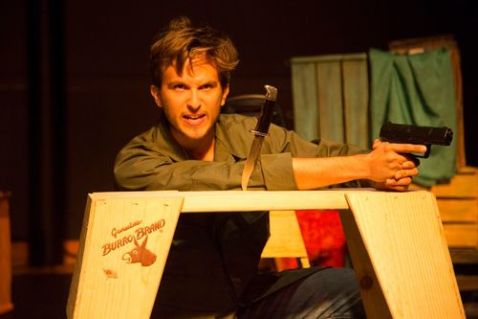
Still from Purple Eyes (Ojos Violetas), with permission from Josh Inocencio who retains copyright.
Reflecting Inocéncio’s cultural multiplicity, Purple Eyes features English, Spanish, and German strategically used at different moments in the play to reflect the temporality, positionality, and relationship to language of each character that Inocéncio inhabits. While the chapter on his father is entirely in English, the final chapter focusing on Josh himself opens with a monologue in Spanish in which the performer narrates the events of the FIFA World Cup before finally announcing to the crowd that the epilogue is Inocéncio’s journey of young love and heartbreak on his journey of queer discovery. This moment features the longest extended use of Spanish in the play. The remaining Spanish is sprinkled in as Josh code-switches between the two languages for added cultural specificity.
While some of my Spanish-speaking students appreciated hearing a play that reflected their linguistic identities, monolingual English speakers in my class claimed that the Spanish confused them and made it difficult for them to follow certain parts of the play. After several students echoed these thoughts, a student from Mexico without full fluency in English comprehension told others about how her experiences were the exact opposite. She had trouble following some of the parts in English since she is still learning the language. I then pivoted the conversation to discuss how my English-dominant students approached the play with the assumption that English is the norm and a performance on a university campus should reflect this. Case in point: several told me that the show should have been subtitled.
But what was most telling was the following exchange. After several expressed confusion over the Spanish, one particularly woke student from Nigeria raised her hand and said: “I haven’t heard anyone say anything about the German in the play and not being able to follow the play during the German part.” She then noted how, in the United States, Spanish is racialized whereas German is not. In fact, most of the students did not even recall German in the play. Admittedly, the play features far more Spanish than German, but the scene in which Inocéncio speaks German occurs while dramatizing his Austrian grandmother’s abortion. As Inocéncio (as Oma) frantically repeated “Ich kann nicht” (I can’t), my students had no trouble; to use some Millennial vernacular, it was with Spanish that they “couldn’t even.” Arguably, this is the most intense scene in the performance and one that my students wanted to discuss. That the majority of them understood this scene without fully registering the German, coupled with their confusion over lines spoken in Spanish, speaks to not only how race and ethnicity impact how languages are heard in the United States. German is viewed as familiar and accessible whereas Spanish is immediately heard as foreign, i.e. undesirable, not welcome here.
As the Latin@ population continues to grow and the Spanish language becomes an increasingly present reality in U.S. everyday life, audiences must consider possibilities not grounded in an English-only narrative. My experiences with Purple Eyes are not unique. I have witnessed and heard many stories about audiences at mainstream theatre companies who have struggled whenever a play included Spanish. While I don’t claim to have the answers to address this across the nation, as an educator, I question what tools I can give my students to help prepare them for sonic experiences outside of their comfort zone and, specifically, how they become aware of subconscious racialization practices. What will they hear? And, more importantly, how will they react?
—
Featured Image: Still from Purple Eyes (Ojos Violetas), with permission from Josh Inocencio who retains copyright.
—
Trevor Boffone is a Houston-based scholar, educator, writer, dramaturg, producer, and the founder of the 50 Playwrights Project. He is a member of the National Steering Committee for the Latinx Theatre Commons and the Café Onda Editorial Board. Trevor has a Ph.D. in Latin@ Theatre and Literature from the Department of Hispanic Studies at the University of Houston where he holds a Graduate Certificate in Women’s, Gender, & Sexuality Studies. He holds an MA in Hispanic Studies from Villanova University and a BA in Spanish from Loyola University New Orleans. Trevor researches the intersections of race, ethnicity, gender, sexuality, and community in Chican@ and Latin@ theater and performance. His first book project, Eastside Latinidad: Josefina López, Community, and Social Change in Los Angeles, examines the textual and performative strategies of contemporary Latin@ theatermakers based in Boyle Heights that use performance as a tool to expand notions of Latinidad and (re)build a community that reflects this diverse and fluid identity. He is co-editing (with Teresa Marrero and Chantal Rodriguez) an anthology of Latinx plays from the Los Angeles Theatre Center’s Encuentro 2014 (under contract with Northwestern University Press).
—
REWIND!…If you liked this post, you may also dig:
“Don’t Be Self-Conchas”: Listening to Mexican Styled Phonetics in Popular Culture*–Sara V. Hinojos and Dolores Inés Casillas
Deaf Latin@ Performance: Listening with the Third Ear–Trevor Boffone
Moonlight’s Orchestral Manoeuvers: A duet by Shakira Holt and Christopher Chien
If La Llorona Was a Punk Rocker: Detonguing The Off-Key Caos and Screams of Alice Bag–Marlen Rios-Hernández
Share this:


Current Top Posts





April 2021

January 2020

November 2019

October 2019

August 2019

April 2014

November 2017

March 2015

December 2017

October 2015
 Sounding Out!
Recent Comments