
SO! L.A.: Sounding the California Story

 Editor’s Note: Welcome to the second installment in our month-long exploration of listening in observation of World Listening Day on July 18, 2012. For the full introduction to the series click here. To peep the previous post, click here. Otherwise, whip out your most oversized sunglasses, kick back, and listen to Bridget Hoida’s California. –JSA
—-
STOP.
Do not read along with me “in your book.”
Resist the temptation to follow along with your eyes.
Click play. Listen.

Sunset in the San Joaquin Valley
If I had things my way, I would whisper these stories to you as we sat in mesh folding chairs on the poured concrete porch of my Central Valley childhood home. If I had things my way, I would refill your glass with lemons and gin, and we would breathe in the sweet, summer smell of rotting blackberry brambles. If I had things my way, we would wait until the sun set against a Tokay harvest, taking with it the harsh triple digit temperature and leaving us nothing but the quiet of a delta breeze and moonlight. If I had it my way, I would ask you to lean in close as I whisper with canonical voices:
“This is a story about love and death in the golden land, …”
“I remember that moment exactly, those exact words registering in my mind like the notes of a solo…”
“Bobby Gene was a tattletale he told everything he heard…”
“You must not tell anyone what I am about to tell you…”
“My history is murky, and I wanted it [ …] that way so I could be free to tell whatever I wanted. ”
“I’ll tell you what I suppose from your silences and few words and you can tell me if I’m mistaken. You’ll have to speak up with the real stories if I’ve got you wrong…”
“And so they talked and told tales of their region, and I listened. Long into the night I listened until I dropped off to sleep and my father would pick me up onto his lap as he continued to talk about the Revolution…. And every camp was different, none existing for more than six or seven weeks, then off we would go to the next harvest, where new people would gather and there would be new tales to be told and heard. I knew when I was six years old that the one thing I most wanted from life was to be a storyteller.
The storied sound of California
-All Voices
Shush…. Listen.
Linger with me on the drawn-out drawl of the stories I was raised on. Of the stories I was raised upon. For this is the sound of the California story: A myriad of voices sounding out narratives onto the page. Conflicting, concurring, spoken-over and rewrote…no one lasts longer than the next harvest, the next filmic “Action!” This is the sound of the storied terrain of interwoven melodies spoken upon the California soil that I call home.
1.
In or around 1995, I fell madly in love with Joan Didion. It’s not so much Didion the woman but rather the sound of Didion’s words that have me so hung up. My obsession began in the stacks of the Bancroft Library at UC Berkeley. I was assistant to the assistant librarian there and during my lunch hour I would take the dumb waiter up to the roof, eat a Kaiser roll with apricot jam, and read dime store copies of classic novels. I chose the roof because I like to read aloud, and in libraries at the time, reading aloud, especially to yourself, was expressly forbidden.

So there I was on the roof of Bancroft, with my roll, my jam, and my dime store copy of Play It As It Lays. I opened the page and read something about snakes and Iago. A mother died, the town of Silver Wells was won, and then lost, in much the same way a marriage slips into divorce. And then it happened. I stumbled across a line that changed the way I thought about words. Page 7, the first full sentence of the top paragraph, on the right: I might as well lay it on the line, I have trouble with as it was.
And after that line a whole lot of white space.
Beautiful, brilliant, blank white space.
As though in the silence of the rooftop, of the view, Didion was screaming to the reader, to me, something louder than words. In that white space there was sound and it was deafening.

2.
Later, when I decided to get a Ph.D. in creative writing, and although I couldn’t say as much on paper, examine, among other things, the commonality of language in California writers and the sonic devices of oral storytelling, I came across a quote from Didion, in interview, that said:
I had the technical intention to write a novel so elliptical and fast […] it would scarcely exist on the page at all…white space. Empty space. […] A white book to which the reader would have to bring his or her own bad dreams…
And although I adore everything about her I almost wished she hadn’t said it. Or that I hadn’t read it, because the thing about Didion is that statement… the part about the blank space… and the nightmare… it was already there. On the roof of the Bancroft library with my Kaiser roll and apricot jam, when the air tasted like September, I brought my own bad dreams because in that brilliant bit of white space I heard the scream.
3.
I like the white page. I prefer stories to plots. Plot for me is how the narrative moves from one space in time (from one line on the page) to the next. Story is how the narrative sounds. Story is voice. Plots are where girls meet boys and girls lose boys and girls get boys back. Stories are the shuffle and stop of scuffed shoes walking railroad levees, old men clearing phlegm, the surprise of an elastic bikini band as it snaps against the freshly burnt back of a burgeoning starlet. And the sounds of words as they smack unbridled against the page.

a traditional page by John Steinbeck

a white page by Joan Didion
4.
When I read Didion we are on my porch and I hear her voice. When we think of writing, when we imagine reading, we think of quiet moments that exist alone with fixed type on a printed page. But as a reader, and more importantly as a writer, I have never felt this way.
5.
Voice, to paraphrase Emily Dickinson, is the “slant” you bring to your version of “the truth.” Plots are recyclable. Hell, you can buy one on eBay, to be sure. But a writer’s voice is different. I don’t read a book to figure out what happens next. I read to hear the whisper of the author’s voice. If they whisper well, I turn the page.
6.
From John Steinbeck to Gertrude Stein, John Fante to Susan Straight, Larry Levis and Mary Hunter Austin to William Saroyan and Shawna Yang Ryan, there is commonality of sound and language that I’m willing to claim composes an aural palimpsest of sorts. A voicing over, both literally and figuratively of native daughters and native sons held up on the tongue of the golden state.
The cadence, the rhythm, the obsession with things past. The aching nostalgic longing. The reflection. The fear. The reclamation. The imagination. The witness of an agrarian undoing. Sleepy Hollow moments reborn—again and again on western soil. The feeling of home. The feeling of home slipping away. The feeling of self, self-made in the image of home, slipping away alongside it. There’s a certain Californianess to it.
7.
What if we found a way to consider the sound these “fixed texts” emote? What if we broke with conventional narrative structure and embraced a written technique that more adeptly mirrored the sound and cadence of spoken story telling? Then might it be possible that the very aurality that is “written over” on the read palimpsest is in fact the sound that also remains?
As a writer, a writer who believes in voice, who rejoices in sounds as the strike-like syllables against a now forgotten Olivetti key, my pursuit in writing not only a novel, but in writing a novel about California was how I could possibly enter into this conversation. How I might be able to raise my voice loud enough to embrace the crowd of such a respectable page. How I could construct my text in such a way that it would not only read, but also sound Californian.

a “docu-page” by Raymond Barrio
8.
In my struggle to voice not only my novel, So L.A., but also my protagonist Magdalena de la Cruz, I relied heavily on the patterns, soundscapes and literary devices of the collective California canon comprised of authors such as the ones I spoke of above. In So L.A. I was looking for a way to tell the story out loud while still operating within the conventional structure of a “type and text” book.
 9.
9.
My novel opens with Magdalena falling off a boat and then moves both forward and backward in time. This is how most people tell stories orally. They begin in the middle and then jump around, forgetting, amending, and calling attention to the most important parts, while the listener rarely ever exclusively listens but instead interjects and provides his or her own connections, observations and experiences. Eliminating quotations allowed me to access some of this interplay. It allowed me to question the reliability of spoken language. Spoken utterance does NOT always translate to precise hearing of the said words uttered. There is always interference—be it emotional (memory-sound triggers), psychological (felt meaning as opposed to said meaning), physical (honking cars, loud birds, eye rolls and sneezing) or linguistic (signifiers and unspoken gestures). Just because words are utter does not mean they are the same words that are heard. And not only did I want this, but I needed it on my page. Although I considered the docunovel (in the vein of Raymond Barrio), autho-interview collage (like Anna Deavere Smith) and autofictive exploration (ala Salvador Plascencia) I ultimately decided to abandon quotation marks.


a “sounded” page from The People of Paper
10.
This (“) says open. It says start.
This (”) says closed. It says stop.
But (“) and (”) also sound.
For me they sound like a particularly rough clearing of the throat. They sound like standing on a library rooftop, trying to confess your love with the passion of a librarian “with hiccups.”
“They” interrupt the eye. “They” provide visual cues for accessing character and I didn’t want Magdalena “to be seen.” I wanted her to sound.
Her voice required a fluidity and unreliability not attainable “in quotes.” Without conventional quotes I was free to wander inside the head and voice of my protagonist as I pushed the blur between what she was saying, what the listener perceived she was saying, and what other characters were voicing without visual interruption.
11.
Also important in my authorial access to sound (and the absence of sound) on the fixed and written page was the use of filmic microchapters (some only as long as a single sentence). A sentence that reads as a chapter, surrounded by all that stark and lovely white space, not only looks different from a classical bookish chapter, but it also sounds different. Read out loud, or quietly inside the reader’s head, it sounds out a particular meaning and resonated differently within the mind’s eye and ear.
12.
With so much of the present world turning virtual, author and storyteller Barry Sanders concludes, “We demand less from the historical accuracy of our stories. We even demand less of a truth. We are content with images and feelings. If it feels closer to the truth then it might as well be.” However I’d like to extend Sander’s assessment beyond image and feeling to include sound. In this newly constructed world of virtual storytelling we are again experiencing a shift (not unlike the shift from oral to written storytelling) that is also sound dependent and sonically informed. From the staccato sounds of Twitter as compared to the unconstricted and leisurely expanse of Tumblr, it is important to acknowledge that the twenty-second sound bite can be (and historically has been) used (and utilized) in fiction to make noise and call attention to lasting moments of profound revelation. Although Didion’s Maria may “have trouble with how it was” I find a certain sense of comfort in how it is provided we are all able to lean in close and listen. Listen past the interference of type, text and YouTube to the sound of words both on and upon the page as,
“These are tales told in darkness in the quiet at the end of the day’s heat…”
—
Opening Image Credit: “L.A. Sky at Sunset” by Flickr User David Vienna
Audio note: Voices used, with the exception of Bridget Hoida, are not the actual voices of the authors listed, nor are they meant to be representative of said authors.
—
Bridget Hoida is the author of So L.A. (2012). In a past life she was a librarian, a DJ, a high school teacher, and a barista. In this life she experiments with words and has taught writing at UC Irvine, the University of Southern California and is currently a professor at Saddleback College. Hoida is the recipient of an Anna Bing Arnold Fellowship and the Edward Moses prize for fiction. She was a finalist in the Joseph Henry Jackson/San Francisco Intersection for the Arts Award for a first novel and the William Faulkner Pirate’s Alley first novel contest. Her short stories have appeared in the Berkeley Fiction Review, Mary, and Faultline Journal, among others, and she was a finalist in the Iowa Review Fiction Prize and the Glimmer Train New Writer’s Short Story Contest. Her poetry has been recognized as an Academy of American Poets Prize finalist and she was a Future Professoriate Scholar at USC.
She has a BA from UC Berkeley, a MA in fiction from San Francisco State University, and a Ph.D. in Literature and Creative Writing from the University of Southern California. So L.A. is her first novel.
Share this:

Radio’s “Oblong Blur”: Notes on the Corwinesque

Miguel Covarrubias, untitled iIlustration to “Radio I: A $140,000,000 Art,” Fortune (May, 1938).
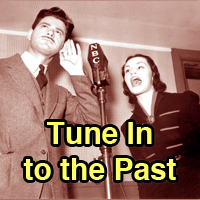 Editor’s Note: Today, Neil Verma kicks off our summer series “Tune In to the Past,” which explores the life and legacy of radio broadcaster Norman Lewis Corwin, the “poet laureate of radio” who died last summer at the age of 101. Corwin, pictured in the icon to the left with actress Peggy Burt around 1947, passed too quietly into the ether–as, unfortunately, has too much of radio history. Sounding Out!‘s three-part exploration of his legacy by radio scholars Verma, Shawn VanCour (July), and Alex Russo (August) not only gives his work new life (and critique), but also speaks to the growing vitality of radio studies itself. As I mentioned this past March in my round-up of the 2012 Society of Cinema and Media Studies conference, radio scholarship is on the rise–a Radio Studies Special Interest Group was established at SCMS this year, reaching a critical mass–and scholars are finding new and innovative ways to approach radio’s unique silences. We are proud over here at SO! to broadcast the future of radio studies by helping you “Tune In to the Past” this summer, so get ready for an array of voices–living and dead, textual and aural–spirited debate, and great sound history, in both senses of the word. So don’t touch that dial. –JSA
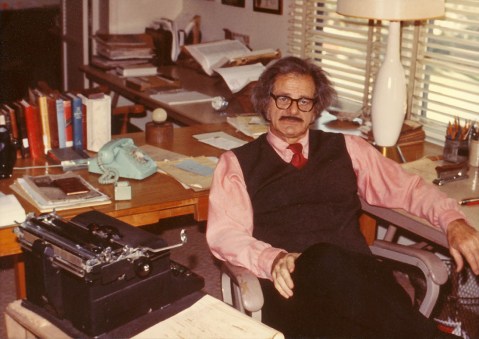
Norman Corwin in 1973 (Source: Arrowcatcher, Wikimedia Commons)
“I am a Dead Sea Scroll,” Norman Corwin, in an interview with writer Tom Lewis, 1992.
 Rising to prominence in the 1930’s, radio dramatist Norman Corwin (1910-2011) aired a body of work of unsurpassed variety, reaching audiences upwards of sixty million with plays that range from “The Odyssey of Runyon Jones,” about a boy searching the afterlife for his beloved dog, to One World Flight, for which Corwin visited 17 countries seeking voices of peace. Often compared to such figures as Eugene O’Neill and Walt Whitman, Corwin was known for seventy years as the “Poet Laureate” of radio, an unofficial title invented for him and impossible to confer on another. I interviewed Norman for my book Theater of the Mind (University of Chicago Press, 2012). These remarks derive in part from those conversations.
—-
In June of 1947, New Yorker writer Philip Hamburger published a profile of Norman Corwin, then already recognized as a distinguished radio dramatist. From Pearl Harbor to V-J Day, Corwin had staged daring plays to mark Allied milestones and earned frothy praise from the likes of Carl Sandburg, who called Corwin’s V-E Day show “On a Note of Triumph” one of the “all-time best” American poems.
Such acclaim was not universal. That same broadcast drew scorn from historian Bernard DeVoto, who called it a “mistake from the first line” full of “pretentiousness” and “bargain-counter jauntiness.” Like many others, DeVoto and Sandburg reacted to Corwin’s habit of excess by mimicking it. Hamburger’s profile caught that same bug. Billing itself as “The Odyssey of the Oblong Blur,” Hamburger tells a gauzy story of Corwin’s older brother building him a crystal set out of a box of Quaker Oats, and relates tall tales of Corwin’s artistry, like the time he spent two days trying to simulate the sounds of depth charges. And not only did Hamburger write the profile as a radio play, but he wrote it in the style of Norman Corwin.
What is that style, exactly? Thoughts on that question have been surprisingly minimal. When Corwin died last fall, commentators celebrated his life (see here, here, here and here), but the memorials lacked precisely the sense of scale to which both Sandburg and DeVoto responded. There was no voice to speak of Norman in a “Corwinesque” manner, in part because the man probably outlived more likely eulogists than anyone else in the history of broadcasting. Had he not outlasted them, Corwin would have been mourned by the avuncular elders of midcentury liberalism, like his friends Edward R. Murrow and Carl Sandburg or admirers Robert Altman, Walter Cronkite and Studs Terkel, any one of whom could have written a loving burlesque in Corwin’s voice.
But no one did, and no one can, not now. Who would get the joke, anyway? Collective experience of Corwin’s sound is passing out of living memory. Yet this very elapsing “afterlife” of the radio age, I feel, lends new richness to the question of the Corwinesque, an aesthetic that needs clarification both to give full credit to the man behind it, and, in a larger sense, to show how a theory of sound experience can “happen” at the twilight zone of collective human memory.
So what was “the Corwinesque” around 1947? What is it nowadays? What might it become in the future? In this post I’ll consider both the nature of the “Oblong Blur” and the methods we’ve tried to bring its ongoing odyssey into focus.
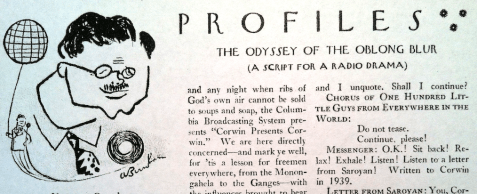
Philip Hamburger’s New Yorker profile, with illustration by A. Birnbaum
A High Wireless Act
In its profile, The New Yorker poked fun at how Corwin made unreasonable demands of sound (e.g. “Music: a universal theme, oscillator beneath, denoting pain of the world and bigness thereof, fading”) and let childish literary tactics run amok, as when the audience is called “Sons of a Sun spinning sadly through space.” In his era, Corwin’s penchant for such overwriting was an unavoidable aesthetic issue.
Corwin’s work was widely understood as a challenge to technicians and actors just for the sake of it. In the script for “New York: A Tapestry for Radio,” for example, a date scene contains this befuddling note: “Music: Love on brownstone stoop at three in the morning after an evening at the RKO Proctor Theater and a long walk in the park. It sustains, behind.” In “The Undecided Molecule,” meanwhile, we learn of a particle that refuses to select his destiny before “The Court of Physiochemical Relations.” Here are some of many tongue-twisting lines in verse:
I’d argue that Corwin’s writing is impressive here precisely because it’s so easy to botch in delivery. The style spotlights its own overworked literary calisthenics, saying: look at me trying so hard I might blow it.
In this way, the Corwinesque names a connection between the soaring and the buffoonish, a link that a contemporary called his “frontier spirit.” Thanks to this spirit, even when the prose was purple, the defect came across as that of an innovator. To keep that up, Corwin had to innovate constantly. That’s why his plays took on so many other forms – the letter (“To Tim and Twenty”); the lecture (“Anatomy of Sound”); the pageant (“Unity Fair”).
So one key to the Corwinesque was to walk a high wire without a net, another was to say so. Nothing confirmed both better than a fall. I’d wager many listened for a lousy line or overdone tune as part of the pleasure of it all. Indeed, it may be incorrect to evaluate Corwin’s aesthetic as poetic; think of the Corwinesque as broadcasting rather than writing, and its liabilities come across as dares.
If that is correct, then the “high wire act” of the Corwinesque relies on a kind of listening-for-risk that’s hard for us to do now, because we can’t listen to Corwin’s work new, or live. One deep aspect of the Corwinesque of the 1940’s – the possibility, even anticipation, of artistic failure, up above an enormous audience out there in the dark – seems lost for good.
Coalition and Collation
But in another way, the Corwinesque is only possible to grasp now, at the safe remove of the digital era. Today it’s easy to listen “distantly” to classic radio through formats that allow us to pause, rewind, categorize and remix vast amounts of golden age audio in a way that was impossible in 1947. By doing so it becomes clear that what we call the “Corwinesque” drew on a broad vocabulary of radio dramaturgy, a way of “talking about” time and space that characterized many programs of that time.
Consider Corwin’s famous attempts to glorify the “common man” – farmers, G.I.s, factory workers – by drawing their voices to a sonorous space and national coalition, indeed by making these two imaginary sites mirror and rationalize one another. Perhaps the paramount example is “We Hold These Truths,” which celebrated the 150th anniversary of the Bill of Rights only days after Pearl Harbor. In that broadcast, we hear Americans of the revolutionary period (widows, blacksmiths, politicians) speak from a series of shallow locations in a quick succession, and a similar group in the present (workers, Okies, businessmen, mothers), as a way of building mystical union through time.
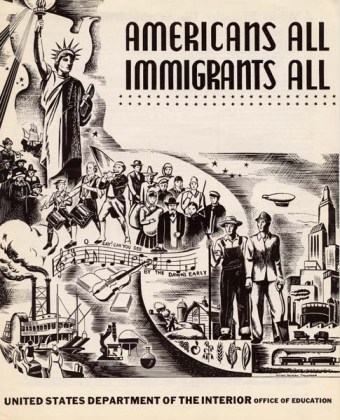
A visual representation of the “kaleidosonic” from the 1939 broadcast “Americans All, Immigrants All”
This style has had many names. Historian Erik Barnouw likened it to painting, calling it a chance to “splash quickly over a large canvas,” while actor Joseph Julian called it a “telescoping montage.” Variety’s radio editor Bob Landry suggested that it resembled cantata. When I interviewed him, Corwin said that it was like writing music; elsewhere he spoke of a kind of “horizontal” drama, or mosaic form.
In my book, I employ another word: “kaleidosonic.” In kaleidosonic radio, we segue from place to place, experiencing shallow scenes as if from a series of fixed apertures, thereby giving time periods expressive existence. That can be contrasted with what I refer to as the “intimate style,” in which the listener is attached to a character who moves through deep scenes, as a way to give space expressive existence. A good example of the latter is Corwin’s American in England series, in which the horizon of wartime is shaped by a proximal relation to a surrogate narrating entity “nearby.” Here’s a representative episode:
Today, listening broadly, it becomes clear that neither of these styles belongs to Norman exclusively. For other uses of the kaleidosonic, consider the works of Stephen Vincent Benét, Orson Welles’ “The War of The Worlds” or Cavalcade of America. For examples of the “intimate style,” listen to Brewster Morgan’s “A Trip To Czardis,” or any “first-person” style play from The Mercury Theater on the Air. What made Corwin special was how he made these styles complimentary. The opening of “On a Note of Triumph” is a good example:
In six minutes, we go from a kaleidosonic sequence of songs and crowds to an ordinary G.I. overseas asking questions intimately. This connection between the context and the individual, between the nearby and the simultaneous, is Corwin’s way of letting space and time merge together vividly.
It is that capability, I contend, that underlies and secures Corwin’s glorification of the common man, who is really Corwin’s public aestheticized. In 1939, Archibald MacLeish wrote, “The situation of radio is the situation of poetry backwards. If poetry is an art without an audience, radio is an audience without an art.” Corwin intuited what MacLeish didn’t understand: in radio, the audience is the art.
And just as airing a coalition of voices was an epistemological act that reinvented those it depicted in 1945, our use of a new collation of recordings today redraws the parameters of what those sounds might mean, amplifying latencies, superficialities, and entwinings hitherto inaudible.
A Dead Sea Scroll
By 1947, Corwin’s dedication to the “little guy” was out of vogue. It seemed seditious to red-baiters, phony to leftists, and compromised to critics – The Nation’s Lou Frankel wrote of One World: “It is as if the late John Barrymore decided, without warning, to play Hamlet in pantomime.” On this point Hamburger’s profile pivots from hagiography to satire, including a series of goofy verses voiced by a “Chorus of One Hundred Little Guys from Everywhere in the World” and a grouchy monologue by the “Common Man,” complaining that Corwin talked past him, advising “you ought to think about what the words mean before you use them.”
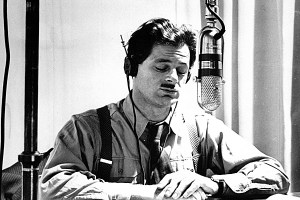
Norman Corwin in 1947 (Credit: Los Angeles Times)
That reminds me of another coda, this one in Corwin’s 1944 play “Untitled.” The play concerns a dead soldier named Hank Peters, who speaks as he lies “fermenting in the wisdom of the earth.” The monologue concludes this way:
Death is a patriotic act, a metaphysical state, but also a restless moral energy bearing down on life, a thing standing in requirement of its vindicating narration. Perhaps this feature of the Corwinesque will ring especially true as classic radio continues to exist in its ongoing pseudo-immortality. Now that Corwin reposes in his own acre of undisputed ground and his voice circulates ghostlike in clouds of data, our question may be what ontological relation we ought to have with that voice, and those of other dead social visionaries, who really do keep on advising us after death, and will go on echoing after we’re gone.
But the Corwinesque isn’t just about how the dead “speak” to the living, long the ruling conceit in the theory of sound recording. It is also about another enigma: how the dead listen to us, an audience eavesdropping, in hiding, taking notes on an old scroll in a lost language.
—
Neil Verma is a Harper-Schmidt Postdoctoral Fellow at the University of Chicago, where he teaches media aesthetics. Verma works on radio and its intersection with other media, and has taught subjects including film studies, sound, art history, literature, critical theory and intellectual history. His book, Theater of the Mind: Imagination, Aesthetics, and American Radio Drama, is published by the University of Chicago Press.
Share this:


Current Top Posts





April 2021

January 2020

November 2019

October 2019

August 2019

April 2014

November 2017

March 2015

December 2017

October 2015
 Sounding Out!
Recent Comments