
Hearing “Media-Capitalism” in Egypt

As I began researching my first book Ordinary Egyptians, a study of Egyptian culture from the 1870s until the eve of the 1919 revolution, sounds and early sound media were the last thing on my mind. However, When I dug more deeply into the historical sources, I realized the importance of music and the comedic theater in the urban culture of turn of the century Egypt. This made me expand the scope of my research to incorporate the vernacular culture of Egypt as an entire media-system, which as I showed in my book, was instrumental in constructing a modern Egyptian national identity. Music, songs, plays, chants, speeches, conversations and chatter, were very influential in forming an Egyptian national culture at the end of the nineteenth century, especially in a society with low literacy rates. By incorporating performance and sound media–especially the rising record industry–my book strives to expand the historical study of this period beyond just the visual and the printed to include sound, and aural/oral expressions of culture.
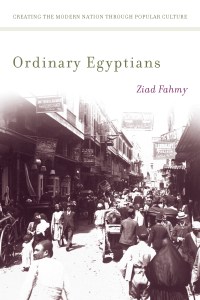
“Muski Street, Cairo, 1903.” Source: William Herman Rau. From Library of Congress Prints and Photograph Division.
Ordinary Egyptians also engages with some of the theories of nationalism and tests their applicability to Egypt and the Arab world. It introduces the concept of “media-capitalism,” which expands the historical analysis of Egyptian nationalism beyond just print and silent reading, through the incorporation of audiovisual, sound, and performance media. By integrating these new media, especially the burgeoning record industry, my book attempts to make room for both the “ear” and the “eye”—for the aural and oral alongside the visual—and in the process provides a more comprehensive explanation for how individuals and communities digest and embody cultural information. As this excerpt explains, cultural productions, in any form, are not socially relevant unless they are communally and socially activated; they must be discussed, breathed, and animated in the routine of everyday life.
The following is an excerpt from Ordinary Egyptians, with thanks to Stanford University Press. Notes have been included in the text to conform to Sounding Out!‘s style sheet.
—
Mundane Nationalism
Egypt’s new mass media reflected on relevant everyday political, economic, and cultural concerns, and amplified them on the national stage in a comprehensible, locally pertinent and entertaining form. The repeated themes of many of these media included: bemoaning the lack of economic opportunities for native Egyptians, portraying the economic exploitation of Egyptians by foreigners, warning of perceived declines in national “morality,” satirizing and at times insulting British and native officials, and rousing patriotism and a sense of collective national solidarity.
However, the most effective way that national identity and a sense of nationhood was ‘absorbed’ was not only through these overstated themes and methods, but through the mundane media portrayals and representations of everyday “national” life and the internalization of these modes in actual practice. As Michael Billig describes in Banal Nationalism, nationalist ideology “might appear banal, routine, almost invisible,” however, these “subconscious” matter-of-fact representations create a common sense “naturalness of belonging to a nation” (15-16). Billig explains that often there is “continual ‘flagging’, or reminding, of nationhood,” as on a daily basis, citizens are reminded of their national identity. This reminding however, is “so familiar, so continual, that it is not consciously registered as reminding” (8). Mundane and unstated representations of Egyptian-ness abounded in most forms of mass culture, where “Egyptians” distinctively spoke and acted and were clearly, though tacitly, differentiated from non-Egyptians. Most of the media examined in this study implicitly addressed their listeners, viewers and readers as members of an Egyptian “nation.” To be sure, the most influential aspect of vaudeville and the satirical press were not necessarily the outwardly nationalistic messages of many of their articles, cartoons, and dialogues, but the recurring and mundane representations of colloquial Cairene as the de-facto dialect of all Egyptians, and the implicit understanding that flawlessly speaking and understanding it was the basic marker of a “modern” Egyptian national identity. Only an “authentic” ibn or bint al-balad (son or daughter of the country) would employ Egyptian Arabic and grasp its multiple meanings and nuances and hence participate in this new mass-produced colloquial culture. In fact, many of the comedic dialogues depicted in political cartoons and vaudeville repeatedly contrasted the mispronunciations of foreigners—who often played unsympathetic or villainous roles—with the “correct” pronunciation of affable Egyptian characters. This repeated portrayal of Cairene as the only “authentic” Egyptian accent reified it as an unofficial dialect of all Egyptians, even if back in the villages and towns of the Sa‛id more localized modes of expression were employed. By way of media-capitalism, Cairo’s dialect and culture was overwhelming—colonizing, if you will— the multitude of other localized dialects and cultures in Egypt. Thus, paradoxically, Cairene Arabic was the primary tool for nationalist, anti-imperialist discourse, and simultaneously, through internal-colonialism, it imposed its own culture on the “nation” [Note: This is very similar to what was happening in France during roughly the same time period. See Eugen Weber’s Peasants Into Frenchmen: The Modernization of Rural France, 1870-1914, 486-88].

“Egyptian crowds with Italian flag during 1919 Revolution.” Source: From L’Illustration (Paris), May 3, 1919.
The Sensorium and the Public Sphere
The efficacy of the new mass media and its potential for mass mobilization was best demonstrated during times of national crisis. The 1906 Dinshaway Incident and the 1919 Revolution in particular reveal how all forms of mass media functioned together to effectively document, memorialize, celebrate, and mobilize on a national scale. The growth of popular Egyptian mass culture, articulated almost exclusively in colloquial Egyptian, was the pivotal factor in the popularization and dissemination of an Egyptian national identity. The evolution and universalization of a colloquial Egyptian middle culture, made possible especially through the utilization of sound and audiovisual media, allowed for a shared and “uniquely” Egyptian cultural landscape. It is primarily within this non-official web of colloquial Egyptian mass culture, driven in large part by media-capitalism, that Egyptian national identity was widely disseminated and popularized.
One crucial aspect of this study was the critical role coffee shops played as cultural hubs, where differing mass media from newspapers to recorded music were publicly merged, negotiated, and digested. Many of the songs initially written for musical and comedic plays were recorded and played, or performed by street musicians at coffee shops and even in the streets and sidewalks. The role of the thousands of urban cafés and other public meeting areas in the broadcasting and reception of these new cultural productions is central to understanding the potency and effectiveness of this developing nationwide culture. Indeed, coffeehouses, as Peter Burke has remarked in A Social History of the Media, “inspired the creation of imagined communities of oral communication” (30).
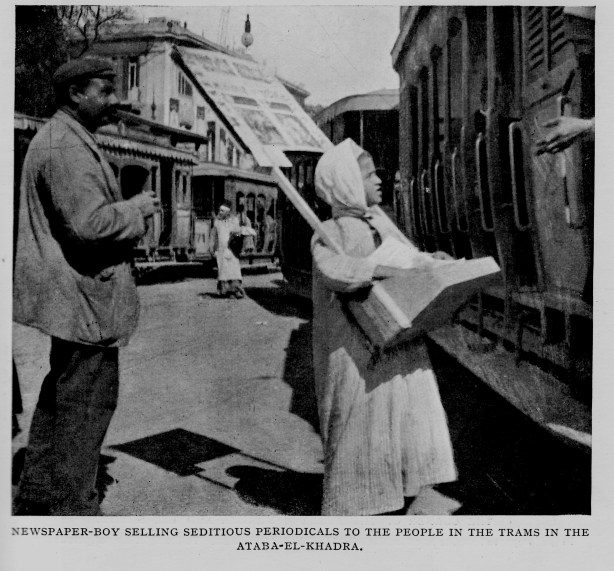
“Egyptian newspaper boy yelling out the latest headlines, Cairo, 1907.” Source: From Douglas Sladen, Oriental Cairo (London: 1911), 64.
However, as discussed in previous chapters, this was never a one way conversation, as writers of these vernacular media were plugged into the streets and public squares through these very same cafés. As we have observed in this study, it can be said that the entire vaudeville theater industry arose out of the cafés on ‘Imad al-Din Street, where most of the vaudeville theaters were housed [Note: See Ibrahim Ramzi, Masrahuna ’Ayyam Zaman wa Tarikh al-Fananin al-Qudama’ (Cairo: Matba‘at al-Salam (1984), 25. There were at least three major cafés in Imad al-Din Street that were frequented by actors, singers, writers, and musicians— Qahwat al-Fan (The Arts Café), Qahwat Barun (The Baron Cafés), and Qahwat Misr (The Egypt Café)]. It was through these dialogical “physical” interactions with the people in the streets, market places, and cafés that the writers, musicians and performers of these media (re)calibrated with the subtleties, textures, and flavors of everyday Egyptian life. As Mikhail Bakhtin cautions in The Dialogic Imagination, we must not ignore the “social life of discourse outside the artist’s study, discourse in the open spaces of public squares, streets, cities and villages;” for it is in these public spheres that Egyptian mass culture is embodied into everyday life, acquiring its socio-economic, political relevance, and more importantly perhaps, its perceived authenticity, and contemporaneity (259). Indeed, access to any form of knowledge— be it visual, aural, tactile, gustatory or olfactory—is corporally mediated and is acquired through a living dialogical engagement. Or as Bakhtin elaborates in Problems of Dostoevsky’s Poetics, “the single adequate form to verbally expressing authentic human life is the open ended dialogue . . . In this dialogue a person participates wholly and throughout his whole life, with his eyes, lips, hands, soul, spirit, within his whole body and deeds” (293). In other words texts alone are meaningless when viewed in isolation of the socially embodied realities of their production, and more importantly perhaps, their reception on the street. It is in their interrelationship with social life that texts become meaningfully activated and authenticated as genuinely reflecting popular concerns and realities. As we have seen throughout this book, colloquial Egyptian culture is better equipped in engaging in this dialogue with the everyday, and hence guaranteeing its circulation and popularity.
(Ordinary Egyptians, p. 170-172)
—
Featured Image: View 042: Egypt – Street in Native Quarter, Cairo., n.d., T. H. McAllister, Manufacturing Optician. 49 Nassau Street, New York. Brooklyn Museum Archives (S10|08 General Views_People, image 9785).
—
Ziad Fahmy is an Assistant Professor of Modern Middle East History at the department of Near Eastern Studies. Professor Fahmy received his History Ph.D. in 2007 from the University of Arizona, where his dissertation “Popularizing Egyptian Nationalism” was awarded the Malcolm H. Kerr Dissertation Award (2008) from the Middle East Studies Association. His first book, Ordinary Egyptians: Creating the Modern Nation through Popular Culture (Stanford University Press, 2011), examines how, from the 1870s until the eve of the 1919 revolution, popular media and culture provided ordinary Egyptians with a framework to construct and negotiate a modern national identity. His articles have appeared in the International Journal of Middle East Studies and in Comparative Studies of South Asia, Africa and the Middle East. Professor Fahmy is currently beginning another book project tentatively titled, Listening to the Nation: Sounds, Soundscapes, and Mass Culture in Interwar Egypt. In 2011-2012, he was a Faculty Fellow at the Society for the Humanities at Cornell University, where the focal theme was “Sound: Culture, Theory, Practice, and Politics.”
Share this:

Decolonizing the Radio: Africa Abroad in the Age of Independence
I never meant to write about radio. Film, video, music, the Internet, television even– but radio had not made a dent in my scholarship or teaching, for embarrassing reasons: it seemed nostalgic even to think about it. It was a residual technology, obsolete even at mid-century, I thought.
And then I stumbled onto the transcripts of “Africa Abroad,” part of The Transcription Centre archives at The Harry Ransom Center.
I was doing research on African American playwright Adrienne Kennedy when two of the fantastic staff at the HRC (Molly Schwartzburg, now Curator at the UVA Special Collections Library, and archivist Gabby Redwine) shared their working African Collections finding aid with me. The description of The Transcription Centre caught my eye, as a radio and public media presence across Africa and the metropolitan diaspora at mid-20th century, whose work included the short variety radio program Africa Abroad (1962-1965) as well as Arts festivals and other cultural events based in London and headed by a former BBC employee. Africa Abroad, a variety show dedicated to the music, art, theatre, literature, and politics of Africa and the African diaspora, offers a compelling glimpse at Independence-Era Africa and some of the technologies that made it, briefly, the center of contemporary diaspora politics.
The transcripts of Africa Abroad document the progressive hope that theorists like Frantz Fanon had for the revolutionary potential of radio in the hands of the (semi)proletariat with cheap access to both production and distribution networks. The background materials on the Centre document its inception as the brainchild of the Congress for Cultural Freedom, a CIA-funded effort to fund anti-communist, pro-democracy sentiment on the continent (a continent who was also being wooed by Russia and China at the time). Africa Abroad then stands as an attempt to rethink the relationship between politics and culture in a difficult, compromised time, self-consciously negotiating the media and mediated trade on Africa as a place and Africa as an international symbol. The radio program takes this moment of African celebrity and finds in it not teleology but proliferation, and a self-aware critique of ‘Africa’ and its public image as it is employed by the diaspora.

released on Riverside Records, 1961.
By the second installment of Africa Abroad on the 26th of April, 1962, what becomes the standard format of the programming emerges, one that begins to place culture as the center of diaspora identity—and politics. There is usually a musical lead—by the 4th installment to become the same “signature tune,” “African Waltz” by Canonball Adderley)—after an announcement of the location (London) and organization of the broadcast. The music and the site identification augurs the emphasis on the multiple and conflicting sites of the black diaspora that are performed within each episode and across the radio series as it continues, starting with an invocation of “Mother Africa”; in this particular episode, James Baldwin calls for the revision of the “American Negro” breaking free of representational binds via “the rise of Africa in world affairs,” then moving to a commentary on a Max Roach jazz piece by Nigerian Aminu Abdullahi that emphasizes the role of pan-African politics in Jazz music, then to a review of Ezekiel (later Es’Kia) Mphahlele’s book The African Image from a Nigerian literature Ph.D. in London, finally leading to a brief interview with Robert Resha, “one of the leaders for the ANC [African National Congress] which has been banned in South Africa, on the eve of his leaving London for a tour of African countries.” This eclectic mix becomes Africa Abroad’s signature format, and its particular concerns—that of the keen recognition that the world’s eyes are on Africa anew during this period of independence, and that Africa is starting to work as a symbolic geography of hope for African America as well as Caribbean emigres to Britain—are also those that inform the rest of its run.

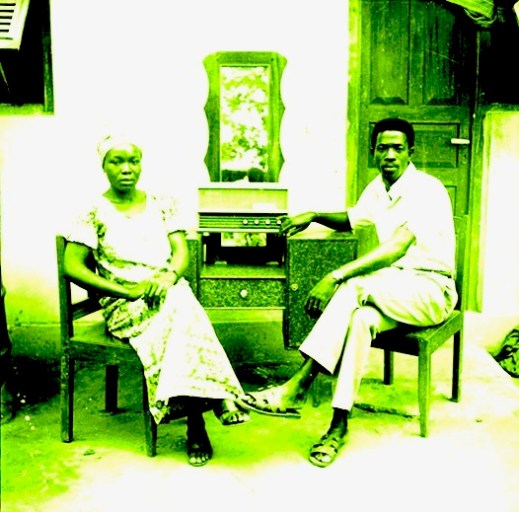
Two friends listen to the radio in the Ivory Coast, 1960s, image courtesy of the BBC Archives
While the range of listeners for Africa Abroad is still hazy—transcripts and recordings were made available across the continent, but there is no record of where they landed or when or if they aired—the way that even its material presence in London acted as a hub for political, literary, and cultural figures from Africa and the diaspora winds up as another meaningful site of contradiction. The programs’ circulation of major literary and cultural figures began to construct and map the canon of African authors we recognize today as the “fathers” of the African renaissance. That gendering is specific as it reflects the kind of access to travel, education, promotion, and connection that was required to be a recurring part of Africa Abroad’s brief run—with a limited number of women being sent to London for education in the time period, and even fewer representing those in privileged political exile. Though what amounts to a handful of women are interviewed on the program, rarely are women writers and thinkers featured beyond actresses. Such representation helped to solidfy a generation of African writers and politics that were defined by the questions of an elite, masculine imagination around what the continent, and art from the continent, should or could be—and this vision of diaspora art and politics circulated via the radio.
In other words, Africa Abroad was produced through and as a representation of the new celebrity of the continent, with the radio program serving as the ideal format to showcase and interrogate the global phenomenon of African Independence and as a harbinger of the postcolonial struggle for its resources that would ensue. As independence struggles adopt and adapt new technologies into forms of “combat,” to use Fanon’s terms from “This is the Voice of Algeria,” radio moves from strictly a medium of the colonizer to a tool, “a system of information, . . . a bearer of language, hence of message” (73). But it is also already “obsolete” by 1962 as a residual cultural form in the Western metropole, taken over in the mainstream by television. Hence, like the flexible political strategies of the Cold War that relied on more than just force, radio at this moment becomes both a tool of cultural revolution (and new-found global relevance) and one of stealth colonial influence. As a program rooted in the West but disseminated across and produced by African continental interests, “Africa Abroad” maintains the complex, contradictory desire of communication post World War II that media communications could both connect us all in a progressive intimacy or hail us into, effectively, sheep. Africa Abroad sounds out this tension in form and in content, through the radio.
As the range of scholars I’ve thankfully met post my encounter with radio attest to, this significant, one might say descendent, moment in radio history is constantly weighted by race, gender, and empire. Ivy Wilson is working on sound and the Transcription Centre on the actual recordings of Africa Abroad. Judy Coffin is mapping the complex work that radio did in the careers of Fanon, Simone de Beauvoir, and other intellectuals of the mid-century. Emily Bloom is tracing BBC radio alongside modernism’s literary pathways. This interdisciplinary community of scholars I’ve discovered alongside of radio signifies the important work being done to think through the possibilities for this medium after its dominant rise and into its political and cultural repurposing in the age of the Cold War—outside of the mainstream center at the same time that it serves to support and traverse new geographic and cultural fronts.
—
Featured Image: original from a BBC collection of images from the Ivory Coast, 1960s
—
Samantha Pinto is an Assistant Professor of English at Georgetown University. She is the author of Difficult Diasporas: The Transnational Feminist Aesthetic of the Black Atlantic (forthcoming from NYU Press) and is working on a new project on early black celebrity and human rights discourse. This research on radio is part of an in-process series of articles on institutional failure in the African Diaspora, Women’s Studies, and other critical sites of progressive political desire.
Share this:


Current Top Posts





April 2021

January 2020

November 2019

October 2019

August 2019

April 2014

November 2017

March 2015

December 2017

October 2015
 Sounding Out!
Recent Comments