
On Donuts, Sandwiches and Beattapes: Listening for J Dilla Six Years On

"J Dilla aka Jay Dee R.I.P." by Flickr user Ohm 17 under Creative Commons License
It has been six years this week since the passing of James “J Dilla” Yancey, considered by many in hip-hop as the quintessential producer’s producer. Over the course of his career the Detroit-born beatmaker garnered production credits with artists ranging from The Pharcyde to Janet Jackson. Since his passing there has been a substantial amount of posthumous output, including a Yancey Boys album with his brother Illa J, Ruff Draft, The Shining and Jay Stay Paid. There have also been the tons of unofficial releases by artists using material from his beattapes without prior permission. An unofficial discography of projects ‘featuring’ Dilla’s work could eclipse his official one.
Dilla’s beattapes, which he shared amongst friends and associates via CDs, eventually traveled the globe via message boards years prior to his passing. His legacy became what it is, at least in part, due to the reach of these CDs, but unfortunately it has also made monetizing the work after his passing a difficult task. There were early issues between Dilla’s family and the legal estate, but for the last couple of years there has been a process established which allows for the use of tracks from his vaults. They are currently set to release The Rebirth of Detroit, which boasts unheard Dilla beats featuring the Detroit artists he came up with:
In addition to posthumous releases under Dilla’s name the estate also licenses tracks for projects by other artists. With over 4000 tracks in their possession, it stands to reason there will be plenty more Dilla in the future. Yet still there is a sense that ‘new Dilla’ will never be new again, as in the future we will only be able to look at Dilla’s past. How would his process as an artist have grown? Surely whatever he was doing before he passed sounds nothing like what he would be doing in 2012.
Fortunately, the creativity of Dilla lives on through his influence on others. In the years since his passing, that influence has gone beyond hip-hop into jazz, indie rock, classical, and electronic music; some might argue Dilla’s influence has spawned new styles or even genres of music . The LA beat scene was seemingly born in homage to him; with its off kilter drums and wild sample chops, it extends beyond the initial influence, projecting into the future a lineage which will forever trace back to Dilla. Another of those lineages takes Dilla to perhaps the least likely place for a hip-hop producer: late-night television, through the figure of Ahmir “?uestlove” Thompson of The Roots.
At the end of the 90s until around 2001, Dilla was a member of The Soulquarians creative team that produced albums for Erykah Badu, D’Angelo, Common, and Bilal:
During this time Dilla worked closely with drummer, producer, and founding member of The Roots ?uestlove. There was a musical bond established over countless studio hours which allowed for a fusion of styles between them that carried Yancey from his Jay Dee period into his J Dilla period, and which ?uestlove continues to carry to this day.
Since Dilla’s passing, ?uest has been an instrumental voice in keeping Dilla’s legacy alive. He regularly DJ’s events celebrating Dilla’s work. On all of The Roots albums except for the most recent one, there have been musical dedications to Dilla. It is when ?uest goes into the studio with The Roots, however, that the living continuation of their musical fusion can be found.
The studio is where ?uest spends a lot of his time, rehearsing The Roots for their role as the house band on the Late Night with Jimmy Fallon show; ?uest records the sessions to listen back before and after the show. On Late Night The Roots play new songs in front of a live audience five nights a week. These songs only air for ten to twenty seconds going in and out of commercials. If you run to grab something from the refrigerator you might miss them. Or, coming back you might find your head nodding to them. Not only are they original works (other than walk on music for show guests, and musical performances), they are an insight into the creative process which shaped both ?uest and Dilla.
?uest names the tracks Sandwiches, a nod to his former collaborator’s Donuts. Donuts was the last official project that Dilla worked on, quite literally on his death bed, and is considered his instrumental opus. It opened up the notion of the short-form instrumental hip-hop work, which traces its own lineage to the history of beattapes. Today, a beattape is a collection of hip-hop instrumentals released as a product through distribution channels (free or paid). In the beginning however, beattapes were physical cassette tapes (and later CD-Rs) passed around from hand to hand. Tracks from beattapes were snippets of beats often recorded right after they were made so the producer could listen to them again outside of the studio setting. They were passed amongst friends and eventually within the industry as a means of selling the producer’s beats.
Early beattapes were not meant for public consumption or as cohesive projects. It’s important to remember that at the time you didn’t finish productions in a home or project studio. Artists, labels, producers etc. would listen to a beattape and select tracks to be purchased for a project. If a beat was bought, the producer would meet the artist in a large studio with an engineer, which is where the beat went into production. The beattape at the time was not considered a final anything, but a sketch of what could become a production.
In addition, beattapes had a secondary purpose as a measure of skill and technique. They became a format for rehearsal and practice. Where a traditional instrumentalist may practice chord changes on their instrument, a beat maker makes beats and records them for easy playback later. For example, a producer could decide to sample the same record as another producer to show how they would use the sample differently. There would be no intent to turn such a track into a full fledged song (though it could happen), instead it would be recorded so they could play it back to a friend or even the producer who originally used the sample for bragging rights.
Dilla was an active participant in this trade. His beat CDs became his calling card particularly for the techniques displayed on them. Donuts was his expansion of that beattape format. Rather than a display of short rough sketches that serve as indications of productions to come, Dilla produced intricate and layered flaunts of technique compacted into short sketches.
The most recognized technique from Donuts is the chop. The chop comes out of the stab line of techniques. A stab is a single instrumental hit played on a sampler. On the MPC line of samplers (which Dilla was famous for using), stabs could be spread across trigger pads pitch shifted chromatically allowing melodic sequences to be played using a single stab. The chop takes that a step further by using multiple samples from the same source (chops) to replace the chromatic stabs, and play melodically. What Dilla displayed on Donuts however, is not merely the chop but the variety of techniques available by which a producer can chop. Working outside the limitations of loops and stabs, new techniques like drum and instrument isolation, de-quantization, vocal stabs and more come at you, one layered technique after the other.
Many of these techniques have been canonized today, but some quality has been lost with that normalization. With de-quantization by example, overuse has practically rendered the technique cliché because its depth was reduced by its definition. De-quantization translates to simply turning off the preference in software programs or hardware beat machines that align all sound triggers to the grid of the tempo and time signature. That definition speaks nothing to what Dilla actually did with that preference off, which was impose his own humanized sense of timing onto the de-quantized patterns of the machine.
Of those that followed Dilla, most got the de-quantization part but missed his sense of time. While de-quantization has shown influence, outside of the ‘stock Dilla’ pattern, his sense of timing has been continued by only a few. At the top of that list is ?uestlove, as he is as responsible for the development of that sense of timing as Dilla is his own. The root of that development can be found in the The Soulquarians period, which can be marked as the time both artists came into their own by working together. That they would come together at all was quite serendipitous, as no player has a better sense of timing than a drummer. It was the mutual sense of timing between Dilla and ?uest that worked to produce the amazing material that resulted.
In The Soulquarians studio sessions ?uest and Dilla created a feedback loop between the drum machine and the drums. This pushed their sense of time as they fused a sonic texture for their drums, which can be heard between their productions. There is a shuffling urgency with a tick of hats between pulses that lead one into the other; the snare or clap crisp, never aggressively cracking, the kick big but not over dominant. It is sequence-based music turned into grooves that maintain the variable constraints of the sequence. They each took these elements with them in their post Soulquarians work, and after Dilla’s passing, you can frequently hear ?uest calling back to those days through his music.
Take a Sandwich like “Gross Understatement.” At the onset a drum loop with a prominent clap is layered into the snare on alternate hits, while a keyboard moves through presets until an organ sound is found. The bass noodles patiently until, with a chord, they meet. When ?uest comes in it takes a couple of bars of him pushing the drums to get everyone else to fall in on his time, but once it hits he can’t control himself, letting out a holler, “something flew out the gate.” What follows is three minutes of magic as the band jams to a grove that is the perfect cross between Dilla and ?uest.
Gross Understatement (G minor) #Sandwich 1397
Up until November 2011, by ?uest’s count, The Roots had created almost 1800 Sandwiches. He has released a stream of Sandwiches through his Swift FM account (the page is currently down until the site relaunches). By his own admission though, all of the Sandwiches aren’t as good as “Gross Understatement.” Out of the 2 to 23 they record each day, he says only about 1 in 19 are bangers. At 94 out of 1800 it isn’t a bad count, enough for nine albums. The only format in these tracks exist however, is as they appear on Late Night, on ?uest’s harddrive and whatever Sandwiches he decides to share. What would a studio project of this material sound like? As big of an audience as they receive on Late Nite, Sandwiches are buried in the mix of television things where it’s not easy to give them the musical attention they deserve. Perhaps in the future an official release of a project from this line will emerge. In the meantime catch them on NBC when you can and stay tuned to ?uest’s social stream.
—
Primus Luta is a husband and father of two (maybe three by the time this goes up). He is a writer and an artist exploring the intersection of technology and art, and their philosophical implications. He is a regular guest contributor to the Create Digital Music website, and maintains his own AvantUrb site. Luta is a regular presenter for the Rhythm Incursions Podcast series with his monthly show RIPL. As an artist he is a founding member of the live electronic music collective Concrète Sound System, which spins off into a record label for the exploratory realms of sound in 2012. Luta is currently working on completing his first book, BeatGenealogy: A History of the Electronic Beat From WWII to Now.
Share this:

Sounds Difficult: James Joyce and Modernism’s Recorded Legacy
 Today’s post from Damien Keane marks the first in our recurrent series, “Live from the SHC,” which will broadcast the research of this year’s Fellows at Cornell University’s Society for the Humanities, directed by Timothy Murray, whose theme for 2011-2012 is “Sound: Culture, Theory, Practice, Politics.” The Society’s Fellows study a diverse range of sound studies topics: the relationship between sound and urban space, the moment when musical sound enters (and exits) the body, the sound of popular culture in interwar Egypt, the role of sound in constructing pious Muslim communities in secular European countries, and the manipulation of sound by “circuit benders”–to name just a few of the projects being researched up at the A.D. White House (To see the full list of Fellows, click here. To see the slate of SHC courses being taught at Cornell this year, click here). To allow our readers the opportunity to listen in to the goings on at the SHC, Sounding Out!‘s correspondent on the inside, Editor-in-Chief and SHC Fellow Jennifer Stoever-Ackerman, will be curating the online conversation amongst the fellows about their current research (and, of course, their sonic guilty pleasures)–so look (and listen) for it on selected Mondays from now through May 2012. –JSA
—-
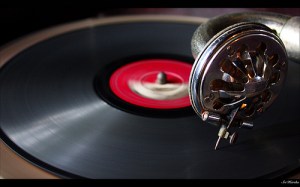
Anyone remember these? "Gramophone" by Flickr User My Little Finger
I began asking my students how many of them had turntables almost nine years ago, when, as a graduate student teaching a course on the twentieth century, I found myself seventy pages into Dracula and having to explain what a phonograph is: then, only one or two hands went up, or half-up, in response to the question. A year ago, when I put this question to students in a course on modernism, fully two-thirds of the thirty-five students in the room raised their hands – although more than a few of them also believed that Steve Jobs had invented the mp3. Even allowing for self-selection and/or misrepresentation on their part, and for a soft form of administrative research and/or miscounting on my part, this swing is quite dramatic.
But what I find intriguing about the uptick is how it tracks with an equally dramatic rise in the use of a kind of allusion in commentaries about the effects of digital media on education. I am referring to those parenthetical asides that so often follow mention of residual technologies such as turntables and albums (e.g. “anyone remember those?”). While these asides are delivered in the manner of a stand-up comic doing material about blind dates or the post office, they serve to euphemize powerful attitudes about technology and what it is to be modern that are even less funny than such shtick, perhaps most directly by assuming the unqualified and unimpeachable newness of the present. Asking if anyone remembers the record player – or the chalkboard or the library or the secretarial staff – takes for granted that you’ve already taken it to the next level, having left off your turntable with parietals and rumble seats.
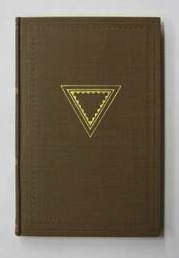
The limited edition of Joyce's _Anna Livia Plurabelle_ (1928). All further images by the author, Damien Keane
Which brings me to the gramophone recording that James Joyce made of the ending of Anna Livia Plurabelle, an episode of what would eventually become Finnegans Wake. Joyce had begun publishing pieces of his work in progress in 1924, and the Anna Livia Plurabelle section was by far the most visible of these, having appeared in several variant forms by the turn of the decade. Among these were its publication as a stand-alone, limited edition book in 1928, and the release of the recording that had been made at C.K. Ogden’s Orthological Institute in Cambridge, as a double-sided twelve-inch gramophone disc in 1929. Each did surprisingly well, and in tandem they helped to secure acceptance of Joyce’s formally challenging aesthetic procedures among readers. Indeed, some in the literary field, such as T.S. Eliot, hoped that recordings of authors’ readings would soon supplant, or at least augment, the market for limited and deluxe editions.
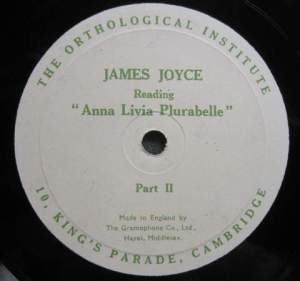
The label for side 2 of ALP gramophone recording (1929)
The fact that recordings did not replace books would be of little interest now, were it not for the way that their relationship in 1929 neatly conjures the supposedly defining trait of our own moment: the demise of one media epoch and the emergence of another (and with economic catastrophe at hand, too). Yet it is the gramophone recording – the “new media” format of that past moment – that is considered thoroughly obsolete today. What then can be said about the “listening history” of the recording? How has the sound of Joyce’s recorded reading interacted with perceptions of the readerly difficulty of the text, which, whether rightly or wrongly, are the pre-eminent “mode” through which readers approach Finnegans Wake? Put simply, if reading the text is hard, is listening to a recorded reading of that text hard?
.
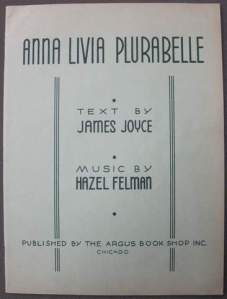
The front cover of Hazel Felman’s setting of ALP (1935)
In thinking about these questions, what catches my attention is the slippage between different senses of “difficulty,” between the positive inflections of literary difficulty and the negative connotations of sonic interference. Contemporary listeners tend to emphasize the crackles and pops that compete with the sound of Joyce’s voice and its language, and thereby locate the “difficulty” of the recorded reading in the sound of the recording itself. It is as though the recording medium actually impedes access to Joyce’s language or somehow imposes itself between the listener and his voice – despite the fact that the medium enables this access in the first place. This is to say, the “low” fidelity of the recording of Joyce’s voice simply cannot reproduce the literary experience of Joyce’s prose, that most elusive, or rarified, object of speculation. (Is it the singularity of literature or is it Memorex?) Today’s default reaction to the recorded reading might be juxtaposed to a much earlier response, Hazel Felman’s setting of the very end of the passage for piano and voice, published in 1935. Here is her explanation of the genesis of her composition:
The emotional reaction I experienced on hearing a recording which James Joyce made of the last pages of ANNA LIVIA PLURABELLE was profound. As I listened to the record time and again, the conviction grew upon me that if I could re-create in music the mood that the author creates when he reads the closing chapters of ANNA LIVIA PLURABELLE, I would be justified in translating into a musical idiom what already seemed to be sheer music.
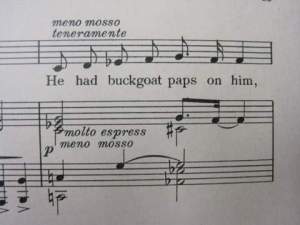
A Close-Up of Felman's Music
Felman’s response pivots on the aural clarity of the Anna Livia Plurabelle recording – she notes, for example, that D is used as a pedal point in the setting because Joyce’s voice modulates around a pitch of D in the recording – and the “sheer music” she heard there was mediated by that very recording.
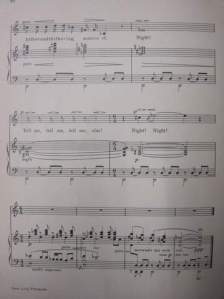
The ending of Felman’s setting, including D pedal points.
Almost eighty years after Felman, today’s hi-fi listeners more often hear in the recording only a poor realization of Joyce’s text, a judgment that has nothing to do with Joyce’s performance and everything to do with the grossly uneven staking of the recording’s semiotic content against its materiality. Yet we do well to recall that surface noise is just as “modernist” as Joyce’s innovative prose. Why do we always forget that? To ask this question brings us back to turntables and students. (Anyone remember them?)
—
Damien Keane is an assistant professor in the English department at the
State University of New York at Buffalo. He is nearing the completion of
a manuscript entitled Ireland and the Problem of Information.
Share this:


Current Top Posts





April 2021

January 2020

November 2019

October 2019

August 2019

April 2014

November 2017

March 2015

December 2017

October 2015
 Sounding Out!
Recent Comments