
Tape Hiss, Compression, and the Stubborn Materiality of Sonic Diaspora

In an article for Pitchfork, music critic Adam Ward reminisces about digital music files that sound as if they’re “being played through a payphone,” and calls the extreme compression of the low-quality MP3 “this generation’s vinyl crackle or skipping CD.” The crackles, hisses, and compression that characterize such sound files are what I term “encoded materiality.” Focusing on the encoded materiality of the digital helps us to reconfigure our approach to sonic media, understanding how the compression of early MP3s and tape hiss remind us not only of lost fidelity, but also of the richness of exchange. These warm and stubborn sonic impurities, having been encoded in our digital listening formats and thus achieving repeatability and variability, act as persistent reminders that we can think diaspora beyond melancholy and authenticity, sidestepping the questions of purity and loss that so often characterize dialogues in the field of diaspora studies.
In Mechanisms, his work on electronic textuality, Matthew Kirschenbaum proposes a “material matrix governing writing and inscription in all forms” composed of four elements: “erasure, variability, repeatability, and survivability” (xiii). The defects of sonic technology that become encoded in digital files are one such type of inscription. Tape hiss and other recording accidents–such as Casey Kasem ruining your attempt to tape record the first Western song you fell in love with after leaving Hong Kong by fading the outro and butting in with his banter–achieve repetition and survival during the digital encoding process, becoming a welcome reminder of time and place. Such materiality helps us to better understand the politics of diaspora. It clues us in to how the elements of textual encoding (erasure, variability, repeatability, and survivability) become embedded within diaspora’s complex logic.

Image by DraconianRain @Flickr CC BY-NC.
To think through these complex moments of exchange, let me offer a story about my experience with tape hiss. I grew up listening to music touched by this particular sonic grain: a ground level of noise upon which my sonic experiences were built. After I received my first iPod in 2005, I connected a tape player to the input of my computer, recorded a stack of tapes, and then manually split them into MP3s—pseudo-piracy committed in earnest. A few weeks ago, I dug up these same files and put them on my phone, once again returning the buried albums to their former glory on a constant rotation playlist. I keep returning to these particular files, rather than finding the now easily available digital versions, because I admire the survivability of their materiality. The materiality of these tracks allowed me to trace the complexity of my own history—the tape hiss is just as much a part of this history as the songs themselves.
After first moving to Canada from Hong Kong, my family and I established ourselves by unswervingly performing the same routine each weekend. We would have late lunch at our favorite dim sum restaurant, drive around for a bit, and then relax at home; there wasn’t much to do in the ex-urbs of Toronto. On those drives, we listened to selections from a stack of cassette tapes in the glovebox of our old Pontiac Bonneville. Sally Yeh’s 1987 album Blessing was on constant rotation and received its fair share of wear. This was one of the tapes I recorded to my computer, destined for digitization.
Because I hit the record button a few seconds early, my MP3 of Sally Yeh’s Blessing begins with a few seconds of silence. It’s enough to trick me into thinking that the song isn’t playing. In a quiet enough spot, I can hear that it’s actually tape hiss. No matter where I am, on the road or in the shower, my mind fills in the blank with the thick ker-chunk of the cassette entering that Pontiac stereo right before that familiar tape hiss would fill the car, always giving us a few sometimes-needed, sometimes-awkward moments of silence before the music started. The sonic texture of that tape stems from its material nature as plastic and metal. The hiss itself is due to the size of the magnetized particles on the plastic. Because of these sounds, the song tells its own story. It recalls our shared sonic and material experience as I migrate it from device to device.
Before Blessing made its way into our car, it was one of the few cassette tapes that my parents carefully packed into a dozen cardboard boxes and shipped by sea to Canada in the late 1980s. This was in the midst of the countrywide protests in China that led to the events at Tiananmen Square. That insistent ker-chunk of plastic on metal that my brain inserts every time I play the MP3s keeps my experience of the music grounded in this earlier history, too. Strange that a fluffy pop song would remind me of the serious political strife taking place on the doorstep of a Hong Kong nervously awaiting its “handover.” This sonic anchor’s ability to recall to me these snippets of history, both personal, national, and transpacific has been crucial in the development of my own diasporic identity. Listening to this particular recording of Blessing helps me to keep track of my self and my history.
Ker-chunk.
The act of withdrawal that many of us perform in order to interface with our sonic technologies, as Alexander Weheliye shows in his reading of Ralph Ellison’s Invisible Man in Phonographies, can play a powerful role in understanding one’s own racial subjectivity. Weheliye focuses on the scene in which the titular narrator-protagonist retreats to a subterranean cave-like space to listen to Louis Armstong’s recorded, disembodied voice in complete solitude. He asserts that the narrator builds his own subjectivity through a recognition of the self by projecting that self onto Louis Armstrong’s “vocal apparatus,” that is, his voice coming through a phonograph (143). “The phonograph’s ability to disconnect the singing voice from its face, or rather to replace it with a technological visage, further heightens its materiality, which impels the protagonist to imbue Armstrong’s voice with a surplus of signification” (Weheliye 145).
More than a black and white photo or a stern historical lecture from the elders, the “heightened materiality” of the digital format, a type of “technological visage” cathects my own diasporic history most forcefully to the sonic anchor of tape hiss because it acts as a “voice without a face” in the same way as the phonographic Armstrong. But despite the privacy of the phonographic listening act in this scenario, Weheliye suggests that
the phonographic listening modality also bears the traces of sociality… since the listening subject is drawn out of him/herself by encountering the technologically mediated sounds of other subjects—we might even go so far as to suggest that the phonograph itself functions as a subject, especially in its interfacings with various humans. (165)
So it is with similar sonic technologies that can encourage the “eschewing [of] the social” such as iPhones, CDs, and, yes, cassette tapes. Like Ellison’s narrator interfacing with the mechanical apparatus that conveys Armstrong’s voice, the insistent “defects” kept on the digital file keep the mechanism of its delivery at the fore, allowing me first to understand that diasporic feeling of dis-ease—and to imagine beyond it.

Sally Yeh’s “Blessing.” Image used with permission by the author.
What I gain from the digital yet still stubbornly material tape of Blessing is not any overt lyrical or thematic gesture to a diasporic subjectivity on the artist’s part, but rather an induction into what Giorgio Agamben calls, “the idea of an inessential commonality, a solidarity that in no way concerns an essence” (18), or perhaps a community based on “belonging itself” (84). Likewise, Weheliye’s “diasporic citizenship coarticulate[s] the national and transnational instead of playing a zero-sum game with political identification” (369). If diaspora is defined by the perpetual desire to seek an imagined originary point of true identity that inevitably leads to melancholy, as psychoanalysis maintains, tape hiss and other encoded materialities turn the gaze away from the mists of origin, validating instead the development of diasporic identity in the aftermath of emigration. Of course, loss and melancholy are legitimate psychic aspects of the diasporic experience, as persuasively demonstrated by scholars such as David Eng, Shinhee Han, Anne Anlin Cheng, but they neither define the whole experience nor are they mutually exclusive to it. It is in this way that we can think of diaspora as a community of belonging by becoming.
A consideration of the stubborn ways that materiality is encoded in the digital helps us to think of diaspora as more than psychic fait accompli—it is also a ‘coming community’ characterized by the process of belonging. Kirschenbaum’s matrix provides the right foundation for a study which considers how material inscriptions are related to our diasporic lives. The inscription that defined my diasporic becoming came from the cassette tape that travelled across the ocean in a boat for five weeks, escaped erasure, survived repeated playings, became digital, and lives on now as a hissing reminder of our history of emigration. What else may we find about our own becoming and belonging if we attune our ears to the encoded materialities of sonic diaspora?
–
Featured image “Decayed Cassette” by darkday @Flickr CC BY.
–
Chris Chien is a Ph.D. candidate in the Department of English at the University of Southern California working variously in the areas of sound, diaspora and transpacific studies, all with a distinctly queer bent. He completed his M.A. in English Literature at Loyola Marymount University and his Honors B.A. in English Literature and Latin at the University of Toronto. Chris has presented papers on angelic gender fluidity in John Milton’s Paradise Lost and post-colonial affect in the work of Herman Melville and Amitav Ghosh at the Rocky Mountain MLA and South Atlantic MLA conferences respectively. He is currently developing a paper that examines the performativity of diaspora, masculinity, and the capitalist ethos in Eddie Huang’s memoir Fresh Off the Boat and its adaptation as an ABC sitcom.
–
 REWIND! . . .If you liked this post, you may also dig:
Pushing Play: What Makes the Portable Tape Recorder Interesting?—Gus Stadler
SANDRA BLAND: #SayHerName Loud or Not at All — Regina N. Bradley
Listening (Loudly) to Spanish-language Radio — Dolores Inés Casillas
Brasil Ao Vivo!: The Sonic Pleasures of Liveness in Brazilian Popular Culture — Kariann Goldschmitt
Share this:

Unsettling the World Soundscape Project: Soundscapes of Canada and the Politics of Self-Recognition

 Welcome to Unsettling the World Soundscape Project, a new series in which we critically investigate the output of early acoustic ecology and assess its continuing value for today’s sound studies. The writings and subsequent musical compositions of original WSP members like R. Murray Schafer, Barry Truax, and Hildegard Westerkamp have been the locus of much critical engagement; ubiquitous references to their work often contain tensions born from the need to acknowledge their lasting influence while critiquing the ideologies driving their work. Yet little attention has been paid to the auditory documents produced by the WSP itself as its members experimented their way through the process of developing methodologies for soundscape research. Drawing on the notion of “unsettled listening” that I wrote about here on Sounding Out! last summer, we pay particular attention to issues of cross-cultural representation in the work of the WSP and ask how their successes and failures can inform new investigations into the sonic environments of the world.
— Guest Editor Randolph Jordan
—
In October of 1973, two young sound recordists embarked on an ambitious field trip across Canada, traversing over 7000 kilometers to commit the national soundscape to tape. From St. John’s, Newfoundland to the harbor of Vancouver, British Columbia, Bruce Davis and Peter Huse pointed their microphones at the things they felt best exemplified their vast country.
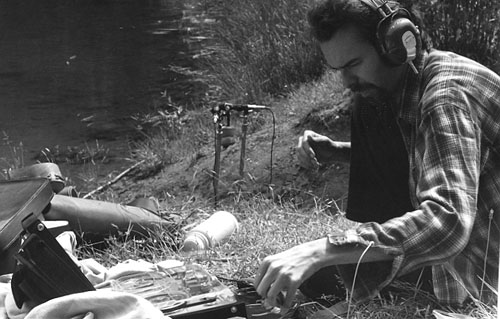
Bruce Davis recording in the field, June 1974
These recordings would become the backbone for Soundscapes of Canada, a series of ten hour-long radio programs carried across the country by the national broadcaster, the CBC. Conceived and produced by the World Soundscape Project (WSP)—a research group formed at Vancouver’s Simon Fraser University in the late 1960s and helmed by the composer and sound theorist, R. Murray Schafer—in its entirety Soundscapes of Canada was an impressively sprawling, eclectic document. Comprised of guided listening exercises and avant-garde sound collages, the program’s stated goal was to open the ears of Canadian listeners to the importance of sonic experience, and to alert them to what they warned was the degradation of the soundscape thanks to the mounting din of industrial modernity.
But there was much more happening out of earshot. Created at a time when Canada’s cultural identity was rapidly changing thanks to an unprecedented swell in immigration from non-European countries, the WSP’s portrait of the nation all but ignored its First Nations and its “visible minorities,” as they would come to be known. While the series was an important statement in the WSP’s larger efforts to bring sound to the forefront of cultural conversation, it is arguably more important to listen to Soundscapes of Canada for what it leaves out, for voices silent and silenced.
For Schafer, the industrialized world had grown measurably louder and qualitatively noisier, which troubled him for both environmental and social reasons. In his 1977 book, The Tuning of the World, Schafer would write, “For some time, I have…believed that the general acoustic environment of a society can be read as an indicator of social conditions which produce it and may tell us much about the trending and evolution of that society” (7). Given the worryingly poor state of the soundscape, for Schafer it followed that society was in bad shape. He was wistful for quieter times, for the days of Goethe, when the cry of the half-blind night watchman of Weimer was within earshot of every one of the town’s inhabitants. Unstated, but implied, here, was the notion that as communities expanded beyond every member’s ability to hear a familiar sound, their common identity would necessarily be eroded. And for Schafer, this was precisely what was happening to Canada.

Father Jean Racine, Percé, Québec, 1974
The WSP’s discussion of “soundmarks” in parts three and four of the series was perhaps their most powerful statement about the stakes for preserving and promoting the nation’s sonic heritage. A “soundmark” is, in the WSP’s lexicon of neologisms, roughly analogous to a landmark: it’s a sound that is supposedly instantly recognizable to members of a community, an irreplaceable acoustic feature of a particular place. In the conclusion to program three, “Signals, Soundmarks and Keynotes,” Schafer intoned, “It takes time for a sound to take on rich, symbolic character—a lifetime perhaps, or even centuries. This is why soundmarks should not be tampered with carelessly. Change the soundmarks of a culture and you erase its history and mythology. Myths take many forms. Sounds have a mythology too. Without a mythology, a culture dies.”
So it seems fair to ask: exactly whose mythology stood to be snuffed out? For Schafer, Canadian culture was (or ought to be) synechdochal with the land, with the nation’s vast, largely uninhabited expanses that stretched all the way to the North Pole. Canadians were (or ought to be) a rugged, self-reliant people—stoic pioneers who shunned cosmopolitan (read ethnic) urban centers, opting for a quiet life in harmony with the country’s settler heritage. This was certainly reflected in program four, “Soundmarks of Canada.” Over the course of an hour CBC listeners would have heard an austere montage almost entirely comprised of mechanical alarms (foghorns and air sirens) and church bells. Each sound presented, carefully, discreetly as though displayed in a museum, free from any traffic noise or sidewalk bustle that might distract the listener. Anyone unfamiliar with the Canadian soundscape would be forgiven for coming to the conclusion that the world’s second largest nation was a bastion of early industrial machinery, a sanctuary for quiet, self-reliant, God-fearing folk.
“Soundmarks of Canada” not only omitted the soundmarks of Canadian cities, it also excluded any sonic trace of the country’s vibrant ethnic and First Nations communities. Produced in the years following the passage of the 1971 Multiculturalism Policy of Canada—which had been adopted in response to a boom of immigration from non-European nations—their portrait of a pastoral, post-colonial British outpost shunted the country’s sizeable non-Christian, ethnic population squarely out of earshot. It should also go without saying that the soundmarks they so prized were deeply entangled with a silencing of Canada’s indigenous population; of a protracted, often violent and brutal, campaign of assimilation that replaced one set of sonic practices with another. For generations of Indigenous Canadians, the sounds of church bells would likely not have connoted community or belonging, but would have rather reverberated with echoes of the “reeducation” in settler religion and language that many were forced to endure in Canada’s residential schools—church-run institutions to which countless children were spirited away against their parents and communities’ wishes.

Canada’s First Protestant Church Bell
This is not to say that any of this was intentional, that the WSP deliberately plugged their ears to Canada’s marginal communities, or that they intended to slight these groups in any way. It may be more accurate to ascribe ignorance and omission to the project, structural forms of inequality that dog even the most well meaning white settlers. Regardless of intent, however, the result is the same.
Soundscapes of Canada shows a troubling politics of self-recognition in action that is far too common throughout the nation’s history. By disproportionately representing the voices and sounds of European Canadians the series necessarily supported the idea that they were, if not the only ones, then at least “ordinary” and incumbent. Projects like these promote and condition a sense of unity and similarity that constitute the nation’s imagination of itself. Benedict Anderson famously observed that nations come into being and are maintained through the cultural work that leads its citizens to identify with the state. Institutions and practices from censuses, maps, nationally available print journalism, etc. all allow people in far-off locales to imagine themselves constituting a limited and sovereign community. In his classic book, Imagined Communities, Anderson proposes that nations have also historically been conceived, created, and ratified through sound. Writing specifically of national anthems, Anderson coins the term “unisonance” to describe the power that sound can have to seemingly erode the boundaries between self and other: “How selfless this unisonance feels! If we are aware that others are singing these songs precisely when and as we are, we have no idea who they may be, or even where, out of earshot, they are singing. Nothing connects us all but imagined sound” (149).
It is significant that the WSP chose the radio—the CBC in particular—as the vehicle for their ambitious project. In the mid-1970s, not only did radio offer the widest reach of any sonic medium, but it also had a particular cultural resonance for Canadians. A nation as vast and varied as Canada could have only come about thanks to mediation; its vastness has always required means of traversing or shrinking space to secure its borders, both psychic and geographical. The westward expansion of the post-indigenous nation was accomplished first by canoe, then by rail, and, beginning in the 1920s, by radio. Appropriately, it was the Canadian National Railway (CNR) that produced the first transnational radio broadcast in 1927—the national anthem performed by bells on the carillon of the Peace Tower—broadcasting the event to railway passengers and home listeners alike. Since the middle part of the 20th century, the national broadcaster has been understood as something of a bulwark against encroaching American culture.
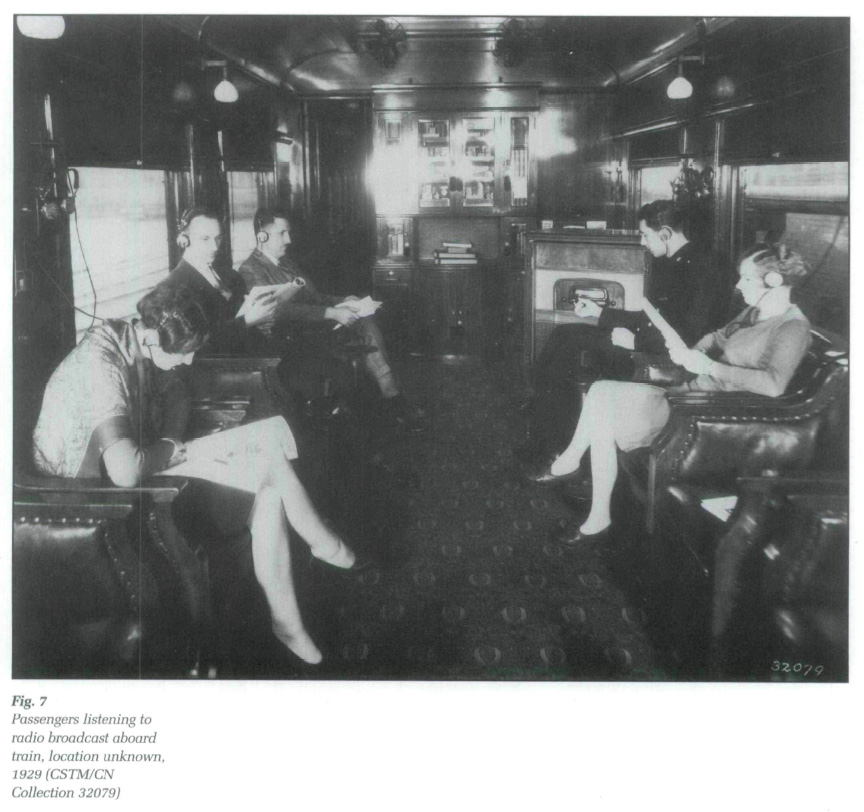
Passengers listening to radio broadcast aboard train, location unknown, 1929
The history of the Canadian airwaves is profoundly mired in struggles to promote, produce, and foster content that might keep the national identity from being completely subsumed under the sprawl and heft of the American culture industry. Schafer had mixed feelings about the medium. On the one hand, he was skeptical of his one-time teacher and mentor, Marshall McLuhan’s, analysis that radio, by its very nature, enfolded listeners in a shared acoustic space, effectively “retribalizing” society. Schafer felt that the airwaves had been packed to such a dense and frenetic level that they actually created “sound walls” that effectively isolated listeners in their own solipsistic, acoustic bubbles. But there was hope for the radio in that it could also facilitate a return to a more wholesome and connected state of being and of listening. Schafer noted this duality in his essay “Radical Radio,” writing, “If modern radio overstimulates, natural rhythms could help put mental and physical well-being back in our blood. Radio may, in fact, be the best medium for accomplishing this” (209). Sonic technology was a source of ambivalence for Schafer; he coined the term “schizophonia” to describe the separation of sound from source that recording effected. He believed that it was problematic to populate the world with copies he deemed inherently inferior to the “original” sonic event. Given the opportunity to reach such a wide swath of the Canadian public, Schafer swallowed his distaste for the schizophonic medium and offered a sonic missive on how to compose a healthy and prosperous nation.
Forty years on, Soundscapes of Canada still stands as a unique experiment in imagining how to build and maintain a nation through sound. But in the same regard it also serves as a troubling reminder of how sonic media can work to occlude the voices of marginal citizens, thereby preventing them from fully finding the place in the national soundscape, simply by ignoring their soundmarks and aural practices. If a nation needs a myth, it can do better than telling stories about the necessity of shoring up a colonial legacy whose time has come.
Readers interested in listening to the full series can stream all ten episodes through the website of the Canadian Music Centre.
—
Mitchell Akiyama is a Toronto-based scholar, composer, and artist. His eclectic body of work includes writings about plants, animals, cities, and sound art; scores for film and dance; and objects and installations that trouble received ideas about perception and sensory experience. Akiyama recently completed his Ph.D. in communications at McGill University. His doctoral work offers a critical history of sound recording in the field and examines an eclectic range of subjects, from ethnographers recording folksongs in southern American penal work camps to biologists trying determine whether or not animals have language to the political valences of sound art practices.
—
Featured image: “Toronto” by Flickr user Kristel Jax. All other images via the author.
—
REWIND! . . .If you liked this post, you may also dig:
À qui la rue?: On Mégaphone and Motreal’s Noisy Public Sphere — Lilian Radovac
Sounding Out! Podcast Episode #7: Celebrate World Listening Day with the World Listening Project — Liana M. Silva
Within a Grain of Sand: Our Sonic Environment and Some of Its Shapers — Maile Colbert
Share this:


Current Top Posts





April 2021

January 2020

November 2019

October 2019

August 2019

April 2014

November 2017

March 2015

December 2017

October 2015
 Sounding Out!
Recent Comments