
Chicana Soundscapes: Introduction

Feminista Music Scholarship understands music production and listening as a collective site of engagement that sometimes produces and sometimes challenges social structures of race, class, gender, sexuality and nation. It is a method and practice that pushes on narrative frameworks that naturalize the absence of women of color and Chicanx subjects in music scholarship. It is always about imagining and practicing life, as the old-saying/ dicho goes says, to the beat of a different drum, to an alternative, more just reality and experience of time, built on the knowledge of buen vivir or sumak kawsay (a kichwe concept and practice that understands the good life cannot be attained without living right with others in convivencia, in mutual respect of marginalized communities, knowledges, cyclical non-linear time, and of La Pachama/mother earth, one that aligns with knowledge practices of many indigenous communities across Las Americas).
This Chicana Soundscapes/Feminista Music Scholarship Forum is inspired by the “Sounds Like Home: Mapping Chicana Mexicana/Indigena Epistemologies in Sonic Spaces” presented at the annual American Studies Association (ASA) Annual Conference, Denver 2017. Thanks to the roundtable organizers Yessica Garcia Hernandez and Iris Viveros Avendaño for inviting me to chair the panel and to ASA Sound Caucus committee for sponsoring the panel and putting a spotlight on this much-needed research. Many have worked tirelessly for over 25 years to make space at the ASA for such a panel–one that is focused on feminista music scholarship, robustly composed of emerging feminista scholars from different localities. It is truly a collective endeavor. That is took this long says much about the way such knowledge has been valued. That is finally happened says much about what’s coming next!
Curtis Marez contextualizes “Chicana Epistemologies/Sonic Spaces” “I’ve been waiting for this panel for my whole academic life” #2016ASA pic.twitter.com/cPTbph1vXb
— Sounding Out! (@soundingoutblog) November 19, 2016
The forum’s inspiring research by scholars/practioners Wanda Alarcón, Yessica Garcia Hernandez, Marlen Rios-Hernandez, Susana Sepulveda, and Iris C. Viveros Avendaño, understands music in its local, translocal and transnational context, and insists upon open new scholarly imaginaries. Not only does each scholar’s research point to the exciting present and future of music studies, it points to the work of feminista scholars and music practicioners who’ve pushed the frames of music studies, from inside and outside of ethnomusicology and musicology, scholars such as: Deborah Wong, Deborah Vargas, Sherrie Tucker, our own mentor Angela Davis, Maureen Mahon, Daphne Brooks, Andreana Clay, Martha Gonzalez, and others. Feminista scholars like Inés Casillas, Jennifer Stoever, Roshanak Kheshti, Monica De La Torre, and others, have made way for for feminista music studies in Sound Studies. And yet, it wasn’t so long ago that Susan McClary shocked the music studies world by insisting that gender mattered in music analysis. We still face constant pushback on that assertion, in particular subfields, especially now. Current times require us to bridge intersectional, decolonial, and gender analysis. Music, and our relationship to it, has much to reveal about how power operates within a context of inequality. And it will teach us how to get through this moment.

(Re)Sounding Misery and Resistance: Chicana Feminist Listening Practices in Radio, Theatre, and Television with Monica De La Torre, Marci McMahon, Sara V. Hinojos and D. Inés Casillas #soundstudiesday #thisistheasa
For the last 13 years my research for Chicanxfuturism manuscript has engaged the following question: What practices compose Feminista Music Scholarship? As a practitioner in dialogue with scholars and practitioners, I identify Feminista Music Scholarship as:
- a fluid practice of collective listening and producing music attentive to power relations
- an examination of power-flows through music via epistemologies birthed from feminist of color and indigenista theorizing and practice
- approaching all genres
- troubling the notion of home
- responding to community displacement & social alienation
- networked (through digital archive, social media, etc…; collaborative and collective; and social justice oriented
- recognizing the reciprocal exchange of knowledge and labor between community and scholarly collaborations
- a collective endeavor
- ever-transforming
Feminista Music Scholarship is what the participants of this forum are doing (among their many important interventions)!

Martha Gonzalez, Scholar and Quetzal vocalist. Photo by Nic Paget-Clarke. This photo was taken during a Quetzal concert at the first community get-together of the Eastside Cafe (May 17, 2002) in the Mazatlan Ballroom in El Sereno (Los Angeles).
Indeed, Feminist Music Scholarship disrupts what Daphne Brooks describes in “The Write to Rock: Racial Mythologies, Feminist Theory, and the Pleasures of Rock Music Criticism” as “the imagined subaltern sphere of independent rock culture (dubbed “indie-rock”) [that] depends on a narrow discourse of shared knowledge that largely marginalizes (if not altogether erases) the presence of women and particularly women of color in alternative music culture” (61). The conceptualization and development of recent pop music exhibits, scholarship by emerging scholars, and community music dialogues, decidedly influenced by Feminista Music Scholarship is one of many possible answers to Brooks’s serious question, “How do we break outside of these tightly policed spheres?” The scholars/music practitioners in this issue respond to the burning question, “how does Chicana feminist music criticism break out of these spheres and serve as a home for new methods for writing about punk, banda, and new wave, son jarocho and participatory community music production?”
During the ASA roundtable, Alarcón, Garcia Hernandez, Rios-Hernandez, Sepulveda, and Viveros Avendaño presented six-minute flash presentations and then opened the floor to a discussion that is wide-ranging yet grounded in the material practices of sound, music, feminism, and home. They continue that important discussion there. More than ever we need panels, forums, dissertations, articles and other forms scholarship that spotlight the ways vulnerable populations have found ways to disrupt systemic oppression through their raucous listening, producing and community practices. This permits us to remember that this fight is not over, that we are deep in it and we have much strategy to share.
Rock on forum readers, rock on!
—
Michelle Habell-Pallán, associate professor of performance culture of the Americas in the Department of Gender, Women & Sexuality Studies, and adjunct associate professor in the School of Music and Department of Communication, at the University of Washington (UW), is currently the Director of the Certificate for Public Scholarship. For her fifteen years plus of community engagement and the arts, she recently received the Barclay Simpson Prize for Scholarship in Public, which recognizes her efforts to foster the humanities as a public good. Her research examines music, performance, and theater as communal forms of expression that archive alternative histories used to imagine new futures. In tandem, her research also reflects on the way developing media platforms compel new methods of cultural expression, research, archiving and delivery. Her most current research considers dialogues between feminista movements and hip hop feminista musics in Ecuador and its relationship to indigenous social movements rooted in Andean concepts of Sumak Kawsai (Right-living). She is the Co-Director of the UW Honors Quito, Ecuador Study Abroad Program.
Habell-Pallán authored Loca Motion: The Travels of Chicana/Latina Popular Culture (NYU Press). Her most recent book is the bilingual American Sabor: Latinos and Latinas in US Popular Music: Latinos y Latinas en La Música Popular Estadounidense co-authored with Marisol Berrios-Miranda and Shannon Dudley, published by University of Washington Press (Autumn January 2017). Her single-authored book Chicanxfuturism: Punk’s Beat Migration and the Sounds of Buen Vivir is in-progress.
Habell-Pallán guest-curated the award-winning bilingual traveling exhibit American Sabor: Latinos in U.S. Popular Music hosted by Smithsonian Institution’s Traveling Exhibition Service (SITES). As a digital feminista she transforms digital humanities, through community engagement, as co-director of University of Washington Libraries Women Who Rock (WWR): Making Scenes, Building Communities Oral History Archive.
A former UC President’s Postdoctoral Fellow, Habell-Pallán is recipient of a Rockefeller Foundation Humanities Research Award, Woodrow Wilson Foundation Research Award, UW Royal Research Fund Award, and UW Simpson Center Digital Commons Faculty Fellowship (underwritten by the Mellon Foundation).
Habell-Pallán makes community & music with the Seattle Fandango Project, and is a member of the Fembot Collective|Gender, New Media & Technology. She collaborates with a range of local community partners to direct the Women Who Rock: Making Scenes, Building Communities Collective, whose free and family-friendly Seattle unConference/Encuentro takes place annually.
—
 REWIND! . . .If you liked this post, you may also dig:
If La Llorona Was a Punk Rocker: Detonguing The Off-Key Caos and Screams of Alice Bag– Marlen Ríos-Hernández
Chicana Radio Activists and the Sounds of Chicana Feminisms–Monica De La Torre
SO! Reads: Deborah R. Vargas’s Dissonant Divas in Chicana Music: The Limits of La Onda–Wanda Alarcon
Share this:

“Don’t Be Self-Conchas”: Listening to Mexican Styled Phonetics in Popular Culture*

*Dedicated to the love we hear in our mothers’ accents. This post is co-authored by Sara V. Hinojos and Dolores Inés Casillas
The Cinco de Mayo season showcases troubling instances of Spanish being mocked. Corporate ‘merica profits from Drinko de Mayo when menus advertise “el happy hour”; words like “fiesta” and “amigo” are overused; and Spanish hyperanglicized for laughs (one of the worst: “COM-PREN-DAY”). These acts of linguistic privilege, according to Jane Hill, elevate whiteness in public spaces. What is heard as playful for the dominant ear is simply an acoustic representation of the racist appropriation of mustaches, sombreros, and sarapes.
CinKO de Mayo(naise)
Fiesta like there’s no mañana
Said no Juan ever
That said, bilennials have struck back.
Last year, the Latino digital platform, we are mitú, published a list that resonated with its young, bicultural readers, those long accustomed to hearing Spanish Accented English (SAE) as part of their everyday speech: 17 Popular Brand Logos If They Looked The Way Your Parents Pronounce Them. This humorous phonetic play in the face of complaints about foreign accents being unintelligible or moral indignation over immigrants who do not learn English with native-like proficiency re-directs our attention to digital, engaged Spanish-English bilingual communities. Like Chicana/o listening practices, these digital memes, gifs, and lists embrace how these accents invoke sounds of survival, solidarity and place making.
Con Fleis (Corn Flakes)
Gualmar (Wal-Mart)
Feisbu (Facebook)
Cosco (Costco)
The witty Buzzfeed-ish list re-spelled English-language global logos in Mexican, immigrant styled phonetics to reflect how said stores, brands, and social media sites are heard within Spanish-dominant or bilingual speaking communities. The absence of letters (Cosco) and/or the substitution of letters (Gualmar) induce an “accented” non-English dominant speech, dislodging standard rules about English-language spelling and pronunciation. Readers chuckled at seeing immigrant, ESL (English as a Second Language), phonetic speech in print – a tactic Sara V. Hinojos refers to in her media writings as a visual accent, or a visual vocabulary based on sound.
In order to “get” the humor behind the wave of memes and gifs that use Spanish Accented English (SAE), Chicana/o readers rely much more on their listening ears than their eyes to understand how these accents are voiced in print. Here, listening to accents operates as a popular form of literacy, one that registers the audible, racialized experiences of Spanish-speaking immigrants. Of course, the use of creative, rasquache forms of humor have long been a hallmark aspect of Chicana/o humor. Yet listening to these digital literacies, especially within the contemporary “build the wall yet eat the taco” era, help make these accents legible.
Estop (Stop)
Eschool (School)
Espray (Sprite)

Certainly, some vocal accents are audibly more patent to select ears than others. Accents work to socially and geographically locate speakers; for instance, often racially indexing Spanish Accented English speakers as Mexican (regardless of nationality), immigrant (regardless of citizenship), and/or poor (regardless of occupation). Sociocultural linguists remind us that accents, word choice, vocal tone and other sound qualities of language are a part of a larger Bourdieu-ian rubric of linguistic capital. Social psychologists consistently demonstrate that listeners make “moral, intellectual, and aesthetic judgments of others based on language use and accent alone.” For scholars of race and sound, accents comprise part of a sonic color line; a socially constructed aural boundary that aligns accented English speech as non-white and non-accented (or Midwestern) English as white. Vocal neutrality, like whiteness itself, operates invisibly as privilege usually does.
Jess (Yes)
Brefas (Breakfast)
Effectively “reading” a visual accent does not privilege a bilingual speaker but rather an accented listener, one raised or surrounded by immigrant speakers. The humorous phonetic play of a visual accent symbolically challenges the capitalist logic that a “neutral accent” or non-accent in English holds immense Western value. For those of us with accented speakers in our families and communities, accents function as emotional markers; vocal or vernacular archives that trace an individual or family’s migration, travels and/or histories. As Denice Forham shares poetically about her Puerto Rican mother’s accent, “even when her lips can barely stress themselves around English, her accent is a stubborn compass, always pointing her towards home.” For our families, accents evince the affective labor entailed in retraining tongues, in learning new idioms, and general struggles to converse in Inglish.
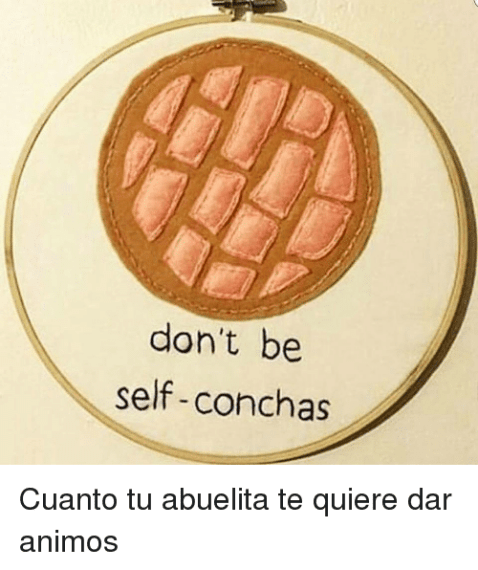
(when your grandmother wants to motivate you)
Using the name of a popular Mexican sweet bread (conchas) as a substitute for “conscious” upsets Western, phonetic understandings of “scious” in favor of a phonetic, Mexican stand-in. Concha, a sea shelled shaped sweet bread, associated with female genitalia and used in digital Latino communities has become a symbol for body positive inclusion; an insistence to not feel “self conchas” when eating (see Nalgona Positivity and SOMAR ATX). These memes privilege an accented listener, a feminist sensibility, as well as a panadería connoisseur.
The mega-for-profit-English-teaching-colonial organization, known as Teaching English as a Foreign Language (TEFL), explains that the lack of distinction in the Spanish language between a short and long vowel – for instance ship/sheep – causes miscomprehension for assumed-yet-never-named native English listeners. Those learning English as a Second Language are encouraged to first reorient their own ears to listen to the subtlety between pull/pool before grasping the complexities of yacht/jot. The communicative burden lies on the accented speaker rather than the non-accented listener. The visual accent places the onus on the English-dominant listener, effectively excluding them.
Trico Tri, Japi Jalogüín!
(Trick or Treat, Happy Halloween!)
Despite the fact that the United States represents the second largest Spanish-speaking country in the world, Spanish maintains a racialized, classed and “second-tiered” status within the United States imaginary (see Bonnie Urciuoli; Jane Hill; Jonathan Rosa; and D. Inés Casillas). These disparaging attitudes are evident when Spanish is prohibited in work places; when bilingual education and English Language Learner (ELL) programs are eliminated at ballot boxes; or when public school teachers are removed from posts based on their “heavy accents.” Institutional efforts to tame bilingual, accented tongues are less about speech and much more about accommodating the dominant, white listening ear.
According to Jennifer Stoever, the listening ear refers to dominant listening practices. Listening, she argues, is an embodied cultural practice that influences one’s position to power. “As the dominant ‘listening ear’ is disciplined to process white male ways of sounding as default—natural, normal, and desirable—alternate ways of listening and sounding are deemed aberrant and, depending upon the historical context, as excessively sensitive, strikingly deficient, or impossibly both.” Therefore the dominant listening ear not only tunes out “other” sounds but also treats them as illegitimate because they deviate from what sounds “normal” (read: white).

Cálmate Carnal, Tey Quirisi
(Relax Friend, Take it easy)
Gail Shuck found that white, native English-speaking college students construct an ideological distinction between Us and Them; gesturing to a sonic color line. Compellingly, she reported how American tourists in Mexico would describe native Spanish speakers as “heavily accented.” Yes. The communicative proficiency of Spanish by Mexicans in Mexico continued to be scrutinized by native English-language listeners.
Cinco de Mayo has versed us too well on the visual markers of racism like oversized sombreros, felt mustaches, and cheap beer pursuits, all a part of the commercial exploitation of Mexican communities in the U.S. But then phrases such as “Grassy Ass” or “No Problem-o” are heard bitterly as recurrent reminders that our language and accents are policed with the same fervor as our bodies. The inventive use of the visual accent archives how we listen, privileging the accented ear. The loving jest that enwraps these digital literacies reminds us to never lose our accents.
—
—
REWIND! . . .If you liked this post, you may also dig:
Chicana Radio Activists and the Sounds of Chicana Feminisms— Monica De La Torre
Could I Be Chicana Without Carlos Santana?— Wanda Alarcon
Speaking “Mexican” and the use of “Mock Spanish” in Children’s Books (or Do Not Read Skippyjon Jones)— Dolores Inés Casillas
Share this:




Current Top Posts





April 2021

January 2020

November 2019

October 2019

August 2019

April 2014

November 2017

March 2015

December 2017

October 2015
 Sounding Out!
Recent Comments