
Stir It Up: From Polyphony to Multivocality in A Brief History of Seven Killings
 For many, the audiobook is a source of pleasure and distraction, a way to get through the To Read Pile while washing dishes or commuting. Audiobooks have a stealthy way of rendering invisible the labor of creating this aural experience: the writer, the narrator, the producer, the technology…here at Sounding Out! we want to render that labor visible and, moreover, think of the sound as a focus of analysis in itself.
Over the next few weeks, we will host several authors who will make all of us think differently about the audiobook selections on our phone, in our car, and in our radios. Last week we listened to a book that listens to Dublin, in a post by Shantam Goyal. Today we have seven narrators telling us the story of an assassination attempt on Bob Marley. What will the audiobook whisper to us that the book cannot speak?
—Managing Editor Liana Silva
Reviews of A Brief History of Seven Killings, Marlon James’ 686-page rendering of the echoes of an assassination attempt on Bob Marley, almost invariably invoke the concept of polyphony to name its adroit use of multiple narrators. In The New York Times, Zachary Lazar maintained that the “polyphony and scope” of the 2014 novel made it much more than a saga of drug and gang violence stretching from 1970s Kingston to 1990s New York. And the Booker Prize, which James was the first Jamaican to win, similarly praised it as a “rich, polyphonic study,” with chief judge Michael Wood calling attention to the impressive “range of voices and registers, running from the patois of the street posse to The Book of Revelation.” It was thus not only the sheer number of voices in a preliminary three-page “Cast of Characters” that critics so unanimously admired but also the variety and nuance evident within them. Norwegian publisher Mime Books even took these polyphonic features a step further by hiring not one but twelve translators in a casting process that auditioned prominent novelists, playwrights, and performers.

Cover of the book, under fair use
James recalls realizing early on that this novel would be one “driven only by voice” (687), which might make such enthusiastic responses to its plurality of perspectives seem unsurprising. But what happens when such polyphony leaves the page behind and actual material voices drive its delivery? If the audiobook is a format of the novel (and here I follow Jonathan Sterne’s definition of format in MP3: The Meaning of a Format as “a whole range of decisions that affect the look, feel, experience, and workings of a medium” [7]), what lessons can listeners learn that print cannot provide? As I argue, the 26-hour-long audiobook version of A Brief History, which Highbridge Audio produced with seven actors (Robertson Dean, Cherise Boothe, Dwight Bacquie, Ryan Anderson, Johnathan McClain, Robert Younis, Thom Rivera), allows us to engage with multivocality rather than polyphony, which is to say the multiple vocal performances of a single individual rather than the presence of many narrators within a print work. And just as this novel’s polyphonic structure destabilizes any attempt at a definitive account of the events it portrays, the multifaceted performances of its audio format work to untrain ears that have been conditioned to hear necessary ties between voices and bodies.
Of course, this effect is not one that most listeners consciously seek, as reviews of the audiobook articulating various reasons for turning to this format as well as diverging responses to it readily attest. Gayle, on Audible, began with the print version: “but as soon as I got to the first chapter that was written in Jamaican patois I knew that I was not able to do that in my head and I was going to miss a lot.” Sound here conveys sense more swiftly than the page, the ear apparently better suited than the eye to encounter difference. (Woodsy, another reviewer, even felt emboldened to ventriloquize in text that sonically distinctive speech: “I found that listening to the Audible version was helpful. Now all me need do is stop thinking in Jamaican.”) Yet it was Andre who offered by far the most memorable characterization of the audiobook and its affordances. As he explained, in James’ novel “the language is a thick, tropical forest of words. Audiobook is the machete that slices through this forest of words so I can enjoy the treasures inside.” The violence of this metaphor matches that of the novel’s most disturbing scenes, yet what is most striking is the way it reiterates once more how reviewers found it easier to access the work aurally rather than visually.
“Studio Microphone” by Richard Feliciano, CC BY-NC-ND 2.0
These reviews, and other similarly favorable appraisals, rarely consider the audiobook on its own terms, insisting instead on comparisons with the text. Negative ones, however, often note distinctively sonic features, with some reviewers echoing one of the Booker judges—who reportedly consulted a Jamaican poet about the accuracy of James’ ear for dialogue—by questioning the veracity of the Jamaican accents in a novel that also features American, Colombian, and Cuban ones. Tending to readily identify themselves as Jamaican, these writers and listeners rarely acknowledge that at least some of the actors were born on the island when asserting that the accents are off. In any case, such efforts to link sound and authenticity, as Liana Silva has argued with respect to the audiobook, wrongly suggest that those who belong to a group must conform to a single sound. James, too, distrusts discourses of the authentic, as characters repeatedly cast suspicion and scorn on anyone uttering the phrase “real Jamaica.”
If the polyphony in James’ novel prevents any one perspective from becoming either representative or definitive, the audiobook pushes this process even further by demonstrating how a single performer’s voice can possess such range that it seems to contain multiple ones. Each performer is responsible for all the voices within the sections narrated by their primary characters, which means that the same character can occasionally be voiced by different actors. In one section, a performer does the voices of a tough-talking Chicago-born hitman and the jittery Colombians he speaks with in Miami; in others, that same performer is both a white Rolling Stone journalist from Minnesota who’s attuned to racial difference and the black Jamaicans he converses with in Kingston. Continuity or strict one-to-one correspondences between performer and character ultimately matter less than the displays of vocal difference that allow the audiobook to contest essentialized notions of voice.
As a result, the audiobook articulates just how constructed vocal divisions based on race, gender, and class are by having its performers constantly cross them. It amplifies the very arbitrariness of such divisions and thereby reveals how, if the page is the space of polyphony, then what the audiobook stages is multivocality. Although they might seem like synonyms, these two terms can actually help us appreciate crucial differences and, in doing so, highlight the specificity of the audio format. On the one hand, –phony or phōnē, as Shane Butler reminds us in The Ancient Phonograph, ambiguously refers to both voice and the human capacity for speech (36), whereas –vocality centers the voice. On the other, the shift from the Greek poly- to the Latin multi- signals a contrast in what gets counted: while polyphony names the quantity of perspectives contributing to a narrative (when introducing it in Problems of Dostoevsky’s Poetics, Mikhail Bakhtin emphasized that polyphony consisted of “a plurality of independent and unmerged voices and consciousnesses” [6]), multivocality instead specifies how the number of voices can exceed the number of performers. In this way, the concept of multivocality outlined here with respect to the audiobook resonates with its use in another context by Katherine Meizel, who mobilizes it with reference to singing and the borders of identity. In both cases, voice names a multiplicity of practices rather than an immutable or inevitable expression, which in turn aligns with Nina Sun Eidsheim’s argument in The Race of Sound about the voice being not singular but collective and not innate but cultural (9).
“Last Exit (Recording Studio)” by Flickr user Drew Ressler, CC BY-NC-ND 2.0
We can therefore say that where print-based polyphony works on the eye by placing various perspectives on a page without necessarily challenging visual perceptions of difference, multivocality in the audiobook can retrain an ear’s culturally ingrained ideas about voice. James himself has experience with these seemingly inescapable meanings assigned to vocal sounds. In a moving essay for The New York Times Magazine, he recounts how, even at the age of 28, “I was so convinced that my voice outed me as a fag that I had stopped speaking to people I didn’t know.” That was already long after high school, when, as he remembered in a New Yorker profile, he had begun “tape-recording his efforts to sound masculine, repeating words like ‘bredren’ and ‘boss.’” He was well aware of the links that listeners created between voice and identity and that could, as he suggests, prove risky in a place with overt homophobia like Jamaica. Writing, however, offered him a space to take on any voice and, at the same time, not be concerned with the sound of his own.
Yet if the page allowed James to effortlessly shift among narrative voices, the audiobook format exhibits voices that ostensibly shift without any effort. Perhaps the most compelling example emerges in the work of Cherise Boothe, whose performance of the novel’s sole female primary character presents the voices of other figures as well. Toward the end of the novel, this character, Dorcas Palmer, is a caretaker for a much older and wealthier white man with amnesia in New York. Boothe not only captures the changes as Palmer often eliminates her Jamaican accent and occasionally lets it loose but also registers the man’s moments of lucidity and confusion. Even if, as listeners, we understand that Boothe is the voice behind both of these characters, the two vocal performances are so distinct that they effectively erode the basis for any beliefs about how a certain body should sound.
Adopting different voices is certainly not unique to the audiobook, but it does provide one of the few forms of extended exposure to this practice. Yet it is worth noting that A Brief History markedly differs from the model of a more extensive cast like the one comprised of 166 voices that recorded George Saunders’ Lincoln in the Bardo. By assigning a performer to every character, such productions ultimately emphasize vocal uniqueness in roughly the same way that Adriana Cavarero conceives it, namely as an index of individuality. But there the voice remains something singular or somehow essential, for there is no opportunity to perform the plurality that appears across A Brief History. At the same time, the use of seven actors also offers a contrast with the opposite extreme: a single performer responsible for all the roles, which demonstrates multivocality but does so on such a small scale that it feels exceptional instead of ordinary. The middle ground, which is to say the model found in A Brief History, allows us to hear multiple instances of how the voice is entrained rather than essential, possibility rather than inevitability.
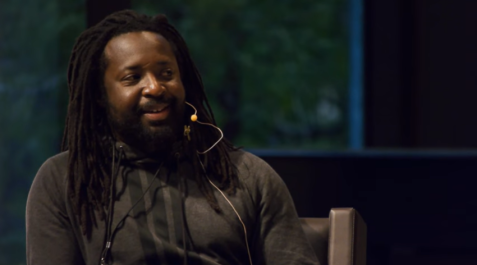
Screenshot from Youtube video “Marlon James: A Brief History of Seven Killings” by Chicago Humanities Festival
When briefly addressing audiobooks in an interview, James remarked that this format possesses a distinct advantage: “even something that is not necessarily plain can be translated because of tone and symbol and voice.” In other words, a voice can register its changing surroundings; conveying these subtle transformations on the page, however, is often far more difficult. This shortcoming is one that Edward Kamau Brathwaithe once memorably described when explaining why he insisted on using a tape recorder in a lecture on language in the Caribbean: “I want you to get the sound of it, rather than the sight of it.” The idiomatic familiarity of the first half, which clashes so sharply with the awkwardness of the second, suggests that the multivocality of an audiobook can open ears by accentuating how the voice is not fixed but in constant formation.
—
Featured Image: “Audiobook” by Flickr user ActuaLitte, CC-BY-SA-2.0
—
Sam Carter is a PhD Candidate in Romance Studies at Cornell University. His work on literature and sound in the Southern Cone has appeared in Latin American Textualities: History, Materiality, and Digital Media and is forthcoming in the Revista Hispánica Moderna.
—
 REWIND! . . .If you liked this post, you may also dig:
SO! Reads: Jonathan Sterne’s MP3: The Meaning of a Format–Aaron Trammell
Radio de Acción: Violent Circuits, Contentious Voices: Caribbean Radio Histories–Alejandra Bronfman
“Scenes of Subjection: Women’s Voices Narrating Black Death“–Julie Beth Napolin
Share this:

Soundwalking on the Edges: Sound, Safety and Privilege in São Paulo, Brazil

 Since its inception at the World Soundscape Project in the 1970s, soundwalking has emerged as a critical method for sound studies research and artistic practice. Although “soundwalking” now describes a diversity of activities and purposes, critical discussions and reading lists still rarely represent or consider the experiences of people of color (POC). As Locatora Radio hosts Diosa and Mala have argued in their 2018 podcast about womxn of color and the sound of sexual harassment in their everyday lives and neighborhoods, sound in public space is weaponized to create “sonic landscapes of unwelcome” for POC.
While we often think of soundwalks as engines of knowledge production, we must also consider that they may simultaneously silence divergent worldviews and perspectives of space and place. In “Black Joy: African Diasporic Religious Expression in Popular Culture,” Vanessa Valdés explored alternate conceptions of space held by practicioners of Regla de Ocha, epistemologies rarely, if ever, addressed via soundwalks. “Within African diasporic religions . . . including Palo Monte, Vodou, Obeah, Macumba, Candomblé – there is respect for the seemingly inexplicable,” Valdés remarks, “there is room for the miraculous, for that which can be found outside the realms of what has been deemed reasonable by systems of European thought. There is room for faith.” Does current soundwalk praxis—either as research method, public intervention, artistic medium, field recording subject, or pop culture phenomenon—impose dominant ideas about space and knowledge production as much as—if not more–they offer access to alternatives? Are there alternate historiographies for soundwalking that predate the 1970s? Can soundwalks provide such openings, disruptions, and opportunities without a radical rethinking? What would a decolonial/decolonizing soundwalk praxis look and sound like?
Soundwalking While POC explores these questions through the work of Allie Martin, Amanda Gutierrez, and Paola Cossermelli Messina. To read the series from the beginning click here. Today, Paola Cossermelli Messina revisits the São Paolo of her youth. —JS
When at home in São Paulo, Brazil, I rarely walk to where I’m going. In a city plagued by mobility issues, a private car is the most efficient way of getting around. Other factors in opting out of public transportation include the limited reach of the subway system, overcrowdedness on buses, sexual harassment of women on public transport going unpunished, and price hikes that lead to no infrastructural improvements. The 2013 protests in Brazil, the largest demonstration in two decades, were initially set off by increased ticket prices for the bus, train, and metro, and later encompassed additional concerns such as corruption and police brutality.
Having spent most of my childhood and all of my high school years (between 1987 and 2005) in São Paulo, I find myself looking back at my sensory experience of the city as one mediated by fear, segregation, and vigilance. I have become interested in Vincent Adrisani’s (2015) idea of sonic citizenship—ordinary, everyday auditory interactions and experiences through which presence in and claim over public spaces is asserted. Consequently, I recorded the following soundwalks on two specific routes to engage with what were once-familiar surroundings as a “sonic citizen.” These soundwalks made me revisit fears and privileges from my life as a queer, white/POC, expatriate/immigrant on the edges of color, as I walked through a microcosm of São Paulo, recording the urban soundscapes that enveloped my day-to-day.
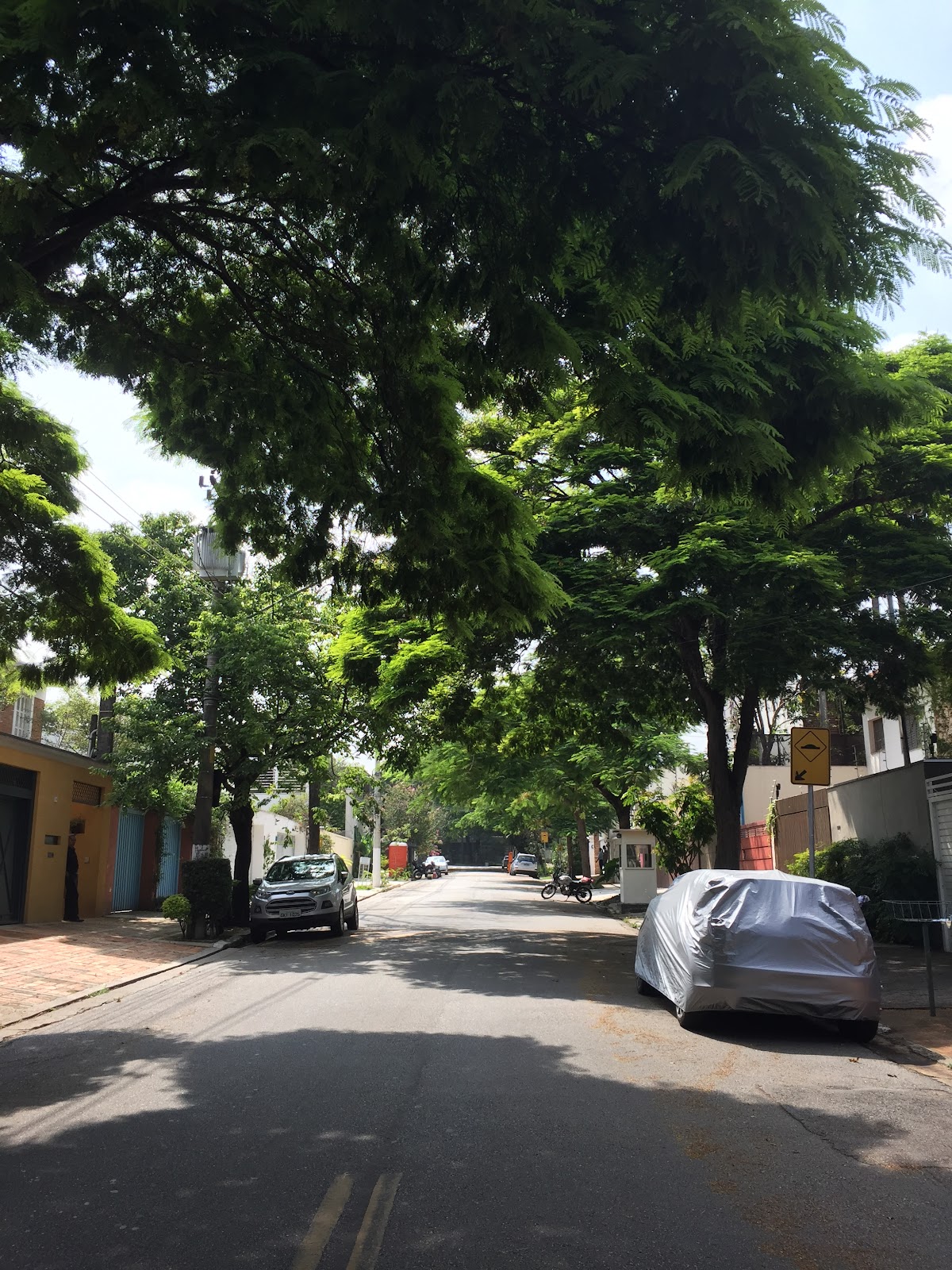
Looking up Rua Juquiá on December 29th, 2018. Images by author
The audio clips included in this essay were sampled from a morning walk between my former high school and home in the Zona Oeste (Western Region), and also from a brief walk on Avenida Paulista. This is a bustling, iconic avenue at the top of one of the steepest hills in the city, located at the crux of the Western, Central and Southern regions of São Paulo. Where one soundwalk ends is merely a ten minute walk from where the other begins. These are physically close, but sonically contrasting, public spaces, both of which are significant to my experiences in the city.
Rua Juquiá is a tree-lined street with walled-off houses and, in my memory, filled to the brim with cars as early as seven in the morning. My school was the only non-residential building on that street. During the day, personal security guards and drivers would find a place to park and nap until the final school bell rang. I recall making a bee line from my mother’s car to the school gate, motivated by word-of-mouth tales of “sequestros relâmpagos” (literally translated to “lightning kidnappings”). Young people going to private schools were said to be the focus of these kidnappings, in which they would be picked off the street by kidnappers and held for ransom. There was one occurrence of this while I was a student at that school.
With these stories in mind (and sometimes also in my dreams), a sensory engagement with my surroundings was often limited in time and scope, as I moved cautiously between interiors – private vehicles, school, thirty-story buildings towering high above the streets, and shopping centers patrolled by armed guards. At night as I laid down to sleep, the sounds of trucks straining to make their way up the steep slope of my street and motorcycle exhaust pipes blasting echoed in lively conversation with each other.
The relationship between my privilege and racial identity were, at that time, quite different from how it would come to be in the United States. Being of mixed Middle Eastern and European descent in Brazil is an identifier of whiteness and, more often than not, an indicator of a comfortable living situation. My school uniform with its red blazer and dark grey skirt, the uncommonly green neighborhood where most of my daily routines took place, and the double-gated apartment building I lived in, were all indicators of my status.
Identifying as queer is the only aspect that overlaps the boundaries between Brazil and the United States, where I currently reside. In both nations, the expression of this identifier is mediated by different levels of fear of violence—not of violence like the one I feared in Brazil, but violence nonetheless. Throughout my youth, it lurked beneath the surface of my consciousness, compounding the fear I already carried in my body. In the U.S., the compounding factors are my mixed racial features and immigration status (or as the USCIS dubs us ‘aliens’). In the eyes of all major institutions of this country, I am a person of color. As such, the soundwalk in São Paulo also became an experiment in juxtaposing these varying experiences at the intersection of privilege, queerness, and race.
In listening to the soundwalk clips below, I find that the absence of people’s voices and sounds, rather than the presence of supposed ‘dangerous people’, per se, is the most disconcerting thing. Though nature sounds predominate in the clips from this walk, they seem to exist in a cement vacuum.

The front entrance to my middle school and high school on Rua Juquiá.
On the morning of December 29th, 2018, there were only a few parked cars and hardly any people on the street. I looked up at the wall obstructing my school from view. These were initially put up at some point during my senior year in 2005, but have been given added height recently, with cameras like bulbous black eyes surveilling the streets from every one of its angles. On Rua Jacupiranga, perpendicular to Rua Juquiá, there is a new addition – a set of ‘city cameras’, curiously placed at eye level. This is hardly what Jane Jacobs meant by “eyes on the street” and their contribution to a feeling of safety in public spaces. In this case, the eyes are cameras and the listening experiences within these spaces are subsequently fractured into the reassured and criminalized. As Robin Sheriff (2000) observed, “silence demands collaboration” and is “both a consequence and an index of an unequal distribution of power.” Although Sheriff was referencing the silence around the discussion of racism in Brazil, I can see a connection with the street level silence.
The silence that this incredibly visible form of surveillance imposes, and the replacement of human bodies with vehicles warrants the question: who and where are the “sonic citizens” of these streets? The only other people outside, besides me, were a few construction workers, shoveling bits of cement into a bin and security guards standing outside walled-off houses. They watched me for a brief moment, concluding soon enough that I was no threat to the houses they were employed to protect. The heightened level of security on the street made me wonder if I was going to be questioned by them, but sure enough, I was deemed unthreatening.
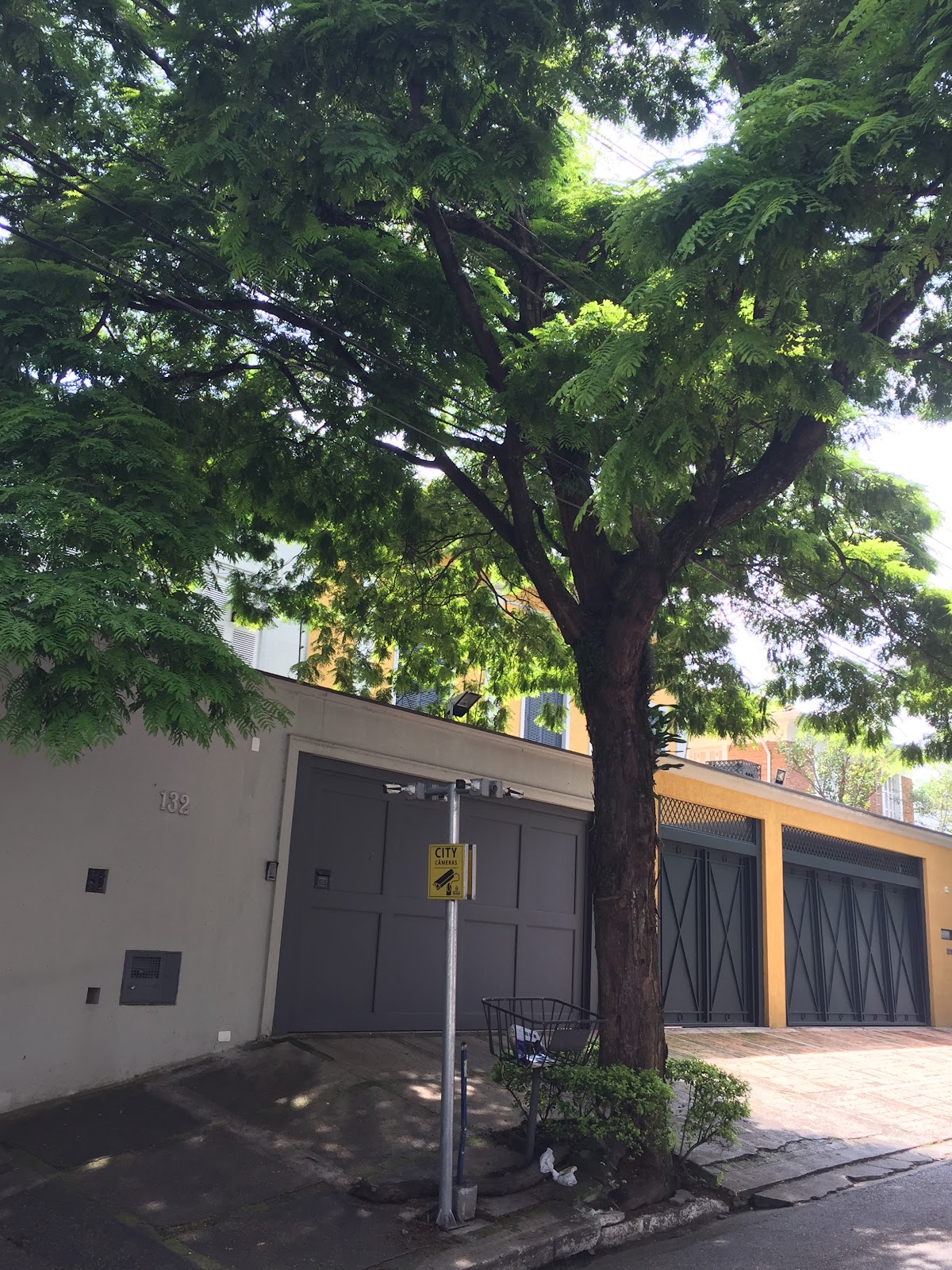
City cameras at eye level on Rua Jacupiranga, perpendicular to Rua Juquiá
On Rua Juquiá and in the neighborhood of my childhood home, about a seven-minute drive away, the bem-te-vi is heard above everything else. The surrounding neighborhood, known as Jardins (‘gardens’), is one of the greenest in the city, yet only the birds seem to be voicing their presence and delight. The name of this species of bird (which translates to “I see you well”) is an onomatopoeia for what their cries sound like. I can’t help but think of them as true sonic citizens of these streets. That citizenship practices have to do with the less powerful establishing their presence in a public space is an idea echoed by Saskia Sassen (2006) and others quoted by Vincent Adrisani (2015). The bem-te-vi, the construction workers and I, as a listener, were momentarily engaged in this practice, though questions such as, “Why are you here?” and “Do you want to know why I am here?” remained between the human participants.
As I ventured further away from my school, the baseline hum of traffic slowly shifted into the background. Up until this point, I had my recording equipment – a Zoom H6 and Rode NTG 2 shotgun microphone – hidden in my bag in order to draw less attention to myself. This is certainly a decision informed by the same fear that would make me hurry from the car to the school gate. As a consequence of this, in the audio clips there may be a light, rhythmic thudding from the microphone hitting the inside of my tote bag.
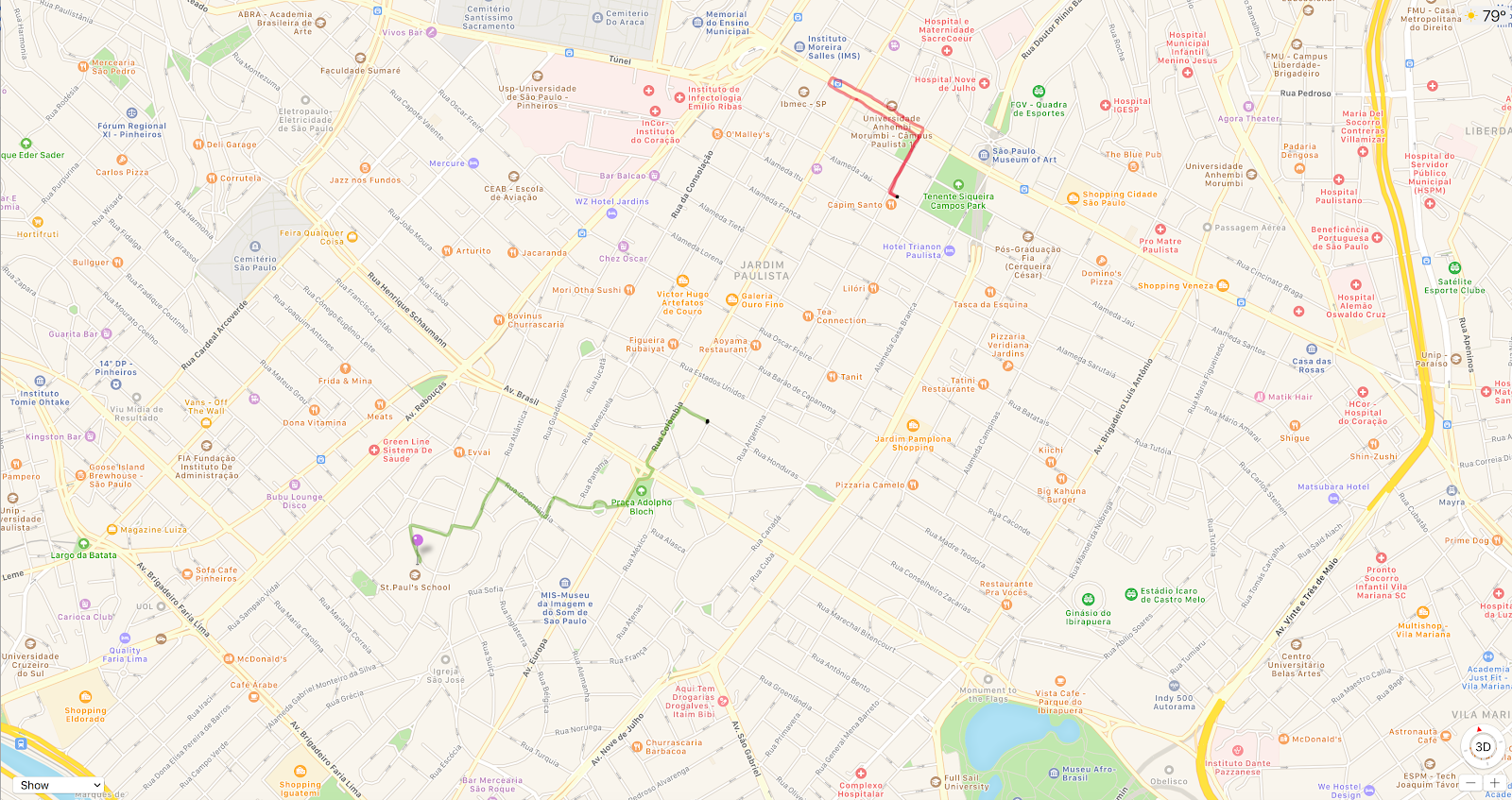
(A map of my two soundwalk routes – in green, the path from my former school and home; in red, a brief walk on Avenida Paulista.
I decided to record a second soundwalk roughly twenty minutes from my school to present dichotomous soundscapes and ways of living, in proximity. Avenida Paulista is a nearly two mile long avenue with ample sidewalks, modelled on those in Manhattan. It used to be more of a dividing line between different sides of São Paulo. When I was growing up and even now, I know that if I take Rua Augusta towards Baixo Augusta (‘low’ Augusta), I’ll find LGBTQ friendly bars and clubs. I remember driving by them with my parents when I was a teenager; there was an implied danger there, too, though it was never uttered out loud like the kidnapping stories.
Though during the day it is a hub for office workers, on the night I recorded this soundwalk the air was buzzing with voices, live music, skateboard decks grating on cement, and street vendors announcing their wares. The abundance of human sounds is clearly in stark contrast to Rua Juquiá, but there is an increase in the sheer number and variety of sounds, too. The surveillance that before stood out like a sore thumb – at eye level and identified with signs – is quite inconspicuous on this soundwalk. Generally, police presence is high on Avenida Paulista – in contrast to the privately hired security on Rua Juquiá’s and that of other wealthy, residential streets.
As a walker and listener, it is clear that the second soundwalk presented a wealth of opportunities to engage as a sonic citizen, while the first – as it was in the past – remained complicated by fear, vigilance, and a vacuum of human activity. I contend that when sonic citizenship is articulated it is, in turn, reflected back to the listener. This exchange is what makes it so valuable on both the level of the community and individual. It made me wonder if having walked Avenida Paulista and its offshoots more often in my youth would have lessened fears and brought me closer to embracing certain aspects of my identity sooner.
Instead, I find parts of myself are sonically engaged in one part of the world and others someplace else. If future soundwalks bridge those gaps in the future, I will be able to listen back to these recordings as the first steps I took in that direction.
—
Featured image: “são paolo” by Flickr user Samuel Loo, CC BY-NC-ND 2.0
—
Paola Cossermelli Messina is a sound designer and audio engineer with research interests that fall in the intersections between music, politics and gender. As Project Manager of Sound Thinking NYC, a program of the CUNY-Creative Arts Team, she has recently gained interest in ties between her work in music and technology to initiatives in education. She holds a B.A. in Music and Writing from Sarah Lawrence College and an M.A. in Media Studies from The New School, with a specialization in sound. Her Master’s thesis on the oral histories of Iranian women musicians received an award from the Middle East Studies Association and was later presented and published by Yale University. For the past 5 years, she has also worked as a Producer and Editor of the Arab Studies Institute podcast Status Hour.
—

REWIND! . . .If you liked this post, you may also dig:
El Caracol: A Stroll through Space and Time in Mexico City–Anthony Rasmussen
Learning to Listen Beyond Our Ears: Reflecting Upon World Listening Day–Owen Marshall
“How Many Latinos are in this Motherfucking House?”: DJ Irene, Sonic Interpellations of Dissent and Queer Latinidad in ’90s Los Angeles—Eddy Francisco Alvarez Jr.
Share this:


Current Top Posts





April 2021

January 2020

November 2019

October 2019

August 2019

April 2014

November 2017

March 2015

December 2017

October 2015
 Sounding Out!
Recent Comments