
SO! Reads: Roshanak Khesti’s Modernity’s Ear

 “I drifted to another place and time,” reminisces drummer and musicologist Mickey Hart in his 2003 book about salvaging indigenous musical traditions, Songcatchers: In Search of the World’s Music. He continues, “Every day I rushed home, put on the sounds of the Pygmies [on the old RCA Victrola], and melted into their very being.” For the Grateful Dead drummer and world music producer, this experience of disorientation would eventually shape his transformation into a “songcatcher,” or one who seeks to preserve the intangible cultural heritage of indigenous music. In Modernity’s Ear: Race and Gender in World Music, author Roshanak Kheshti interrogates the “origin myth” presented by Hart, along with other collective fantasies and historical narratives that urge listening to world music. She argues that we must look beyond the political and economic exploitation of actual musicians to consider the economy of desire in which the conditions of possibility for such exploitation are formed. In contrast to a critical discourse on musical appropriation and exploitation among ethnomusicologists, one that Martin Stokes acknowledges is “marked by an anxious awareness of complexity and complicity” with world music (835), Kheshti deftly tunes into racialized and gendered yearnings for the recorded sounds of others.

Sounds in bodies
Crucial to Kheshti’s argument is her radical proposition for what occurs as, to briefly return to Hart’s aural memories, the sounds of others “melt” into our “very being.” In a crucial maneuver that focuses on how what is being heard is shaped by the embodied experience of listening, Kheshti proposes that “the object [of listening] becomes a part of the self by being taken into the body” (41). Thus when “sound, the listener’s body, escape, and affect fold into one another” (54-56) in the act of listening (a Derrida-derived encounter that Kheshti dubs “invagination”), selfhood is performatively constituted through the aural other. Moreover, the pleasure of imagining the other through listening, writes Kheshti, is not only the hegemonic form of listening within the world music industry but an experience of desire that Western media markets have historically capitalized upon.

“Whispers” by Flickr user Nicola Colella, CC BY-NC-SA 2.0
Given the ways in which listening embodies an economy of desire, Kheshti tells the history of this libidinal economy through a narrative in which modern selfhood is constructed through the racialized and gendered aural other. The Godzilla in this narrative is the World Music Culture Industry (WMCI), an entity conjured by Kheshti in reference to the historical juncture of comparative musicologists in the early twentieth century with the popular music recording industry, a coupling that she argues spawned the globalized product of modern media known as world music. As a set of hybrid musical practices designed by and large for Western media markets, world music is the key object of her inquiry (in contrast to the diversity of musical practices worldwide).
The imagined listener
 Though the book does not proceed chronologically, the first chapter seeks to interweave memory with history by opening with the early twentieth century. Stressing the pioneering role of white female sound archivists, this chapter is crucial for setting up the historical significance of the feminization of listening, a process familiar to readers of Jonathan Sterne, Louise Michele Newman, and William Howland Kenney. Kheshti puts Songcatcher (2000), a feature film about a fictional comparative musicologist who dives into Appalachian country and “discovers” Scottish and Irish ballads thought to have gone extinct, into conversation with the iconic images of Frances Densmore, an ethnologist affiliated with the Bureau of American Ethnology in the 1910s, who famously staged phonographic recordings of the Blackfoot chief, Mountain Chief (Nin-Na-Stoko). The point of convergence between these materials is the gendered and racialized politics of who was sent where to record whose sounds: white female sound archivists, spurned by their male colleagues and sent to the periphery of their respective fields to practice their craft. Once in the field, these comparative musicologists, one fictional and one real, committed acts of racial appropriation and erasure. The song catcher deracinates Appalachia by stripping the region of its Native American and African-American histories in favor of the ‘collective origin fantasy’ that links European and American genealogies, while Densmore, among others, domesticates indigenous sounds in her work for the Bureau.

Frances Densmore recording Mountain Chief. Picture by Harris & Ewing [Public domain], via Wikimedia Commons
Though the book tends to favor intensive re-readings of critical and psychoanalytic theory (from Adorno and Benjamin to Freud and Lacan) over thick ethnographic description, Kheshti touches upon key encounters in this culture industry to explain how listening to world music engenders modernity’s ear. For instance, she transcribes segments from a radio show in Northern California in which the host, a middle-aged white female, discusses what constitutes “African rhythms” with a record label executive. The two banter about this misnomered subject for some length. The host interprets what she is hearing as “African rhythms coming through.” Her visitor, an expert in world music, affirms and clarifies this attribution: “Yeah, absolutely. The rhythm on this particular song… is from a style of music called Afro-beat… that rhythm you’re hearing is definitely African, so, you don’t know nothing, you’re learning” (52). Kheshti interprets this banter as an example of how world music listeners “cherish” the experience of listening to sonic difference as a moment to live out “fantasy and imaginative play” (54), in other words, that the pleasures experienced through aurality have become definitive of twentieth-century modernity.

“world music 2” by Flickr user wayne marshall, CC BY-NC-SA 2.0
In other chapters, she details how record labels fulfill this fantasy through the production of hybrid sound media. The orchestration of these sounds in the studio not only enables the listener to feel “lost” and transcend the contingencies of the listening event, they also “pronounce and suppress presences and absences of all sorts of bodies and grains” (77). Drawing on phenomenological descriptions of her own listening experiences as well as liner notes and other commercial media, she describes how non-Western sounds are encoded as feminine, whereas the synthetic production and digital manipulation of sounds are rendered techno-logically modern and masculine. Racialized and feminized bodies are put to work in constituting the modern cosmopolitan listener. Furthermore, Kheshti argues that market mobility and aesthetic mobility are gendered male and alterity is gendered female in ways that link, for her, to miscegenation. The listening self reproduces dominant forms of heteronormativity in the consumption of modern sound media.
The listening self reproduces dominant forms of heteronormativity in the consumption of modern sound media.
Kheshti offers a radical alternative to these normative listening practices by turning to field recordings taken by Zora Neale Hurston between 1933 and 1939. Trained by Franz Boas in the traditions of nascent cultural anthropology, Hurston is kin to Densmore and those who worked for the Bureau of American Ethnology a few decades earlier. Like them, she goes to record America’s aural others, or “black folk.” But unlike her white foremothers, Hurston does not attempt to splice out the “noise” of the recordings. She “refuses fidelity” (126). Instead of staging field recordings, she made studio recordings of herself performing songs and discussing rituals. When recording her interlocutors, she interrupts, interjects, and poses directorial cues that Kheshti reads as an attempt to resist the desire to faithfully (re)produce an archive of phonographic subjects.

ca. June 1935, Eatonville, Florida, USA — Author and anthropologist Zora Neale Hurston sitting on a porch in Eatonville, Florida with two musicians, Rochelle French and Gabriel Brown. — Image from Stuff Mom Never Told You
Recommended for advanced graduate students and faculty, this virtuosic and tightly rehearsed tour through critical and psychoanalytic theory offers an ambitious and groundbreaking retake on an industry that we thought we understood, perhaps too intimately. Kheshti asks her readers to hold themselves accountable to their own forms of aural pleasure. In so doing, she offers a fresh perspective on the role of embodiment in relation to knowledge production. Rather than embracing somatic methods of inquiry as a welcome challenge to inductive reasoning, she argues that taking pleasure in listening enables the commodification of desire that sustains the world music culture industry.
Kheshti shifts the discussion of world music qua music (aesthetics, history, representation) towards issues of alterity and sound. As such, this book contributes to sound studies by holding the field accountable for difference, and, by inscribing this accountability within the history of the field itself. Indeed, Modernity’s Ear is about how the forces of desire that constitute the modern listening self are enveloped in the aural other as phonographic subject.
—
Featured image: “ear” by Flickr user Leo Reynolds, CC-BY-NC-SA 2.0
—
Shayna Silverstein is an assistant professor of Performance Studies at Northwestern University. Her research generally examines the performative processes of politics, culture, and society in relation to sound and movement in the contemporary Middle East. Her current book project examines the performance tradition of Syrian dabke as a means for the strategic contestation of social class, postcolonial difference, and gender dynamics in contemporary Syria. She has contributed to peer-reviewed journals and several anthologies including The Arab Avant-Garde: Music, Politics, and Modernity, Islam and Popular Culture, the Sublime Frequencies Companion, and Syria: From Reform to Revolt. Previously a Mellon Postdoctoral Fellow in the Penn Humanities Forum, Shayna received her PhD in Ethnomusicology from the University of Chicago and her BA in History from Yale University.
—
 REWIND!…If you liked this post, you may also dig:
SO! Reads: Daniela Cascella’s F.M.R.L. (Finding Materials for Remembering and Listening) — Kyle D. Stedman
Lokananta: Sounds of Crisis and Recovery from Indonesia’s National Record Company — Ian Coss
Saving Sound, Sounding Black, Voicing America: John Lomax and the Creation of the “American Voice” — Toniesha L. Taylor
Share this:

Listen to the Sound of My Voice

Betrayal
I first realized there was a problem with my voice on the first day of tenth grade English class. The teacher, Mrs. C, had a formidable reputation of strictness and high standards. She had us sit in alphabetical order row after row, and then insisted on calling roll aloud while she sat at her desk. Each name emerged as both a command and a threat in her firm voice.
“Kelly Barfield?”
“Here,” I mumbled quietly. I was a Honor Roll student with consistent good grades, all A’s and one B on each report card, yet I was shy and softspoken in classes. This was an excellent way to make teachers amiable but largely go unnoticed. The softness of my voice made me less visible and less recognizable.
Mrs. C repeated my name. Caught off guard, I repeated “here” a little more loudly. She rose to her feet to get a better look at me. I knew what she saw: a petite girl with long ash blonde hair, big brown eyes, and overalls embroidered with white daisies on the bib. When her gaze finally met mine, Mrs. C frowned at me and cleared her throat loudly. I curled into my desk, hoping to disappear.

“Lincoln High School 9-16-2007 008” by Flickr user Paul Horst, CC BY-NC 2.0
“Miss Barfield, did you hear me call your name twice? In this class, when I call roll, you respond.” I gave a quick nod, but Mrs. C wasn’t finished: “We use our strong voices in here, not our girly, breathy ones.” My cheeks flushed red while Mrs. C droned on about confidence and classroom expectations.
“Do you understand me?”
I stammered a “yes.” Mrs. C turned her attention back to the roll call. Her harsh words rang in my ears. I sank low in my chair, humiliated and angry. I couldn’t help that I sounded girly: I was, in fact, a girl. This was the way my voice sounded. It was not an attempt to sound like the dumb blonde she appeared to think I was.
That day I decided that I would never speak up in her class. Forget the Honor Roll. If the sound of my voice was such a problem, then my mouth would remain firmly shut in this class and all of my others. I would never speak up again.

“Listen” by Flickr user lambda_x, CC BY-ND 2.0
My vow to stop speaking lived a short life. I enjoyed Mrs. C’s serious fixation on diagramming sentences and her attempts to show sophomores that literature offered ideas and worlds we didn’t quite know. At first, I spoke up with hesitation and fear of the inevitable dismissal, but I continued to speak. Becoming louder became my method to seem confident, even when I felt anything but.
Throughout high school, my voice emerged again and again as a problem. Despite the increased volume, my voice still sounded tremulous, squeaky, hesitant, and shrill to my own ears. Other girls had these steady, warm voices that encouraged others to listen to them. Some had higher voices that were melodic and lovely. I craved a lower, more resonant voice, but I was stuck with what I had. In drama club, our director scolded me with increasing frustration about my tendency to end my lines in the form of a question. My nerves materialized as upspeak. The more he yelled at me, the more pronounced the habit became. He eventually gave up, disgusted by my inability to control my vocal patterns.

By Dvortygirl, Mysid [GFDL (http://www.gnu.org/copyleft/fdl.html) or CC-BY-SA-3.0 (http://creativecommons.org/licenses/by-sa/3.0/)%5D, via Wikimedia Commons
Meanwhile, at a big state university in my native Florida, I learned quickly that a Southern accent marks you as a dumb redneck from some rural town that no one had heard of. Students in my classes asked me to say particular words and then giggled at my pronunciations. “You sound like a Southern belle,” one student noted. This was not really a compliment. According to my peers, Southern belles didn’t have a place in the classroom. Southern belles didn’t easily match up with “college student. As a working-class girl from a trailer park, I learned that I surely didn’t sound like a college student should. I worked desperately to rid myself of any hint of twang. I dropped y’all and reckon.
I listened carefully to how other students talked. I mimicked their speech patterns by being more abrupt and deadpan, slowly killing my drawl. When I finally removed all traces of my hometown from my voice, my friends both from home and from college explained that now I sounded like an extra from Clueless. My voice was all Valley girl. I was smarter, they noted with humor, than I sounded and looked. My voice now alternated between high-pitched and fried. Occasionally, it would squeak or crack. I thought I sounded too feminine and too much like an airhead, even when I avidly tried not to. I began to hate the sound of my voice.
My voice betrayed me because it refused to sound like I thought I needed it to. It refused to sound like anyone but me.
When I started teaching and receiving student evaluations, my voice became the target for students to express their displeasure with the course and me. According to students, my voice was too high and grating. Screechy, even: one student said my voice was at a frequency that only bats could hear. In every set of evaluations, a handful of students declared that I sounded annoying. This experience, however, was not something I alone faced. Women professors and lecturers routinely face gender bias in teaching evaluations. According to the interactive chart, Gender Language in Teaching Evaluations, female professors are more likely to be called “annoying” than their male counterparts in all 25 disciplines evaluated. The sound of my voice was only part of the problem, but I couldn’t help but wonder if how I sounded was an obstacle to what I was teaching them.
Once again, I tried to fix my problematic voice. I lowered it. I listened to NPR hosts in my search for a smooth, accentless, and educated sound, and I attempted to create a sound more like them. I practiced pronouncing words like they did. I modulated my volume. I paid careful attention to the length of my vowels. I avoided my natural drawl. None of my attempts seemed to last. Some days, I dreaded lecturing in my courses. I had to speak, but I didn’t want to. I wondered if my students listened, but I wondered more about what they heard.
Sound
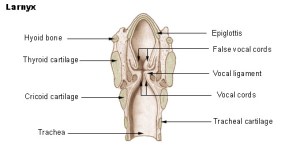
Public Domain, https://commons.wikimedia.org/w/index.php?curid=1393933
The sound of your voice is a distinct trait of each human being, created by your lungs, the length of your vocal cords, and your larnyx. Your lungs provide the air pressure to vibrate your vocal cords. The muscles of your larnyx adjust both the length and the tension of the cords to provide pitch and tone. Your voice is how you sound beyond the resonances that you hear when you speak. It is dependent on both the length and thickness of the vocal cords. Biology determines your pitch and tone. Your pitch is a result of the rate at which your vocal cords vibrate. The faster the rate, the higher your voice. Women tend to have shorter cords than men, which makes our voices higher.
Emotion also alters pitch. Fright, excitement, and nervousness all make your voice sound higher. Nerves would make a teenage girl have an even higher voice than she normally would. Her anxious adult self would too. Her voice would seem tinny because her larnyx clenched her vocal cords tight. Perhaps this is the only sound she can make. Perhaps she is trying to communicate with bats because they at least would attempt to listen.
Biology, the body, gives us the voices we have. Biology doesn’t care if we like the ways in which we sound. Biology might not care, but culture is the real asshole. Culture marks a voice as weak, grating, shrill, or hard to listen to.

“Speak” by Flickr user Megara Tegal, CC BY-NC-ND 2.0
My attempts to change my voice were always destined to fail. I fought against my body and lost. I couldn’t have won even if I tried harder. My vocal cords are determined that my voice would be high, so it is. The culture around me, however, taught me to hate myself for it. Voice and body seem to cast aspersions on intelligence or credentials. It’s the routineness of it all that wears on me. I expect the reactions now.
I wonder if I’m drawn to the quietness of writing because I don’t have to hear myself speak. I crave the silence while simultaneously bristling at it. Why is my voice a problem that I must resolve to placate others? How can I get others to hear me and not the stereotypes that have chased me for years?
Fury
My silence has become fruitful. The words I don’t say appear on the page of an essay, a post, or an article. I type them up. I read aloud what I first refused to say. I wince as I hear my voice reciting my words. I listen carefully to the cadence and tone. This separation of words and voice is why writing appeals to me. I can say what I want to say without the sound of my voice causing things to go awry.
People can read what I write, yet they can’t dismiss my voice by its sound. Instead, they read what I have to say. They imagine my voice; my actual sound can’t bother them. But, they aren’t really hearing me. They just have my words on the page. They don’t know how I wrap the sound around them. They don’t hear me.
Rebecca Solnit, in “Men Explain Things to Me,” writes “Credibility is a basic survival tool.” Solnit continues that to be credible is to be audible. We must be heard to for our credibility to be realized. This right to speak is crucial to Solnit. Too many women have been silenced. Too many men refuse to listen. To speak is essential “to survival, to dignity, and to liberty.”

“Listen” by Flickr user Emily Flores, CC BY-ND 2.0
I agree with her. I underline her words. I say them aloud. The more I engage with her argument, the more I worry. What about our right to be heard? When women speak, do people listen? Women can speak and speak and speak and never be heard. Our words dismissed because of gender and sound. Being able to speak is not enough, we need to be heard.
We get caught up in the power of speaking, but we forget that there’s power in listening too. Listening is political. It is act of compassion and empathy. When we listen, we make space for other people, their stories, their voices. We grant them room to be. We let them inhabit our world, and for a moment, we inhabit theirs. Yes, we need to be able to speak, but the world also needs to be ready to listen us.
We need to be listened to. Will you hear me? Will you hear us? Will you grant us room to be?
When I think of times I’ve been silenced and of the times I haven’t been heard, I feel the sharp pain of exclusion, of realizing that my personhood didn’t matter because of how I sounded. I remember the burning anger because no one would listen. I think of the way that silence and the policing of how I sound made me feel small, unimportant, or disposable. As a teenager, a college student, and a grown woman, I wanted to be heard, but couldn’t figure out exactly how to make that happen. I blamed my voice for a problem that wasn’t its fault. My voice wasn’t the problem at all; the problem was the failure of others to listen.
“listen” by Flickr user Jay Morrison, CC BY-NC-ND 2.0
Loss
While writing this essay on my voice, I almost lost mine, not once but twice. I caught a cold and then the flu. My throat ached, and I found it difficult to swallow. A stuffy nose gave my voice a muted quality, but then, it sounded lower and huskier. I could hear the congestion disrupting the timber of my words. My voice blipped in and out as I were radio finding and losing signal. It hurt to speak, so I was quiet.
“You sound awful,” my husband said in passing. He was right. My voice sounded unfamiliar and monstrous. I tested out this version of my voice. It was rougher and almost masculine. I can’t decide if this is the stronger, more authoritative voice I wanted all along or some crude mockery of what I can never really have. I couldn’t sing along with my favorite songs because my voice breaks at the higher register. I wheezed out words. I croaked my way through conversations. “Are you sick?” my daughter asked, “You don’t sound like you.”
Her passing comment stuck with me. You don’t sound like you. Suddenly, I missed the sound of my voice. I disliked this alien version of it. I craved that problematic voice that I’ve tried to change over the years. I wanted my voice to return.
After twenty years, I decided to acknowledge the sound of me, even if others don’t. I want to be heard, and I’m done trying to make anyone listen.
—
Featured image: “Speak” by Flickr user Ash Zing, CC BY-NC-ND 2.0
—
Kelly Baker is a freelance writer with a religious studies PhD who covers religion, higher education, gender, labor, motherhood, and popular culture. She’s also an essayist, historian, and reporter. You can find her writing at the Chronicle for Higher Education‘s Vitae project, Women in Higher Education, Killing the Buddha, and Sacred Matters. She’s also written for The Atlantic, Bearings, The Rumpus, The Manifest-Station, Religion Dispatches, Christian Century’s Then & Now, Washington Post, and Brain, Child. She’s on Twitter at @kelly_j_baker and at her website.
—
REWIND!…If you liked this post, you may also dig:
Vocal Gender and the Gendered Soundscape: At the Intersection of Gender Studies and Sound Studies — Christine Ehrick
On Sound and Pleasure: Meditations on the Human Voice– Yvon Bonefant
As Loud As I Want To Be: Gender, Loudness, and Respectability Politics — Liana Silva
Share this:


Current Top Posts





April 2021

January 2020

November 2019

October 2019

August 2019

April 2014

November 2017

March 2015

December 2017

October 2015
 Sounding Out!
Recent Comments