
Fiddling With Freedom: Solomon Northup’s Musical Trade in 12 Years a Slave

DOI: https://doi.org/10.59350/gn8rg-bat87
Editor’s Note: Sound Studies is often accused of being a presentist enterprise, too fascinated with digital technologies and altogether too wed to the history of sound recording. Sounding Out!‘s last forum of 2013, “Sound in the Nineteenth Century,” addresses this critique by showcasing the cutting edge work of three scholars whose diverse, interdisciplinary research is located soundly in the era just before the advent of sound recording: Mary Caton Lingold (Duke), Caitlin Marshall (Berkeley), and Daniel Cavicchi (Rhode Island School of Design). In examining nineteenth century America’s musical practices, listening habits, and auditory desires through SO!’s digital platform, Lingold, Marshall, and Cavicchi perform the rare task of showcasing how history’s sonics had a striking resonance long past their contemporary vibrations while performing the power of the digital medium as a tool through which to, as Early Modern scholar Bruce R. Smith dubs it, “unair” past auditory phenomena –all the while sharing unique methodologies that neither rely on recording nor bemoan their lack. Today, the series kicks off with Mary Caton Lingold‘s exploration of the materialities of Solomon Northup’s fiddling as represented through sheet music embedded in his 1853 narrative, amplifying a sound that was key to both his freedom and his enslavement.–Jennifer Stoever, Editor-in-Chief
—
Steve McQueen’s recent film Twelve Years a Slave has renewed interest in the original 1853 narrative, which has long been a valued resource for historians of nineteenth-century slavery, literature, and music. Because Solomon Northup was a highly-skilled fiddler and a keen observer of plantation culture, his autobiography is one of the most substantive accounts of musical life during slavery and, to my knowledge, the only slave narrative that includes sheet music in its text. As such, it preserves in audible form a precious record of Northup’s musical artistry and facilitates a sound-based study of nineteenth-century black fiddling, a tradition that was flourishing during Northup’s lifetime.
Uncovering the sounds of vernacular music of the pre-recorded era can be incredibly challenging. For this reason, Northup’s descriptions, when coupled with musical notation, make it possible for us to hear something historically significant. Although “slave music” was all the rage in the 1850s due to the widespread popularity of blackface minstrelsy, print-based compositions by enslaved (or free) musicians are difficult to come by and even more challenging to verify. The tune presented in Northup’s memoir has its own complex relationship to the minstrelsy genre, but it remains a unique sample of African-American music that warrants close-listening.
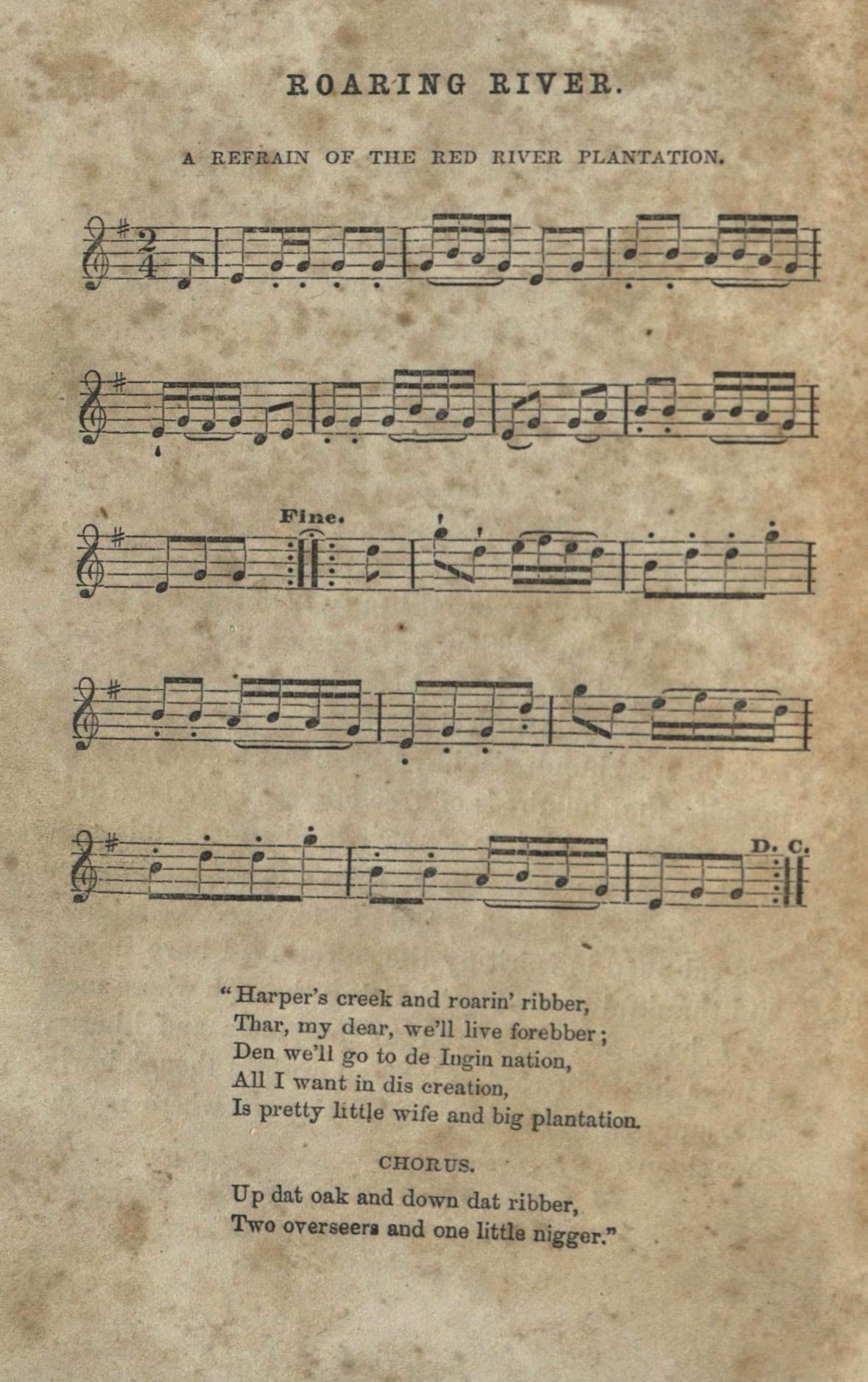
I use performance as a research method for exploring historical vernacular music, offering here my interpretation of “Roaring River: A Refrain of the Red River Plantation.” As I discuss in an essay titled “Listening to the Past,” the process of performance illuminates the subtleties of musical expression. (Do I play it like this or like that? At what tempo?) The aim of such exercises is not historical accuracy, but rather, an attunement to the sonic possibilities of a given piece. These possibilities cannot tell me how Northup would have played the song or what it meant to him, but they allow me to consider the kinds of choices that he would have had to make as a performer, thus illustrating the intellectual and sensorial richness of his music-making. Rather than simply presenting and describing the sheet music, I aim to make it possible for people to hear what would otherwise sit silently on the page.
In the first recording I play Northup’s melody solo to give you a sense of the tune.
In the second, I am joined by guitar.
The use of guitar accompaniment would have been highly unlikely during the period, but it helps to support my amateur playing by providing a livelier, fuller feeling. Northup connected with banjoists, percussionists and dancers as an enslaved and free musician and it’s interesting to imagine how a single song like this would have been transformed according to the talents, desires, and constraints of the performers assembled. It is unclear from the narrative whether or not the tune is an original composition or something Northup learned while living along the Red River, where he was enslaved in Louisiana. One also wonders how many nineteenth-century readers would have plucked the melody at a keyboard or bowed it on a family fiddle. What might their motivations have been?
Though Northup does not discuss the fiddle tune in the text, he does describe the lyrics below it, remarking that they were accompanied by a percussion technique called “patting” among his fellow slaves. He describes this widely documented practice as follows: “The patting is performed by striking the hands on the knees, then striking the hands together, then striking the right shoulder with one hand, the left with the other—all the while keeping time with the feet, and singing” (219). According to Northup, the lyrics that accompanied patting were often nonsensical because they were made to conform to the tonal and rhythmic pattern being patted. He offers “Harper’s Creek” as suitable for the practice but it’s worth noting that the lyrics voice a presumably white man’s desires to own a piece of land and a slave. Though presented below the sheet music at the end of the book, the lyrics are ill-fitting for the fiddle tune provided, which seems more likely to have been played without vocal accompaniment. In light of Northup’s descriptions, the sheet music creates an interesting blend of various performance modes, from popular folksy vocal diddy (with possible origins in minstrelsy), to patting, and fiddling. Here you can see a wonderful example of patting accompanying a nineteenth-century fiddle tune as performed by the Carolina Chocolate Drops and guest Danny Barber (Intricate patting begins at 1:22).
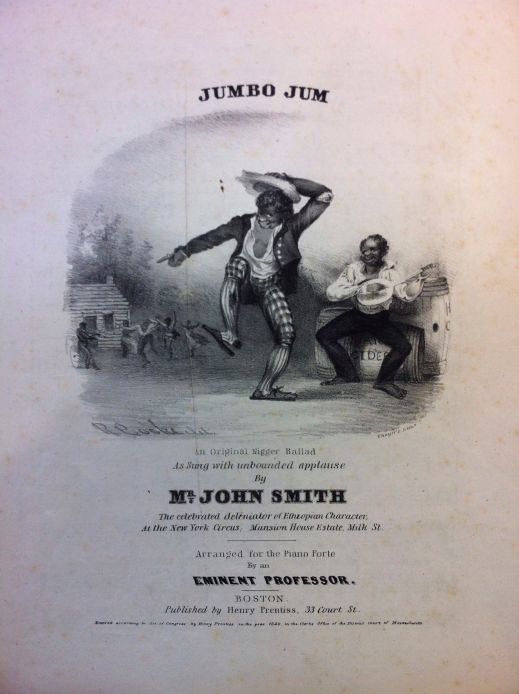
In addition to serving as auditory artifact, the presence of sheet music in the narrative relates to the way Northup’s musicality was commodified within the aesthetic economy of slavery during and after his captivity. After regaining freedom, his talents are presented for sale in the book presumably to appeal to the sort of audiences who would also have coveted the sheet music of minstrelsy, which caricatured and lampooned black performances. Popular appetites for representations of plantation culture left an imprint on Northup’s autobiography as well as other abolitionist publications, like Uncle Tom’s Cabin.
Music-making was both labor and leisure for Solomon Northup and it profoundly influenced his experiences as a slave. His narrative also illuminates the far-reaching impact that he and other black musicians had on their communities as well as nineteenth century music.
Alas! had it not been for my beloved violin, I scarcely can conceive how I could have endured the long years of bondage. It introduced me to great houses —relieved me of many days’ labor in the field—supplied me with conveniences for my cabin—with pipes and tobacco, and extra pairs of shoes, and oftentimes led me away from the presence of a hard master, to witness scenes of jollity and mirth. It was my companion—the friend of my bosom triumphing loudly when I was joyful, and uttering its soft, melodious consolations when I was sad. (217)
Solomon Northup’s biography is highly atypical of slave narratives because he is a free man who is sold into slavery. Some have criticized the popularization of his circumstances, arguing that because he conforms to modes of respectability as a literate, propertied black man, he serves as an ideal hero for white audiences while inadequately representing the experience of slavery. Though many aspects of Northup’s biography are unusual, his status as a highly sought-after musician is emblematic of a legion of black fiddlers who dominated music scenes North and South, from ballrooms to barns, beginning as early as the late seventeenth-century, as Dena Epstein explains in her indispensable study, Sinful Tunes and Spirituals: Black Music to the Civil War (1977).
Prior to enslavement, fiddling, “the passion of [his] youth,” provides Northup with supplemental income that helps to sustain his family during periods of insufficient employment in agriculture and carpentry. Music was an ideal side-career for someone in such circumstances, though, as Northup’s story shows, it did not protect him from the dangers of being black in the United States. He is captured and enslaved while touring as a circus musician. Ferrying South toward the Louisiana plantations that would become his deplorable home, Northup’s freedoms are violently stripped away. But his talent as a first-rate fiddler travels with him, becoming a defining element of his experience of slavery.
Fiddles were extraordinarily popular instruments during the era. Lightweight, portable, and increasing in mass production during the nineteenth-century, a single fiddle could service a large dance if need be. As such, slaves were encouraged (or forced) to take up the instrument and musical ability was considered a highly prized skill. Fiddling granted (primarily male) slaves an unusual degree of mobility as well as opportunities for economic advancement. The fact that numerous runaway slave ads note that the sought-after individuals were fiddlers or had in their possession a violin suggests that the increased mobility and access to income may have facilitated escape for some. For more information about these trends and their eighteenth-century origins, I highly recommend Richard Cullen Rath’s How Early America Sounded (2003), an excellent cultural history of sound.
Just before being sold at market to his first master, Northup encounters an enslaved young man in possession of a fiddle and sizes him up by asking if he could play the “Virginia Reel,” a popular dance. The young man cannot and so Northup takes the instrument from him, boldly showing off his more substantial repertoire and ability, much to the delight of those around him. Though about to be sold into an unknown and terrifying fate, this seemingly mundane interaction underscores how important musicianship is to Northup’s identity and also how significant it was to the societies through which he was forced to move. Whether in New York State, a New Orleans slave market, or a backwoods swamp plantation, fiddling was a thoroughly popular form of entertainment, widely enjoyed by Americans, slave and free, rich and poor, native and immigrant.
Northup expresses pride in the fame he earns in the Red River region, noting that he was known widely as the “Ole Bull of Bayou Boeuf.” Ole Bull was a famous Norwegian violinist, who was one of the first musicians to professionally tour the United States in the 1850s; he became a widely-known celebrity. Because of Northrup’s sought-after talents, his masters hired him out extensively to play at the fashionable balls of nearby plantations as well as the Christmas dances held yearly for slaves. At one ball, he was tipped seventeen dollars, an extraordinary amount that he used to furnish his cabin with bare necessities. In contrast to these more favorable gigs, Northup was also forced to perform during his savage Master Epps’ alcoholic binges. These events were held for hours on end in the middle of the night as Northup’s fellow slaves were commanded to dance. The violent, dreaded affairs interrupted precious sleep and were utterly humiliating for the participants. Depicted memorably in both the memoir and the recent film, the horrifying scenario shows the way slavery degrades Northup’s musicianship and his peers’ dancing, turning these arts into yet one more thing that the master possesses. For Master Epps, Northup is a mere musical device, a kind of proto-phonograph, full of tunes that can be made to play on command. Northup’s “passion” and economic livelihood are thus converted into a mechanized musical labor commodity under slavery.
Through Northup, we can see how before the eras of sound reproduction and broadcast, the circulation of music across North America was greatly facilitated by the forced migration of enslaved people. At the time of Northup’s capture, large numbers of mid-Atlantic slaves were being sold South to the booming plantations along the frontier of Louisiana and Texas. Northup brought a unique repertoire on his journey and he also learned new music that he transported back to the New York publishers of his autobiography. Afro-diasporic musicians began revolutionizing Western music centuries before Northup was born, and as we can see, continued to do so in profoundly significant ways in the Antebellum era both in spite of and due to the harsh conditions of their enslavement.
—
I’d like to thank the students in my course “Sounds of the South” for their lively discussion and excellent essays regarding music in Solomon Northup’s Narrative. I’m also deeply grateful to my musical collaborator, Eric Olsten.
—
Featured Image by Flickr User kubotake
—
Mary Caton Lingold is a doctoral candidate in English at Duke University researching early Afro-Atlantic literature, music, and sound. She leads a collaborative experiment called the Sonic Dictionary at Duke’s Audiovisualities Lab and co-directs Soundbox, a project dedicated to enhancing the practice of using sound in digital scholarship.
—

REWIND! . . .If you liked this post, you may also dig:
“Como Now?: Marketing ‘Authentic’ Black Music,” –J. Stoever
Hearing the Tenor of the Vendler/Dove Conversation: Race, Listening, and the “Noise” of Texts –Christina Sharpe
How Svengali Lost His Jewish Accent––Gayle Wald
—
Share this:

Heard Any Good Games Recently?: Listening to the Sportscape

DOI: https://doi.org/10.59350/dqt3h-mch65
Sound and music play important roles in shaping our experiences of sports. Every sport has its own characteristic sounds and soundscape; some are very silent while others can be dangerously noisy. Barry Truax, in his engagement with R. Murray Schafer’s concept of soundscape in the book Acoustic Communication, states that the listener is always present in a soundscape, not solely as a listener but also as a producer of sound (10). Both Truax and Schafer use the term hi-fi to describe environments where sounds may be heard clearly, while lo-fi, often urban, environments, have more overlapping sounds. When an audio environment is well balanced (hi-fi), there is a high degree of information exchange between sound, listeners and the environment, and the listener is involved in an interactive relationship with the other two components (Truax 57). Truax’s understanding of the concepts of hi-fi and lo-fi enable a better understanding of the power relations between the key sonic elements of sports: players, the audience and the organizer (usually a game DJ), an increasingly prominent role in today’s team sports events due to permeation of recorded music. Using examples from Finnish soccer, pesäpallo (“Finnish baseball”), and ice hockey, I track how a particular game’s sonic balance can be altered to shape the atmosphere of the event and, even influence the game’s outcome.
In Europe, soccer is overwhelmingly associated with crowd chants, as noted by Les Back in his article “Sounds in the Crowd.” Without the sounds from the audience, the soccer soundscape would be more hi-fi, revealing the keynote sounds of the sport clearly: for example, the thuds from kicking the football, individual shouts from both the players and the spectators. The clear hi-fi signal articulation may be desirable at other times, but from a home team perspective, it does not provide a good soccer atmosphere. However, while playing recorded music to engage the crowd preceding free kicks or corner situations is not prohibited, it breaks the unwritten rules of the game. This means that creating a good atmosphere becomes the crowd’s responsibility; thus, the infamous songs and chants.
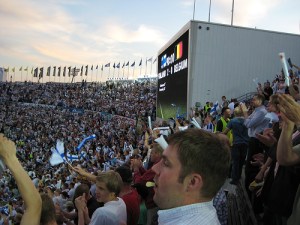
The culture of avoiding electronically reproduced music reveals the potential vulnerability of soccer’s soundscape to silence as much as chants, if not more so. Silence often becomes a way of effecting change at the level of soundscape. A silent, passive, crowd can mirror, for example, the team’s performance on the field or reflect a general lack of interest. Organized supporter groups can also demonstrate their dissatisfaction with something by refusing to sing.
This sound clip demonstrates how keynote sounds of soccer are exposed while approximately 1200 people in the audience seem to be “just watching” a very important home game at the end of the Veikkausliiga season 2012. In the end of the clip the home team, FF Jaro, equalizes and eventually went on to avoid relegation by just 1 point.
In contradiction to soccer, an important part of the pesäpallo experience (Finnish baseball, the national sport of Finland) is actually listening to the continuous communication of the teams. The key to pesäpallo, and the most important difference between pesäpallo and American baseball, is the vertical pitching. Hitting the ball, as well as controlling the power and direction, is much easier. This gives the offensive game much more variety, speed and tactical dimensions than in baseball. The fielding team is forced to counter the batter’s choices with defensive schemes and the game becomes a mental challenge. The continuous communication by the batting team standing in a half circle around the dueling batter and pitcher influences the pesäpallo soundscape. For a better appreciation of the sport, spectators must carefully tune in to the teams’s communiqués.
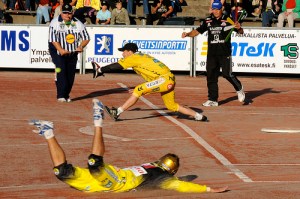
The male pesäpallo team Vimpelin Veto from the small village of Vimpeli in rural Finland has a very active crowd, with a high know-how of the sport. The village has only a little over 3200 inhabitants but had an average of 2087 spectators/game during the 2012 season. In a local newspaper article Veto’s player Mikko Rantalahti reveals that when the crowd is making lots of noise the visiting players’ tactical “wrong”-shouts (“väärä” in finnish), like when a pitched ball is too low, can’t be heard by the fielding players of the visiting team. The audiences’ collective shouting makes the soundscape more lo-fi and the visiting team’s communication difficult.
This tradition of strategic noisemaking has, before the use of headsets, also been heard in American football, when crowds make noise to make the vocal communication difficult for the visiting team. According to Matthew Mihalka’s PhD dissertation “From the Hammond Organ to ‘Sweet Caroline’: The Historical Evolution of Baseball’s Sonic Environment,” crowd noise in baseball is viewed as less influential since directions are sent via hand signals (44). Even though the pesäpallo manager leads the offensive play with a multicolored fan and other visual signals much of the communication is verbal.
(starting point ~16:30)
In this video clip from the 2011 Superpesis final between Vimpelin Veto and Sotkamon Jymy, the audience tries not only to disturb the focus of the hitter, but also the communication of the visiting team standing in the half circle around the batter. Even the commentators are struck by the crowd noise and note its influence.
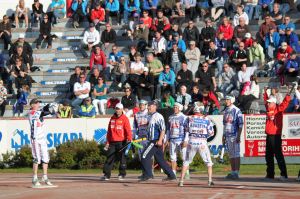
At Vetos games, the audience creates the sonic atmosphere just as in soccer. When the home team is batting, the audience engages in rhythmic hand clapping, deliberately uncoordinated with the organizers’ music. In 2012, I interviewed the managing director J-P Kujala, who is responsible for the music at Vetos games, and he stated that the atmosphere at Veto’s home games is so good that “there is no need for musical reinforcements.” He also doubted that the audience would react positively to music played to activate the audience. At the stadium, music is only heard before the game, during warm-up and intermissions. Kujala refrains from playing music when the visiting team is batting since that can be considered as “disturbing. . .we don’t do that here.” From the organizers’ perspective, the teams are sonically treated equally, but if the home audience creates a sound wall that drains out the visiting teams’ tactical shouts—making the soundscape more “lo-fi”—it is considered as home court advantage. In this context, lo-fi is not related to the use of technology and playing music, but instead to the audience’s sounds.
However, in contrast to the Vetos’ home court sound culture, more teams are beginning to play music inside the actual game, not only when the home team is batting (2:19) but also when the visiting team is batting. DJs often use songs to create funny remarks at the visiting team’s expense. Whatever the implied interpretation of the music might be, the strategy of playing music in this core situation also modifies something very authentic about the pesäpallo experience. In this sound clip from Koskenkorvan Urheilijat’s home game one can hear the visiting team Pattijoen Urheilijat communicating underneath the Finnish hit song Älä tyri nyt (“Don’t mess up now”). Notice that the home crowd, unlike at Vetos games, is not actively making noise—hence the use of music.
As this clip shows, the increasing use of music in pesäpallo calls attention to the need to develop up-to-date rules for the use of recorded music rather than relying on custom or practice.
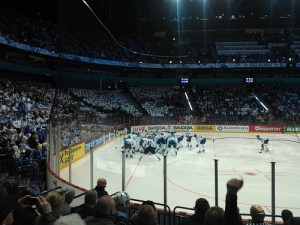
When discussing the soundscape of ice hockey, the most popular sport in Finland, the question is no longer about whether or not to play music but which music suits certain situations best. As in soccer, the most active fans often get cheaper tickets to fill in their own fan sections and sing from the curve behind the goals. Apart from singing along to iconic goal songs or team anthems, the fans very seldom interact with the other music played by the DJ. Moving toward a more mediated sport experience, the ice hockey soundscape is also becoming more lo-fi and the balance of sound making has shifted towards the organizers, with lots of sound events using recoded sound (music, videos, commercials etc.) to entertain the crowd during breaks of play. This shift from hi-fi to lo-fi can, according to Truax, encourage the feeling of being cut off from the environment and may begin to dramatically shift the audience’s experience of the sport (20).
There is no doubt that supporter groups have an important role as creators of meaningful sounds and good atmosphere in Finnish ice halls. In that sense it is a paradox that much of the music played “from record” overlaps their activity. John Bale has written that “fully modernized sport will alter the nature of the soundscape of stadiums and arenas […] and that electronically amplified sound will also increase and hence reduce the spontaneity of the crowd’s songs and chants” (141). The hockey example above with its planned rituals confirms this statement. Discussing and choosing the right songs for the right moment in an attempt to not only entertain but also coordinate the crowd is of course a way to deal with this schizophonic clash of sounds. A more and more common way to integrate the fans in the formation of the soundscape is the possibility of interacting with the DJ through for example Twitter. This is also a way to recognize the power relations in the soundscape.
The ice hockey team HC TPS, together with a long time sponsor, recently came up with the idea of “buying silence” and donating the spot to fans. The sponsor also provided the organizers and fans with radiotelephones. That way they could, when prompted by a text on the video screens in the hall, communicate when the spot is being played and make the best out of the situation. This innovative action alters the balance of the soundscape allowing other sounds to be produced and heard more clearly. It makes the ice hockey soundscape hi-fi again; the fans’ interaction with the environment improves and showcases how the balance in the soundscape of hockey is now entangled with the use of technology for sound reproduction.
As highlighted by the examples above, sounds play an important role for experiencing sports. For the audience, making sounds is a way to participate and interact with the event. When the use of music, at least in finnish sports, seems to increase there is also a need to identify the underlying necessity to the play music; it becomes a race to not only find suitable sport music but identify why music is played and which effects it might have on the soundscape as a whole. In soundscape research there has been a certain romanticization for hi-fi soundscapes, but in the cases I have studied there are no clear dichotomies where the one stands for something negative (lo-fi) and the other for something to strive for (hi-fi). Both hi-fi and lo-fi environments reveal power relations in how they connect to the audience’s motivation and ability to contribute with sounds, in addition to the use of technology.
—
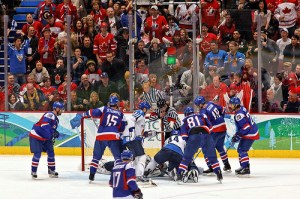
Featured image: “Finland vs. Belarus” by Flickr user s. yume, CC-BY-2.0
—
Kaj Ahlsved is a PhD student in musicology at Åbo Akademi University in Turku, Finland. His research focus is on the ubiquitous music of our everyday life and especially how recorded music is used during sport events. He does ethnographic field work in team sports, mainly focusing on Finnish male teams in ice hockey, soccer, pesäpallo (“finnish baseball”), volleyball, floorball and basket. His research is funded by PhD Program in Popular Culture Studies and he is a member of the Nordic Research Network for Sound Studies (Norsound). He holds a master’s degree in musicology and bachelor’s degree in music pedagogy (classical guitar). Kaj is a Finnish-swede living with his wife and three children in the bilingual town of Jakobstad/Pietarsaari. He is, of course, a proud fan of the local soccer team FF Jaro.
—
Share this:




Current Top Posts





April 2021

January 2020

November 2019

October 2019

August 2019

April 2014

November 2017

March 2015

December 2017

October 2015


Recent Comments