
Ill Communication: Hip Hop Studies & Sound Studies @ Show And Prove
“The engaged voice must never be fixed and absolute but always changing, always evolving in dialogue with a world beyond itself” –bell hooks, quoted by d. Sabela Grimes at Show and Prove, 9.18.10
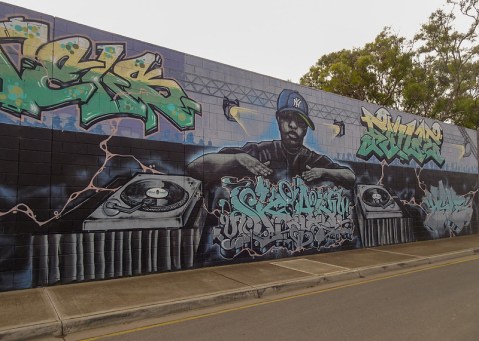
This past Saturday, I got up before dawn and bussed it into New York City to attend Show and Prove , a conference on “the tensions, contradictions, and possibilities of hip hop studies in practice,” organized by my friend and colleague, Imani Kai Johnson. The conference was excellent—intense, earnest, and busting at the seams with ideas—and was one of the few in recent memory that left me energized and ready to put pen to paper ASAP. In fact, I scratched out the rough draft of these lines in my notebook on the bus ride home, all Eminem 8 Mile-style. So embedded somewhere in my words will inevitably be the thick chug of the engine, the squeaky bounce-bounce of the shocks, the ocean-like roar of (the)17, and the steady tsk-tsk-tsk-tsk of hip hop pumping from my fellow commuter’s earbuds. Across the bus aisle, this secondhand beat called to me and challenged me to think about ways that sound studies can reach across the (inter)disciplinary aisle to hip hop (and vice versa). So that’s where my head’s at right now: what does sound studies bring to hip hop’s platform? And what does hip hop offer in return?
I should say first off that I don’t necessarily see an intellectual conflict between these two fields—although Norma Coates’ 2008 Cinema Journal piece, “Sound Studies: Missing the (Popular) Music for the Screens?” makes a compelling case for institutional turf wars on the horizon between sound studies, media studies, and popular music study writ large—I actually came to sound studies through hip hop, and obviously haven’t left hip hop behind (and neither has Sounding Out!: peep Liana Silva and Scott Poulson-Bryant’s recent posts). Among the many things that hip hop has done for me and to me—personally, socially, and politically—was to open my ears to all sorts of amazing and important sounds, which eventually translated academically into frustration with the limits of popular music study back in the early 2000s. I found many texts that deconstructed hip hop lyrics and visual imagery, parsed MC’s personas, dropped some socio-historical science, and traced capitalist networks like you wouldn’t believe, but when it came down to the constitutive element of the medium itself, the sonic art through which it devoted itself to moving heads, hearts, and butts simultaneously, there was silence (and not because Doug E. Fresh said so).
Outside of Tricia Rose’s landmark chapter on “flow, layering, and rupture” in 1994’s Black Noise, I found precious few texts that were willing or able to engage with the primary way in which hip hop put in work “if not in the word, in the sound” as Frederick Douglass once put it a long time ago. Hip hop was, true to its word, bringing the noise, and traditional music studies wasn’t making meaning of it in even part of the way that hip hop audiences were. To signify on Shante Smalls’s comment at Show and Prove in reference to trying to teach Murs’s “Dark Skinned White Girl” to an NYU class, hip hop sounded to popular music scholars just like a guy talking over some beats—all flattened out. So I strapped on my headphones night after night, trying to fill this void by listening and writing, writing and listening. You can read my early attempts in a discography of Los Angeles hip hop called “Audible Angels” I published online in 2004, in which I tried to capture the sonic signature of each artist I wrote about, integrating it with their vocal style, lyrical themes and historical and regional context. The fact that one of the artists in the discography sent me a remastered version of their record based on some of my commentary not only suggested that I did a halfway decent job, but also that the artists themselves are clamoring for scholars to take their sound as seriously as they do.
Because of the bus, my experience at the conference was shorter than I would have liked, so I can’t remotely claim full coverage (I am especially sorry to have missed Antonio T. Tiongson, Jr.’s talk on Filipino DJs and contemporary U.S. racial formations, which I know would have (re)mixed sound, race, and hip hop, hamster style), so I will have to sample the bits and bytes that I did hear.
In a panel on “Methodology, Pedagogy, and Educational Practice,” M.C. K-Swift talked about the sonic differences between standard English, Black English, and Hip Hop English and what it means to code switch between all three. Johan Söderman discussed similar issues about hip hop in Sweden, especially the way in which hip hop enables marginalized Swedish youth to sound and signify differently in the same language.
In the panel I moderated, “Aesthetic Dimensions of Hip Hop”—in which there were amazing papers by Naomi Bragin on popping in Northern California’s East Bay and Jessica Pabón on the “feminist masculinity” of female graffiti in Brasil, Mexico, and the US—sound was largely a shadow presence, animating limbs, accompanying film, and being punctuated by muscle pops and krylon hisses. Jens Althoff discussed 1970s samples briefly in his talk on the influence of blaxploitation cinema on hip hop but there was really only one paper that explicitly addressed sound, Joshua Bennett ’s “I Love it When You Call Me Big (Poppa).” Bennett used Barthes’ “The Grain of the Voice” to give an evocative and nuanced reading of the “palpable sense of surplus” in Notorious B.I.G’s voice, the way in which his heavy timbre comes together with his “wheezing undertone” to re-present his corporeal body as superabundant rather than substandard.
Finally, in the afternoon, I was fascinated by Nicole Hodges Persley’s exploration of the sound of cross-racial appropriation both in her paper, “People in Me” and in her performance, in which she used both voice and gesture to represent a white suburban teen, a young Asian graffiti writer from Silverlake, and a Senegalese student drawn to the U.S. by hip hop. Persley raised important questions about who has “the right to talk black” while addressing the pleasures and the politics of using the body as a remixing agent and translator of hip hop, accent, culture and immigrant experience.
So of course I came to Show and Prove eager to take in some talk about sound—and I wouldn’t say I was disappointed. Surprised (slightly) and challenged (totally), but not disappointed. Sound wasn’t as center stage as I expected, but it certainly wasn’t marginalized either. Instead, it was ubiquitous; sound in hip hop studies seems to be taken for granted in the same way that vision is just about everywhere else. Although hip hop is understood to be an audio-visual art, its organizing metaphors are sonic: remixing, sampling, scratching, and Dj-ing all describe sonic phenomena as well as aural frameworks for understanding the world. The way in which hip hop studies take sound for granted presents both a lesson and an opportunity for sound studies.
While I had been hoping to hear more papers that brought the conversation back around to the beat, I felt that all the papers spoke through it, even if the topic reached beyond it to bodily movement, visual culture, theatre, and pedagogy. And that is where I think hip hop studies asks sound studies to step up its game—to take seriously sound’s intersection with the other senses, using sound as a jumping off point and not always a final destination. In Jeff Chang ’s Total Chaos: The Art and Aesthetics of Hip Hop, dancer Rennie Harris described bodily movement as “just the last manifestation of sound,” which blew my mind, because even though sound and motion are so fluidly entangled, we usually talk about them as if they are separate entities.
On the flip side, one of the things that distinguishes sound studies from popular music study is its methodology—the way in which sound is treated as an active process, a way of thinking and being, rather than solely an object of study. And this methodology is what I think sound studies can offer hip hop studies—a sustained conversation on listening in a multiplicity of forms. Listening practices are what knits the different elements of hip hop together, what links artist to producer to audience, sometimes in the very same body at the very same time. What happens when we think of hip hop artists as listeners? What if we viewed them not only as producers of tracks but also of listening practices? Is there such a thing as hip hop listening? If so, what are its ethics and aesthetics? How might hip hop listening practices impact and feed into the various modes of hip-hop performance in music and beyond: dance, cinema, theatre, literature, graphic design?
So, while hip hop studies and sound studies have quite a bit to show and prove to each other, I can’t be the only one eager for the collabo.


—
Featured Image by Michael Coughlin, CC BY-SA 2.0 DEED
Share this:

The Noise of SB 1070: or Do I Sound Illegal to You?
 There have been many heated debates over Arizona’s newly-implemented legislation SB 1070, a law which targets one of the U.S.’s most vulnerable communities, undocumented workers, and makes them subject to deportation, police harassment, and criminalization. However, in the midst of all the shouting, there has been surprisingly little said about what the role of sound will be in the enforcement of this law. Conversations about racial profiling have been predominately limited to visual aspects: skin color, haircuts, and most infamously, footwear selection. However, in order to fully understand the devastating impact of SB 1070, we need to render sonic examples of discrimination as visible as their visual counterparts. In other words, what does “illegality” sound like? And, conversely, how is U.S. citizenship produced through sound? Even though we rarely talk about either of these auditory social constructions, sonic representations of both abound in American culture, and—regardless of constitutionality—Arizona residents will use both to ferret out whom they feel belongs and whom they believe does not.
In other venues, I have termed dominant listening practices in America the listening ear [For those with access to an online Social Text subscription, click here to download the full text of my article, “Splicing the Sonic Color-Line: Tony Schwartz Remixes Postwar Nueva York”]. The listening ear is a phrase that describes mainstream perception. It represents the ways in which Americans have been disciplined to consider some sounds as natural, normal, and desirable, whole deeming alternate ways of listening and sounding as aberrant, dangerous, and yes, even illegal. Basically, the listening ear is what Judith Butler calls “a constitutive constraint” in Bodies that Matter: a socially-constructed filter that produces but also regulates specific cultural ideas about sound. In regards to SB 1070, the listening ear lines up a little too comfortably with the hazy language of “reasonable suspicion” that has been the focus of so much outcry against the law.
Basically, before Judge Susan Bolton declared a temporary injunction against the law on July 28th, 2010, it allowed police to check the immigration status of any one they made a “lawful contact” with, provided that “reasonable suspicion exists that the person is an alien.” Because unspoken, racialized norms about sound exist and circulate through American culture via the listening ear, members of dominant groups may use sound with impunity to forge “reasonable suspicion” about the citizenship status of anyone who sounds different from them (and who creates, consumes, and appreciates sounds differently from them). Certainly the sound of Spanish is at the top of this list; even though the United States does not have an official language, Arizona has enacted multiple strident “English Only” laws, the most recent of which resulted in the removal of a U.S. Census 2010 banner in Prescott, AZ because it included a sentence in Spanish. Beyond the sound of Spanish itself, there is the sound of accented English, and, as Stanford sociologist John Baugh’s work on linguistic profiling bears out, accents can have extreme impact on one’s economic chances in the U.S. as well as one’s sense of belonging. Now, accents may decide whether or not one gets hassled for their papers and detained and—if not a citizen or a legal resident—deported. Undoubtedly, the accent of the Fresno, CA-born American citizen who was asked to show his birth certificate to police at a truck weigh-in station in Arizona in April 2010 had much to do with his subsequent detainment.
In one of few examples to address the sonics of citizenship via language and accent, the ACLU’s recently released video “Would You Ask This Man for His Papers?” utilizes the sound of Spanish to illustrate the potential for auditory markers to determine citizenship status, especially in concert with visual cues like skin color and classed and raced job duties, like landscaping in the Southwest.
The video’s message—that sonic markers of citizenship are just as unreliable as visual ones—hinges on the fact that the man in the video, Roberto Reveles, is not only bilingual, but a prominent, natural born citizen; he has been president of the Arizona Board of Directors of the ACLU since 2006. However, the stark contrast in representation here risks reifying the division between the sound of Spanish as “foreign” and the sound of English as “normal” or “American,” just as it suggests that speakers of Spanish are much more agreeable to the American listening ear when their citizenship status is no longer in question.
The sounds of Spanish, however, are only the most obvious of a whole host of sonic markers of citizenship. The sounds of music are another. The American listening ear lumps musical genres like mariachi, Tejano, salsa, norteña and reggaetón together—regardless of the diverse national origins of the music or its consumers—and the sounds of instruments like the accordion, timbales, and brass horns become metonyms for the presence of Latino/a “Others.” For many monolingual English-speaking U.S. citizens, the increasing numbers of radio stations that broadcast pan-Latin musical genres—there are over 23 in the state of Arizona—sonically symbolize the perceived invasion and encroachment of the undocumented Latino/a “Others” on (white, English) American territory. The film “The Job” (2008), a short by Screaming Frog that satirizes the imagery of immigration in light of America’s most recent economic crash, represents one facet of the ready associations that the dominant American listening ear draws between music, sound, race, and social status.
The parodic twist in “The Job” turns on the association of particular types of music with undocumented workers. Note the sonic contrast between the “serious” sounds of the white corporate atmosphere and the festive stylings of the Latin music—not unimportantly, a “stock” song called “mariachi” that the producers obtained from Royalty Free Music—as well as the expedient way in which the horns function to herald the brown body of the Latino day laborer before viewers see him.
Given these preexisting aural connections, noise laws are a ready site at which SB 1070’s all-important “reasonable suspicion” can be obtained in a manner that circumvents traditional “colorblind” ideas about racial profiling. After all, it isn’t merely the content of a sound that determines whether or not listeners will hear it as “noise,” but also its context—its appearance in time and space. Whereas numerous forms of representation have disciplined the dominant American listening ear to hear mariachi music at El Torito’s Sunday brunch as a pleasant aural form of “local color,” the reaction to hearing a version of said music emanating from the backyard of one’s neighbor late on a Saturday night might be qualitatively and quantitatively different, particularly if the listener is already primed to perceive immigrants and/or people of color as threatening trespassers, no matter what their legal status may be. Historian Peter Bailey describes noise as “sound out of place,” and I cannot think of a more apt description for the aural stakes of illegality in America’s borderlands. In other words, it isn’t just the sound of an accent or the blare of a trumpet that marks someone as a noncitizen—or worse yet, a non-person, as the progenitors of the dehumanizing term “illegal alien” would have it—but where and when the sound appears and what boundaries it is perceived to cross by citizens empowered to lodge noise complaints.
Tellingly, the language of many noise ordinances is just as vague as SB1070, echoing the normative language of “reasonable suspicion” and the hidden classed, raced, gendered, and nationalized standards of the dominant American listening ear. For example, although the noise laws of Phoenix, Arizona can be quite specific—referencing barking dogs, whistling on the streets, and loudspeakers for advertising—they include a general “morals and conduct” clause that allows that “anything which is obnoxious to health, or is indecent, or is offensive to the senses, or is an obstruction to the free use of property so as to interfere with the comfortable enjoyment of life or property by any considerable number of persons, or unlawfully obstructs any public street, alley, sidewalk or highway is hereby declared a nuisance and may be abated by order of the City Court” (emphasis mine). Clearly, terms like “comfortable” and “offensive” are a socially determined grey area dependent upon which “considerable number of persons” comprise the power base for any given area. It is not a stretch of the imagination to consider how already “Othered” sounds like Spanish accents and Latin music or the sounds of daily life in Latino households that fall outside of the purview of the dominant American listening ear—alternate religious practices, holidays, and customs about children’s play and front/back yard use, for example—can lead to some SB 1070 dime-dropping by one of said “considerable number of persons.” Just ask the predominately Latino gardeners of Los Angeles, CA, who found themselves sonically profiled by wealthy whites who rallied against the sound of the gas-powered leaf blower in 1998, in part to decrease their presence in exclusive neighborhoods. Despite a prominent hunger strike on the steps of city hall by a coalition of Latino gardeners, leaf blowers were deemed illegal in L.A. that same year.
Not surprisingly, there has been an uptick in the battle against noise in the state of Arizona at the same time as the struggle over SB 1070 has heated up. Citizens of cities like Scottsdale and Prescott have been clamoring for tighter noise legislation and increased noise code enforcement in 2010; in language quite similar to SB 1070, one citizen of Scottsdale told the Arizona Republic that police officers should be empowered to “distinguish and make judgment calls as to who is loud and who’s not.” Note the telling slippage between noise and the people who (allegedly) make it.
 Interestingly, in spite of the utility of noise laws for implementing SB 1070, the overt demographic target of much Arizona noise legislation has been motorcycle owners, who are among the whitest, wealthiest, malest, and most middleaged populations in the U.S. according to statistics complied by the 2008 Motorcycle Industry Council Owner Survey, and therefore traditionally a group resistant to visual racial profiling—at least in the arena of law enforcement. Perhaps, given Gary L. Kieffner’s claim in “Police and Harley Riders: Discrimination and Empowerment” in the Spring 2009 issue of the International Journal of Motorcycle Studies that the struggle of Harley-Davidson riders had “similarities with the civil rights movement of the 1960s, women’s liberation in the 1970s, and advances by other oppressed minorities,” aggrieved motorcyclists will join hands with the undocumented workers finding themselves on the wrong side of America’s sonic color- line.
Instead of holding my breath, I am going to put at least some of my faith in Sound Strike, a group of artists including Ozomatli, M.I.A., Rage Against the Machine, Nine Inch Nails, DJ Spooky, Los Tigres del Norte, Kanye West, and Yeasayer among many others devoted to fighting the noise of SB 1070 with the silence of Arizona’s empty concert halls.
The Sound Strike on Facebook
Sound Strike Petition to Stop SB 1070
And it’s not like Public Enemy hasn’t been warning us for years. I’d like to close with their “noisy” rejoinder to Arizona’s refusal to acknowledge Martin Luther King Jr. as a national holiday back in 1986, “By the Time I Get to Arizona”. DJ Spooky has created a free downloadable remix of the song in the wake of SB 1070 for your listening displeasure. Let the sound strike begin.
P.S. I also want to mention that many artists are choosing to fight SB 1070 through their performances in AZ rather than boycotting the state, most notably Lady Gaga.


Share this:


Current Top Posts





April 2021

January 2020

November 2019

October 2019

August 2019

April 2014

November 2017

March 2015

December 2017

October 2015
 Sounding Out!
Recent Comments