
Pleasure Beats: Using Sound for Experience Enhancement
 After a rockin’ (and seriously informative) series of podcasts from Leonard J. Paul, a Drrty South banger dropped by SO! Regular Regina Bradley, a screamtastic meditation from Yvon Bonenfant, a heaping plate of food sounds from Steph Ceraso, and crowd chants courtesy of Kariann Goldschmidt‘s work on live events in Brazil, our summer Sound and Pleasure comes to a stirring (and more intimate) conclusion. Tune into Justyna Stasiowska‘s frequency below. And thanks for engaging the pleasure principle this summer!--JS, Editor-in-Chief
—
One of my greatest pleasures is lying in bed, eyes closed and headphones on. I attune to a single stimuli while being enveloped in sound. Using sensory deprivation techniques like blindfolding and isolating headphones is a simple recipe for relaxation, but the website Digital Drugs offers you more. A user can play their mp3 files and surround themselves with an acoustical downpour that increases and then develops into gradient waves. The user feels as if in a hailstorm, surrounded by this constant gritty aural movement. Transfixed by the feeling of noise, the outside seems indistinguishable from inside.

Screenshot courtesy of the author
Sold by the i-Doser company, Digital Drugs use mp3 files to deliver binaural beats in order to “simulate a desired experience.” The user manual advises lying in a dark and silent room with headphones on when listening to the recording. Simply purchase the mp3, and fill the prescription by listening. Depending on user needs, the experience can be preprogrammed with a specific scenario. This way users can condition themselves using Digital Drugs in order to feel a certain way. The user can control the experience by choosing the “student” or “confidence” dose suggestive of whether you’d like your high like a mild dose of marijuana or an intense dose of cocaine. The receiver is able to perceive every reaction of their body as a drug experience, which they themselves produced. The “dosing” of these aural drugs is restricted by a medical warning and “dose advisors” are available for consultation.

Screenshot courtesy of the author
Thus, the overall presentation of Digital Drugs resembles a crisscross of medicine and narcotic clichés with the slogan “Binaural Brainwave doses for every imaginable mood.” While researching the phenomena of Digital Drugs, I have tried not to dismiss them as another gimmick or a new age meditation prop. Rather, I argue the I-Doser company offers a simulation of a drug experience by using the discourse of psychoactive substances to describe sounds: the user becomes an actor taking part in a performance.
By tracing these strategies on a macro and micro scale I show a body emerging from a new paradigm of health. I argue that we have become a psychosomatic creature called the inFORMational body: a body that is formed by information, which shapes practices of health undertaken to feel good and form us. This body is networked, much like a fractal, and connects different agencies operating both in macro (society) and micro (individual) scales.
Macroscale Epidemy: The Power of Drug Representation
Heinrich Wilhelm Dove described binaural beats in 1839 as a specific brain stimuli resulting in low-frequency pulsations perceivable when two tones at slightly different frequencies are presented separately through stereo headphones to each of the subject’s ears. The difference between tones must be relatively small, only up to 30 Hz, and the tones themselves must not exceed 1000 Hz. Subsequently, scientific authorities presented the phenomena as a tool in stimulating the brain in neurological affliction therapy. Gerard Oster described the applications in 1968 and the Monroe Institute later continued this research in order to use binaural beats in meditation and “expanding consciousness” as a crucial part of self-improvement programs.
I-Doser then molded this foundational research into a narrative presenting binaural beats as a brain stimulation for a desired experience. The binaural beats can be simply understood as an acoustic phenomena with application in practices like meditation or medical therapy.
I-Doser also employs the unverified claims about binaural beats into a narration that consists of the scattered information about research; it connects these authorities with YouTube recordings of human reactions to Digital Drugs. Video testimonies of Digital Drugs users caused a considerable stir among both parents and teachers in American schools two years ago. An American school even banned mp3 players as a precautionary measure. In the You Tube video one can see a person lying with headphones on. After a while we see an involuntary body movement that in some videos might resemble a seizure. Losing control over one’s body becomes the highlight of the footage alongside a subjective account also present in the video. The body movements are framed as a drug experience both for the viewer who is a vicarious witness and the participant who has an active experience.
This type of footage as evidence was popularized as early as the 1960s when military footage showed reactions to psychoactive substances such as LSD.
In the same manner as the Digital Drugs video, the army footage highlights the process of losing control over one’s body, complete with subjective testimonies as evidence of the psychoactive substance’s power.
This kind of visualization is usually fueled by paranoia, akin to Cold War fears, depicting daily attacks by an invisible enemy upon unaware subjects. The information of the authority agencies about binaural beats created a reference base that fueled the concern framing the You Tube videos as evidence of drug experience. It shows that the angst isn’t triggered by technology, in this case Digital Drugs, but by the form in which the “invisible attack” is presented: through sound waves. The manner of framing is more important than the hypothetical action itself. Context then changes recognition.
Microscale Paradigm Shift: Health as Feeling
On an individual level, did feeling better always mean being healthy? In Histoire des pratiques de santé. Le sain et le malsain depuis le MoyenAge, Georges Vigarello, continuator of the Foucault School of Biopolitics, explains that well-being became a medicalized condition in the 20th century with growing attention to mental health. Being healthy was no longer only about the good condition of the body but became a state of mind; feeling was important as an overall recognition of oneself. In the biopolitical perspective, Vigarello points out, health became more than just the government’s concern for individual well-being but was maintained by medical techniques and technologies.
In the case of Digital Drugs the well-being of children was safely governed by parents and media coverage creating prevention in schools from the “sound drugs.” Similarly, the UAE called for a ban on “hypnotic music” citing it as an illegal drug like cannabis or ecstasy. Using this perspective, I would add that feeling better, then, becomes a never-ending warfare; well-being becomes understood as a state (as in condition and as in governed territory).
Well-being is also an obligation to society, carried out by specific practices. What does a healthy lifestyle actually mean? Its meaning includes self-governance: controlling yourself, keeping fit, discipline (embodying the rules). In order to do it you need guidance: the need for authorities (health experts and trainers) and common knowledge (the “google it” modus operandi). All of these agencies create a strategy to make you feel good every day and have a high performance rate. Digital Drugs, then, become products that promise to boost up your energy, make you more endurable, and extend your mind capabilities. High performance is redefined as a state that enables instant access to happiness, pleasure, relaxation.

“Submerged” by Flickr user Rene Passet, CC BY-NC-ND 2.0
inFORMational Body
Vigarello reflects that understanding health in terms of low/high performance—itself based on the logic of consumption—created the concept of a limitless enhancement. Here, he refers to the information model, connecting past assumptions about health with a technique of self-governing. It is based on senses and an awareness of oneself using “intellectual” practices like relaxation and “probing oneself” (or knowing what vitamins you should take). The medical apparatus’s priority, moreover, shifted from keeping someone in good health to maintaining well-being. The subjective account became the crucial element of a diagnosis, supporting itself on information from different sources in order to imply the feeling of a limitless “better.” This strategy relies strongly on the use of technologies, the consideration of a sensual aspect and self-recognition—precisely the methodology used for Digital Drugs’ focus on enhancing wellbeing.
Still, this inFORMational body needs a regulatory system. How do we know that we really feel better? Apart from the media well-being campaign (and the amount of surveillance it involves), we are constantly asked about our health status in the common greeting phrase, but its unheimlich-ness only becomes apparent for non-anglo-saxon speakers. These checkpoint techniques become an everyday instrument of discipline and rely on an obligation to express oneself in social interactions.
So how do we feel? As for now, everything seems “OK.”
—
Featured image: “Biophonic Garden” by Flickr user Rene Passet, CC BY-NC-ND 2.0
—
Justyna Stasiowska is a PhD student in the Performance Studies Department at Jagiellonian University. She is preparing a dissertation under the working title: “Noise. Performativity of Sound Perception” in which she argue that frequencies don’t have a strictly programmed effect on the receiver and the way of experiencing sounds is determined by the frames or modes of perception, established by the situation and cognitive context. Justyna earned her M.A in Drama and Theater Studies. Her thesis was devoted to the notion of liveness in the context of the strategies used by contemporary playwrights to manipulate the recipients’ cognitive apparatus using the DJ figure. You can find her on Twitter and academia.edu.
—
 REWIND!…If you liked this post, check out:
Papa Sangre and the Construction of Immersion in Audio Games–Enongo Lumumba-Kasongo
On Sound and Pleasure: Meditations on the Human Voice—Yvon Bonenfant
This is Your Body on the Velvet Underground–Jacob Smith
Share this:

On Sound and Pleasure: Meditations on the Human Voice

After a rockin’ (and seriously informative) series of podcasts from Leonard J. Paul–a three part “Inside the Game Sound Designer’s Studio”– and a post on sound and black women’s sexual freedom from SO! Regular Regina Bradley, our summer Sound and Pleasure series keeps doin’ it and doin’ it and doin’ it well, this week with a beautiful set of meditations from scholar, artist, performer, and voice activist, Yvon Bonenfant. EVERYBODY SCREAM!!!–-JS, Editor-in-Chief
—
1
What I have to say about sound and pleasure can mostly be summed up this way: everyone deserves to take profound pleasure in their body’s sound.
Not only this, everyone deserves to both engage passionately with social sound and negotiate the exchange of social sound on pleasurable terms.
Like other expressive systems, however, these inalienable sonic human rights are mostly ignored, curtailed, or otherwise ‘disciplined and punished’ in the Foucauldian sense by our social systems. So, we are mostly neurotic, or otherwise hung up on, what kinds of sounds we make, where and when. We fetishise sound, particularly virtuosically framed sound, because it is part of a series of sublimated impulses, or we repress it because we think we aren’t supposed to emit it, or we ignore it.
2

“DSC_0296” by Flickr user Anastasia CW, CC BY-NC-SA 2.0
In any given human relationship within which all parties can vocalize, the voice is an evident, key relational tool. It is full of gesture and meaning and text and sends rapid-fire, complex, layered, even self-contradictory or oxymoronic messages. It is a truly tangled web, and of course, for those who can use speech, transmits language.
However, I’d like to disentangle our sound from our language for a moment. Indeed, sound is not necessary in order to develop and transmit linguistically carried ideas, information and impulses. It has long been accepted that sign languages are fully developed languages, with intricate grammatical systems, vocabularies, and all of the other features of spoken languages. It is thus not necessary to use sound as a carrier of language. Yet if we have a voice, we almost always use sound to carry our language. And we force deaf people to try to fake having a voice and to fake listening to voices through lip reading and gesturing.
The last twenty years has seen a real boom in speculation and even scientific experiments that theorise why human bodily sound – the most evident aspect of which is our vocal sound – is so important to us. Musicology, biomusicology, evolutionary psychology, neuropsychology, and cultural studies of many kinds have tried to account for this. I have my own favorite reason, one I’ve tried to describe in a number of scholarly articles. This is that sound is much like touch. Like, yet unalike. It reaches and vibrates bodies, but at distance. It voyages through space in other ways, but it evokes haptic responses.
3
Sound isn’t solid, but it takes up space. This is expressed by Stephen Connor within his concept of the vocalic body. When we sound, there is a resonant field of vibration that moves through matter, which behaves according to the laws of physics – it vibrates molecules. This vibratory field leaves us, but is of us, and it voyages through space. Other people hear it. Other people feel it.
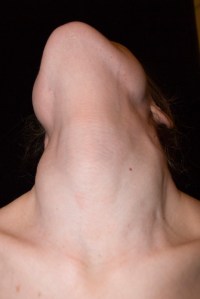
“GAELLE” by Flickr user Pauline Thomas, CC BY-NC 2.0
I’ve said that sound is like touch. However, one key way that it is not like touch is that it can do this thing. It can leave our bodies and travel away from us. We don’t need to grip it. We don’t need to hold on. And once emanated, it is out of our control.
More than one emanation can co-exist within matter. Their vibrations interact with one another, waves colliding and travelling in similar or different directions, and the vocalic bodies that they represent are morphed, hybridized: they intersect and invent composite bodies.
We hear the resulting harmonies. Historically policed into ‘consonances’ and ‘dissonances’, we have the power to let the negativizing connotations of either of these words go and simply hear the results of the collisions. Voices sounding simultaneously create choreographies of gesture that can be jubilant, depressing, assertive, aggressive, delightful, morose… or many of these simultaneously and in rapid alternation.
The fields of human sound in which we bathe are a continually self-knitting web of sensation. They are full of gestures pregnant with intention, filled with improvisatory spontaneity, success, failure and experimentation. They are filled with a desire to act upon matter, and to reach and engage one another.
4
My Ukrainian-origin mother was ‘loud’, I guess, at least by Anglo-Saxon standards, and her voice was timbrally very rich. And my father was a radio announcer (he disliked being called a DJ immensely, even though he worked in commercial radio and worked on shows that spun discs – he preferred being associated with talking). His voice was also very rich, as well as extremely crafted. It could be pointed and severe: a weapon. He had professional command of its qualities. We were not a quiet family; none of us were vocal wallflowers. But were our soundings pleasure-filled? Certainly, we were allowed to make lots of sound in some circumstances. However, just being allowed to be loud – though it might sometimes be a pleasure – does not necessarily lead to a pleasure-filled dynamic. Weightlifting makes us stronger, but it doesn’t necessarily feel good.
The amount of sound and whether ‘lots’ of it, or heightenings of its qualities – lots of amplitude, or lots of other kinds of distinctness, let’s say things like pitch or emotional timbre – are key variable features of family life in our cultures. Sound takes us directly into the meatiest of interpersonal dynamics – the dynamics of space and gesture, the dynamics of who takes up space with their sound and when. Families are, of course, microcosms of this sonic dynamic, but any group within which we generate relationships and encounters is subject to this dynamic, too. Our very own bodies end up developing what Thomas Csordas might call a ‘somatic mode’ that embodies our experience of these dynamics.

“Scream” by Flickr user madamepsychosis, CC BY-NC-ND 2.0
Whether we start from psychodynamic, neuropsychiatric, or even habitus-based models, it’s clear that repressing the expression of bodily sound regulates breathing impulses and other metabolic processes in ways that might become, well, habits.
Let’s put this in other ways.
The classic, Freudian, psychodynamic model of neurosis – as disputed as it is, and with all of its colonial, sexist, homophobic, racist and even abuse-denying overtones – did at least one thing for our understanding of what repressed emotion does. Repressed emotion affects the body.
Today, a popular understanding of this kind of emotional repression from a biophysical perspective might be: the use of the conscious mind to hold back emotional flow, and along with it, the emotional qualities of certain associations, memories, or even the content of the memories themselves.
Repressing this thing we might call emotional flow represses the voice. The literal, physical voice. Now, this kind of repression of the voice can become what Freudians would call unconscious. To allow it out isn’t any longer a choice that can be made, because we’re so used to holding back, that we don’t realize we’re doing it any more.
Somatics have taught us, through the contended practices of the body psychotherapies descended from Wilhelm Reich’s work, or Bonnie Bainbridge Cohen’s Body-Mind Centering, or any numerous other somatic practices – from certain styles of yoga through to Zen meditation and beyond – that emotional flow is at least partly dependent on how we breathe. And neuropsychology and physiology bear this out.

“Screaming Out My Hell” by Flickr user L’Orso Sul Monociclo, CC BY 2.0
Whatever might ‘cause’ an emotion – and the roots of the causes of emotion are a source of debate – once it gets going, it isn’t just a thought process. Emotion is meaty and full of pumping hormones and breath pattern alterations and gestures and rushes of fluid. Chemicals get released. Chemicals get washed away. Heart rates speed up and slow down. Our breath rises and falls and its patterns change. Digestion patterns speed up or slow down or get interrupted. What happens in the body affects the body. What happens in the body affects the voice. Ever heard that kind of voice that seems hardened against the world? Or that media voice – the voice that is carefully shaped to invoke reason? Maybe these vocalisers can never let go of that sound: maybe it’s the only sound they can do, now. It’s just too habitual to let it change.
So, these habits can become so habitual that we don’t notice them anymore. We might change our breathing in some way to modify our expressive states. Because the exact nature of the sound our voices make is exquisitely dependent on how we breathe, and on everything else we do with our bodies, it then changes as well. Our choices to not let impulses flow – and the breath is only one bodily impulse among many – get caught up in this web. What were once choices can become embedded, difficult, and stubborn. To go far beyond the psychoanalytic and neurophysiological models, we can end up embodying a culture of these choices, and invent together a cultural body that regulates vocal sound based on groups of people making similar choices or playing by similar rules of sonic exchange.
This can end up perpetuating itself within our very tissues, and it can be an incredibly subtle dynamic to identify and shift. The way we embody the complexities of how we structure our physical and psychological engagement with the world – the ways we breathe, look, move, gesture… the ensemble of these is how Bourdieu defined the habitus. Where these complexities start and end is perhaps an infinite loop, a continual cycle of turning and exchange and influence flowing from ourselves to our culture and back again. Our bodies are cultural, counter-cultural, infra-cultural, extra-cultural bodies: we react to culture; we interact with it: we take positions.
Sound – who gets to do it, and when and how – is negotiated, with others, but also, within our own bodies. The traces that others leave there, the things we might call sonic and vocal inhibitions, tensions, these held-back-nesses, eventually become ours to carry, live with, and/or dissolve. They are gifted to us by our culture…. by our environment… by our experience … and by our bodies themselves.
We negotiate sounding.
Pleasure is negotiated, too.
5

“Quiet” by Flickr user Leo Reynolds, CC BY-NC-SA 2.0
We do this to our children: we shut them up. Oh, of course, we also facilitate their sound, and some do this more than others. But even if we give them sonic liberty at home, someone will shut them up, somewhere. We all know and we all remember being silenced as children by somebody, or at least, made to raise our hands in a classroom to ensure one speaker at a time, chosen by the authority in question. Later, teenagers, more often girls than boys, are called mouthy. The mouth: implicitly loud, and if too active, implicitly offensive. The term has been used against feminists, every identity we might include within LGBTI+, African-Americans, and the list goes on.
The wet, open, loud, loud mouth, just ready to mouth off, just ready to make trouble with its irritating, nasty, and above all, bothersome noise – bothersome because it makes us have to react – to have to consider the existence, the needs, the demands of those we might otherwise ignore – that moist orifice can be a source of great pleasure.
6
And on the score of that poor mouthy mouth, let’s consider some other colloquial terms, like ‘sucker’. Sucking is bad, apparently. It expresses need. Thumb out of the mouth! Stop wanting intimacy, reassurance, warmth, contact, and above all stop wanting to satisfy your hard-wired, biological need to suck for comfort and food (my little child). And you there, you sexually active adult! You fucking cocksucker. You ass-licker. That gaping mouth should shut itself up: its gooey pleasures are disgusting. These pleasures involve direct skin-to-skin contact.
Perhaps there is a revolution to be had, in the simple facilitation of gape-mouthed drool.
The vocal tract – that long tunnel surrounded by tongue and palates and teeth and various bits of throat, with at its bottom, the resonant buzz of elastic membranes, through which air is squeezed – also grips the world with direct contact. It’s not just a resonating and sound-shaping cave.
7

“Whistling Boy by Frank Duveneck” by Flickr user Mary Harrsch, CC BY-NC-SA 2.0
I’m making some artworks for children and families right now, and I group them together under the project moniker “Your Vivacious Voice” [See SO! Amplifies post from 6/19/14 to learn more about the free Voice Bubbles App aspect of YB’s project—ed]. I’m collaborating with some scientists and clinician-scientists on this project. They all work with the voice – in psycholinguistics, in understanding infant language acquisition, in voice medicine, and even in laryngeal surgery. We interview these scientists, and use inspiration from our conversations as sources of metaphors for art-making.
One of these is the head Speech and Language Therapist at the Royal National Ear, Nose and Throat Hospital in London, Dr Ruth Epstein. She sees and/or oversees some of the most difficult cases of vocal problems in the whole of the UK. When we asked her what concerns she’d most like us to address in artworks for children and families, she responded along the lines of: please, find a way to get through to them that voice is contact, human contact. She has begun using communication skills, such as eye contact and turn-taking exercises, in addition to vocal skills, in families with children who have injured voices – because she realized at some point that in many of these families, the near exclusive modality of contact was yelling: yelling without contact – without relationship.
The contactless yell is the thrashing arm that somehow remains alone in a void. It’s a yell that might strike if it lands on other flesh, but somehow doesn’t grip, and can’t convert to a caress. It can’t hold… it only punches.
This reminds me of a rockish tune by Carole Pope and Rough Trade from the Canadiana of my childhood – the refrain went:
It hit me like, it hit me like, it hit me like a slap, oh-oh-oh, all touch…
All touch and all touch and no contact…..
8
Back to our children, and to us.
Bodily sound can be a pointed weapon. It can be violent, in that it can frighten, dominate, attack, evoke deep fear, and engage other mechanisms of terror and control and subjugation, and that it can attempt to annihilate our ability to recognize the existence of others. We can drown out others’ sounds. We can drown out their gesture. We can drown their vocalic bodies in our own through amplitude and clashes of timbral spectra. We can shut them up.
Let us consider, here, the desire for amplification and how amplified sound represents an exaggeration of this power, a cybernetic enhancement of the ability to dominate with our emanating waves. We can drown out the social ability for whole groups to hear anyone but ourselves.
However, if, in our cultural environments, everyone is allowed to sound – if, indeed, we facilitate social environments in which everyone’s sound is welcome, then those who are subjected to vocal and sonic violence have an incredible counter-power to this power: they have the power to make sound too.
Although making sound back to violent sound, back to annihilating sound, is not always easy, possible or permitted, it is a power that can’t be easily erased. And we can almost always feel, if not cognitively hear, our own sound vibrate within our own skulls and through our own bones, no matter what is coming from the outside, no matter what waves of vocalic body are streaming toward us. Our sound waves continue to exist, even if transformed.
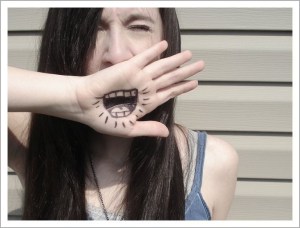
“Mouthing Off” by Flickr user Demi-Brooke, CC BY 2.0
We can give voice to ourselves. We can change our habits. We can expand away from them.
It isn’t even necessary to fight back. It’s only necessary to vibrate.
And we can take it further.
We can actively encourage each other’s sound. We can actively encourage our children’s sound. We can actively encourage social sound. We can actively encourage a dance with others’ voices. We can facilitate, make space for, enjoy being touched by, the uniqueness of other voices. We can play with how our voices collide and create children with the vocalic bodies of others. After all, our composite vocal bodies are the products of our intensive exchange. We can jublilate in the massages we receive by making our own sound, by vibrating our own skulls, flesh, blood, lymph, interstitial fluid, and the air near us, and we can make it so that we can engage in passionate exchange with the vibrations of others.
This might be something like music. Or other kinds of art. Or it might be simple conversation. Or it might be cooing with a baby. Or it might be making comforting sounds while a toddler cries. Or it might be screaming with rage together.
What it always is, though, is focusing on, opening up to, enjoying the dynamics of the dance of individual, idiosyncratic, messy, fleshly, bodily, sonic emanations reacting with one another.
In the end, the policing of our sound is under our control. We can find ways to unpolice, and enjoy the unbridledness of our sound.
Our bodily sound is a means of engaging passionately with relationship and of glorying in its results.
—
Featured image: “Faces 529” by Flickr user Greg Peverill-Conti, CC BY-NC-ND 2.0
—
Yvon Bonenfant is Reader in Performing Arts at the University of Winchester. He likes voices that do what voices don’t usually do, and he likes bodies that don’t do what bodies usually do. He makes art starting from these sounds and movements. These unusual, intermedia works have been produced in 10 countries in the last 10 years, and his writing published in journals such as Performance Research, Choreographic Practices, and Studies in Theatre and Performance. He currently holds a Large Arts Award from the Wellcome Trust and funding from Arts Council England to collaborate with speech scientists on the development of a series of participatory, extra-normal voice artworks for children and families; see www.yourvivaciousvoice.com. Despite his air of Lenin, he does frighteningly accurate vocal imitations of both Axl Rose and Jon Bon Jovi. www.yvonbonenfant.com.
—
 REWIND! . . .If you liked this post, you may also dig:
Experiments in Aural Resistance: Nordic Role-Playing, Community, and Sound— Aaron Trammell
This Is Your Body on the Velvet Underground— Jacob Smith
Sound Designing Motherhood: Irene Lusztig & Maile Colbert Open The Motherhood Archives— Maile Colbert
Share this:


Current Top Posts





April 2021

January 2020

November 2019

October 2019

August 2019

April 2014

November 2017

March 2015

December 2017

October 2015
 Sounding Out!
Recent Comments