
Hearing the Tenor of the Vendler/Dove Conversation: Race, Listening, and the “Noise” of Texts
In the beginning there were no words. In the beginning was the sound and they all knew what the sound sounded like. –Toni Morrison, Beloved
DOI: https://doi.org/10.59350/zssew-bpa12
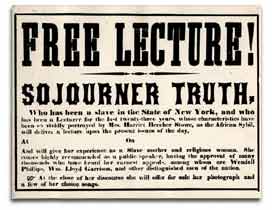
A conversation in my Black Feminist Theories class on the two versions of Sojourner Truth’s famous speech from the Ohio Women’s Convention—the one published in 1863 that renders her words in a black southern dialect or the 1851 version that does not—elicited the following story about listening. A black male student was student teaching/observing in a classroom — the teacher was white, the student teacher black. The exercise he observed involved transcribing speech and then reading it back. A black male student in the classroom spoke and the white teacher and black student teacher each transcribed the speech and read their transcriptions aloud. The white teacher’s transcription/recording was in dialect, the black student teacher’s was not. The student teacher maintained that what and how the white teacher heard the black student was not, in fact, either what or how the black student spoke.
Discussions like these have spurred me to meditate more deeply on sound. And now that I’ve really begun to consider it, texts have become much noisier places; the white spaces and black marks becoming places for reading and hearing. Thinking more deeply about sonic affinities and communities has helped me really begin to understand how sound shapes sight and sight shapes sound.
An example: Since reading Fred Moten’s In the Break, in particular “The Resistance of the Object,” it’s not only impossible for me to read the scene of Captain Anthony’s beating/rape of Aunt Hester in Frederick Douglass’s Narrative without hearing Abbey Lincoln’s hums, moans, and screams, it is not possible for me to read the entire text without populating it with sound, even as those sounds are, in my imagining of them, not always specific.
.
Perhaps it’s most accurate to say that I am aware that the world that the text references is a world filled with sounds peculiar to it, many of which may no longer be present in our contemporary world. At the same time, I try to bring at least some of those sounds—talking drums, field hollers, whips cracking, the sounds of chains, etc.—and approximations of sounds into the classroom when I teach Douglass’s Narrative and My Bondage and My Freedom (as well as when I teach other texts).
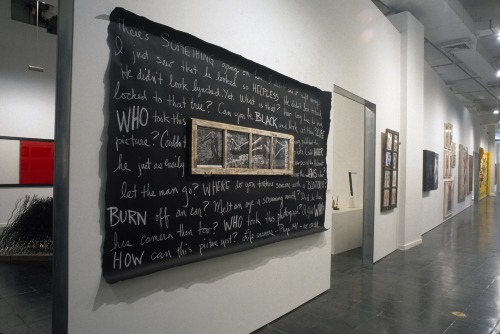
In “The Word and the Sound: Listening to the Sonic Colour-line in Frederick Douglass’s 1845 Narrative” (2011) Jennifer Stoever-Ackerman writes, “The emphasis Douglass places on divergent listening practices shows how they shape (and are shaped by) race, exposing and resisting the aural edge of the ostensibly visual culture of white supremacy, what I have termed the “sonic colour-line” (21). Stoever-Ackerman riffs on Elizabeth Alexander’s “Can you be BLACK and Look at This: Reading the Rodney King Video” (and Alexander riffs on Pat Ward Williams’s “Accused, Blowtorch, Padlock”) to ask, “Can you be WHITE and (really) LISTEN to this?” or alternatively, “Are you white because of HOW you listen to this?” (21).
.
In his review of Shane White and Graham White’s The Sounds of Slavery: Discovering African American History Through Songs, Sermons, and Speech (Beacon Press, 2005) in the July 2009 issue of the Journal of Urban History, Robert Desrochers contrasts the abolitionists who were attuned to how to make a white audience hear the sounds that surrounded and produced the (performances of the formerly) enslaved, to the “Virginia patriarch who failed to mention the singing of his slaves even once in a diary that ran to hundreds of manuscript pages” (754). Given these examples of the ways that many white ears had to be systematically attuned to hearing slavery’s sounds as well as the understanding that, “the very things that made slave sounds distinctive—chants, grunts, and groans; melismatic, repetitious, and improvisational lyric play; pitch and tonal inflections and cadences; timbral variations, polyrhythms, and heterophonic harmonies—struck whites mostly as strange, inappropriate, wrong” (754)—the answers to Stoever-Ackerman’s questions may be respectively “no” and “yes” (or several combinations of no and yes), particularly if we engage “whiteness” as an ideology and not simply (or not only) a “raced” description of those people constituted socially and legally as (presumably) white.
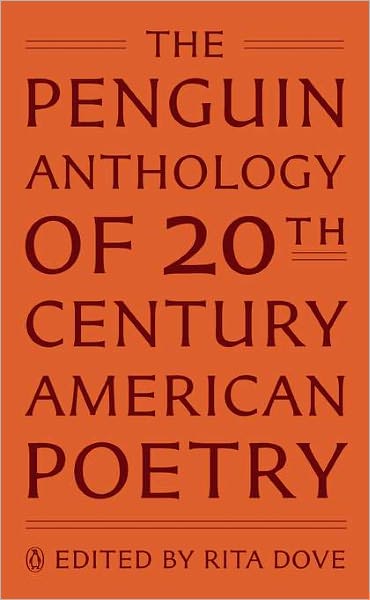
It was with these kinds of questions of sound and sonic whiteness on my mind (especially this question of who hears, who doesn’t hear, and then again what is and isn’t heard) that I read and was brought up short by Helen Vendler’s recent November 24, 2011 New York Review of Books review of Rita Dove’s The Penguin Anthology of 20th Century American Poetry. In this piece, Vendler takes Dove to task for what she considers the anthology’s over-inclusiveness (“No century in the evolution of poetry in English ever had 175 poets worth reading”), the “accessibility” of the poems (“short poems of rather restricted vocabulary”), and the appearance of a large number of black and other non-white poets in the latter part of the twentieth-century. In short, from Vendler’s perspective, Dove is choosing “sociology” and complaint over artistry; mixing the wheat and the chaff.
Vendler writes, “Rita Dove, a recent poet laureate (1993–1995), has decided, in her new anthology of poetry of the past century, to shift the balance, introducing more black poets and giving them significant amounts of space, in some cases more space than is given to better-known authors. These writers are included in some cases for their representative themes rather than their style. Dove is at pains to include angry outbursts as well as artistically ambitious meditations.”
And Vendler on Dove on Hart Crane: “sometimes one wonders whether Dove is being hasty. She speaks, for instance, of ‘the cacophony of urban life on Hart Crane’s bridge.’ But the bridge in his ‘Proem’ exhibits no noisy ‘cacophony’; its panorama is a silent one. The seagull flies over it; the madman noiselessly leaps from ‘the speechless caravan’ into the water; its cables breathe the North Atlantic; the traffic lights condense eternity as they skim the bridge’s curve, which resembles a ‘sigh of stars’; the speaker watches in silence under the shadow of the pier; and the bridge vaults the sea. The automatic—and not apt—association of an urban scene with noise has generated Dove’s ‘cacophony.’”
Why does Vendler insist on silence where Dove joins sight and sound? That Vendler imagines silence and takes Dove to task for attaching cacophony to the city scene in the bridge poem is a struggle over meaning, over epistemology and ontology. How is Vendler registering not only the poem but also the entire text differently? This isn’t the only instance of Vendler’s insistent sonic “whiteness” whereby and wherein the reading of the poem, the anthology, and the anthologizer herself are disciplined.
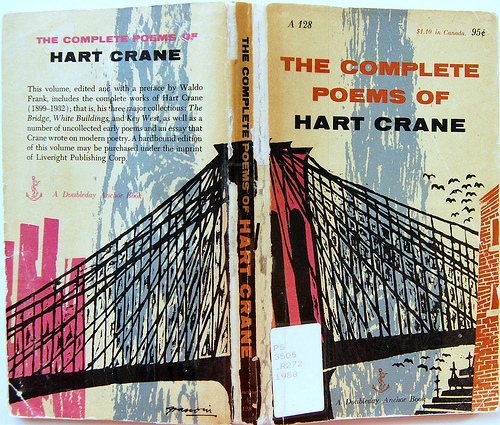
Speechlessness though, is not soundlessness, and it seems to me that Dove locates herself on the bridge (and in the soundscape of the contemporary written poem) such that she hears the water, the seagull, and the leap and curve and flap of gull and man. As Dove herself responded (also in the New York Review of Books), “A cursory sweep over just the section [Vendler] excerpted in my anthology yields a host of extraordinary sounds: what with trains whistling their “wail into distances,” chanting road gangs, papooses crying—even men crunching down on tobacco quid—my gasp of surprise at Vendler’s blunder can barely be heard.”
In Vendler’s remarks and Dove’s response we might read the kind of cultural dissonance that continues to both construct and give insight into how different communities of readers and listeners are formed and the ways they are and aren’t racialized. By the end of the review, Vendler wants to be heard by those whom she imagines as the anthology’s likely readers: she wants to turn to them and “say,” to “cry out,” that there are better poems than those included here. For the sounds that in this anthology that Vendler hears most often in the “minor” poems, in the “minority” poets, and the “minority” anthologizer, are simplicity, noise, and needless complaint. And Vendler and Dove have been here before – see Vendler on Dove and Delaney on Vendler and Dove.)
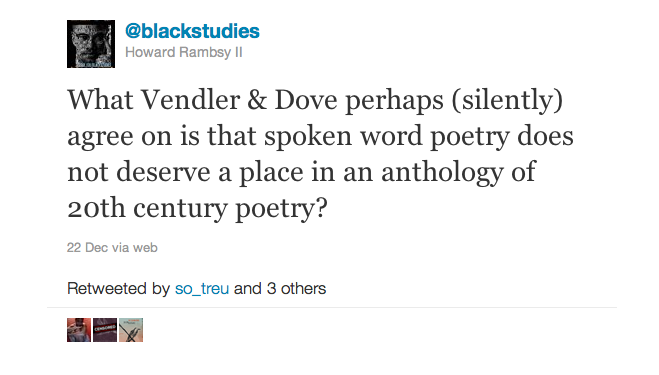
But despite the debate putting poetry front and center and enacting ways that it matters, Vendler’s critique and Dove’s response are each conservative, though in quite different ways. Neither Vendler nor Dove in the review, anthology, and defense of the anthology imagines the inclusion of spoken word, hip-hop (see Howard Rambsy II), and other forms of contemporary rhyme and verse that speak to a broad range of audiences across race, sex, and class. The inclusion of rap might further change the tenor of the conversation, opening up in important ways the debate over what counts as poetry, and expanding how black musical and poetic forms are heard and by whom.
—
Christina Sharpe is Associate Professor of English and American Studies at Tufts University where she also directs American Studies. Her book Monstrous Intimacies: Making Post-Slavery Subjects was published in 2010 by Duke University Press. Her current book project is Memory for Forgetting: Blackness, Whiteness, and Cultures of Surprise.
—
Share this:

Sounding Out! Occupies the Internet, or Why I Blog
DOI: https://doi.org/10.59350/66m9a-9at32
Welcome to our 100th post! It’s me, Jennifer Stoever Editor-in-Chief, Guest Posts Editor, and Co-Founder of Sounding Out! : The Sound Studies Blog, which has been faithfully “pushing sound studies into the red since 2009.” Together with Liana Silva, Co-Founder and Managing Editor, and Aaron Trammell, Co-Founder and Multimedia Editor, we thank you for your faithful readership, your enthusiasm, and of course, your likes, shares, retweets, and good, old-fashioned word-of-mouth!! We are going to keep serving up sound studies’ latest and greatest for a long time to come, for anyone who wants to listen. Keep a look out for our site redesign coming in January 2012: same good stuff, just that much easier on the eyes.
In honor of this momentous occasion, I am going to get all “meta-“ on you and take you behind the scenes of Sounding Out!, sharing some of the reasons why we decided to start a public conversation about sound studies on the Internet. A manifesto of sorts, this post is adapted from a talk I gave a few weeks back at the American Studies Association annual meeting in Baltimore as part of an excellent panel called “Digital Displays: Women Imagining The Blogosphere as Alternative Public Spheres,” sponsored by the American Studies Women’s Committee, organized by Nicole Hodges Persley (University of Kansas) and featuring the excellent work of Tanya Golash-Bolaza, Judy Lubin, and Jamie Schmidt Wagman.
With all that has happened in the short time that has passed since mid-October—especially at #Occupy sites across the country and around the world—I am only more convinced of the need to empower ourselves by building our own microphones, platforms, and audiences, rather than wait for “official” channels to open up; more often than not, they are cut off, nonresponsive, non-existent or just plain hijacked. Without stretching the metaphor too far or confusing what we do with front-line activism—no one is pepper spraying SO!, let’s be real—I’d like to think that the story of Sounding Out! is also a tale of occupation in its own way. In that spirit of solidarity and D.I.Y. information exchange, here’s a bit about why I blog. I hope to inspire you to join in the conversation.
(P.S. Check our November 2011 coverage of the acoustics of the #Occupy movement thanks to guest writers Gina Arnold and Ted Sammons)
***
In their introduction to the hot-off-the presses special issue of American Quarterly on sound studies—which actually mentions Sounding Out!, on page 451! Yes!—editors Kara Keeling and Josh Kun report receiving an unusual number of submissions from junior faculty members and graduate students, which they describe as “a sign not only of sound’s quantitative currency but the promise of its future as a field of ongoing inquiry, and its importance and relevance to the future of American Studies itself” (452). Keeling and Kun’s editorial openness to newer work is a wonderful exception in traditional academic publishing, where issues of access can loom large for emerging scholars struggling to publish and build a national reputation, particularly for women, scholars of color and/or first-generation scholars, whose expertise in their particular fields is rarely taken for granted. I use the term access here to refer to breaking into the centers of power on our campuses and/or in our respective fields. When you are a “nontraditional” scholar frequently isolated at and from your institution, marginalized in your field, and excluded from formal and informal networks of power, all key characteristics cited by Rosabeth Kanter’s influential study of “Tokenism,” gaining a foothold in the increasingly bleak academic landscape can seem insurmountable.

Because Sound Studies is not yet fully institutionalized—there are beginning to be sound studies masters’ concentrations at a few schools like NYU and the New School, but there are still no “sound studies” departments in the United States—I believe the kind of intervention that I am helping to stage with Sounding Out! is even more important. Scholars working in audio cultures are spread across, and often isolated in, many fields that are themselves identified as white and male dominated, both in terms of demographics and research agenda: media studies, the history of science and technology, popular music, sound art and design, and film studies, to name a few. When considered alongside the abysmal numbers of many professional fields for sound practitioners, like video game design, radio announcing, and audio recording—the Women’s Audio Mission reports that 95% of the professional recording industry is currently male—the need is even more clear for two-way channels that increase the access of women and people of color to the central conversations of their industries and academic fields while improving the access of other scholars and wider reading publics to our work.

Rather than wait for a platform for our sound studies scholarship to arise, I helped to build a public conversation in a medium that could not only be more responsive to the lightning-paced nature of sound studies’ breakthrough moment, but also one that could be more responded to: open, collaborative, and in conversation with a wide range of interested parties. Way back in 2009, there were few traditional publication venues for research on sound; sound studies scholars had to rely on rare special issues or occasional essays on the margins of various disciplines’ journals. The first print journal primarily devoted to sound launched in Summer 2008, Music, Sound, and the Moving Image, but it still left large gaps for those not working in film. Not only did we lack the considerable resources necessary to start a print journal, but the medium wasn’t quite up to our tasks. A blog seemed much more flexible, able to build a continuously updated, networked, public archive of sound studies scholars, while sustaining what Kathleen Fitzpatrick describes as “an open, post-publication review process [that] is a non-anonymous discussion by a community of scholars working together on collective issues” in her September 30th, 2011 interview with Inside Higher Ed.
Paul Krugman called such interventions “breaking in from anywhere” in his October 18th, 2011 blog for the New York Times, “Our Blogs, Ourselves,” arguing that the blogosphere makes academia’s “magic circles” seem “less formal and less defined by where you sit or where you went to school.” Krugman argues blogging has “showed what things are really like. If some famous economists seem to be showing themselves intellectually naked, it’s not really a change in their wardrobe, it’s the fact that it’s easier than it used to be for little boys to get a word in.” We at Sounding Out! like to think we’re also helping women (little, big, or otherwise) to join this conversation, and more importantly, to change it.

While voices like those on Team Sounding Out! are often central to the “ground floor” conversations that shape a new field at conferences, online, and/or at our home institutions, they are often left behind when a field crystallizes in print journal publishing, which, given its limited space and slower-pace, favors the seasoned scholar. Publishing a blog can both complement peer-reviewed research and intervene in its recalcitrant institutional practices. As Claire Potter, author of the blog Tenured Radical, writes, the blogosphere “works against the stultifying tendency of the academy to keep untenured people in as subservient a state as possible for the longest possible time.” Sounding Out! enables our untenured but knowledgeable editorial crew to approach the field with agency and gusto, actively seeking out the “ground floor” intellectual labor and innovation happening in sound studies, making it audible and visible in a public forum that is far from ghettoized. We deliberately curate an integrated, and dynamic collaboration between junior scholars, senior scholars, graduate students, and sound professionals. Thanks to you, we’ll be topping 50,000 hits this week.
Before this all sounds too rosy, I should also be clear that running Sounding Out! is plenty of work, even with a brilliant editorial team. I am constantly surprised at how much time I spend just wrestling with WordPress, let alone the cooler parts of the gig. Not to mention, its role in my tenure case remains to be seen. However, even when the hours get long (squeezed in on nights and weekends after already impossibly long days and weeks), I will also say that it is work that is deeply satisfying and creative, work that feels both truly my own and yet deeply connected to a worthy collective goal.
I am also thrilled to report that several members of my non-academic family have told me that, thanks to the blog, they “finally understand what the hell it is I do,” which is one of the highest compliments I have received in a long while. As Editor-in-Chief, one of my main missions for Sounding Out! has always been for the blog to become—and remain—a smart, well-written, and informative-yet-irresistible venue for the work of emerging sound studies scholars for academics and non-academics alike. That is ultimately why we work so hard over here at SO!: to share the most vital and important findings of our field in a way that impacts lives as well as careers.
—
Jennifer Stoever is co-founder, Editor-in-Chief and Guest Posts Editor for Sounding Out! She is also Assistant Professor of English at Binghamton University and a Fellow at the Society for the Humanities at Cornell University.
—
Share this:




Current Top Posts





April 2021

January 2020

November 2019

October 2019

August 2019

April 2014

November 2017

March 2015

December 2017

October 2015


Recent Comments