
Hearing Eugenics


DOI: https://doi.org/10.59350/hm73d-zg765
Editor’s Note: Today we start off a series, a propos for World Listening Day 2016 on digital humanities and listening. As I mentioned in my Call for Abstracts in March, this forum considers the role of “listening” in the digital humanities (DH, for short). We at Sounding Out! are stoked to hear about (and listen to) all the new projects out there that archive sound, but we wonder whether the digital humanities engage enough with the the notion of listening. After all, what’s a sound without someone to listen to it? The posts this month consider: how have particular digital studies, projects, apps, and online archives addressed, challenged, expanded, played with, sharpened, questioned, and/or shifted “listening”? What happens to digital humanities when we use “listening” as a keyword rather than (or alongside) “sound”?
We will be hosting the work of DH scholars who are doing exactly that: prompting readers to consider what it means to listen in the context of DH projects. Fabiola Hanna will be reflecting upon what DH means when it talks about participatory practices. Emmanuelle Sonntag, who has written for SO! before, will be addressing listening from the starting point of the documentary Chosen (Custody of the Eyes). Today, however, we start things off with a collaborative piece from the Vibrant Lives team on the ethics of listening to 20th century sterilization victims’ records.
Don’t just stand there. Take a seat and listen.-Liana M. Silva, Managing Editor
—
In the 1920s a young woman was admitted by her mother to a mental institution in California. The local doctor recommended her for sterilization with the following notes:
has been reported to have interest in sexual encounters
Mother is pregnant and cannot care for her (thinks she may be able to post-sterilization).
This brief note is representative of the stories of the roughly 20,000 people who were sterilized in California institutions of mental health. The soundscape of these institutions is largely lost to the past. We cannot recover the sounds of treatment spaces, family visits, recreation, and everyday life of those in the care of the state of California who were considered feeble, insane, or otherwise out of control.
Like the conversations about illness and reproduction presumably had in those halls, the sounds of salpingectomies (removal of fallopian tubes), vasectomies (severing the vas deferens), and, later, tubal ligations are lost to us. In the absence of human rights violations, this is perhaps as it should be; we cannot collect the minutiae of everyday life. But in situations where reproductive and disability rights have been limited, where we can see race and gendered bias, we may well have need of telling such stories.
Reparative justice best practices dictate that survivors should be able to tell their own stories on their own terms. How can we listen to such stories when the majority of our survivors have died and we have little to nothing in their own words?
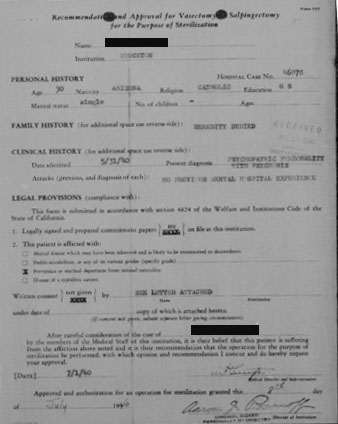
While conversations between patients, parents, and doctors might be lost to us in terms of playback, they have embodied traces in the nearly 20,000 people sterilized in California between 1919 and the 1950s under eugenic sterilization laws. The 19,995 sterilization recommendations and notes, brought together under the project Eugenic Rubicon: California’s Sterilization Stories, cannot currently be made publicly available due to U.S. patient privacy laws. Important documentary films like No Más Bebés, which tells the story of Mexican-American women sterilized without consent at Los Angeles County – USC Medical Center in the 1960s and 1970s, have made it possible for us to hear accounts of such reproductive injustice first hand. But for the thousands of people sterilized between 1909 and the repeal of eugenics laws in 1979, we must find other ways to listen and to hear.
Given the privacy restrictions on working with this dataset and our concerns to care for the people who are represented therein, we (the Vibrant Lives team) felt it was important to find alternative methods that did more than de-identified and quantified graphs could do. We know all too well that we can’t recover the past “as it was.” Nevertheless, we are working to bring the emotional and intellectual power of sound and critical listening to a largely unheard history of sterilization of Latinx people. Specifically, our project prompts listeners to consider how listening fits into reparative justice for the victims of sterilization.
Listening Toward under the Law
That eugenics laws and their surgical enactments played out in racialized and gendered ways is not surprising but bears repeating. For example, according to work by Alexandra Minna Stern, Nicole Novak, Natalie Lira, and Kate O’Connor, patients with Spanish or Hispanic surnames were three times as likely to be sterilized as their non-Hispanic counterparts. Those lost sounds have traces in California’s Latinx communities, both in terms of the community structures themselves, but also in terms of soundscapes that never were because of sterilization. This acoustic ecosystem in which the politics of race, gender, nation, and mental health converged in dramatic fashion is recorded only in the bodies and medical records of the patients and the 21st century communities shaped by the children, born and unborn, of these patients.
Not only are we limited to working with the textual, institutionally generated remnants of the past, we are also constrained by 21st century health and personal data privacy laws. Our archive is a set of medical records and as such this collection contains sensitive patient data that must be de-identified and used in accordance with contemporary HIPAA (Health Information Portability and Accountability Act) regulations and IRB protocols.
This means that we cannot reveal names, dates, and other identifying information regarding those who were sterilized in the first half of the 20th century. We are unable to tell individual stories of sterilization lest the individual be identified. Traditionally, historians have used fictional composites to tell such stories and our collaborator Alexandra Minna Stern used this method in her 2015 second edition of Eugenic Nation.
The HIPAA guidelines and their impact on how we tell the history of medicine raises important legal questions about how we might balance a public right to know about practices (we’d call them abuses) within state-run facilities with the need to protect patients’ rights to privacy regarding their own reproductive and mental health. In some cases, it seems as though the privacy guidelines protect the state more than they protect any individual patient. In fact, we have seen a remarkable lack of concern for these records in their discovery and transmission. The records themselves were largely abandoned when Stern discovered the microfilm reels in the 2000s. They were lost again after she returned them to the state after having made a copy. The originals are lost as far as we know.

Listening Toward the Past
Vibrant Lives is working not with sounds found, but with archival records found and then sonified (transformed into sound) as a way of listening toward those rooms, conversations, and procedures. In brief, this sonification entails the following steps
- Selecting a subset of the large data set (we can’t currently process the whole)
- Selecting between two and four axes of information, such as gender, race, age at sterilization recommendation, consent, or nationality
- Mapping the informational values into numerical space – sonification requires the creation of a dataset whose limits are 1 and -1 (based on how the speakers work)
This work has been done to date using two tools: Sonification Sandbox, an open source tool developed at the University of Georgia, and GarageBand, a proprietary music making tool that comes with Macintosh computers. We use Sonification Sandbox to create the score first and then turn to GarageBand because it has a greater range of instrumentation available. The sonification process is still very experimental and exploratory. Team member Jacqueline Wernimont does all of our sonifications for us and she is trained as a historian of literature and technology. While she has extensive experience within digital humanities methodologies, sonification is a new effort for us.
We have begun producing short sample tracks that allow us to enact the kind of listening toward that we’re advocating for. In the track below, we have data from the age, gender, and consent axes for the period 1940-1949. Additionally, this sample draws only from what we’ve described as “Spanish surname” patients, the vast majority of whom were American-born of Mexican descent, although they also include some other Latinx national communities.
Latinx Eugenics Sample Track
As you listen, each note represents one Spanish-surnamed person recommended for sterilization. The children, both boys and girls under 18, who were sterilized without consent are the highest notes, and the adult men who were sterilized with consent are the lowest.
Listening Toward as Ethical and Communal
Listening is always about an ethical relationship and it is particularly fraught when the effort to listen and to encourage others to listen entails hearing about a person’s most intimate health information and experiences. This is particularly true when those experiences may include trauma from unwanted surgery or other experiences.
While we might think of patient privacy as a form of care, in this instance we find ourselves wondering who these regulations actually serve. According to the updated 2013 HIPAA guidelines, personal health records are no longer considered sensitive information 50 years after death (it was previously 100 years). Preliminary estimates by our team indicate that as many as 1,000 survivors might be alive in 2016. However, while the vast majority of the people discussed in the records are no longer alive, family and friends may well be.
We respect the need for family members and friends to privacy when it comes to the health records of their loved ones. At the same time, an essential component of most restorative justice programs, like those undertaken for North Carolina eugenic sterilizations, is an articulation of the violations, which HIPAA blocks in many ways (North Carolina’s cases were revealed by investigative journalists who are not subject to HIPAA and the IRB regulations that we must adhere to as academics). As a consequence, those who might most benefit from reparations – sterilized individuals and their immediate families, including children – are likely to die before the privacy laws enable us to draw attention to the individual impacted by the racialized and gendered discrimination evident in the records.
The sonification of these records and the companion participatory performances that we facilitate allow us to intervene and share these important stories before all of the survivors and family members have passed away. We have the opportunity to drive justice-oriented processes forward while there is still time.
Consent/Non-consent Sample Track (entire population)
Vibrant Lives focuses not just on the stories but also on the people who listen to the audio. We spend time watching how our audiences participate in listening toward the history of eugenic sterilization in California. Below are images of recent presentations of this work in which we’ve incorporated both haptic (touch-based) and sonic performance.
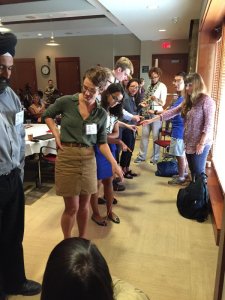
Part of what we see here is the attentive posture of our participants – leaning in to feel a history of sterilization. The haptics are being shared with a thin, red metal wire that the participants have to touch lightly in order to not dampen the signal for others. For us, this is an effort to bring care for the experiences of others into the performance. The history of eugenics has impacted communities and we are creating communal aural and tactile experiences as a way to disrupt the notion that academic work and knowledge is a solitary endeavor.
The performance captured above is also an exercise in patience and as such expresses a willingness on the part of the participants to sit with a disturbing history. The sample people are listening to and feeling here is 100 seconds long with each note/vibration corresponding to one person who was sterilized. In most performances the participants stay for the duration of the piece, but there have been instances where people have touched a haptic piece and then walked quickly away. We can’t know why some have chosen to walk away.

Some of those who have stayed have shared with us that they felt responsible to feel and hear each person. It’s an abstraction, to be sure, but we are intrigued by the power of listening and feeling to encourage people to not simply look and walk away. As one participant at a Michigan performance noted, the “tingling (from the haptics) lingers, it’s spooky.” Another participant at the same performance indicated that she felt “more implicated” having engaged with a multi-media experience than with a visual like a graph or chart. When asked why, she responded “I’ve felt it and will continue to remember that, but still will likely do nothing in response.”
In creating performances where participants have to care for one another and care enough about the people represented in the data to stay through a durational piece, we are working to redress the extraordinary lack of care that the records represent, both in terms of testifying to the violence done to men’s and women’s bodies and in terms of the State of California’s lack of regard for this history.
Sounds Felt, Sounds Touched

Our work is an ongoing experiment. We’ve moved from haptics along a wire, to haptic spheres that vibrate with the sonification. The image above is from one of these events this spring. We’ve retained the communal effect while transforming the embodied structure of the event. Participants now gather around, encircling the object as they listen toward a history of reproductive injustices. People still tend to lean in – to have heads lowered in a posture of intense focus. The sphere itself demands that someone cradle it and it also requires that people touch lightly once again so as to not dampen the experience for others.
We plan to expand our durational events in our next iteration known as “Safe Harbor” in which we hope to explore how to best care for those people sterilized by the state by caring for their data. In this instance we are thinking of sounds (and more) that we’ll make together with impacted communities. For this work we are particularly interested in engaging audience members in the hosting and care of the eugenics data and, by extension, the survivors.
As a way of enacting a site-specific response to both historical and contemporary human and reproductive rights violations that have occurred in the state, we plan to stage this durational event in California. We’ll begin by inviting audiences to help build and shape an empty warehouse space with us, transforming the empty space into a place of care where we can listen toward these histories. The audience will be invited to converse about the research and reflect upon conversations through making, creating, and ultimately building up our safe harbor.
We plan to listen to and co-create with impacted communities through collective making of the space. As a result, Safe Harbor will enact a cooperative improvisational process shaping socially responsive dialogue – performing, hearing, listening, documenting, and rebuilding notions of care in real time. What we hope to discover here are shared sounds of resistance, repair, and healing. Sounds that might let us listen toward the past, while also creating more just futures.
—
Featured image: “Water under 12.5 Hz vibration” by Jordi Torrents, CC BY-SA 4.0, via Wikimedia Commons
—
Vibrant Lives is a collaborative team that makes, stages, and performs as part of interactive multimedia installations. Jessica Rajko and Eileen Standley are both professors in the Dance area of the School of Film, Theater, and Dance at Arizona State University (ASU). Jacqueline Wernimont’s home department at ASU is English and she’s a digital humanities and digital archives specialist. Wernimont and Rajko are also multimedia artists/faculty working in Arts, Media, and Engineering.
The data derives from a larger project, known as Eugenic Rubicon: California’s Sterilization Stories, a multidisciplinary collaboration among Arizona State University, University of Illinois Urbana-Champaign, and University of Michigan. This larger collaboration includes historical demography and epidemiology, public health, history of medicine, digital storytelling, data visualization, and the construction of interactive digital platforms. This team is quite large, with our center of gravity residing at the University of Michigan where historian of science Alexandra Minna Stern directs the Eugenic Rubicon lab. Stern discovered the microfilms of more than 20,000 eugenic sterilization patient records in 2013. Stern and her team have created a dataset with this unique set of patient records that includes 212 discrete variables culled from over 30,000 individual documents. This resource is the first of its kind, encompassing almost one-third of the total sterilizations performed in 32 states in the U.S. in the 20th century.
—

REWIND!…If you liked this post, you may also dig:
Sound Off! // Comment Klatsch #4: Sound and The Digital Humanities, or #dhsound
EPISODE LI: Creating New Words from Old Sounds–Marcella Ernest, Candace Gala, Leslie Harper, and Daryn McKenny
Radio Preservation Task Force Conference: Sound History and the Logistics of Social Recognition-Josh Sheppard
—
Share this:

A Conversation With Themselves: On Clayton Cubitt’s Hysterical Literature

DOI: https://doi.org/10.59350/ce6hh-aw686
Welcome to our second installment of Hysterical Sound. Last week I discussed silence and hysteria in relation to Sam Taylor-Johnson’s silent film Hysteria, suggesting that the hysteric’s vocalizations go unheard because we have tuned them out. In upcoming weeks Veronica Fitzpatrick will explore how the soundtrack of The Texas Chainsaw Massacre can be considered hysterical in its rejection of language and meaning and John Corbett, Terri Kapsalis and Danny Thompson share an excerpt from their performance of The Hysterical Alphabet.
Today, Gordon Sullivan, considers the video art series Hysterical Literature in relation to a long history of women’s vocalizations serving as aural fetishes for the pleasure of male listeners. In doing so he troubles the dichotomies raised by the project, dichotomies between masculine visual pleasure and feminine aurality, between language and bliss.
— Guest Editor Karly-Lynne Scott
—
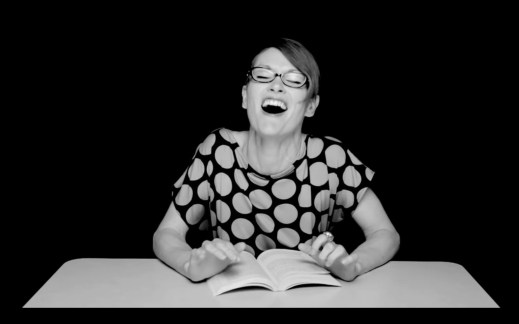
Each video in filmmaker and photographer Clayton Cubitt’s Hysterical Literature series (2012-) – which consists of 11 “sessions” so far – appears deceptively simple. We see a black and white frame with a clothed woman seated at a table, visible from the sternum up, holding a book of her choosing. She announces her name and the title of the book before beginning to read. While reading, the subject generally begins to stumble, the speeding of reading slowing down or speeding up, changes in pitch and emphasis growing more pronounced. Eventually, she is able to read no more and gives in to sighs, groans, or silent, eye-closing paroxysms. When she returns to herself, she announces again her name and the title of the book before the “session” ends.
Despite the consistency of the concept, the 11 “sessions” have been viewed a combined 45 million times, and perhaps much of the appeal of the series is in what it doesn’t show. What we do not see – and indeed do not hear – is the “assistant” beneath the table with an Hitachi Magic Wand physically stimulating the subject. What might have been errors or difficulties in the reading are retroactively understood as evidence of the difficulty of “performing” under the attention of the vibrator.
According to Cubitt, the series’ title and conceit nod at the Victorian-era propensity for naming “unruly” female behavior as “hysterical,” where the cure was often the application of a vibrating device to produce “release.” Female sexuality is therefore the absent center of Hysterical Literature – it is there, but can be disavowed (at least visually), a trend that places it firmly in a culture that has an ambiguous relationship to female pleasure and its sounds.
As John Corbett and Terri Kapsalis note in “Aural Pleasure: The Female Orgasm in Popular Sound,” the sounds of female pleasure are “more viable, less prohibited, and therefore more publically available form of representation than, for instance, the less ambiguous, more easily recognized money shot” that characterizes “hard core” pornography (104). Certainly Hysterical Literature’s home on YouTube would seem to confirm Corbett and Kapsalis’ claim that sounds of female pleasure “occur in places…that would otherwise ban visual pornography” (104).
Indeed, the question of pornography looms over Hysterical Literature, as Cubitt seeks to push on YouTube’s “Community Guidelines” by exhibiting female pleasure sonically (See also Joshua Hudelson for a discussion of sexual fetish and the ASMR community on Youtube). Here the sound of the subject’s voice echoes Linda Williams’s description in Hard Core: Power, Pleasure, and “The Frenzy of the Visible,” where the female voice “may stand as the most prominent signifier of female pleasure” that can stand in for the pleasure we are denied access to visually (123). In this way, the sound of female pleasure is, as Corbett and Kapsalis suggest, always evidentiary (104). For them, a woman’s pleasure may/must be corroborated by her sounds (For an alternative view of gender and sound as it relates to women, see Robin James’ “Gendered Voice and Social Harmony”).
This pleasure calls to mind Roland Barthes, who saw the possibility of bliss and representation as fundamentally incompatible. For Barthes, the “grain” of the voice is a bodily phenomenon, not one of language and signification. For him, “the cinema capture[s] the sound of speech close up…and make[s] us here in their materiality, their sensuality, the breath, the gutturals, the fleshiness of the lips, a whole presence of the human muzzle” (67). This “materiality” has a single purpose: bliss. This bliss doesn’t reside in language, with its representational aims, but in those aspects of the voice that are not ruled the signifier/signified dynamic.
What draws me to these discussions – and their relation to Hysterical Literature – is the almost overwhelming insistence on dichotomy. The visual “evidence” of hard core pornography is juxtaposed to the aural “evidence” of female pleasure. Male pleasure (on the side of the visible) is opposed to female pleasure (on the side of the invisible). Representation is incompatible with “bliss.”
This logic is not confined to discussions of sound, but is echoed in some of the writing on Hysterical Literature as well. In her profile (which included her own “session”), dancer and writer Toni Bentley argues that the series “juxtaposes the realm of words literally atop the realm of the erotic.” In her view, this immediately becomes a conflict: “Who would win the inevitable war? Upper body or lower? Logic or lust? Prefrontal cortex or hypothalamus?” Though her list of oppositions may seem idiosyncratic, she still insists on division before suggesting that what might emerge instead is that they “meld together.”
Bentley is not alone in understanding the videos this way, as other subjects find a clean break between “I am reading” and “I am orgasming” that would suggest a strict dichotomy between, as Barthes would put it, representation and bliss. For Bentley, this is a “literate, and literal, clitoral monologue that renders the Vagina Monologues merely aspirational.” I’m not sure that “monologue” captures the depth of what is happening in each Hysterical Literature session. Cubitt’s goal is to reveal something about his subjects, to use “distraction” as a means for revelation that ultimately removes him from the scene. Indeed, the participation of the vibrator-wielding “assistant” and Cubitt’s status as filmmaker argue that instead of a monologue, the series facilitates what Cubitt calls “a conversation with themselves.”
Though Cubitt and his subjects seek to maintain the division between the subject and her distraction, the series is far more interesting than that dichotomy would suggest. Hysterical Literature is interesting not because it juxtaposes “reading” and “orgasm,” but rather because of the rigor with which it is willing to dwell in between these two (apparently) opposed states. There is no cut, no switch in which a subject goes from reading to not-reading. Every video begins and ends the same way – we open on a woman telling us her name and her book, and end the same way, orgasm over with. In between, however, we have a combination of the book chosen by the subject and her augmented reading. Rather than the sighs and groans that supposedly evidence the subject’s pleasure, the more interesting elements are the sounds of the book transformed. The cadence that slows down, speeds up, gets lost, and must repeat. The drawn out vowels that teeter between a gracefully pronounced word and the abyss of unintelligibility. That the “struggle” will end in orgasms and the loss of speech is less significant than the attempt to maintain a voice in the face of what cannot be denied.
If we grant a gulf between “representation” and “bliss,” Hysterical Literature suggests that such a gulf is a productive place to be.
—
Gordon Sullivan is a PhD candidate at the University of Pittsburgh, currently writing a dissertation on questions of sensation and the political in exploitation films.
—
Featured image taken from “Hysterical Literature: Session Four: Stormy“.
—
REWIND! . . .If you liked this post, you may also dig:
Echo and the Chorus of Female Machines — AO Roberts
This Is How You Listen: Reading Critically Junot Díaz’s Audiobook — Liana M. Silva
Standing Up, For Jose — Mandie O’Connell
—
Share this:




Current Top Posts


April 2021
January 2020
November 2019

October 2019

August 2019

April 2014

November 2017
March 2015
December 2017

October 2015


Recent Comments