On a recent episode of Law and Order: SVUMariska Hargitay’s Olivia Benson takes her new paramour, David Haden (played by Harry Connick Jr.) to see Michel Hazanavicius’s The Artist. When Benson asks him what he thought of the film, he replies with notable disdain: “I think maybe there’s a reason they don’t make silent films anymore.” When Benson responds nervously to his subsequent display of affection, presumably fearing that someone from work might see them, Haden pronounces, “Don’t worry. Nobody we work with could sit through two hours of black-and-white, no talking.”
Haden’s response might seem surprising given the box-office and critical success of the film, with The Artist grossing more than $120 million worldwide and receiving five of the Academy’s most coveted Oscars, including Best Picture, Best Direction, and Best Actor in a Leading Role. In fact, with both The Artist and Martin Scorsese’s Hugowalking away with a preponderance of Academy Awards, many critics, including the editors of Cineaste, began to wonder if we were finally seeing a long-overdue challenge to “long-entrenched cultural prejudices against silent cinema.” There seems to be a renewed optimism that, with The Artist’s critical and commercial success, the popular stereotypes about silent film—heavy-handed acting, artless cinematography, mundane plots—may finally begin to break down.
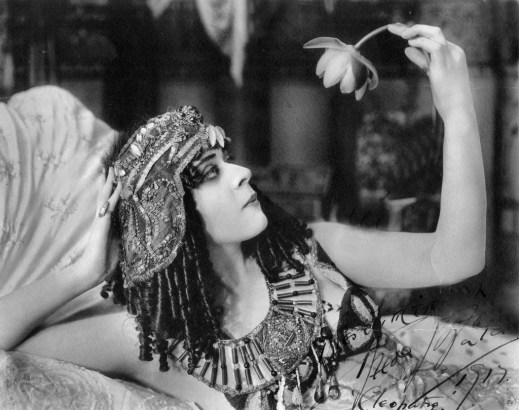
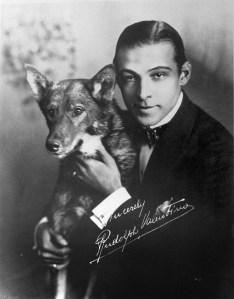
As a film studies professor who specializes in the pre-sound era and frequently asks even my freshman students to engage with at least one silent film, I am both buoyed and dubious about this supposed sea change in public attitudes toward silent cinema. While some of my students sound a lot like David Haden after I ask them to watch even the most accessible silent slapstick comedies, many of my upper-level students now count works like F. W. Murnau’s Sunrise among their favorite films. And I’ve discussed the merits of The Artist with many of those same students, who easily recognized the film’s many references to other silent-era works, and appreciated its ability to mimic a very particular brand of silent film. I honestly believe there is some truth to the claim that films like The Artist and Hugo have encouraged spectators to engage with other silent films, including the recently restored color version of Trip to the Moon that is showcased in Scorsese’s film. In fact, in recent weeks there has been considerable buzz about skyrocketing demand for silent films via streaming services and even Cinemark’s XD-equipped theaters will be screening the 1927 film Wings as part of its “Reel Classics” series in late May. Rumor has it that Broadway will soon be hawking a production about Charlie Chaplin’s life and 2012 will see the life of silent film star Rudolph Valentino represented in Silent Life.
Michel Hazanavicius explains in the production notes to The Artist that his desire to make a silent film had been brewing for years: “From the beginning of my career, I fantasized about making a silent film.” But he also viewed the dream as far-fetched, one that would be unlikely to draw support in contemporary film production circles: “I call it a fantasy because whenever I mentioned it, I’d only get an amused reaction—no one took this seriously.” Despite this resistance, Hazanavicius refused to let go of the idea and continued to imagine how he might capitalize on the unique artistic potential of the silent medium: “As a director, a silent film makes you face your responsibilities. . . .Everything is in the image, in the organization of the signals you’re sending to the audience. And it’s an emotional cinema, it’s sensorial; the fact that there is no text brings you back to a basic way of telling a story that only works on the feelings you have created. I thought it would be a magnificent challenge and that if I could manage it, it would be very rewarding.”
Despite the initial skepticism Hazanavicius faced, The Artist’s unexpected international success has revealed consumers’ (perhaps temporary) appetite for silent film. Parody trailers of upcoming Hollywood blockbusters like The Avengers have aped silent film form and The Artistifier allows users to transform any Youtube video into a silent film.
.
Even hipster clothiers, Shabby Apple, have taped into silent film’s newfound cultural cache by launching a “Silent Era” collection of swimsuits with names like the “Bara swim mini” and the “Karloff swim top.” Despite this recent upsurge in references to and imitations of the silent film medium, advertisers, filmmakers, artists, and musicians have expressed a nostalgic reverence for silent film for decades. Between 2007 and 2010, Janelle Monáe released her Metropolisand ArchAndroid Suites, which refashioned Fritz Lang’s iconic 1927 film, Metropolis.
.Mimicking both the film’s visual style and political message, Monáe also refashioned herself as Metropolis’s iconic android and adopted her trademark tuxedo attire after seeing photos of Marlene Dietrich, the silent and sound film star who helped mainstreamed this androgynous look in the 1920s (and also as a tribute to the working class uniforms of her parents). From AFLAC’s 2006 satirizing of the medium’s stereotyped damsel in distress, to IBM’s 1986 series of ads featuring Charlie Chaplin, marketers have frequently banked on silent films’ ability to attract the public eye.
.
What do we make of this renewed interest in silence? We must first remember that, as I tell my students, silent films were never designed for silent viewing at all given that most were screened with musical accompaniment that ranged from a single organist to a 40-piece orchestra. Even the composition of The Artist reveals the lie behind silent film “silence,” with composer Ludivic Bource employing 80 musicians from the Flanders Philharmonic Orchestra in developing the score for the film. Despite the fact that live orchestral accompaniments of silent film have become staples of film festivals around the world, most of today’s viewers’ experiences with silent film are limited to watching DVD transfers of varying quality, with canned music that is sometimes recycled from one DVD release to another, regardless of film title or subject matter. Few viewers, including those who have attended screenings of The Artist, have truly experienced the “silent” medium as it was intended, with sound and image working in tandem via a combination of “live” music and projected celluloid. Two years ago, I saw the transformative effect of recreating a more authentic silent film viewing experience when I arranged a screening of Sunriseat the University of Northern Colorado with the Mont Alto Chamber Orchestra providing live musical accompaniment. Many of my students still speak of that experience with tremendous reverence, explaining that they finally understood what it meant to truly experience a “silent film.”
While popular audiences tend to neglect how integral sound was to silent film, Rick Altman has argued in Silent Film Sound that sound has thus far failed to establish its own “autonomous measure of worth,” with scholars arguing that because film’s historical roots are bound up in silence “cinema is thus essentially a visual art” (6). Yet, this bias seems to be belied by the reaction to The Artist, with even the Oscars ceremony choosing to use the film’s only synchronized sound scene when introducing it as a the Best Picture nomination. It seems that even an acclaimed twenty-first century silent film must flaunt its, albeit brief, reliance on synchronized sound. Certainly, the many viewers who demanded refunds from their local cineplexes reflect the prevailing opinion that film must include sound if it hopes to maintain their interest and earn their cinema-going dollars.
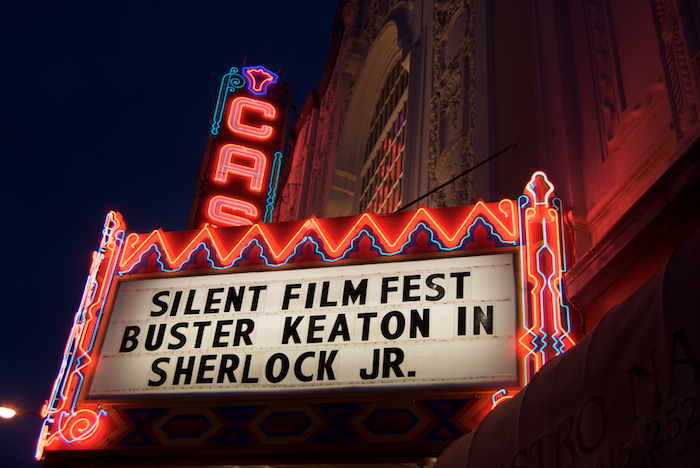
Silent Film Festival Winter event at the Castro by Flickr User Steve Rhodes
So, what is the appeal then of these “silent” films in which, though accompanied by music and sound effects, dialogue is not spoken but read via soundless lips or intertitles? For me, the attraction comes from both understanding the aesthetic and technological roots of an art form that I admire and the fact that they require the development of character and narrative in purely visual terms. I am also attracted to its higher degree of abstraction, its ability to create a kind of poetry while also defying the very essence of language itself. And I see in the absence of sound a refreshing denunciation of contemporary demands for ever-increasing realism. Silent film is the antithesis of today’s fetishizing of 3-D.
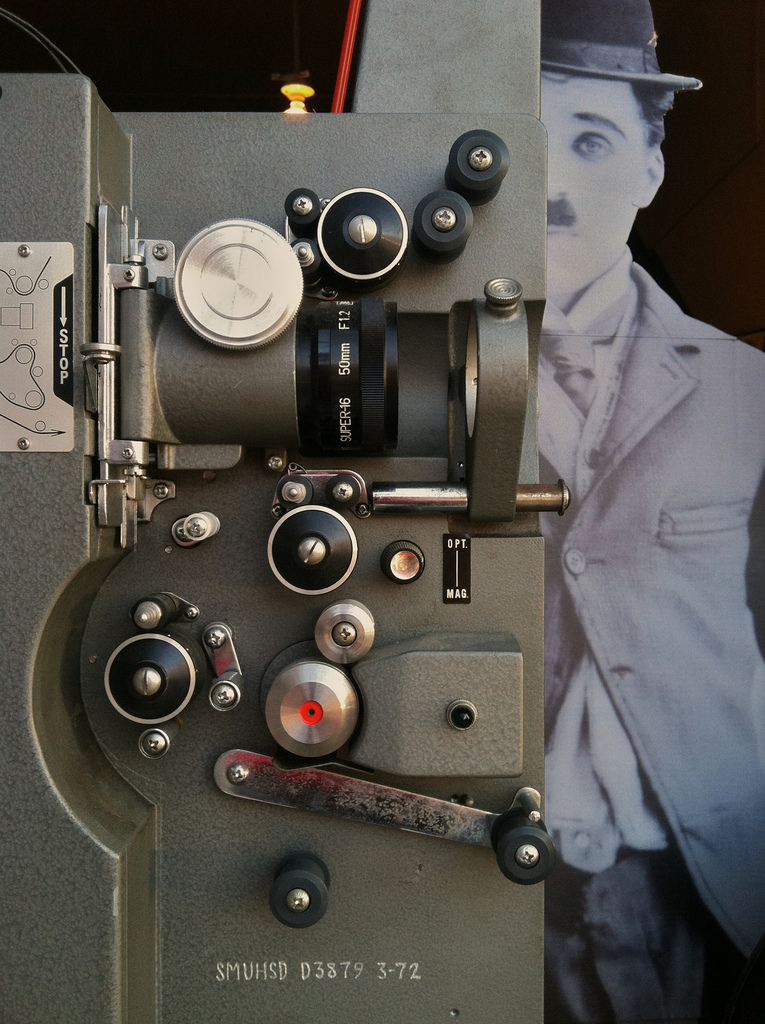
Projector, Chaplin by Flickr User Stephen Coates
While I acknowledge this statement may seem naïve given that Scorsese’s aforementioned film manages to combine that “new” technology with a tremendous reverence for silent film’s seemingly “primitive” techniques, I firmly believe that the aesthetics of “silence” have an important resonance for contemporary viewers raised on Dolby. After hearing my frequent complaints about the current impetus toward 3-D, one of my students has taken to calling me Charlie Chaplin, seeing in my resistance a mirroring of the great comedian and director’s opposition to sound technology. Like Chaplin’s Tramp in Modern Timeswho cannot keep up with the machine-age and its insistence on productivity, I often find myself longing for something simpler from film, something more retrained and abstracted, less motivated by the demand for “progress” and, at least on the surface, The Artist’s return to silence seems to fulfill that admittedly nostalgic desire. While it is an imperfect, and perhaps misleading, example of the silent medium, even the modernized form of silent cinema that we see in The Artist demands that viewers consider the relationship between history and memory, between film’s relatively youthful heritage and its contingent representations of the past, between sound and silence.
—
April Miller is an Assistant Professor and Director of Film Studies at the University of Northern Colorado. Her research focuses primarily on the intersections between literature, film and socio-scientific concerns such as criminality and mental illness. She is currently completing a book manuscript, Offending Women: Modernism, Crime, and Creative Production, which investigates the female criminal and her often-overlapping sites of representation in literature, journalism, and silent film.
This year, my first book—Dance and the Hollywood Latina: Race, Sex, and Stardom (Rutgers UP: 2011)—was born. The writing process required nearly a decade of thought and development, a gestation period that reminded me how to listen as well as see.
As a sound recordist in film school, I became acutely aware of the hierarchization of the visual over the aural: it was a challenge to claim space for sound when the director wanted to yell “Action” as soon as camera was ready. Me (covered in grime, Nagra deck over one shoulder and boom pole in hand): “What’s the frame line? Is my mic—or the shadow of my boom pole—in the shot? And, maybe I can get a level-check before we shoot—so the audio levels are as pretty as your exposure? Maybe?”
Yet, most of those instincts and that tenacity dissipated during graduate school. As I honed the language of film and television analysis, I, too, began to privilege the visual over the aural. Over time—and with the help of colleagues like Jennifer Stoever-Ackerman—Dance and the Hollywood Latina reminded me how to listen.
And so, I present a moment from the book that reinforced the scholarly importance of watching with my ears. In the following excerpt, I analyze Rita Moreno’s aural Otherness in West Side Story. The scene, like many others of Moreno’s career, illustrates the tension between the “look” and the “sound” of the Hollywood Latina. While my book is primarily organized around the ways that racialized sexuality is encoded in the dance of the Latina body in Hollywood film, the chapter “Rita Moreno, the Critically Acclaimed ‘All-Round Ethnic'” helps clarify how the Hollywood Latina has been read as both “easy on the eyes, but hard on the ears,” a phrase used to describe Moreno during her appearance on The Muppet Show in 1976.
The excerpt explores a pivotal scene in the film, where Anita (Moreno) confronts Maria (Natalie Wood), whom she discovers has just slept with Tony—the murderer of Bernardo (George Chakiris), Anita’s boyfriend and Maria’s brother:
[T]he nondance musical number “A Boy Like That” illuminates how the Hollywood Latina has also been aurally imagined and reproduced. [The song] expresses Anita’s anger and sense of betrayal, and eventually builds into a powerful duet (“I Have a Love”) between the women. As a backdrop, the setting and bodies of the scene are visually coded as Latino/a: the apartment matches the purples, blues, and reds associated with the Sharks in the film, while the two Latinas in the frame—one real and one diegetic—are colored Puerto Rican through the use of brown makeup. These stylized signifiers set the tone for Moreno’s aural representation in the scene. As the only Puerto Rican in the film cast, Rita Moreno gave a performance that became a touchstone of aural authenticity for non-Puerto Rican actors such as George Chakiris (Bernardo). In one interview, Chakiris notes that he and the Shark actors used Moreno as their sonic “guide” (Gross 2001). [Interestingly, the West Side Story shooting script available in the Bob Wise Collection at the University of Southern California Cinematic Arts Library includes written dialect for the Jets but not the Sharks, suggesting that the sonic expectations of the Latino/a characters were self-evident].
Both Natalie Wood and Rita Moreno lip-synch to prerecorded tracks, but unlike Wood, Moreno performs her other songs herself; “A Boy Like That” is Moreno’s only song that does not feature her real singing voice. While the dubbed vocal performance compensates for Moreno’s higher vocal range, it undercuts the ferocity of her physical performance. As Moreno’s facial expressions and posturing exhibit an angry and forceful delivery, singer Betty Wand’s vocal interpretation of the lyrics overly amplifies the supposed sound of a Latina body in lieu of the emotional urgency of the song. Moreno’s assertive body language is thus mismatched with the generic quality of Wand’s artificial accent, a kind of aural brown-face that flattens the scene’s intensity.
In a 2001 interview, Moreno expressed her disapproval of the vocals in “A Boy Like That,” claiming that Wand’s lack of acting skills resulted in a restricted interpretation that did not match the physical intensity of the scene. She explains: “[Wand] just couldn’t get it the way I wanted it…to sound. It should have almost been a growl…you know, barely sung. And she ended up sounding…almost like a cliché Mexican” (Gross 2001). Despite Moreno’s coaching, Wand could only articulate the song’s Latina-ness, a sonic interpretation that solely relied on a stereotypical accent to tell its story. This racialized vocal performance is incompatible with the emotional depth Moreno produces onscreen because it was only—always, and already—aurally Other. [This shift is most noticeable at the moment in “A Boy Like That” when Rita Moreno’s dialogue as Anita suddenly shifts to the lyrics of the song].
Rita Moreno’s career enabled me to hear the Hollywood Latina, an experience that enhanced my analysis of Dolores Del Rio, Carmen Miranda, Rita Hayworth (Rita Cansino), and Jennifer Lopez—the other women I study in Dance and the Hollywood Latina. I am thankful for Moreno’s (creative/political/critical) voice and hope that she continues to help me listen anew.
And thank you, dear listeners, for your time and attention. I hope to hear from you soon.










Recent Comments