
Reproducing Traces of War: Listening to Gas Shell Bombardment, 1918

DOI: https://doi.org/10.59350/bjmd1-g2d64
Welcome to World Listening Month 2014, our annual forum on listening in observation of World Listening Day on July 18th, 2014. World Listening Day is a time to think about the impacts we have on our auditory environments and, in turn, its affects on us [for the full deets, peep our recent SO! Amplifies post by Eric Leonardson, Executive Director of the World Listening Project]. We kick off our month of thinking critically about listening with a post by media historian Brian Hanrahan, who listens deeply to sonic traces of the past to prompt us to question our desires for contemporary media representations of “reality.” It also marks the global 100 year anniversary of World War I this August 2014: a moment of silence. —J. Stoever, Editor-in-Chief
—
For some reason that I don’t fully understand, I am very emotionally moved by the space around a sound. I almost think that sometimes I am recording space with a sound in it, rather than sound in a space. –Walter Murch
If you want to listen to the past, there’s never been a time like the present. Every year, it seems, new old recordings are identified, new techniques developed to recover sounds thought irrecoverable. Here is Bismarck’s voice, preserved on a cylinder in 1889. Here, older still, is Edison’s. There is the astonishing recuperation of phonautograms – reverberation traced onto soot-blackened paper in the mid-nineteenth century, digitally processed and played back in our own. But as that processing underlines, no sound recording straightforwardly reproduces the real. An acoustic artifact is a compound of materiality, form and meaning, but also a place where technology meets desire. Old recordings meet the listener’s longing halfway; they invoke a reality always out of reach. And not simply a longing to hear, but also to touch, and be moved by, the fact of an absent existence.
Take, for instance, HMV 09308. In October 1918, just before the end of the Great War, William Gaisberg, a sound recordist of the pre-electric era, took recording equipment to the Western Front in order to capture the sound of British artillery shelling German lines with poison gas. Gaisberg died not long after, probably from Spanish flu, although some say he was weakened by gas exposure during the recording. Nonetheless the “Gas Shell Bombardment” record – a 12-inch HMV shellac disc, just over 2 minutes at 78 rpm – was released a few weeks later, just as the war came to an end. Initially intended to promote War Bonds, ultimately the record was used to raise money for disabled veterans.
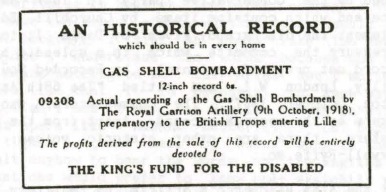
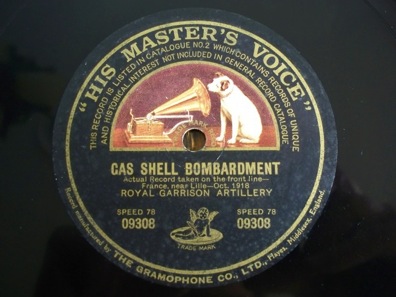
For decades, the HMV recording had a reputation as one of the very earliest “actuality” recordings – one documenting a real location and event beyond the performative space of the studio, imprinted with the audible material trace of an actual moment in space and time. Documents like this – no matter what the technology – usually come with additional symbolic authentication. Here, the record’s label does some of that work. This “historic recording,” says the subtitle, is an “actual record taken on the front line.” Publicity pieces drove home the message. In the popular HMV magazine The Voice, Gaisberg – or probably his posthumous ghost-writer – described the expedition in detail, claiming the track to be a “true representation of the bombardment.”
.
In the same issue, a Major C.J.C. Street compared the recording to his own experience on the Front. “Its realism,” he wrote, ”took my breath away… I played the record many times… finding at each attempt some well-remembered detail.” He didn’t say so in his article, but Street – an artillery officer, a novelist and a propaganda man for the intelligence agency MI7 – was in fact the impresario of the record. This was not the first time he had found astute uses for sound media. The previous year he had put together a record that set artillery drill commands to popular tunes – the recording was both a propaganda release and an army training tool for new recruits. With the Gas Shell record, Street knew he wasn’t just selling recorded sound, but also an auratic sense of closeness to an overwhelming reality, the palpable proximity of war and death. Authenticating detail helped to underpin this sense of an absent real made present. Street cued the listener for those “well-remembered details.” In particular, he singled out one indistinct rattly flap-whizz noise, hearing in it, he claimed, the sound of a round with a “loose driving-band.”
The record stayed in the HMV catalog until 1945, but only in the early 1990s were its production history and authenticity claims seriously examined. In specialist journals, archivists, collectors and amateur historians undertook a collective forensic and critical analysis. A promising auditory witness was located: 95-year-old Lt.-Col. Montagu Cleeve another former artillery officer, in his time a developer of “Boche Buster” railway gun, later a music professor – was invited to critically assess the recording. Cleeve vouched unreservedly for its authenticity. He heard in it, he said, an unmistakable succession of sounds – the clang of the breech, the gigantic report of the firing explosion, the distinctive whiny whistle of a gas shell on its way across no-man’s-land. Others looked to data rather than the memories of old soldiers. One expert on pre-electric recording noted the angles commanded in firing instructions, correlated them with known muzzle velocities for 4.5 and 6-inch howitzers, then used this and other information to “definitively” explain the counter-intuitive anti-Doppler sound of the shells’ whistling. He also identified the audible echo effect – the curious “double report” of the guns heard here – as the sound of a brass recording horn violently resonating at a distance of exactly 26.5 meters from the guns.
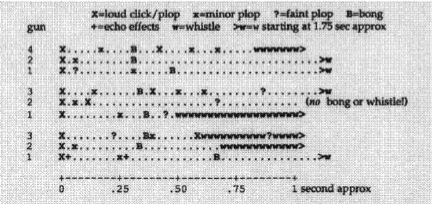
Eventually, skepticism won out. Close listening at slow speeds – just careful attention and notation, nothing more elaborate – revealed inconsistencies and oddities in the firing noises. The bongs, plops and whistles seemed internally inconsistent. Some of the artillery sounds – ostensibly a battery of four, firing in quick succession – varied implausibly with each successive firing. Physical evidence from the record’s groove, as well as extraneous noises – surface crackle and fizz, and, audible within the recording, the swish of a turntable – seemed to indicate at least two rudimentary overdubs, in which the output of one acoustic horn was relayed into a second, possibly using an auxetophone, an early compressed-air amplifier. All this resulted in a double- or triple-layered sonic artifact. Finally – the crucial evidence, although oddly it was hardly noticed at the time – an alternative take was located. In this take, according to its discoverer, the entire theatrics of gunnery command is simply absent, and there is no sound at all of whistling shells in motion. What was left was a skeleton sequence of clicks, thuds and cracks, supplemented with only a single closing insert, the portentous injunction “Feed the Guns with War Bonds!”
In short, it seems highly likely that any original field recording was, at the very least, post-dramatized with performed voices and percussive and whistling sound effects. So, it is tempting to say, that clears that up. The recording’s inauthenticity is proven. File under Fake. But in fact, if we don’t stop there, if we set aside narrow and absolutist ideas of authenticity, and instead explore the recording’s ambiguity and hybridity, then Gas Shell Bombardment becomes all the more interesting as an historical artifact.
Let’s assume, for the sake of argument, that some form of basic recording was done in France, very possibly a staged barrage specifically performed for Gaisberg’s visit, and that this recording then had effects added back at HMV in London. The record might then be seen less as a straightforward documentary, and instead as an unusual version of the “descriptive speciality,” a genre of miniature phonographic vignette dating back to the 1890s, far predating longer-form radio drama. Very little is known about these early media artworks, but it is a fair generalization to say that in America the genre was more slanted towards vaudeville comedy, whereas in Europe, imperial and military scenes predominated. As early as 1890, for example, there had been German phonographic representations of battles from the Franco-Prussian war. The Great War saw a flourishing of the genre. Scholars are just beginning to take an interest these old phonographs; here’s one recent essay on the “Angel of Mons,” for example, a British acoustic vignette of a famous incident on the Western Front.
Listen to a 1915 German descriptive speciality, depicting the attack on the fortress of Liège the previous year:
.
As a descriptive speciality, Gas Shell Bombardment is unusual because it incorporates an actual indexical trace. But such traces – as emphasized by Charles Sanders Pierce and many later media-theoreticians– do not resemble their referent, they are caused by it. The bullet hole does not look much like a bullet; thunder is lightning’s trace, not its likeness. But for Street and Gaisberg, the trace’s lack of resemblance caused problems: the original recording’s lack of detail, cues and clues, but above all its lack of internal dimensionality, created a perceptual shortfall and a lack of credibility. Maybe they hoped that the guns, by sheer force of amplitude, would overcome the spatially impoverished, reverbless reproduction of pre-electric recording. If so, it didn’t work. Without added effects, the guns’ trace was as flat and “body-less” as a sequence of Morse. It was a sound without a scene. The producers’ interventions aimed to thicken the primary artifact with referential-sounding detail, but also to heighten the sense of materiality and spatiality, and to strengthen the sense of diegetic presence, of worlded thereness. The soldiers’ voices – louder and quieter, close-up and farther-out – and the fake-Doppler of the “shell whistling” lent the recording narrative direction (literally, some trajectory) and “authenticating” points of detail. But above all they gave a sense of internal space to the recording, a space into which the listener could direct her attention.
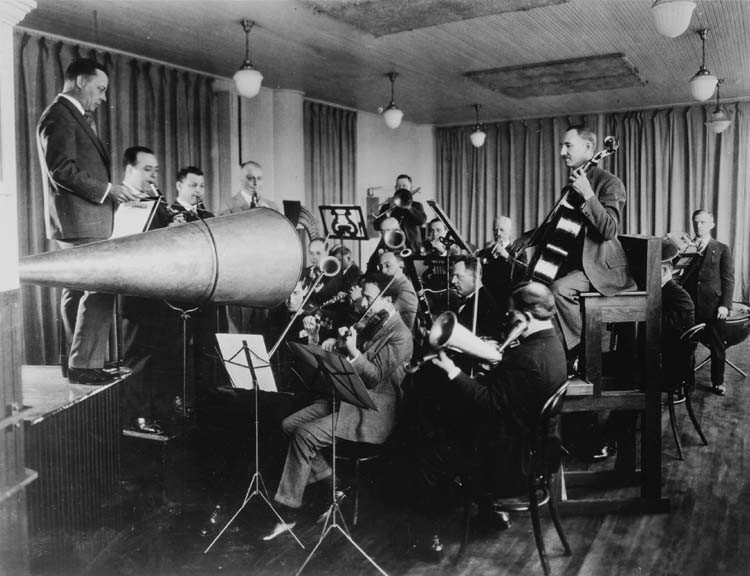
In this context, we can only admire the creativity and performative élan of the unknown production crew. We know little about effects production in early phonography. It is a safe bet that some techniques were adopted from theatre, and that there was overlap with silent film accompaniment. But whatever the method used, it would have called for the awkward orchestration of a limited number of iconic sounds to create an impression of a spatially coherent and materially detailed sonic environment. The recordist and his team would first have had to imagine how relative loudness – of voices, of material objects struck and sounded – might create a sense of spatial depth when transduced through the horn’s crude interface. Then they would have had to perform this as a live overdub, keeping time with the base track of the gun recording played through another horn. And all this done with participants and equipment crowded tightly around the mouth of the huge horn, crammed into the tiny pick-up arc, a scene looking something like this image of Leopold Stokowski’s pre-electric recording sessions or this photograph of the recording of a cello concerto.
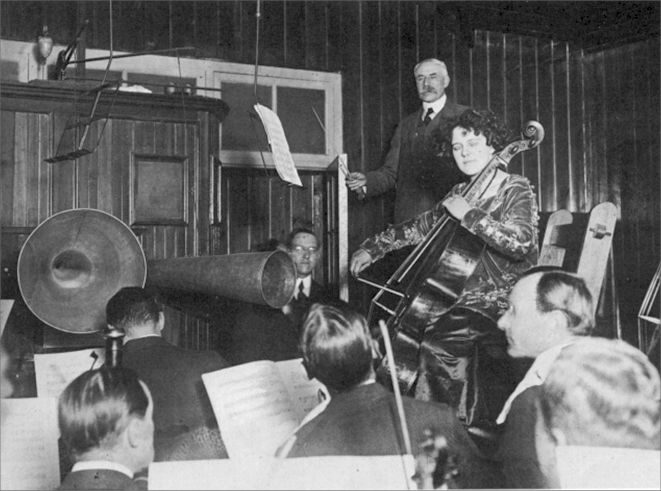
As well as this hybrid of trace and live performance, there is another performance here – Gaisberg’s journey itself. With twenty years of recording experience, Gaisberg was probably very well aware that the expedition would not yield a “realistic” recording of the guns. But the expedition had to be made, so that it could be said to have taken place. Expectations had to be primed and colored, so that, to use André Bazin’s famous phrase about photographs, the recording could partake in an “irrational power to… bear the belief” of the listener. The journey, and the accounts of Gaisberg and Street are not a supplement to the “true representation” of the gas bombardment. They are part of that representation. Moreover, in subsequent writing it is noticeable that the manner of Gaisberg’s death becomes a rhetorical amplification for the authenticity of the recording’s trace, as if his fatal inhalation (of gas molecules or flu bacilli) were itself a deadly indexation, paralleling the recording’s claim to capture the breath of the War, and even of History itself.
In media-historical terms, the Gas Shell Bombardment recording can be understood as a late, transitional artifact from phonography’s pre-microphonic era. The desire for the sonic trace, for an ever more immersive proximity to events was there, but electro-acoustic technology was not yet in place. Two years later, in 1920, Horace Merriman and Lionel Guest made the first experimental electrical recording, arguably also the first true field recording. The event, appropriately enough, was an official war memorial service in London, where Merriman and Guest – working for Columbia Records – put microphones in Westminster Abbey, running cables to a remote recording van parked in the street outside, where they sat amidst heating ovens and cutting lathes. By the end of the 1920s, remote recording and broadcasting, while never straightforward, were well on the way to ubiquity.
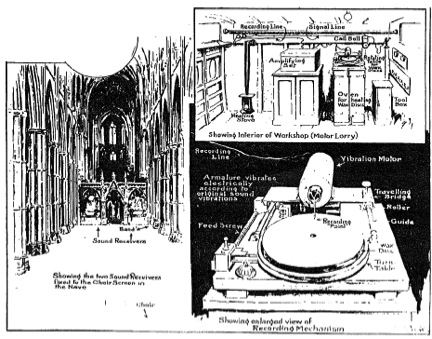
Claims made on behalf of technologies of reproduction may seem simplistic, but there’s a grain of truth to their simplicity. If there were nothing special – even magical – in the referentiality of the camera that captures the moment, the recording that’s like being there, the liveness of the live broadcast, these things would not play the role they do in everyday life and in the ideological fabric of society. But there is falsehood too, in over-simplifying the nature and affective charge of old photographs, old footage, old recordings. These are made things, composed of different materials, media, signs and conventions; they are inseparable from the desires and expectations they induce and direct. They function in part by mimesis and verisimilitude, but also through the gaps, blank spots and false illusions of their trace. They can – rightly – intensify our feeling towards the past, but should also prompt us to think about our own desires and investments.
—
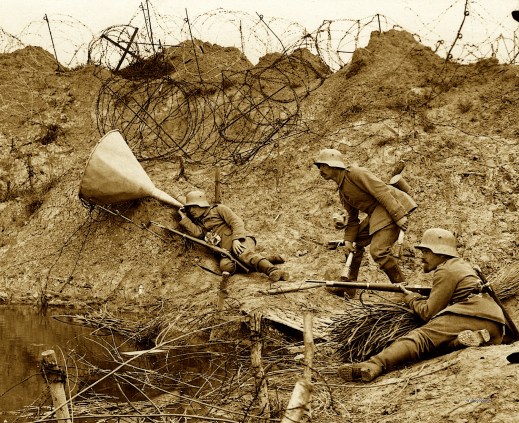
Image by Flickr User DrakeGoodman, “Horchposten im Spengtrichter vor Neuve-Chapelle 6km nördlich von La Bassée Nordfrankreich 1916,” A trio of lightly equipped soldiers from an unidentified formation oblige the photographer by looking serious and pretending they’re just metres from the enemy, listening for activity in his lines. The improvised “listening device” is actually a large funnel, probably liberated from a nearby farm.
—
Brían Hanrahan is a film, media and cultural historian, whose work focuses on the history of acoustic media, German and European cinema and the culture of the Weimar Republic.
—
Edited post-publication at 8:00 pm EST on July 7, 2014
–
REWIND!…If you liked this post, you may also dig:
SO! Reads: Susan Schmidt Horning’s Chasing Sound: Technology, Culture and the Art of Studio Recording from Edison to the LP–Enongo Lumumba-Kasongo
A Brief History of Auto-Tune–Owen Marshall
DIY Histories: Podcasting the Past–Andrew Salvati
—
Share this:

Something’s Got a Hold on Me: ‘Lingering Whispers’ of the Atlantic Slave Trade in Ghana
DOI: https://doi.org/10.59350/gv459-wx462
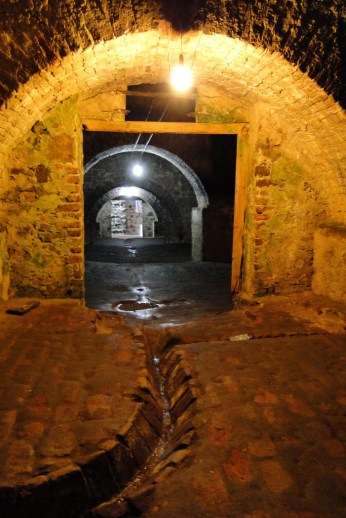
I am standing in the mouth of the female dungeon. I hesitate to breathe for fear the hole will swallow me. It is competing with a rising tide of anguish that also threatens to eat me alive. The hole is dark, dank and noisome yet oddly comforting. After all, this is why I, and others, come to this site of torture—to fill in the gaps of our history, to make better sense of our lives, to find some comfort. But how does one find home in throbbing loss? Why must one dig for answers—that, ultimately, produce new questions—within the locus of pain? I run my fingers across the length of the thick, cavernous rock. It is brown like my skin…I can’t tell where it ends or begins.
In a 2010 interview with FADER Magazine, poet Gil Scott-Heron declared, “The spirit should be material. It’s your blood. Inside your bloodstream is your parents and their parents and their parents and their parents and they want you to make it, because when you do what you do and you’re successful, then they’re happy you made it. You’re the link with immortality” (88). What Scott-Heron articulates here is an ontological claim to spirit as inherently material and always already an eternal force over life’s struggles. The answers to the puzzle are embedded underneath the skin in an internal dialogue between spirit, mind, blood, bone and mass. This same ideological force is what pulls so many African American tourists back to Elmina and Cape Coast Castles in Ghana, in search of what Anne Bailey calls “lingering whispers” in African Voices of the Atlantic Slave Trade (3). We spin back the wheel of time to re-trace its deep grooves and recover the loss/lost in dungeons, burial sites, Donkor Nsuo (The Slave River), and the Atlantic Ocean.
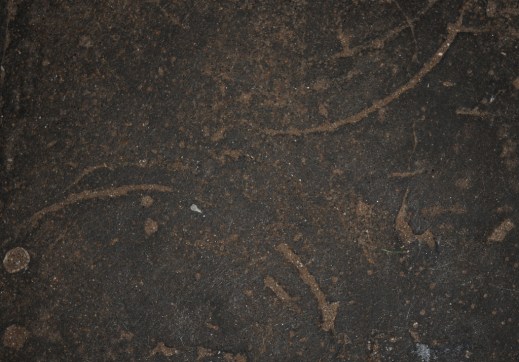
Perhaps one’s DNA is a recording that is not only biological and racial but cultural and cosmological. Carolyn Cooper, in Noises In the Blood: Orality, Gender, and the “Vulgar” Body of Jamaican Popular Culture discusses “noises in the blood and reverberating echoes in the bone” as genealogical discourses of race. Can one’s DNA be an embedded and embodied soundtrack that charts particular and interconnecting nodes of history? Are those memories, experiences, dreams and longings then “recorded on my body,” as Nancy Frey suggests in “Stories of the Return: Pilgrimage and Its Aftermaths” (101) ? If we broke down the strands into coherent codes, or notes, or rearranged them into other combinations, what would they sound like? Would it produce a series of mixtapes, like hip hop records that sample older Black music—blues, R&B, funk, soul and jazz—and re-articulate them with new and emerging sounds? Perhaps it’s like Nathaniel Mackey muses in Bedouin Hornbook, “The last thing I remember is coming to the realization that what I was playing already existed on a record” (5). The slave forts become the ontological point of racial and cultural identity because, according to Saidiya Hartman’s Lose Your Mother: A Journey Along the Atlantic Slave Route, “the dungeon was a womb in which the slave was born” and where, by the performance of walking through the “Door of Return” one’s social life can be recovered, revitalized or remade (111).
I strain to hear any forms of life. As Slavoj Žižek suggests in “‘I Hear You With My Eyes’; or, The Invisible Master,” “ultimately we hear things because we cannot see everything” (90 and 92). According to tour guides at Elmina and Cape Coast Castles, the brick slave pens reverberate with the loss/lost of life, particularly at night, where bodiless moans, sobbing, screams and litanies can be heard rocking through the forts. But I can only detect distant sounds of activity beyond the back of the castle doors and “The Door of No Return.” The predominant noise is the Atlantic Ocean, crashing against the seashore. I hear the fishermen speak in rapid, hushed tones as their bodies struggle against the tiny canoes, their oars pulse against the waves as nets are thrown in with great precision. At the entrance of the castle, teenaged boys patronize African American tourists with “Sister! Brother!,” “Akwaaba”(Welcome), or “Welcome Home” as they pass folded letters with requests for contact information, money, or school donations, colorfully braided bracelets or other trinkets for sale. Market women pierce the air with unique calls for customers to try their products of bagged ice water, oranges, sugarcane, pineapple, and groundnuts. Cab drivers compete for tourists’ attention with loud, intermittent honks, verbal petitions or hisses.


The shops in the courtyard just beyond the reception area are now filled with traditional instruments—drums, guitars, piano boxes, and rattles—beads, cloth, masks, paintings, rugs and postcards. It is no longer a market in Black flesh but of “African” objects, or cultural artifacts that amplify the racial identity of diasporic visitors, and make them more “real” once they return home. Shop owners busy themselves making crafts, passing the day chatting with one another and potential customers.
This cell in which I stand is one of many at the Twin Castles, the gargantuan fortresses that after five hundred years continue to hold fast to the southern coast of Ghana. The intersecting trails of fine cracks rupture the once-pristine white paint on the walls. . .possibly one for every person stolen out of the dungeons. The hull is transfixing, the hold captivating. For some reason, I am suddenly reminded of Rev. James Cleveland’s gospel song, “Something’s Got A Hold On Me” where he proclaims, “Something hit me/Up over my head/And run right to my feet.”
.
Cleveland is talking about the power of the Holy Ghost to re-fashion his troubled life through spiritual re-birth. He sings of transformation from a life of misery to a brand new liberation that is manifested like a shock through his entire being and body. This new shock counters the crisis he regularly experiences “in the world.” This new bodily sensation permeates his entire being and acts as a shield against daily strife. Similarly, Etta James’ secular version, “Something’s Got A Hold On Me” attests, “My heart feels heavy/my feet feel light/I shake all over/ but I feel alright.”
.
James’ something is more possessive of her person; it is the overwhelming yoke of romantic love that seeps into her pores and won’t let up. This occupation of James’ senses is so startlingly pleasurable that she longs for and needs it. Similarly, The Miracles’, “You’ve Really Got A Hold On Me” pronounces, “Don’t want to leave you/don’t want to stay here/don’t want to spend another day here/oh, oh, oh, I wanna sit now/I just can quit now.”
.
Robinson expresses the ambivalence of love and longing—frustration, disappointment, ecstasy and desire—that crowds the senses with the sheer torture of being powerless over this structure of feeling. The protagonist is unable to shake hold of the beloved object, which makes him question his own capacity.
The “hold” becomes embodied and acts out in ways the mind cannot comprehend or prevent. It is the same hold the castles have on many African American visitors—an enigmatic narrative of love, loss and longing that the progeny of slaves refuse to relinquish and attempt to retell by inserting their bodies into slave histories. African Americans tour the castles as a way of tracing what Ralph Ellison calls “the grooves of history” in Invisible Man (443). Like a phonograph record, grooves are meant to be linear and progressive, but diasporic African history is awkward, uneven and full of odd ruptures, gaps and distortions. As James Clifford insists in “Diasporas,” “Diaspora discourse articulates, or bends together, both roots and routes” (251). These grooves consist of a series of complex and overlapping relationships that are multi-directional and non-linear. Like an album record, the records of history indicate particular events of static (crisis), interludes (junctures), and rhythms (discourse).

“The music is mysteriously ‘in’ these physical recesses, pressed into the vinyl,” Steven Feld argues in Music Grooves: Essays and Dialogues, “and listeners may imagine journeying there to merge right ‘into the groove’” (111). Grooves are doubly intentioned as: 1) the tracing of deep historical roots through specific routes of migration and 2) a physical and/or psychic space where utopic possibilities are imagined, alternative choices can be sought out, and past and future events are persistently contextualized within the present moment. To be “in a groove” is to be in tune with multiple realities simultaneously, to compress or stretch out time and space and one’s capacity in extraordinary ways.
Strangely, this cell is absent of all sound, even the static, white noise of silence. But it refuses to sound for me and tell me its history. I hear nothingness in the emptied hole. All that remains is a heavy vastness of what once was. As Mackey so profoundly articulates, “I wept for the notion of kin, as though the very idea were an occasion for tears, a pitiful claim to connection, a bleeding socket whose eye’d been plucked out” (21).
Over time, the cold stone has absorbed the blood, sweat, feces and bones of its inhabitants. It is the only material trace that proves the enslaved were once there.
—
Sionne R. Neely received her Ph.D. in August 2010 in American Studies & Ethnicity from the University of Southern California. Her dissertation examines how music artists in Ghana create transnational work alliances in response to shifting political regimes under independence, from Kwame Nkrumah’s administration to the present. Since 2005, Dr. Neely has recorded and archived more than 150 interviews with creative artists and industry professionals based in Ghana. In 2010, Dr. Neely co-founded ACCRA [dot] ALT, a cultural organization that promotes the alternative work of emerging Ghanaian artists through innovative programming and international exchange with artists worldwide. In 2011, she co-produced the Accra homecoming concert and documentary film for hip hop artist Blitz the Ambassador and Afro-Pean soul duo, Les Nubians. She is co-producer of Gbaa Mi Sané (Talk To Me), a short documentary film that explores the creative process of young visionary artists in Ghana (to be released in Summer 2013). Dr. Neely will also publish an article on hip hop practices in Ghana in the forthcoming Cambridge Companion Series (Fall 2013).
—
Share this:




Current Top Posts


April 2021
January 2020

November 2019

October 2019

August 2019

April 2014

November 2017
March 2015

December 2017

October 2015


Recent Comments