
Sound at SCMS 2015

DOI: https://doi.org/10.59350/79ycx-b5t83
Each March one brave Sounding Out! author takes on the task of wading through the catalog of the annual conference of the Society for Cinema & Media Studies (SCMS), to produce a curated guide for scholars interested in sound and its intersection with media. For several years now, SCMS has been both widening its intellectual scope and becoming one of the primary venues for scholars working in sound, and so making sense of the rich and noisy expansion of the field in this context takes a pretty keen ear.
This year we are extremely happy that that ear belongs to Alyxandra Vesey of the University of Wisconsin, Madison. Vesey is not only a leading feminist sound theorist, a radio host, and an editor at our peer website Antenna, but she is also one of the people behind the recent special issue of Velvet Light Trap on Sound, which is sure to become a landmark in the field in years to come.
We asked her to begin with some thoughts on what this year’s offerings at the Montreal conference (held March 25 to 29) tell us about sound scholarship these days. Some food for thought for conference attendees as they contemplate the best place for an oven-warm Montreal bagel on a cold winter morning, or work up the courage to try out some rusty French in la belle province …
— Special Editor Neil Verma
—
In a recent essay for this site, Robin James situated Dove’s #SpeakBeautiful Twitter campaign within larger histories of patriarchal conventions that moderate “women’s literal and metaphoric voices to control their participation in and affect on society, ensuring that these voices don’t disrupt a so-called harmoniously-ordered society” (2015).
That line came back to me as I began assembling a list of relevant panels, workshops, presentations, and events for sound studies scholars at this year’s SCMS Conference. Of course, the field of film and media studies has been concerned about the voice since the works of Michel Chion, Kaja Silverman, Michele Hilmes and Roland Barthes, many of whose ideas have been revived in recent years, including in a recent issue of Velvet Light Trap, which pursued the voice through a variety of contexts.

But that legacy alone can’t explain the diversity of interest in the subject at SCMS this year; Montreal’s conference might signal the year of the voice in media studies.
Wednesday’s itinerary features “Hearing Voices, Songs, and Speech.” The panel is chaired by Kyle Stevens, who will also present research on the functions of voice-over in representations of suicide and women’s sexuality. Dolores McElroy’s research on Judy Garland, Patrik Sjoberg’s exploration of documentaries’ dubbing and lip sync practices, and Liz Greene’s work on pop music’s signification of middle-aged nostalgia rounds out the proceedings. On Saturday, “The Voice in Transition” includes presentations from chair Jennifer Fleeger, Sarah Wright, Tom Whittaker, and Christine Ehrick on opera in Italian film, silent cinema, dubbing in Spanish film, and Niní Marshall’s film comedies. “Hear and There: The Politics of Sound” include two compelling presentations: Cassie Blake and Tessa Idlewine’s work on female voiceover in theatrical trailers and Allison McCracken’s discussion on auditions and essentialism on NBC’s The Voice.
Heightened interest in podcasting also appears to be symptomatic of interest in the voice. The first day of the conference includes an entire panel on the subject. Chaired by Andrew Bottomley, “Podcasting: A Decade into the Life of a ‘New’ Medium” includes presentations from Brian Fauteux on podcast aesthetics and satellite radio, Andrew Salvati on historiography in Dan Carlin’s Hardcore History, and Kelli Marshall on WTF host Marc Maron.
However, scholarly inquiry around podcasts may have as much to do with the interest in radio and the medium’s extensions online. On Thursday, Doron Galili and Gabriel Paletz will chair “A Paragon of Intermedial Adaptation: The War of the Worlds in Radio, Film, and Social Media,” exploring the program’s long afterlife alongside a co-authored paper by Neil Verma and Jennifer Stoever and respondent Timothy Corrigan. This event occurs simultaneously with a workshop on radio production cultures chaired by Bottomley and featuring participants Shawn VanCour, Tom McCourt, and David Uskovich. Friday afternoon winds down with a workshop chaired by Jason Loviglio entitled “The Problem of the Radio Canon” that includes Debra Rae Cohen, Bill Kirkpatrick, Kate Lacey, and Elena Razlogova. And on Saturday Jennifer Wang will chair “Fringe Time: Gender and Crossover Programming in the U.S. Radio-TV Transition” with presentations on soap opera’s transitional moment, ethnicity and diet-oriented programming, and discourses around liveness in wrestling from Elana Levine, Jennifer Lynn Jones, and Kate Newbold.
Saturday’s radio studies panels also touch on three other areas of interest for sound studies scholars: technological affordances, historical interventions, and identity politics. To that first point, Wednesday includes Tim Anderson’s presentation on musicians and the professional economies of social networking and Andrew deWaard’s discussion on big data’s influence over ownership in the recording industries. Saturday evening’s “Stream Engines: Streaming Services and Media Distribution” promises to deliver some compelling original research as well. Jeremy Morris and panel chair Devon Powers will co-present a paper on curation and digital music services. Eric Harvey will explore how streaming services become sites of commerce, an extension of his and Maura Johnston’s “Loose Change” series for Pitchfork.
In terms of historiography, Wednesday’s “Music Screens, Music Stars, Music Scenes” is at the top of my list. Chaired by Charlotte Howell, who will also present original research on Atlanta’s public access program The American Show, the panel includes Kristen Alfaro’s work on the Fales Library’s nightclubbing collection, Matt Stahl’s research on royalty reform for R&B artists in the mid-1980s, and Brad Stiffler’s study on TV Party and cable access in the 1970s.
Saturday afternoon includes “Historicizing Music and Transmedia” with presentations from Kyle Barnett, Kevin John Bozelka, chair Landon Palmer, and myself on Jazz Age-era media convergence, post-war publishing and recording practices, The Beatles’ relationship with United Artists, and playlist production as extensions of feminist activism. During that time, Morgan Sea of Tranzister Radio will also participate in a panel with Alexandra Juhasz on trans women’s AIDS media activism. If I could be at two places at once, I would.
This brings us back to questions of identity and how sound signifies larger representational strategies. On Thursday, Jack Curtis Dubowsky chairs “Sound Tracks,” which features presentations from Monique Bourdage, Carl Laamanen, and Rembert Hueser about gender and taste on Playboy after Dark, Her and acousmêtre, the music of La Chinoise, and queer musical signification. I’m also looking forward to seeing Ryan Powell’s presentation on “Queer Aurality in Seventies Gay Art Porn.” Thursday’s panels conclude with “Screening Instability: Genders, Genres, and Soundscapes of Cinematic Modernization in 1960s Mexico,” which includes Brian L. Price’s work on rock ‘n’ roll films in the country, chair Francisco Flores-Cuante’s analysis of masculinities in Viento Negro, and Carolyn Fornoff’s discussions on musical interludes. And on Friday, I plan to attend “She Bop on Screen: Girls, Popular Music, and Visual Media” with original research from Mary Kearney, Norma Coates, Morgan Blue, and Diane Pecknold on the gendering of post-war teen media, the Disney Channel and pop girlhood, and tween pop in the public sphere.
Finally, there are a number of special events for sound scholars to enjoy. Those interested in sound’s immersive potential should take time out on Friday night to visit the Satosphere Dome, which harnesses the potential of 360-degree screen projections, complex speaker system, and environmental sound to place visitors within a large-scale work of art. The official meeting of the Sound Studies Special Interest group (SSSIG) is Wednesday, 3/25, from 2-3:45pm in Les Voyageurs, Lobby Level. The official meeting of the Radio Studies Scholarly Interest Group (RSSIG) will be Saturday, 3/28, from 9:00-10:45 pm, in Les Voyageurs 2, Lobby Level. In addition to SIG business, the RSSIG will also share an update from the Radio Preservation Task Force and will host award-Winning WireTap producer Mira Burt-Wintonick, who will present ideas on storytelling and sound design in the golden age of podcasting. How do you make your stories stand out in a sea of audio content? What’s different about producing for radio vs. podcasts? How do you create a signature sound? Part listening party, part discussion, this session aims to explore a variety of new sonic trends and possibilities in radio production.

But considerations for the voice also lead us to listen for silences and absences. In that regard, I’m reminded of Neil Verma’s desire “to see future presenters using sound in innovative ways to think about objects and events well outside the perimeter of sound studies, drawing experimental modes of listening in to the conference experience and challenging how scholarship itself is fashioned and displayed” at the end of his “Sound at SCMS 2013” post. This appeal brings to mind Pauline Oliveros’ concept of deep listening, which describes how the music heard in a live or recorded context cannot be reduced to composition without critical attention toward the intersection of producers, listeners, and their shared environment (Rodgers 2010). Such interests seem to influence certain panels’ and participants’ work, particularly “Historicizing Technical Standards and Practices in Film Sound,” “Sounding the Interactive Documentary: Non-fiction, New Media, and the Problem of Immersion,” and James Deaville’s “Music and Sound in Film Trailers: A Preliminary Ethnographic Study of Producers and Consumers.”
Yet I wonder how we could harness sound as a resource for developing pre-existing scholarly approaches and fields. How might we “use sound” in production and industry studies research not only of radio, but in scholarship around other areas and sectors where the image still has primacy? What can sound teach us about precarity and other bedrock concepts within those discourses?
Furthermore, how can we “use sound” as a political intervention? As a field, we know how to analyze sound for the purposes of academic critique. But sound’s relationship to activism is underrepresented at this conference. I’m heartened by Morgan Sea and Jonathan Sterne’s participation in workshops on trans women’s media activism and disability studies. But I want consideration for how to use sound as resources to challenge institutions and ideologies that advance the violent force of intersectional discrimination, civil rights violations, widening class division, surveillance, eroding labor rights, and geopolitical conflict.
In addition, how can we “use sound” to teach? Wednesday concludes with “Participatory Pedagogy” a workshop and networking event about issues related to teaching gender and media. How can we use sound not only to enter into discussions amongst ourselves, but as a resource in the classroom?
Nick Couldry argues that the role of the voice hinges upon the cultural and political value assigned to it, which “involves particular conditions under which voice as a process is effective, and how broader forms of organization may subtly undermine or devalue voice as a process” (2). A number of presentations, panels, and workshops take up the voice as a resource for inquiry. Others will be raising them to ask questions of sound, music, and aurality’s influence in shaping media technologies, texts, representational strategies, and reception practices. And, as always, there are silences and absences we must recognize and address.
Let’s listen. Let’s raise our voices as well.
—
Alyxandra Vesey is a feminist media scholar who uses industry and production studies approaches to explore the relationship(s) between gender, labor, and music. Her dissertation analyzes identity and music-based intermediary practices in post-network television. Her work has appeared in Antenna, Flow, In Media Res, The Moving Image, Cinema Journal, Studies in French Cinema, and Saturday Night Live and American TV. She is also an editor for Antenna and The Velvet Light Trap. As an extension of her scholarship, she is also a contributor to Bitch Magazine, a volunteer for Girls Rock Camp Madison, and the host of WSUM 91.7 FM’s “Feminist Music Geek Presents…”
—
Featured image: “Feux d’artifice au port du vieux Montréal” by Flickr user Emmanuel Huybrechts, CC BY 2.0
—
Jump to WEDNESDAY, MARCH 25, 2015
Jump to THURSDAY, MARCH 26, 2015
Jump to FRIDAY, MARCH 27, 2015
Jump to SATURDAY, MARCH 28, 2015
Jump to SUNDAY, MARCH 29, 2015
WEDNESDAY, March 25
Session A 10 – 11:45 a.m.
A11. Sound and Music
Chair: Michael Baumgartner, CLEVELAND STATE UNIVERSITY
Ian Kennedy, WAYNE STATE UNIVERSITY, “Visual Music and the Enactive Theory of Musical Perception”
Mark Durrand, SUNY-UNIVERSITY AT BUFFALO, “On Seeing and Hearing in Sergio Leone’s Once Upon a Time in the West (1969)”
Summer Kim Lee, NEW YORK UNIVERSITY, “‘Too Much Exposure’: The Paranoia of Race in Gothic Orientalism”
Michael Baumgartner, CLEVELAND STATE UNIVERSITY, “Expanding the Horizon on Film Music Studies: Jean-Luc Godard’s Use of Music in His Films as a Counter-model to the Music in the Mainstream Film Tradition”
Session C 2:00 – 3:45 p.m.
C1. The Spoilage of America Garbage, Junk, and Audiovisual Noise in US Film and TV
Chair: Allison Rittmayer, NORTHWESTERN STATE UNIVERSITY OF LOUISIANA
Michael Rowin, UNIVERSITY OF FLORIDA, “Noise and Spectatorship in Lynch’s Films”
Tania Darlington, SANTA FE COLLEGE, “From Hill Street to Farmington: The Station House as Symbol of Urban Neglect in Television Police Procedurals”
Jacob Agner, UNIVERSITY OF MISSISSIPPI, “Salvaging The Counselor: Watching Cormac McCarthy’s Really Trashy Movie”
Allison Rittmayer, NORTHWESTERN STATE UNIVERSITY OF LOUISIANA, “‘Deswamped and Denuded, and Derivered’: Some Aspects of the Southern Gothic in Rural Noir Landscapes”
C11. Hearing Voices, Songs, and Speech
Chair: Kyle Stevens, BRANDEIS UNIVERSITY
Dolores McElroy, UNIVERSITY OF CALIFORNIA-BERKELEY, “In Extremis: An Inspirational Reading of Judy Garland and The Man That Got Away”
Patrik Sjoberg, KARLSTAD UNIVERSITY, “Your Tongue in My Mouth: Lip Synch, Dubbing, Ventriloquism, and the Othering of Voice in Documentary Media”
Liz Greene, DUBLIN CITY UNIVERSITY, “Listening, Singing, and Dancing to Pop Songs in Film: The Sound of Middle-aged Nostalgia”
Kyle Stevens, BRANDEIS UNIVERSITY, “‘I Had No Thoughts at All’: Voice-over, Suicide, and Women’s Sexuality”
Session D 4:00 – 5:45 p.m.
D11. Music Screens, Music Stars, Music Scenes
Chair: Charlotte Howell, UNIVERSITY OF TEXAS AT AUSTIN
Kristen Alfaro, NEW YORK UNIVERSITY, “Screens of Punk, Punks of Screen: Video History and the Nightclubbing Collection at the Fales Library, New York University”
Matt Stahl, UNIVERSITY OF WESTERN ONTARIO, “We Have Paid a Price to Sing This Music: Aging R&B Stars’ Struggle for Reparations and Royalty Reform in the US Recording Industry, 1984–2004”
Brad Stiffler, UNIVERSITY OF MINNESOTA, “Anti-antinetwork TV: TV Party and the (Un)popular Avantgarde on 1970s Cable Access”
Charlotte Howell, UNIVERSITY OF TEXAS AT AUSTIN, “Symbolic Capital and Cable Access: Production Discourse of The American Music Show”
Sponsor: Sound Studies Scholarly Interest Group
D18. Podcasting: A Decade into the Life of a “New” Medium
Chair: Andrew Bottomley, UNIVERSITY OF WISCONSIN-MADISON
Brian Fauteux, WILFRID LAURIER UNIVERSITY, “Blog Radio: Satellite Radio and the Aesthetics of Podcasting”
Andrew Salvati, RUTGERS UNIVERSITY, “Podcasting the Past: Historiography and Interactivity in Dan Carlin’s Hardcore History”
Kelli Marshall, DEPAUL UNIVERSITY, “Transmedia Storytime with Your Host Marc Maron”
Sponsor: Radio Studies Scholarly Interest Group
Session E 6:00 – 7:45 p.m.
E11. Hear and There: The Politics of Sound
Chair: Allison McCracken, DEPAUL UNIVERSITY
Jim Knippling, UNIVERSITY OF CINCINNATI, “Vicissitudes of Normativity in Non-diegetic Film Music: 1940–1975”
Tim Bell, INDIANA UNIVERSITY, “White Jazz: Music and Fantasies of English Modernity in The Avengers (1961–69)”
Cassie Blake and Tessa Idlewine, ACADEMY FILM ARCHIVE, “Better Seen than Heard: The Anomaly of Female Voiceover in Theatrical Trailers”
Allison McCracken, DEPAUL UNIVERSITY, “Blind Auditions and Vocal Politics: Enacting and Exposing Vocal Essentialism on NBC’s The Voice”
Sponsor: Sound Studies Scholarly Interest Group
Wednesday Individual Papers of Interest
A5. Asha Tamirisa, BROWN UNIVERSITY, “Aurality, Virtuality, and the Feminization of Technological Space in Her”
A10. Lindsay Affleck, UNIVERSITY OF CALIFORNIA-LOS ANGELES, “‘100 Dollars a Day Plus Expenses’: Richard Diamond as Radio Shamus and Hollywood Telefilm Production”
A17. Anna Dimitrova, UNIVERSITY OF PITTSBURGH, “Polyphonic Soundscape in the Dardenne Brothers’ Film Lorna’s Silence”
A18. Tim Anderson, OLD DOMINION UNIVERSITY, “Time for Brand Practice: Networking Finances and the ‘Social Musician’”
C6. Kara Fagan, UNIVERSITY OF IOWA, “Dancing on Ice, Falling out of the Gender Script: Sonja Henie’s 20th Century Fox Musicals and the Feminization of Figure Skating”
Spring-Serenity Duvall, SALEM COLLEGE, “When Gen X Icons Grow Up: Celebrity, Aging, and (Trans) national Canadian Identity in the Careers of Alanis Morissette and Sarah McLachlan”
D5. Veronica Fitzpatrick, UNIVERSITY OF PITTSBURGH, “The Also at Work in Every Intended Something: Belief, Belonging, Sound of My Voice, the East”
D12. Joseph Pfender, NEW YORK UNIVERSITY, “The Lifespan of Circuits: Cinematic Experimentalism in the Chaotic Music of Louis and Bebe Barron”
D16. Rachel Kahn and Marc Rose, SOLOMON R. GUGGENHEIM MUSEUM AND UNIVERSITY OF PORTSMOUTH, “Music Video Art House: An Auteurist Study of the Music Video Production Company”
E12. Jing (Jamie) Zhao, CHINESE UNIVERSITY OF HONG KONG, “Problematizing a ‘Desirable’ Queer Media Culture: A Study of the Chinese Reality Talent Shows Super Girls, The Voice of China, and Your Face Sounds Familiar”
E20. Andrew deWaard, University of California-Los Angeles: “New Gatekeeper Same as the Old Gatekeeper: Big Data, Big Content, and the Continued Concentration of Ownership in the Music Industry”
THURSDAY, March 26
Session F 9:00 – 10:45 a.m.
F11. Composing Narratives: The Role of Music in Film and Television
Chair: Paula Musegades, BRANDEIS UNIVERSITY
Paula Musegades, BRANDEIS UNIVERSITY, “The Sounds of Shangri-La: Romantic Exoticism in Lost Horizon”
Sheri Chinen Biesen, ROWAN UNIVERSITY, “Blues, Smoke, and Shadows: Jazz in ‘Musical’ Noir Films”
Reba Wissner, MONTCLAIR STATE UNIVERSITY, “‘I Am Big—It’s the Pictures that Got Small’: Franz Waxman’s Scores for the Big and Small Screens: Sunset Boulevard (1950) and The Twilight Zone’s ‘The Sixteen Millimeter Shrine’ (1959)”
Georgia Luikens, BRANDEIS UNIVERSITY, “Singing Suburbia, Seeing Suburbia: Leonard Bernstein’s Trouble in Tahiti and the Operatic Teleplay”
Session G 11:00 a.m. – 12:45 p.m.
G7. A Paragon of Intermedial Adaptation: The War of the Worlds in Radio, Film, and Social Media
Chair: Doron Galili, STOCKHOLM UNIVERSITY
Co-Chair: Gabriel Paletz, PRAGUE FILM SCHOOL
Gabriel Paletz, PRAGUE FILM SCHOOL, “Book to Broadcast and across Media: Orson Welles’s Strategies of Adaptation”
Doron Galili, STOCKHOLM UNIVERSITY, “War of the Worlds, Mass Media Panic, and the Coming of Television”
Jennifer Stoever-Ackerman, SUNY-UNIVERSITY AT BINGHAMTON, “Invading Auditory Practice: On the War of the Worlds and #WOTW75”
Respondent: Timothy Corrigan, UNIVERSITY OF PENNSYLVANIA
Sponsor: Radio Studies Scholarly Interest Group
G12. Sound Tracks
Chair: Jack Curtis Dubowsky, ACADEMY OF ART UNIVERSITY
Monique Bourdage, UNIVERSITY OF MICHIGAN, “‘You Don’t Appreciate True Musical Genius’: Negotiating Gender and Musical Taste on Playboy after Dark”
Carl Laamanen, OHIO STATE UNIVERSITY, “Her and the Technological Acousmêtre”
Rembert Hueser, GOETHE UNIVERSITY FRANKFURT, “Easy Listening in Godard’s La Chinoise”
Jack Curtis Dubowsky, ACADEMY OF ART UNIVERSITY, “Queer Monster Music”
Sponsor: Sound Studies Scholarly Interest Group
G21. Workshop: Sound Work Radio Production Cultures
Chair: Andrew Bottomley, UNIVERSITY OF WISCONSIN-MADISON
Workshop Participants:
Shawn VanCour, NEW YORK UNIVERSITY
Tom McCourt, FORDHAM UNIVERSITY
David Uskovich, ST. EDWARD’S UNIVERSITY
Sponsor: Radio Studies Scholarly Interest Group
Session H 1:00 – 2:45 p.m.
H12. Historicizing Cinema’s Sounds and Color
Chair: Andrew Horton, UNIVERSITY OF OKLAHOMA
Benjamin Wright, UNIVERSITY OF TORONTO, “The House that Zimmer Built: Romantic Minimalism and Group Style in Contemporary Film Music”
Julie Hubbert, UNIVERSITY OF SOUTH CAROLINA, “Records, Repertoire, and Rollerball (1975): The Hi-Fi Movement and the New Hollywood Soundtrack”
John Belton, RUTGERS UNIVERSITY, “Man, God, and Kodachrome: The Beginnings of a Color Vernacular”
Session I 3:00 – 4:45 p.m.
I11. Historicizing Technical Standards and Practices in Film Sound
Chair: Katherine Quanz, WILFRID LAURIER UNIVERSITY
Michael Slowik, SAN DIEGO STATE UNIVERSITY, “The Curious Case of Myrna Loy: Voice, Ethnicity, Impersonation, and Early Synchronized Sound Technology”
Eric Dienstfrey, UNIVERSITY OF WISCONSIN-MADISON, “Prints and the New Power Regulations: New Data on the 1938 Academy Curve”
Katherine Quanz, WILFRID LAURIER UNIVERSITY, “The Aesthetic Impact of the National Film Board’s Sound Technology After 1956”
Kevin Donnelly, UNIVERSITY OF SOUTHAMPTON, “Progressive Rock, Technology, and Film in the 1970s”
Sponsor: Sound Studies Scholarly Interest Group
Session J 5:00 – 6:45 p.m.
J11. Screening Instability Genders, Genres, and Soundscapes of Cinematic Modernization in 1960s Mexico
Chair: Francisco Flores-Cuautle, WICHITA STATE UNIVERSITY
Brian L. Price, BRIGHAM YOUNG UNIVERSITY, “Rock and Roll Films and the Development of Mexican Counterculture”
Francisco Flores-Cuautle, WICHITA STATE UNIVERSITY, “Hyperbolic Masculinity and Effeminacy in Viento Negro (Dark Wind)”
Carolyn Fornoff, UNIVERSITY OF PENNSYLVANIA, “Musical Interludes in Mexican Melodrama: Crafting a Sonic Space of Exclusion”
Ignacio Sanchez Prado, WASHINGTON UNIVERSITY IN ST. LOUIS, “A Hero and the Monsters of Modernity: Wrestler Cinema as Popular Cosmopolitanism”
Respondent: Sergio de la Mora, UNIVERSITY OF CALIFORNIA-DAVIS
Special Event 7:30 p.m.
Wind from the Middle East: An Evening of Music and Film
Location: La Vitrola, 4602 Boulevard Saint-Laurent
The Middle East Caucus presents an evening of entertainment and discussion, featuring a performance by local Montreal musicians Sam Shalabi (playing oud) and Stefan Christoff (on electric guitar). Following the musical performance, there will be a presentation by Negar Mottahedeh, Associate Professor of Literature at Duke University, and author of Displaced Allegories: Post-Revolutionary Iranian Cinema. Professor Mottahedeh’s talk is titled “Le Vent Nous Portera: of lovers possessed, times entangled, and bodies carried away,” and will be accompanied by a video projection.
Metro: Station Laurier or a short taxi ride from the conference hotel.
Sponsored By: Middle East Caucus and supported by SCMS
Thursday Individual Papers of Interest
F6. Zachary Campbell, NORTHWESTERN UNIVERSITY, “The Audiovisual Otherwise: Valences of Media as Political Figurations”
F7. Denise Mok, UNIVERSITY OF BRITISH COLUMBIA, “Transnational Agencies and Auras: Performance and Star Power in Transatlantic Film Performances in Early Sound Cinema”
F8. Theo Stojanov, CONCORDIA UNIVERSITY, “Manufactured Soundscapes: Recycled Media, Sound Archives, Materiality”
G10. Anupama Kapse, QUEENS COLLEGE-CUNY, “Autobiographies of Dissent: Memories of Screen Acting in the Early Sound Film”
G11. Colin Burnett, WASHINGTON UNIVERSITY IN ST. LOUIS, “The Vernacular of Rhythm: How the Language of Postwar Film Culture Elaborated on a Musical Analogy”
H8. Jane Stadler, UNIVERSITY OF QUEENSLAND, “Sonic Disturbance: Film, Phenomenology, and the Threshold of Acoustic Experience”
H11. Anne Jerslev, UNIVERSITY OF COPENHAGEN, “David Lynch and Haptic Audio-Visuality in Crazy Clown Time”
H18. Ryan Powell, INDIANA UNIVERSITY, “Queer Aurality in Seventies Gay Art Porn”
I4. James Deaville, CARLETON UNIVERSITY, “Music and Sound in Film Trailers: A Preliminary Ethnographic Study of Producers and Consumers”
J7. Katherine Spring, WILFRID LAURIER UNIVERSITY, “Film Music and Moral Rights in Hollywood’s Early Sound Era”
FRIDAY, March 27
Session K 9:00 – 10:45 a.m.
K22. Dis-locating Sound
Chair: Lutz Koepnick, VANDERBILT UNIVERSITY
Co-Chair: Nora M. Alter, TEMPLE UNIVERSITY
Nora M. Alter, TEMPLE UNIVERSITY, “Shocking Sounds: Surrealism, Songs, and the Essay Film”
Jennie Hirsh, MARYLAND INSTITUTE COLLEGE OF ART, “Transmissions of Fascism: Advertising Architecture through the Ente Radio Rurale Poster Campaign”
Kenneth White, STANFORD UNIVERSITY, “Reason and Passion: Joyce Wieland, Pierre Vallières, and Cold War North American Avant-garde Cinema”
Lutz Koepnick, VANDERBILT UNIVERSITY, “Sounds without Frontiers, Cinemas without Screens”
Sponsor: Sound Studies Scholarly Interest Group
Session M 2:15 – 4:00 p.m.
M2. She Bop on Screen Girls, Popular Music, and Visual Media
Chair: Diane Pecknold, UNIVERSITY OF LOUISVILLE
Mary Kearney, UNIVERSITY OF NOTRE DAME, “Getting Girls to Rock: Gendering Rock ‘n’ Roll in US Teen Media, 1956–1966”
Norma Coates, UNIVERSITY OF WESTERN ONTARIO, “Dangerous Representations: Empowered Teen Girls, the Monkees, and ‘The’ Monkees”
Morgan Blue, UNIVERSITY OF TEXAS AT AUSTIN, “Disney Channel’s Pop Girlhood”
Diane Pecknold, UNIVERSITY OF LOUISVILLE, “Spectral Cityscapes and the Tween Pop Public Sphere”
Sponsor: Sound Studies Scholarly Interest Group
M8. Workshop: The Problem of the Radio Canon
Chair: Jason Loviglio, UNIVERSITY OF MARYLAND
Workshop Participants:
Debra Rae Cohen, UNIVERSITY OF SOUTH CAROLINA
Bill Kirkpatrick, DENISON UNIVERSITY
Kate Lacey, UNIVERSITY OF SUSSEX
Jason Loviglio, UNIVERSITY OF MARYLAND
Elena Razlogova, CONCORDIA UNIVERSITY
Sponsor: Radio Studies Scholarly Interest Group
Special Event 9:00 – 9:30 p.m.
Satosphere: 360-Degree Spherical Screen with 157 Speakers
Location: Société des Arts et Technologies, 1201 Boulevard Saint Laurent, 3rd Floor
Channeling the techno-utopianism of Expo 67, the Satosphere Dome is a state-sponsored, permanent environment dedicated to large-scale moving image and sound experimentation. With a screen that is eighteen meters in diameter (that’s 60 feet!), you can sit back—or literally lie down—on the couches and ponder a distinct mode of spectatorship, immersion, and art. An experience of audio-visual envelopment not to be missed!
Metro: St Laurent
Directions: From conference hotel—a 15 minute walk from the hotel. Walk east on René-Lévesque and turn left (north) onto Boulevard Saint Laurent.
Sponsor: Concordia University
Friday Individual Papers of Interest
K13. Alan Pike, EMORY UNIVERSITY, “The Genrefication of Prison Films in the Early Sound Era”
K14. Thomas Dorey, YORK UNIVERSITY, “Pop-up Paratext: Film Directors, Music Videos, and Paramediality”
L9. Eileen Rositzka, UNIVERSITY OF ST. ANDREWS, “Corpographic Coordinates: Zero Dark Thirty, United 93, and the Sound of Vision”
L12. Lilya Kaganovsky, UNIVERSITY OF ILLINOIS AT URBANA-CHAMPAIGN, “Socialist Realist Sound”
M6. Vanessa Chang, STANFORD UNIVERSITY, “From Playback to Play: Gestural Invention and Digital Music”
M7. Michael B. Gillespie, OHIO UNIVERSITY, “‘Ne me quitte pas’: 9/11, Civic Pop, and Sonic Historiography”
SATURDAY, March 28
Session N 9:00 – 10:45 a.m.
Meeting
Radio Studies Scholarly Interest Group
Room: Les Voyageurs 2, Lobby Level
N8. The Voice in Translation
Chair: Jennifer Fleeger, URSINUS COLLEGE
Sarah Wright, ROYAL HOLLOWAY-UNIVERSITY OF LONDON, “Locating the Voice in Silent Cinema: Pablo Berger’s Blancanieves”
Jennifer Fleeger, URSINUS COLLEGE, “Tito Schipa, Italian Film Sound, and Opera’s Legacy on Screen”
Tom Whittaker, UNIVERSITY OF LIVERPOOL, “‘Being’ Woody Allen: Dubbing, Vocal Performance, and Stardom in Spanish Film”
Christine Ehrick, UNIVERSITY OF LOUISVILLE, “Voice, Gender, and the Soundscapes of Buenos Aires in the Comedy of Niní Marshall, 1937–1947”
Session O 11:00 a.m. – 12:45 p.m.
O6. The Public Good Goes to Market: North American Public Service Media and the Marketplace in the Digital Convergence Era
Chair: Christopher Cwynar, UNIVERSITY OF WISCONSIN-MADISON
Jason Loviglio, UNIVERSITY OF MARYLAND, “NPR Listens: Psychographics, Audience Measurement, and the Privatization of Public Service Radio”
Kyle Conway, UNIVERSITY OF OTTAWA, “Policy beyond the Nation-State; or, Why the French Didn’t Watch Canada’s Little Mosque on the Prairie”
Christopher Cwynar, UNIVERSITY OF WISCONSIN-MADISON, “Social Service Media?: Assessing the CBC and NPR’s Engagement with Social Media Platforms”
Respondent: Laurie Ouellette, UNIVERSITY OF MINNESOTA
Sponsor: Radio Studies Scholarly Interest Group
O11. The Sonic Impact of Scale Local and National Radio in “the 1960s”
Chair: Darrell Newton, SALISBURY UNIVERSITY
Josh Glick, YALE UNIVERSITY, “Soundscapes of South Los Angeles: Radio and the Voices of Resistance”
Darrell Newton, SALISBURY UNIVERSITY, “Being of Color in Britain: Identity, 1960s Radio, and West Indian Immigration”
Eleanor Patterson, UNIVERSITY OF WISCONSIN-MADISON, “We Are Not Reviving a Ghost: Reconfiguring Radio Drama in Post-network Era United States”
Alexander Russo, THE CATHOLIC UNIVERSITY OF AMERICA, “Musical Storytelling to a Fragmented Nation: American Top 40 and Cultural Conflict”
Sponsor: Radio Studies Scholarly Interest Group
Session P 1:00 – 2:45 p.m.
P7. Fringe Time: Gender and Crossover Programming in the US Radio-TV Transition
Chair: Jennifer Wang, INDEPENDENT SCHOLAR
Elana Levine, UNIVERSITY OF WISCONSIN-MILWAUKEE, “Picturing Soap Opera: Daytime Serials and the Transition from Radio to Television”
Jennifer Wang, INDEPENDENT SCHOLAR, “Resuscitating the Wife Saver: Gender, Genre, and Commercialism in Postwar Broadcasting”
Jennifer Lynn Jones, INDIANA UNIVERSITY, “Signal Size: Gender, Ethnicity, and Diet Episodes in the Radio-TV Transition”
Kate Newbold, NORTHWESTERN UNIVERSITY, “‘Now the Booing Is Done in Soprano’: Wrestling, Female Audiences, and Discourses of Liveness in the Radio-to-TV Transition in America, 1940–1953”
Sponsor: Radio Studies Scholarly Interest Group
P10. Historicizing Music and Transmedia
Chair: Landon Palmer, INDIANA UNIVERSITY
Kyle Barnett, BELLARMINE UNIVERSITY, “Popular Music Celebrity, Jazz-age Media Convergence, and Depression-era Transmedia”
Kevin John Bozelka, AUSTIN COLLEGE, “Everything on the Pig but the Squeal: Artist/ Publishers and Recordings in the Post-WWII American Entertainment Industry”
Landon Palmer, INDIANA UNIVERSITY, “All Together Now: The Beatles, United Artists, and Transmedia Conglomeration”
Alyxandra Vesey, UNIVERSITY OF WISCONSIN-MADISON, “Mixing in Feminism: Playlists, Networks, and Counterpublics”
Sponsors: Radio Studies and Sound Studies Scholarly Interest Groups
P12. Workshop: Trans Women’s Media Activism Digital Interventions and HIV/AIDS
Chair: Marty Fink, GEORGIA INSTITUTE OF TECHNOLOGY
Workshop Participants:
Morgan Page, MCGILL UNIVERSITY
Morgan Sea, TRANZISTER RADIO
Bryn Kelly, INDEPENDENT SCHOLAR
Alexandra Juhasz, PITZER COLLEGE
Sponsor: Media Literacy & Pedagogical Outreach Scholarly Interest Group
Session Q 3:00 – 4:45 p.m.
Q18. Workshop: Something Good? The Sound of Music at Fifty
Chair: Desirée Garcia, Arizona State University
Workshop Participants:
Steven Cohan, SYRACUSE UNIVERSITY
Caryl Flinn, UNIVERSITY OF MICHIGAN
Sean Griffin, SOUTHERN METHODIST UNIVERSITY
Adrienne L. McLean, UNIVERSITY OF TEXAS AT DALLAS
Desirée Garcia, ARIZONA STATE UNIVERSITY
Q22. New Approaches to Music and Film Theory and History
Chair: Lea Jacobs, UNIVERSITY OF WISCONSIN-MADISON
James Buhler, UNIVERSITY OF TEXAS AT AUSTIN, “Toward a Theory of the Part-talkie”
Lea Jacobs, UNIVERSITY OF WISCONSIN-MADISON, “Rethinking the Sync: Adorno, Eisler, and Eisenstein”
Jeff Smith, UNIVERSITY OF WISCONSIN-MADISON, “Paying the Piper at Paramount: Budgets, Shooting Schedules, and the Score for Midnight (1939)”
Andrew Johnston, NORTH CAROLINA STATE UNIVERSITY, “Chromatic Rhythms and Display Memories”
Q23. Stream Engines: Streaming Services and Media Distribution
Chair: Devon Powers, DREXEL UNIVERSITY
Jeremy Morris and Devon Powers, UNIVERSITY OF WISCONSIN-MADISON AND DREXEL UNIVERSITY, “Now Streaming: Control, Content, and Curation in Digital Music Services”
Blake Hallinan, INDIANA UNIVERSITY, “‘My Context Is My Query’: Algorithmic Flow as Emergent Entertainment Paradigm”
Eric Harvey, WEBER STATE UNIVERSITY, “Listening Like a Platform: The Reorganization and Intensification of Streaming Music Commerce”
Chris Baumann, STOCKHOLM UNIVERSITY, “It’s Not TV, It’s Netflix: On Streaming Netflix, Technological Obsolescence, and the Cultural Status of a Medium”
Session R 5:00 – 6:45 p.m.
R11. The Acoustic 1930s: Global Film Sound Technique and Aesthetic from Silent to Sound
Chair: Ling Zhang, UNIVERSITY OF CHICAGO
Kathryn Kalinak, RHODE ISLAND COLLEGE, “New Means of Enormous Power: Soviet Film Music in the 1930s”
Charles O’Brien, CARLETON UNIVERSITY, “Film Sound and Dubbing Technique”
Jeremy Barham, UNIVERSITY OF SURREY, “When Is a Musical Film Not a Film Musical?: Diegetic and Generic Complexity in Germany’s First Sound Films”
Ling Zhang, UNIVERSITY OF CHICAGO, “The Comic Soundscape and Audiovisual Heterogeneity: Yuan Muzhi’s Scenes of City Life (1935) and Street Angel (1937)”
Respondent: James Lastra, UNIVERSITY OF CHICAGO
R12. Sounding the Interactive Documentary: Non-fiction, New Media, and the Problem of Immersion
Chair: Michael Baker, SHERIDAN COLLEGE
Co-Chair: Randolph Jordan, SIMON FRASER UNIVERSITY
Michael Baker, SHERIDAN COLLEGE, “Bear 71, Popular Music, and the Problem of Immersion”
Randolph Jordan, SIMON FRASER UNIVERSITY, “The Soundscapes of Mobile Periodization in Stan Douglas’s iOS app, Circa 1948”
Milena Droumeva, SIMON FRASER UNIVERSITY, “Curating Everyday Life: Smartphones and Interactive Documentary as Daily Practice”
Respondent: Andrew Utterson, ITHACA COLLEGE
Sponsor: Documentary Studies Scholarly Interest Group
Special Event 8:00 – 9:30 p.m.
Experiments in 3D: Norman McLaren
Location: Henry F. Hall Building, Concordia University, 1455 boulevard de Maisonneuve Ouest, Room H-110
Please refer to Montreal vicinity map on page 32 for location. Join us for a screening of four recently restored stereoscopic and stereophonic shorts by renowned Scottish-Canadian animator and experimental filmmaker Norman McLaren. The evening will also feature a new documentary about McLaren’s musical compositions entitled Norman McLaren: Animated Musician, with its director Donald McWilliams in attendance. A brief question period will follow the screening with the National Film Board filmmakers, researchers, and McLaren collaborators who formed the restoration team.
Films to be screened in 3D:
Around Is Around, directed by Norman McLaren, 1951 (3D animation)
Now Is the Time, directed by Norman McLaren, 1951 (3D animation)
O Canada, directed by Evelyn Lambart, 1952 (3D animation)
Twirligig, directed by Gretta Ekman, 1952 (3D animation)
Norman McLaren: Animated Musician, directed by Donald McWilliams, 2014 (documentary live action)
Metro: Guy-Concordia
Directions: From the conference hotel—15 minute walk from the hotel. Walk west on René-Lévesque and then turn right on MacKay St. until you come to boulevard de Maisonneuve. The Hall Building will be on the north and west side of de Maisonneuve and MacKay.
Sponsors: Concordia University, McGill Institute for the Study of Canada, and the National Film Board
Saturday Individual Papers of Interest
N7. Yeidy Rivero, UNIVERSITY OF MICHIGAN, “The Original Miami Sound Machine: The Emergence of Miami as a Production Center for the US and Latin America”
Christopher Westgate, JOHNSON & WALES UNIVERSITY, “Passion Points for Latin@ Pop Music: Heat, Hits, and the Emotion of Economics”
P17. Ioana Uricaru, MIDDLEBURY COLLEGE, “No Melo—Music and Minimalism in Recent Romanian Cinema”
Q4. Andrew Ritchey, UNIVERSITY OF IOWA, “Trompe l’oreille: Dislocations of Sound and Sense in a Partly Québécoise Family of Recorded Sound Works by Michael Snow”
R7. Kathy Fuller-Seeley, UNIVERSITY OF TEXAS AT AUSTIN, “Becoming Benny: Jack Benny’s Production of a Radio Comedy Persona, 1932–1936”
Lauren Sklaroff, UNIVERSITY OF SOUTH CAROLINA, “The Hilarious Sophie Tucker: Humor, Womanhood, and the Dynamics of Delivery”
R20. Victoria Simon, MCGILL UNIVERSITY, “Anybody Can Be a Musician: Transparency and the Discursive Construction of Touch in Interfaces for Music Composition”
SUNDAY, March 29
Session S 9:00 – 10:45 a.m.
S16. Speaking of Sound: Historical Studies in Sound Practices and Technologies
Chair: Matthew Perkins, UNIVERSITY OF CALIFORNIA-LOS ANGELES
Meredith Ward, NORTHWESTERN UNIVERSITY, “The Sound Industry Lays the Golden Egg: Noise, Electroacoustical Research, and the Adjustment to Film Sound”
Casey Long, UNIVERSITY OF WISCONSIN-MADISON, “First Thing I Learned . . . Is When to Say Ain’t: Dialect in 1930s Hollywood”
Jennifer Psujek, WASHINGTON UNIVERSITY IN ST. LOUIS, “‘Free to Do Anything’: Fight Club (1999), Indiewood, and the Composite Score at the Turn of the Twenty-first Century”
Matthew Perkins, UNIVERSITY OF CALIFORNIA-LOS ANGELES, “Sound Work: The Acquisition of Sound Labor and Division Thereof at Vitaphone and Warner Bros., 1925–1931”
Sponsor: Sound Studies Scholarly Interest Group
Session T 11:00 a.m. – 12:45 p.m.
T11. Sound, Technology, and Auditory Knowledge
Chair: Alejandra Bronfman, UNIVERSITY OF BRITISH COLUMBIA
Workshop Participants:
Axel Volmar, MCGILL UNIVERSITY
Carolyn Birdsall, UNIVERSITY OF AMSTERDAM
Anthony Enns, DALHOUSIE UNIVERSITY
Alejandra Bronfman, UNIVERSITY OF BRITISH COLUMBIA
Session U 1:00 – 2:45 p.m.
U3. Workshop: What Can Disability Studies Do for Media Studies?
Chair: Bill Kirkpatrick, DENISON UNIVERSITY
Workshop Participants:
Elizabeth Ellcessor, INDIANA UNIVERSITY
Mara Mills, NEW YORK UNIVERSITY
Tasha Oren, UNIVERSITY OF WISCONSIN-MILWAUKEE
Jonathan Sterne, MCGILL UNIVERSITY
U12. Music Structures and Affect
Chair: Britta Hanson, UNIVERSITY OF SOUTHERN CALIFORNIA
Katherine Reed, UNIVERSITY OF FLORIDA, “Between Grace and Nature: The Tree of Life’s Musical Dialogic Process and Formal Structure”
Phoebe Macrossan, UNIVERSITY OF NEW SOUTH WALES, “Constructing Glee’s Sung-through Musical Narrative through Spontaneity and Verisimilitude”
Christopher Culp, SUNY-UNIVERSITY AT BUFFALO, “‘This Isn’t Real, but I Just Wanna Feel’: Musicals, Television, and the Queer Ineffable Passage of Time”
Britta Hanson, UNIVERSITY OF SOUTHERN CALIFORNIA, “Music as Rhetoric in Contemporary Documentaries”
U18. Discontinuous Colonial Modernities of Media Film and Radio in British Malaya and Portuguese Southern Africa
Chair: Peter Bloom, UNIVERSITY OF CALIFORNIA-SANTA BARBARA
Co-Chair: Nadine Chan, UNIVERSITY OF SOUTHERN CALIFORNIA
Ines Cordeiro Dias, UNIVERSITY OF CALIFORNIA-LOS ANGELES, “Discourses of Urban Modernity in Portuguese Colonial Cinema”
Nadine Chan, UNIVERSITY OF SOUTHERN CALIFORNIA, “Cinematic Afterlives: Films of the Malayan Emergency at the Transition from Empire to Independence”
Peter Bloom, UNIVERSITY OF CALIFORNIA-SANTA BARBARA, “Learning the Speech of Counterinsurgency as National Allegory: BBC Radio and Instructional Propaganda Film during the Malayan Emergency”
Respondent: Peter Limbrick, UNIVERSITY OF CALIFORNIA-SANTA CRUZ
Sponsor: Middle East Caucus and Radio Studies Scholarly Interest Group
Sunday Individual Papers of Interest
T7. Keir Keightley, UNIVERSITY OF WESTERN ONTARIO, “Tin Pan Alley Goes Silent: Two Films about the Music Industry in 1919”
T13. Roger Almendarez, NORTHWESTERN UNIVERSITY, “Radio Arte—The Formation of a Mediated, Local Latina/o Identity in Chicago’s Pilsen Neighborhood”
Share this:

Finding My Voice While Listening to John Cage


DOI: https://doi.org/10.59350/d0h6d-ncz68
Editor’s Note: Today I bring you installment #4 of Sounding Out!‘s blog forum on gender and voice! Last week Regina Bradley put the soundtrack of Scandal in conversation with race and gender. The week before I talked about what it meant to have people call me, a woman of color, “loud.” That post was preceded by Christine Ehrick‘s selections from her forthcoming book, on the gendered soundscape. We have two more left! In the next few weeks we’ll have A.O. Roberts with synthesized voices and gender, and lastly Robin James with an analysis of how ideas of what women should sound like have roots in Greek philosophy.
This week guest writer and professor Art Blake shares with us a personal essay. He talks about how his experience shifting his voice from feminine to masculine as a transgender man intersects with his work on John Cage. So, lean in, close your eyes, and try not to jump to conclusions before you listen. –Liana M. Silva, Managing Editor
—
When I walked into the packed lecture theatre at the start of the Fall term 2012 I was hoping, more than any other year, to sound convincing. I had been teaching for 11 years by that time so I knew what I was doing. But I was walking into class as a man, for the first time. I was not sure if my newly thickening vocal chords would hold me at a convincing “male” pitch or if I would be able to project that developing voice to the back of the room. I thought I looked “manly” enough; but would I sound manly?
I had been researching and teaching about sound since 2003 but had not confronted myself as a potential object of study until I was preparing to return to teaching in 2012 following the early phase of my transition from female to male. My notions of “masculinity” have never been conventional: as a somewhat incompetent butch-ish lesbian I’d attempted but never “mastered” the appropriate vocal or bodily swagger. I abandoned those conventions to evolve my own more elfin, more queer swish. But on that first day back in the classroom, and for much of that term, I felt I needed to produce “normal guy”—a gender-identity category I didn’t believe in or want to become—so I might feel secure enough later to explore and tweak my newly gendered voice and body. I wanted a baseline from which I could re-build. I wasn’t ready to be out as trans* in the classroom. Yes, I was in a closet; but I needed it to serve as a dressing room, a place of private preparation, rather than as a long-term hiding place.
I started testosterone therapy in January 2011, on a low dose as is the standard of care. As my doctor increased my dose over the months, I noticed the beginning of the physical changes I’d been waiting for: more body hair, muscle development, and a hoarsening voice. I earnestly weighed and measured myself, worked out at the local YMCA, chose a new name and made it legal … and dealt with months of severe anxiety and depression. Puberty isn’t fun, and doing it again in my forties, as part of gender transition, was not the seamless story of celebration familiar from the YouTube videos I’d watched obsessively charting other guys’ transitions. Those videos were mostly about looking male, not sounding male, and rarely addressed transitioning at work, within a profession.
I spoke to a transman, also an academic, to discuss the challenges of transitioning in our profession. His version of masculinity was more conservative than I had expected, and a bit homophobic, but what really worried me was his concern about my voice: “I really hope for your sake your voice changes,” he said. What did he mean? Would I fail the test of public masculinity not only because I wasn’t wearing a jacket and tie but because I sounded feminine?
All those images of authoritative, sonorous, academic masculinity flooded me with panic. Testosterone wasn’t going to make me any taller, give me an Adam’s apple, or bigger hands and feet. I was going to be a small guy, standing at the front of the classroom with years of academic expertise, but a mismatched voice might undermine that basic authority. Female academics, like most female professionals, have to work harder for the respect of students as well as colleagues; we all have seen or know of evidence for this sexism. Men, just by being perceived as male, get more generous teaching evaluations from undergraduates. As I transitioned I found myself grasping for that authority in a way I hadn’t imagined before.
In search of help, I went to see Dr. Gwen Merrick, a therapist in the Speech Pathology section of Toronto’s St. Michael’s Hospital. Gwen is known in the trans* community and trans* health networks for her work with transwomen. To my surprise I was her first transmale patient. While admitting her lack of experience she also welcomed the challenge to help masculinize my voice and lessen my anxiety around my vocal-gender dysphoria.
So we began: she examined my vocal chords (properly “vocal folds”). We then moved on to discuss my goals and concerns, and began the process of recording my voice—measuring its volume and tone, listening to the digital recordings, and training me to hear and then adjust my vocal pitch and speech rhythms. She gave me vocal exercises for homework, and taught me how to relax and move my larynx lower in my throat to lengthen it and create a lower pitch. Gwen also encouraged me to imagine myself into the vocal change I sought. I tried taking up more space as I sat in her office, head up and chest out, adopting an attitude of greater confidence, channeling the burliest and butchest of my cismale friends.
My scholarly life took a nosedive during those months on medical leave. The first piece of scholarship I re-engaged with during this time was something I’d been thinking about for years: an article about the composer John Cage‘s voice. I wanted to write about the disconnect I had heard between Cage’s speaking voice and my assumptions about him based on his appearance. I sought to hear Cage’s voice in the context of the post-1945 period when he rose to great prominence as a composer. What I gradually came to hear as I returned to this research was how and why Cage’s voice, within the context of the 1950s in particular, spoke to me so profoundly as I emerged publically as trans*.
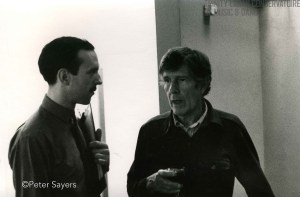
I first heard his recorded speaking voice while teaching some of his work in an early iteration of my sound studies seminar. I’d seen photographs of Cage as a middle-aged and older man; from those images of a tall, craggy-faced guy in a sports jacket or woolly sweater, I had expected to hear a baritone, chest-resonant, rich “masculine” voice. Instead, Cage’s voice was light, with very little chest register, almost breathy sometimes, and inflected with the rhythm and occasional sibilance of what I “recognized” as a gay male (American) voice.
How had Cage navigated the homophobia of the 1950s with a voice like that? Was what I heard as his audible difference perceived that way in the postwar period as he rose to prominence as a modernist composer? According to some older gay men I’d interviewed for my 2004 radio documentary on the early gay leather scene in the 1950s, they had consciously altered their voices in everyday situations where they didn’t want (or couldn’t risk) being heard as gay. As one guy mentioned, for such circumstances he adopted his “gas station voice”—a vocal pitch and style to get him through such commonplace moments of public masculinity as talking to the gas station attendant. I wondered if Cage also kept one voice in the closet and adopted another one he needed based on circumstance.
As I sought my own “gas station voice” in the fall of 2012, returning to Cage and listening to his voice in his 1956 composition Indeterminacy helped gradually lessen my anxiety about audibly “passing.” Listening to Indeterminacy, a series of stories occasionally interwoven with a piano, allowed me to not only hear but also admire Cage’s voice and the political resonance it may have held in McCarthy-era America.
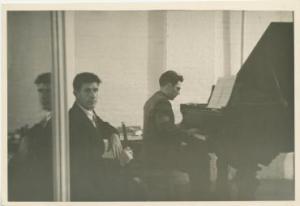
I looked for examples of Cage speaking outside of his own compositions, someplace more public—someplace where I might hear him put his voice in the closet and butch himself up for the public ear. I looked for ways to contextualize Cage’s voice in the era of determinacy — mainstream 1950s America, high modernist, planned, and in love with postwar military-industrial efficiency and the performance of expertise.
My urban history self focused on New York in the 1950s, listening for other voices resonant with the era’s “structure of feeling.” If heard by a 1958 resident of New York City, Indeterminacy might have sounded somewhat familiar. The experience of listening to all or parts of Indeterminacy resonated with the interruptions, the drowned-out words, the overlapping and oppositional sounds, the proximity of people and machinery, which characterized Manhattan (in particular) in the late 1950s. Cage spent periods of time in New York City as well as upstate in the 1950s, moving between different art scenes. What did New York sound like in the 1950s? The Puerto Rican migration and urban renewal re-shaped the city’s soundscape on the west side, as documented by sound recordist Tony Schwartz and re-presented through the musical West Side Story. I had written about those encounters with audible difference but now wanted to listen more closely. What did the city’s infamous urban planner, master of urban renewal, Robert Moses sound like? What did his outspoken critic Jane Jacobs sound like? And how might I hear their contemporary John Cage in this context with reference to the notion of “indeterminacy”?
Within a Cold War-McCarthyist context, voices represented an aspect of the suspect-self available for investigation, interrogation, and pathologizing. I identified, to an extent, with such a predicament, such a fear of exposure and of the negative consequences I presumed would follow. While I listened to John Cage’s and others’ voices from this period, I listened for how Cold War authorities may have heard them. John Cage’s voice offers indeterminacy itself, hovering in the margins of the tonal, rhythmic, and pitch ranges of conventionally “masculine” and “feminine” voices at mid-century. Despite our contemporary resistance to stereotyping, one hears in Cage’s gendered oscillation, mixing minor chest resonance with the higher, softer, breathier sounds, a definitive type of “gay” male voice: the sissy voice. As Craig Loftin has argued in “Unacceptable Mannerisms: Gender Anxieties, Homosexual Activism, and Swish in the United States, 1945-1965,” during the 1950s gay men as well as the heteronormative majority, produced intense hostility to the archetype of the “sissy,” whose voice and body movements marked him as politically problematic in the context of both homophile activism and Cold War homophobia.
Paul J. Moses aimed to analyze in his 1954 book, The Voice of Neurosis (one of the many works in the field of “personality studies” popular in the 1950s) the personality from the speaking voices of his subjects with a method he called “creative hearing.” Moses’s work suggested that the voice revealed the “true” personality, belying a person’s efforts to disguise themselves through dress, work or relationships. Such secrets could be heard, or listened for, through Moses’ “creative hearing.” Of course, when he published his work in 1954, the Cold War made aural surveillance, the use of listening devices, as well as the “creative hearing” of expert listeners, a crucial weapon in a war of secrets.

In January 1960 John Cage appeared as a contestant on the popular television game show I’ve Got a Secret (CBS, 1952-1967), a show that perfectly channeled concerns about hidden identities at the heart of public and Congressional anti-Communism within Cold War politics in the United States. Derived from the radio show What’s My Line in which a celebrity panel tried to discover a person’s job, in I’ve Got a Secret the panel tried to uncover the contestant’s “secret,” normally something unusual or perhaps embarrassing. The I’ve Got a Secret format played with the tension between who knew and who did not know the contestant’s “secret.” After being introduced by name and hometown, the show’s host asked each contestant to whisper their secret in his ear. During the on-camera intimacy of mouth-to-ear divulgence, text of the revelation scrolled up over the TV screen for the viewers at home and was visible to the studio audience. The panel of celebrity inquisitors could only observe the studio audience’s responses of laughter, shock, or titillation.
John Cage’s appearance on the show was devoted to the performance of his “secret.” Cage whispered to host Garry Moore that he had made a musical composition using a bathtub, jugs, a blender, radios, a piano, a tape recorder, a watering can, and other common household objects. In an absurdist version of a laboratory experiment, Cage darted from one to the other object, pressing buttons, pouring liquids, hitting radios, putting flowers in a bathtub, all the while holding and responding to the stopwatch in his hand. Cage performed inefficiency and absurdity, inviting laughter, the opposite of industrial modernism’s demand for logic, order, and compliance to norms. Cage’s non-compliant, queer performance and composition satirized the efficiency experiments of twentieth century time-management experts; the “Water Walk” “instruments”, all objects from everyday life, bear no productive relation to each other and are not arranged in a manner producing efficiency. Cage thus queered the modern, as typified in mid-20th century American industry, corporate capitalism, and national infrastructure projects such as urban renewal.
Cage’s voice provides an added and unexpected queer flourish to his TV appearance on I’ve Got a Secret. The sound of Cage’s voice (soft, higher-pitched, lilting, slightly sibilant) contrasts with his formal attire and hetero-normative environment. Cage’s voice reveals a “secret”—his homosexuality—different from the “secret” featured on the show. Like most Cold War secrets, it was not a secret to him or his close friends but was supposed to function as a secret in that historical context. Cage resisted, consciously or not, the vocal closet; he made no attempt, as far as I can hear, to alter his voice in the very public context of a live television show. John Cage appears happy, playful, and delighted to perform for the audience. His antic performance of “Water Walk” endeared him to a mid-century audience who came ready to enjoy the show’s pleasurable revelation of secrets.
Other “hearings” of Cage’s non-normative self might well have produced a less relaxed response from those same audience members: his voice at a Congressional HUAC hearing; his voice overheard on the street or in a cafe. The gay or gender non-conformist audience members may have thrilled to Cage’s double-edged performance of his “secrets,” or they may have cringed at such possible revelations, in fear of their also being heard as different but lacking the protection of Cage’s (albeit limited) celebrity.
Standing at the front of the lecture theatre in September 2012, I felt I too had a secret, and my heart pounded, my stomach jittered for fear of its revelation. But, as I continued to listen to Cage’s voice on a recording of Indeterminacy, and to think through his TV performance on I’ve Got a Secret, I grew more able to let go of my fear of being heard as trans*. I heard and saw Cage as a man who resisted convention and a culture of fear and judgment.
Four years on, I no longer worry whether or not my voice signals my transmasculinity. I can’t control how my students or anyone else hears me, or the joy, confusion, curiosity, or disgust their hearing me may produce in them. My last term’s teaching evaluations, from Fall 2014, for that same large lecture class I first taught in Fall 2012, included many positive comments about my teaching; they also included a student’s written comment describing my voice as “gentle” and thus sometimes harder to hear. I will wear a microphone for volume, if needs be, to increase my audibility. But I feel no need to alter what that student heard as “gentle.” I can live with gentle, for which I thank John Cage.
—
Featured image: from Issue Project Room
—
Art Blake is an Associate Professor in the Department of History at Ryerson University, Toronto, where he also teaches and supervises grad students in the Communication and Culture program. He is completing his second book, Talk To Me: Mediated Voices in 20th Century America. His new research concerns contemporary international urban “maker” cultures.
—

REWIND!…If you liked this post, you may also dig:
Music to Grieve and Music to Celebrate: A Dirge for Muñoz—Johannes Brandis
On Sound and Pleasure: Meditations on the Human Voice—Yvon Bonefant
Sound as Art as Anti-environment—
Share this:




Current Top Posts





April 2021

January 2020

November 2019

October 2019

August 2019

April 2014

November 2017

March 2015

December 2017

October 2015


Recent Comments