
G.L.O.S.S., Hardcore, and the Righteous White Voice


DOI: https://doi.org/10.59350/e85c7-6fj16
For full intro and part one of the series click here. For part two, click here. For part three click here.
Our Punk Sound series implicitly argues that sound studies methodologies are better suited to understanding how punk works sonically than existing journalistic and academic conversations about musical genre, chord progressions, and/or genealogies of bands. Alexandra Vasquez’s sound-oriented work on Cuban music, for example, in Listening in Detail (2014) opens up necessary conversations about the “flashes, moments, sounds” in music that bear its meanings and its colonial, raced, classed, and gendered histories in material ways people can hear and feel. While retaining the specificity of Vasquez’s argument and the specific sonic archive bringing it forth, we too insist on “an ethical and intellectual obligation to the question: what do the musicians sound like” (12) and how do folks identifying with and through these musical sounds hear them?
In this series, we invite you to amplify varied historicized “details” of punk sound–its chunk-chunk-chunk skapunk riffs, screams, growls, group chants, driving rhythms, honking saxophones–hearing/feeling/touching these sounds in richly varied locations, times, places, and perspectives: as a pulsing bead of condensation dripping down the wall of The Smell in Downtown LA (#savethesmell), a drummer making her own time on tour, a drunk sitting too near the amp at a backyard party, a queer teenager in their bedroom being yelled at to “turn it down” and “act like a lady[or a man]”. . .and on and on. Today’s essay is by the amazing and prolific Chris Chien. Join Chris as he questions the the uneven intersection of racial and sexual vocalization in punk’s legacy.
SOUND!
–Aaron SO! (Sounding Out!) + Jenny SO! (Sounding Out!)
Eddy is white, and we know he is because nobody says so. – Toni Morrison, Playing in the Dark
We just celebrated the 4th of July, which is really just national Fuck the Police Day… I bet that during the Revolutionary War, there were songs similar to mine. — Ice-T, interview in Rolling Stone, August 1992
I think it’s real important that us as Americans recognize the fact that we have a lot of violence inherent in us, you know, it’s like part of our culture; it’s part of our art, you know, the 1950s, the great artists, like [Jackson] Pollock and [Willem] de Kooning, and we should work now, now that wars are over to not be ashamed to put violence in our art; I have a lot of violence in my art — Patti Smith, interview from Rock My Religion
INTRO
In a 2015 interview with Terry Gross on NPR, Toni Morrison recounts the time her father threw a drunken white man down the stairs because he thought the man was coming for his daughters. She concluded that it made her feel protected. Gross circuitously questions this rationale, implying that her father’s act, his black violence, must have been terrifying for Morrison and her sister to see. Morrison responds, “Well, if it was you and a black man was coming up the stairs after a little white girl and the white father threw the black man down, that wouldn’t disturb you.” Chastised, Gross adds, “I think it’s a product of being in this, like, not-very-violent, working-class, middle-class family where I didn’t see a lot of violence when I was growing up, so any violent act would probably have been very unnerving to me.” Gross’ response to Morrison’s childhood memory of black fatherly love and protection, coded to elevate her white, middle-class upbringing, left me wondering: whose violence is acceptable, and whose is not?
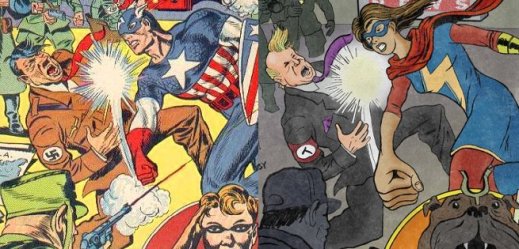
This question remains pressing in today’s climate. In the past year, state-sanctioned violence against indigenous, black, brown, queer and trans people, which has run like rich, nourishing marrow through the backbone of this country, is once again being openly and actively fomented throughout the public sphere by the figures at the apex of state power. In reaction, antifa anarchist groups, responsible for the much-publicized #PunchANazi meme have revived the use of black bloc tactics; along with the rise of “left-leaning” gun clubs, these responses have given renewed currency to the notion of arming up to fight back out of fear, disgust, and rage.
Olympia queer and trans hardcore band G.L.O.S.S. embodies many of these impulses, especially in their most recent (and now final) EP, Trans Day of Revenge. Through calls to direct action and explicit violence, the band rages against every oppressor that has ever crossed its path. On the whole, popular and critical reception to the EP has been positive, even celebratory, due in part to the preceding lineage of music criticism in which the violence of hardcore music is neutralized or intellectualized because of the implicit whiteness of the genre. And, in mirroring both critical and popular reactions to the work of Black Lives Matter and other black social movements, the calls to direct action in rap and hip hop are either discredited or disavowed. In other words, certain white genres of music, and the violence therein, appear to require intellectual analysis or even possess an inherent rationalization. (Dan Graham’s seminal video essay Rock my Religion is an early example of this foundational project in the history of intellectualizing rock.) The mutation into either incredibility or physical threat, on the other hand, accompanies music produced by certain racialized subjects—in America, almost always the black musician. By looking at the critical reception to G.L.O.S.S.’ Trans Day of Revenge, I will examine the dynamic that celebrates the white voice, especially when it calls for violence, as righteous and “metaphysical,” exemplified by the Patti Smith interview in the epigraph (note the use of the uninterrogated second person), and condemns the voice of black rage in rap and hip hop, for its “thuggery.” To question this dynamic is not specific to G.L.O.S.S. but is meant to denaturalize the uneven musical imaginary that supports the white ‘voice’ and smothers the black, as symptomatic of the way in which the political horizons of black political action are foreclosed in favor of righteous white action.
While there may be a seeming disconnect between music criticism and the politics of activism, radical hip hop’s roots in Black Power movements and hardcore and punk’s roots in the politics of white disaffection of the 1970s have both been well-documented. These political-sonic genealogies bind these respective genres to their racialized origins and mark the political stakes of G.L.O.S.S.’ message and its critical reception. The primary difference between the two genres is that the former genre was racialized from the start while the latter remains “unmarked” to this day, despite its early, close connection to white supremacy as documented by, among others, influential rock critic Lester Bangs. Even fascinating work that links and critiques American machismo and hardcore violence completely occludes the valence of race in discussions of masculinity. A closer look at the critical reception to Trans Day of Revenge will help to tease out the ongoing influence of the racialized origins of these two genres on contemporary music and political movements.
To be clear, it is not my intent to moralize the use of violence in leftist social movements. It would be foolish to deny the trans and queer rage that permeates Trans Day of Revenge, and which G.L.O.S.S. literally embody as an apt and poignant expression of a life lived under state-sponsored brutality and domestic abuse. No where is it more poignant than the opening, which is inaugurated with squealing feedback, dense, chugging guitar, and then a strained scream from lead singer Sadie Switchblade: “When peace is just another word for death, it’s our time to give violence a chance!” The four songs that follow, totaling a mere 7 minutes, all tap into the well-established tradition of nihilistic vengeance in G.G. Allin’s “Violence Now—Assassinate the President,” direct aggression in antifa punk in Oi Polloi’s seminal “Pigs for Slaughter” and “Bash the Fash,” and hardcore staples such as Black Flag’s “Police Story” and The Dicks’ “Hate the Police,” which center on booting (or shooting) oppressors in the face. More than that, however, G.L.O.S.S. is intent on smashing the culture of respectability and pacifism of LGBT politics, singing, “Your calls for peace are ignorant and basic / Self-appointed leaders / Who put you in charge?”
In a glowing review that invokes Jose Esteban Muñoz’s Cruising Utopia, Brad Nelson of Pitchfork insists that, “At its best, hardcore is personal; it tends to erase the spatial distinctions between performer and audience, until there is a primordial flow of bodies, ideas, and energy.” Putting aside the cognitive dissonance of quoting Muñoz in a review of an album that urges the use of outright violence, Nelson espouses the grounding liberal, “post-racial” ideology that informs many contemporary conceptions of punk and hardcore. And in doing so, Nelson papers over the racialized history of hardcore while quickly conflating the specificity of state-sanctioned anti-black violence, which G.L.O.S.S. is explicit about, with generalized notions of state oppression. Other reviewers have similarly intellectualized the band’s explicit incitements to violence. Embedded within these glowing reviews, all of which fail to mention the white racial position from which the band speaks and celebrate their calls to violent action, then, is the assumption that white violence is inherently justified because it’s so rare. Put simply, if it’s happening, it’s happening for a good reason. Contrast this with perception that direct action and (self-defensive) violence in both black activism and music reveal some corruption of being, such as an essential “violent character” or the well-worn notion of a savage nature.
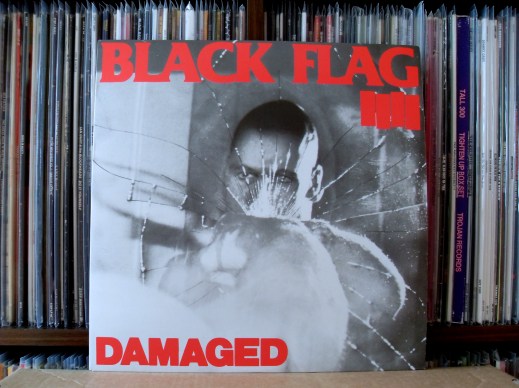
It is certainly possible to argue for trans and queer ways of knowing and creating art that evade these hetero-masculinist histories but this does not seem to be the case here: many reviewers cite the band’s positive influence on hardcore as both genre and scene, work that the band themselves seem invested in. Such interventions in the scene, then, compel us to recognize that the band’s message is channeled through the generic conventions of hardcore, which prime listeners to appreciate the role of violence as a necessary outcome of and antidote to oppression. The main progenitor of this narrative is Black Flag’s Damaged, which invokes the chaotic, uncontrollable violence of white male angst in songs such as “Damaged I.” (Golden Age country music provides an apt analogue with its generic figure of the violent, romantic white outlaw.) Though G.L.O.S.S. rails against murderous gender and sexual violence, they do so by asserting their position in the tradition of white rage that made Black Flag and Minor Threat the deified figureheads of hardcore—though admirable of gender-nonconforming and transfolk to do this work, this tension of lineage is neither addressed nor resolved. In this way, the violent implications of the genre, along with the issue of a privileged white voice, are absorbed and normalized—just a part of the scene.
Indeed, not a single review so much as gestures towards the band’s race, which, as Toni Morrison suggests, codes the neutral as white (whether this is true to their “actual race” or not is not the point—it’s a matter of perception). This is all the more glaring as multiple songs encourage fighting racist police violence against black trans women; yet this message inhabits a continuum of hardcore and punk that has long held an equivocal relationship with white supremacy, which has often been positioned as either a simple matter of white male disillusionment or edgy nihilism. And while there has certainly been anti-racist music in hardcore, the message becomes mixed by veneration of and apologias for songs such as Minor Threat’s “Guilty of Being White” and Black Flag’s “White Minority.” This muddled message appears in G.L.O.S.S.’ work as well. During the opening track, Switchblade screams: “anti-racist doesn’t mean non-racist!” The lyric may be a riff on a Guardian video by Marlon James in which he insists that “non-racist doesn’t mean anti-racist.” He asserts that non-racism (non-action, moral statement of belief) is inadequate since it does not prevent racial violence. Instead, one must go further and adopt an anti-racist (active) stance. G.L.O.S.S.’ inversion of James’ formulation in the context of hardcore and punk, however, reads with an added bit of irony: if even active anti-racist action does not preclude one from holding racist views, then this highlights the submerged racial dynamics of voice that hold up G.L.O.S.S.’ violent aesthetic and that elude the onslaught of sloganeering that shape their lyrics.
Certainly G.L.O.S.S. screaming the refrain “black lives don’t matter in the eyes of the law!” is critical work being done to highlight anti-black violence and their commitment to addressing oppression of all kinds. But it does not preclude them from criticism for benefiting from structural racism, which includes enjoying the unquestioned privilege of being feted for advocating extreme violence rather than, say, being placed on an FBI watchlist. Simply put, the band has the option of espousing this violence from a position of relative safety, especially from state-sanctioned repercussion and harassment. These unnuanced lyrics make it all the more difficult to square some of their anti-racist lyrics with their intersectional politics. The generic bounds of hardcore dictate crafting lyrics like volleys of missiles, and here such pithy concision becomes an easy conflation of anti-black, anti-queer, anti-trans, and anti-femme oppressions that threatens, ironically, to erase the hard work and frequent clash of axes of oppression in the formation of transversal alliances rather than support it.
If the new hardcore that G.L.O.S.S. spearheaded intends to responsibly involve itself in social justice, the lyrics must move beyond sloganeering. The continued submersion of the multiple and complex intersections of race in white activism is an elision that performs its own form of silencing, a repression of a black voice that has long and often erupted into righteous anger and violence. Scholar Tricia Rose provides an extensive history and analysis of this dynamic in in Hip Hop Wars. In addition to Rose, many scholars from Houston A. Baker to Nelson George, have noted the deep indebtedness of early gangsta rap and radical hip hop (Public Enemy and dead prez, for example) to the tradition of anti-passive philosophies of Malcolm X, the Black Panthers, and earlier pre-Civil Rights movement radicals. Due to these genre’s callback and conscious inhabitation of the genealogy of the black resistance in order to address the historical nature of their continued material oppression, critical responses to this music focus largely on the music’s racial aspects (unlike G.L.O.S.S., or hardcore music in general). Consequently, the condemnation of violent action against oppression rather than celebratory accreditation is always couched in the fear of the black voice and active body.
This dynamic is nowhere clearer than the press’ reaction to Ice-T’s side project Body Count, which featured the controversial song “Cop Killer.” Ice-T has stated that the album as a whole was meant to actively invoke the sonic cues of not only hardcore but metal (also known for its troubled relationship to white supremacist politics) the mainstream media applied the label of “rap” to it in order to identify the violence as both gendered and racialized, that is, more closely with a black, male genre of music, with all that that entails to American society. Ice-T’s transgressive identification of black genres of music in the epigraph, “music like mine,” with the originary, rebellious violence of the Revolutionary War speaks to the divide within the American imaginary between “justified” revolutionary, white violence, and corrupted black violence. He observed:
There is absolutely no way to listen to the song “Cop Killer” and call it a rap record. It’s so far from rap. But, politically, they know by saying the word rap they can get a lot of people who think, “Rap-black-rap-black-ghetto,” and don’t like it…They don’t want to use the word rock & roll to describe this song. (qtd. in Rose 130)
In contrast to criticism of heavy metal, Rose, in Black Noise: Rap Music and Black Culture in Contemporary America, explains, “The terms of the assault on rap music are part of a long-standing sociologically based discourse that considers black influences a cultural threat to American society” (130). She explains, young fans of rap are themselves in concert with the music, ready agents of destruction whereas heavy metal is a threat to the fans, young white males, inherently innocent but in danger of corruption. Put simply, the dynamics of racialized music criticism reflect the attitudes of society writ large: the dismissal of the righteousness of violence in black genres of music mirror the same in black social movements or personal survival.
Across the spectrum of black musical genres, we see the same dynamic. Beyoncé, a master of combining maximalist visuals, nuanced political messages, and hyper-popular culture, was greeted with boycotts and protests after her performance at Super Bowl 50, which invoked a Black Panther aesthetic and, presumably, the group’s promotion of anti-passive and self-defense ideologies. Similarly, she faced a backlash to her music video for Formation, which was perceived as “anti-police” and resulted in an attempted nationwide police boycott of her Formation World Tour. Outside the strict confines of the music industry, black folks, especially black transwomen of color, are held to a different standard in eschewing the avenues of violent protest and activism—or even self-defense (see the tragic case of CeCe McDonald). In a seven-minute EP, G.L.O.S.S. highlights the continued violence against black transwomen in their work, which is positive, critical work. But the uneven reception of black political music by the American public proves just how fraught that project can be without full knowledge of one’s positions of privilege, or the history from which one speaks.
OUTRO
In the end, this issue of voice is about political horizons. G.L.O.S.S. is entirely future-oriented: Switchblade sings, “we break the cycle with revenge,” the band’s name stands for Girls Living Outside of Society’s Shit, and their first EP features a song called “G.L.O.S.S. (We’re from the Future).” But just how much do their actions refuse repetition?
Jose Muñoz was no stranger to witnessing and experiencing the horrors of anti-queer police brutality. In Cruising Utopia he recalls the brutality of riot police attacking a peaceful vigil after the murder of Matthew Shepard (while recognizing that “if Shepard had not been a pretty white boy, there would have been no such outcry”) (63). Muñoz fights against the violence of the “here and now,” the quagmire of political expediency, which is analogous to G.L.O.S.S.’ anger at the pragmatism of LGBT politics. Yet, in a very real way, violence at all costs can be considered a “political expediency” of its own for what occurs after violence? Is revenge and ultra-violence as sole response really “breaking the cycle”? In the rush to implement such violence, who is left by the wayside as we seize and assert our power? This is a question of effectivity, not morality.
For his part, Muñoz insists on breaking the cycle of the present by citing the use of “queer anger” through activism as public performance (64). This is the means toward utopian possibility, that imagines otherwise in a violent, repressive heteronormative present. But he stops short of arguing that queers must take up arms. The critique often levied against revolutionary utopian theorizing has been the obviation of the conditions of “the post-revolution” in favor of dreamy, uncritical rhetoric. Indeed, the same can be said here in the case of G.L.O.S.S. and all others who uncritically embrace not only outright violence but also intersectional politics blanched of much-needed nuance. As a vehicle to bringing trans and queer folk together, G.L.O.S.S.’ rage is a form of Muñoz’s ‘public performance’; they have poignantly invoked his “critical dissatisfaction.” But the generic bounds of hardcore preclude a nuanced conception of his “collective potentiality” (189), particularly one that is attentive to the racial hierarchies of voice. In short, there are yet songs to be sung. Though they have disbanded, we can thank G.L.O.S.S. for helping to set the stage.
–
Cover image is G.L.O.S.S. by Sid Sowder @Flickr CC BY-NC-ND.
—
Chris Chien is an American Studies and Ethnicity graduate student at the University of Southern California, and is doing research on early Asian gay and lesbian organizing in North America, and these social movements’ place within contemporary transpacific, diasporic narratives of a liberalizing Asia, particularly Hong Kong. He has previously written on Sounding Out! about the sonic materiality of diasporic feeling through the relic of the cassette tape, and has an upcoming article on righteous white violence in the music of trans-hardcore band G.L.O.S.S. He hadn’t seen Moonlight or even a trailer before this screening, but heard from many people he respects that it was magical. When SO! ed-in-chief JS reached out after seeing him post about attending on FB, he immediately embraced the idea of a conversation with Shakira.
–

REWIND! . . .If you liked this post, you may also dig:
Listening to Punk’s Spirit in its Pre-, Proto- and Post- Formations – Yetta Howard
Feeling Through the Keen and Grind: Team Dresch’s Personal Best – Gretchen Jude
Riot-Grrrl, Punk and the Tyranny of Technique – Tamra Lucid
—
Share this:

Ritual, Noise, and the Cut-up: The Art of Tara Transitory


DOI: https://doi.org/10.59350/0rczr-41z23
Marginalized bodies produce marginalized sounds to communicate things that escape language. The queer body is the site of sounds that engage pleasure, repression, rage, isolation, always somehow outside of dominant language. Sound Studies tells us that we should trust our ears as much as our eyes, justifying our trust in sound, and of the resonating body. Affect Theory goes further, saying that all senses play into a body that processes input through levels of response, experience, and anticipation. Affect is the vibrational space that is both bodily memory and anticipation. So where do sound and affect meet in queer bodies? How do marginalized peoples use sound and the body to express liberation, objectification, joy, and struggle?
Our writers in Sound and Affect tackle these questions across a spectrum of the marginalized experience. I opened the series by offering the concept of the tremble, a sonic form of affect that is necessarily queer in its affective reach. Then, Kemi Adeyemi, sloooooooowed thingggggggggs doooooooooownnnnn so to hear the capitalist connections between the work expected of black bodies and the struggle for escape from this reality through the sonic affects, temporal shifts, and corporeal elsewhere of purple drank. Last week, Maria P. Chaves Daza explored the connection between voice, listening, and queer Chicana community formation: through space, across time, and with laughter. In the final post of the Sound and Affect forum, Justyna Stasiowska brings the noise in a discussion of the trans body and the performance work of Tara Transitory. —Guest Editor Airek Beauchamp
—
Ritual is another word that needs a new definition… Ritual, as I use the term, refers to an artistic process by which people gather and unify themselves in order to confront the challenges of their existence. –Anna Halprin
The shivering on your skin gradually builds like a soft electric shock that presses you down to the floor. The whole experience feels like an earthquake, with vibrations pricking through bone into organs. The affective tonality of the performance puts the body in a state of alarm, where listening turns into self-observation. Your perception is immersed in sensing the materiality of a room filled with other bodies, all attuning to the low frequencies resonating with the architecture of space, trying to maintain equilibrium. You refocus away from the artist to yourself and the rest of the audience, realizing the depth of your feelings of total connection.
This transcendence comes through dissolving the boundaries of the body and the vibrational disturbance of one’s kinesthetic sense of self in a room, or proprioception. As One Man Nation, Tara Transitory creates noise during her performances to offer out-of-body experiences for her listeners, a ritual where the unity of body and self dissolves. Using samples gathered through field recording and sounds from her midi controller, 64button monomer, and contact microphones on the tables and floor, Transitory catches her body moving and interacting with the instruments, amplifying the process of making sound in the here and now.
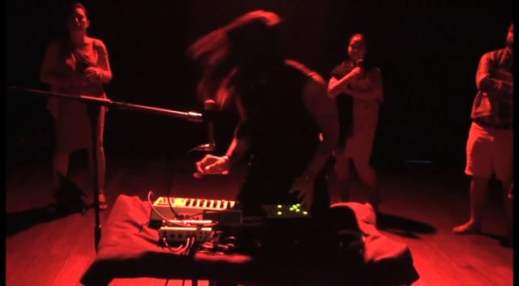
Transitory’s artistic praxis enables me to explore the ways in which the body creates and receives noise. I define noise here as the unwanted and always-present materiality of (mis)communication. Transitory explores the body as a site of noise and disruption, working to disrupt the false narrative of unity pervasive in Western concepts of gender. Using cut-ups, noise, and ritual, Transitory exposes the falsehoods of gender norms and repositions the body as a locus of possibility that allows for transgression and what Angela Jones and Baran Germen have called “queer heterotopias.”
Queer Heterotopias and the Rituals of Self
Morning rituals like taking pills and brushing teeth produce the tiny noises of becoming one’s self, or at least molding one into a presentable self. Repetition is a key element, making the process seem effortless and automatic. As Judith Butler discussed in Gender Trouble, everyday movements, gestures, actions, and ways of using and presenting one’s body are framed by gender categories. Butler also demonstrated that gender is a performance made of repeating gestures and movement that are prescribed to male and female genders.
The everyday routine of Transitory’s life, therefore, in a specific socio-political context, can seem unnatural and marginalized. Taking drugs every day changes the meaning of an action, whether the drugs are hormonal, supplemental, medicinal, or recreational. Still, the “natural,” as most queer theorists show, exhibits power only through the framing of social categories as transparent, creating an illusion of normalcy. However, while this post-structuralist perspective seeks an antidote to the normalization of cultural schemes, it does not make clear what to do after destroying society’s illusion. Deconstructionist perspectives produce a constant grating sound coming from the friction between the conceptual framing of body and the materiality of fleshly gender performance.
In other words, what didn’t make the cut?
Cut-up spaces
As proposed by Brion Gysin and William Burroughs in The Third Mind, the cut-up method, an early analog method resembling sampling, involved artists cutting up pieces of text and reassembling the pieces in a new form. This technique, used across different media, enables artists to create a self outside the limits of the body. In Burroughs’ Invisible Generation, he describes creating a “cut-up” using a tape recorder. Recording, cutting up the tape, then reassembling it for playback allows the listener and the artist to become aware of a specific socio-cultural programming that Burroughs presents as method of policing the self. However, remixing and repetition also opens spaces to reprogram our-selves. The tape recording cut-up becomes a multisensory stimulant used to create an other self through de- and re-construction. Furthermore, the body, working as a membrane, becomes transformed through the repetition of these new sounds; sound affects listeners simultaneously at the level of cognition as well on the level of the body as a corporeal listening apparatus.
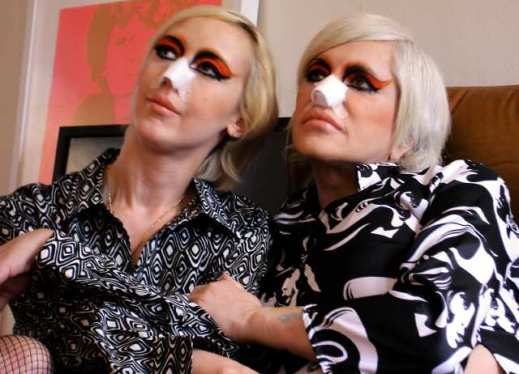
Genesis Breyer P-Orridge and Lady Jaye also explored the concept of the body itself as a cut up medium in their Pandrogeny project. They underwent the process by cutting up each other’s gestures and behaviours through mimesis and cutting up parts of their bodies by undergoing plastic surgery in order to create a third being. According to a post by a plastic surgeon in Louisville, the cut up material that they used is DNA, which they refer to as the “first recording.” They used the pronoun “We” even after Lady Jaye left her body (passing away in 2007), so the third being is not just a shared body, but a connection of minds and spirits across the divisions of gender and body. Making a cut-up of the body enabled them to create an other, a combined Genesis and Lady Jaye, the pandrogyne self, the WE that is now Genesis and Lady Jaye. Pandrogyny is, in their project, a unified being presented as the double self in the negation of gender. It is a performance aimed to create a space for the connected consciousness, the third mind within a physical space of the body.
Tara Transitory uses a different method of “cut-up,” focusing on vibrational exchange among bodies to create communitas—or common public– specific to ritual in order to disenchant the geopolitical connection of body and gender. Transitory’s “cut-up” aims to create a body in transition, which connects with other bodies through the amplification of noises the body produces. Her work uses vibration to establish communication across genders, within a body or between bodies in a state of flux.
The last day before the end of the world. Somehow I feel my life has been up till now very fulfilling and I really cannot think of what more I want, or what I need to do before the end. My only plan is to take my first pill of estrogen at 2359 tonight Bangkok time, the beginning of the apocalypse of my testosterone. –Tara Transitory, Ritual.
Originally from Singapore, Transitory works as One Man Nation, documenting and developing communities in Europe and Asia. Her project International //gender|o|noise\\ Underground consists of mapping and documenting lives of trans women in Asia and Europe and creating performances using noise. She, with Miriam Saxe Drucki-Lubecki, also took part in establishing a monthly trans/queer left- field music party in Granada called Translæctica. Translæctica has grown to other countries, with editions (in Paris, Bankok, Saigon), and includes lectures, workshops and film screenings mixed with electronic music. As posted on Translæctica’s Facebook page, the goal behind the event is to present “the idea of a new world as one borderless living space, with all the shifts and transformations and their irreversible impact on local/original cultures.” It connects local and international artists and activists to create an ever-evolving community without borders.
As Transitory’s name might suggest, she herself is not committed to a national identity. Throughout her migratory experience, Transitory gathers field recordings then uses narrative to transform them. Her site-specific approach focuses on concrete, situated realities that are entangled in current political situations, where friction arises between the policing norms in Asian and European societies and her own functioning as a nomadic being in state of transition. Her performances are rituals that blur the restrictions that society conveys through noise (screams, samples from field recording, the sound of the moving body) as an affective force, creating a state of meditation and catharsis. For example, while documenting the lives of trans experience, she worked with trans women street performers from Ho Chi Minh City in Vietnam.
These women make fire performances to “Gangnam Style,” moving during the night from one public place to another to perform for unsuspecting audiences. Sampling the street noises and then playing them back during the performance creates a mirror for the audience; interjecting common noise into a common dance song established a specific heterotopia, shifting what might be a normal experience into something uncanny within the conventions of street entertainment.
In her performances, Transitory uses noise as an intentional activity, suspending communication, disabling the recipient from receiving information, leading to an “immersion in noise.” This immersion is similar to sensory deprivation in that it overloads the receiver with stimuli, suspending communication. Its affective force comes from invading the body with frequencies and vibrations, where one feels the body in constant movement – a state of perpetual flux. It becomes the tactic of distancing from the self, enabling the listener to create different experiences, a heterotopian space of otherness and developing new rituals for specific situations.
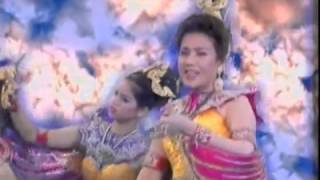
One Man Nation’s performances end with Traditional Laotian Molam-style music (“Mo” is an artist and “Lam” is a kind of performance art where the artist tells a story using tonal inflections) sung by Angkana Khunchai, a 1970’s pop-music singer. The pop-ish songs are calming and soothing after the intense experience of Transitory’s performance. The text is a repetition of the words “calm down,” a therapeutic ending creating a sense of light from this cathartic performance. Transitory’s use of Molam eases re-entry into one’s everyday existence outside of the performance. The harmonies and softness of the song contrast with the harshness of noise performance as part of ritual – from transgressing the everyday and entering the liminal state that Transitory creates in her performances to better re-enter society.
Transitory’s work conjures new rituals of transcendence and distancing one-self from the body. I treat the //gender|o|noise\\ as a hacking of the everyday experience of body. By creating a temporary heterotopia. Tara’s work reveals the tactics of hacking gender, generating a temporary space for alternative modes of existence. She creates flux in bodies and bodies in flux, thus affectively crafting heterotopic spaces, sites which are, as Brian Massumi states:
[…]an open threshold — a threshold of potential. You are only ever in the present in passing. If you look at that way you don’t have to feel boxed in by it, no matter what its horrors and no matter what, rationally, you expect will come. You may not reach the end of the trail but at least there’s a next step (“Navigating Spaces”).
The everyday processes of becoming oneself by repeating practices become rituals when performed in different contexts. This ritual is a process of creating an affect, a space of potentiality that enables the body to reshape and change, much like Transitory refits old rituals into new skin. The ritual forms applied to actions of the everyday enable us to change their meaning and our perceptions, creating a sense of the transitory nature of one’s body. Sonic rituals like Transitory’s are tactics to develop a self-conscious and creative approach to everyday activities and use them, as Anna Halprin says, to confront the challenges of existence.
—
Featured Image: Tara Transitory in performance mode
—
Justyna Stasiowska is a PhD student in the Performance Studies Department at Jagiellonian University. She is preparing a dissertation under the working title: “Noise. Performativity of Sound Perception” in which she argues that frequencies don’t have a strictly programmed effect on the receiver and the way of experiencing sounds is determined by the frames or modes of perception, established by the situation and cognitive context. Justyna earned her M.A in Drama and Theater Studies. Her thesis was devoted to the notion of liveness in the context of the strategies used by contemporary playwrights to manipulate the recipients’ cognitive apparatus using the DJ figure. You can find her on Twitter and academia.edu.
—

REWIND!…If you liked this post, check out:
Pleasure Beats: Using Sound for Experience Enhancement ––Justyna Stasiowska
Papa Sangre and the Construction of Immersion in Audio Games–Enongo Lumumba-Kasongo
SO! Reads: David Novak’s Japanoise: Music at the Edge of Circulation—Seth Mulliken
—
Share this:




Current Top Posts





April 2021

January 2020

November 2019

October 2019

August 2019

April 2014

November 2017

March 2015

December 2017

October 2015


Recent Comments