
Tape Hiss, Compression, and the Stubborn Materiality of Sonic Diaspora

DOI: https://doi.org/10.59350/wq79t-x3184
In an article for Pitchfork, music critic Adam Ward reminisces about digital music files that sound as if they’re “being played through a payphone,” and calls the extreme compression of the low-quality MP3 “this generation’s vinyl crackle or skipping CD.” The crackles, hisses, and compression that characterize such sound files are what I term “encoded materiality.” Focusing on the encoded materiality of the digital helps us to reconfigure our approach to sonic media, understanding how the compression of early MP3s and tape hiss remind us not only of lost fidelity, but also of the richness of exchange. These warm and stubborn sonic impurities, having been encoded in our digital listening formats and thus achieving repeatability and variability, act as persistent reminders that we can think diaspora beyond melancholy and authenticity, sidestepping the questions of purity and loss that so often characterize dialogues in the field of diaspora studies.
In Mechanisms, his work on electronic textuality, Matthew Kirschenbaum proposes a “material matrix governing writing and inscription in all forms” composed of four elements: “erasure, variability, repeatability, and survivability” (xiii). The defects of sonic technology that become encoded in digital files are one such type of inscription. Tape hiss and other recording accidents–such as Casey Kasem ruining your attempt to tape record the first Western song you fell in love with after leaving Hong Kong by fading the outro and butting in with his banter–achieve repetition and survival during the digital encoding process, becoming a welcome reminder of time and place. Such materiality helps us to better understand the politics of diaspora. It clues us in to how the elements of textual encoding (erasure, variability, repeatability, and survivability) become embedded within diaspora’s complex logic.
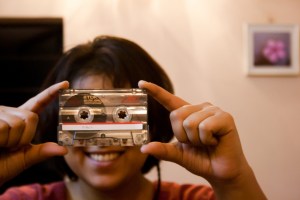
To think through these complex moments of exchange, let me offer a story about my experience with tape hiss. I grew up listening to music touched by this particular sonic grain: a ground level of noise upon which my sonic experiences were built. After I received my first iPod in 2005, I connected a tape player to the input of my computer, recorded a stack of tapes, and then manually split them into MP3s—pseudo-piracy committed in earnest. A few weeks ago, I dug up these same files and put them on my phone, once again returning the buried albums to their former glory on a constant rotation playlist. I keep returning to these particular files, rather than finding the now easily available digital versions, because I admire the survivability of their materiality. The materiality of these tracks allowed me to trace the complexity of my own history—the tape hiss is just as much a part of this history as the songs themselves.
After first moving to Canada from Hong Kong, my family and I established ourselves by unswervingly performing the same routine each weekend. We would have late lunch at our favorite dim sum restaurant, drive around for a bit, and then relax at home; there wasn’t much to do in the ex-urbs of Toronto. On those drives, we listened to selections from a stack of cassette tapes in the glovebox of our old Pontiac Bonneville. Sally Yeh’s 1987 album Blessing was on constant rotation and received its fair share of wear. This was one of the tapes I recorded to my computer, destined for digitization.
Because I hit the record button a few seconds early, my MP3 of Sally Yeh’s Blessing begins with a few seconds of silence. It’s enough to trick me into thinking that the song isn’t playing. In a quiet enough spot, I can hear that it’s actually tape hiss. No matter where I am, on the road or in the shower, my mind fills in the blank with the thick ker-chunk of the cassette entering that Pontiac stereo right before that familiar tape hiss would fill the car, always giving us a few sometimes-needed, sometimes-awkward moments of silence before the music started. The sonic texture of that tape stems from its material nature as plastic and metal. The hiss itself is due to the size of the magnetized particles on the plastic. Because of these sounds, the song tells its own story. It recalls our shared sonic and material experience as I migrate it from device to device.
Before Blessing made its way into our car, it was one of the few cassette tapes that my parents carefully packed into a dozen cardboard boxes and shipped by sea to Canada in the late 1980s. This was in the midst of the countrywide protests in China that led to the events at Tiananmen Square. That insistent ker-chunk of plastic on metal that my brain inserts every time I play the MP3s keeps my experience of the music grounded in this earlier history, too. Strange that a fluffy pop song would remind me of the serious political strife taking place on the doorstep of a Hong Kong nervously awaiting its “handover.” This sonic anchor’s ability to recall to me these snippets of history, both personal, national, and transpacific has been crucial in the development of my own diasporic identity. Listening to this particular recording of Blessing helps me to keep track of my self and my history.
Ker-chunk.
The act of withdrawal that many of us perform in order to interface with our sonic technologies, as Alexander Weheliye shows in his reading of Ralph Ellison’s Invisible Man in Phonographies, can play a powerful role in understanding one’s own racial subjectivity. Weheliye focuses on the scene in which the titular narrator-protagonist retreats to a subterranean cave-like space to listen to Louis Armstong’s recorded, disembodied voice in complete solitude. He asserts that the narrator builds his own subjectivity through a recognition of the self by projecting that self onto Louis Armstrong’s “vocal apparatus,” that is, his voice coming through a phonograph (143). “The phonograph’s ability to disconnect the singing voice from its face, or rather to replace it with a technological visage, further heightens its materiality, which impels the protagonist to imbue Armstrong’s voice with a surplus of signification” (Weheliye 145).
More than a black and white photo or a stern historical lecture from the elders, the “heightened materiality” of the digital format, a type of “technological visage” cathects my own diasporic history most forcefully to the sonic anchor of tape hiss because it acts as a “voice without a face” in the same way as the phonographic Armstrong. But despite the privacy of the phonographic listening act in this scenario, Weheliye suggests that
the phonographic listening modality also bears the traces of sociality… since the listening subject is drawn out of him/herself by encountering the technologically mediated sounds of other subjects—we might even go so far as to suggest that the phonograph itself functions as a subject, especially in its interfacings with various humans. (165)
So it is with similar sonic technologies that can encourage the “eschewing [of] the social” such as iPhones, CDs, and, yes, cassette tapes. Like Ellison’s narrator interfacing with the mechanical apparatus that conveys Armstrong’s voice, the insistent “defects” kept on the digital file keep the mechanism of its delivery at the fore, allowing me first to understand that diasporic feeling of dis-ease—and to imagine beyond it.
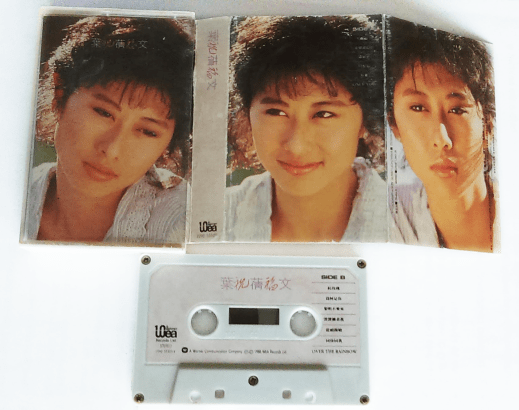
What I gain from the digital yet still stubbornly material tape of Blessing is not any overt lyrical or thematic gesture to a diasporic subjectivity on the artist’s part, but rather an induction into what Giorgio Agamben calls, “the idea of an inessential commonality, a solidarity that in no way concerns an essence” (18), or perhaps a community based on “belonging itself” (84). Likewise, Weheliye’s “diasporic citizenship coarticulate[s] the national and transnational instead of playing a zero-sum game with political identification” (369). If diaspora is defined by the perpetual desire to seek an imagined originary point of true identity that inevitably leads to melancholy, as psychoanalysis maintains, tape hiss and other encoded materialities turn the gaze away from the mists of origin, validating instead the development of diasporic identity in the aftermath of emigration. Of course, loss and melancholy are legitimate psychic aspects of the diasporic experience, as persuasively demonstrated by scholars such as David Eng, Shinhee Han, Anne Anlin Cheng, but they neither define the whole experience nor are they mutually exclusive to it. It is in this way that we can think of diaspora as a community of belonging by becoming.
A consideration of the stubborn ways that materiality is encoded in the digital helps us to think of diaspora as more than psychic fait accompli—it is also a ‘coming community’ characterized by the process of belonging. Kirschenbaum’s matrix provides the right foundation for a study which considers how material inscriptions are related to our diasporic lives. The inscription that defined my diasporic becoming came from the cassette tape that travelled across the ocean in a boat for five weeks, escaped erasure, survived repeated playings, became digital, and lives on now as a hissing reminder of our history of emigration. What else may we find about our own becoming and belonging if we attune our ears to the encoded materialities of sonic diaspora?
–
Featured image “Decayed Cassette” by darkday @Flickr CC BY.
–
Chris Chien is a Ph.D. candidate in the Department of English at the University of Southern California working variously in the areas of sound, diaspora and transpacific studies, all with a distinctly queer bent. He completed his M.A. in English Literature at Loyola Marymount University and his Honors B.A. in English Literature and Latin at the University of Toronto. Chris has presented papers on angelic gender fluidity in John Milton’s Paradise Lost and post-colonial affect in the work of Herman Melville and Amitav Ghosh at the Rocky Mountain MLA and South Atlantic MLA conferences respectively. He is currently developing a paper that examines the performativity of diaspora, masculinity, and the capitalist ethos in Eddie Huang’s memoir Fresh Off the Boat and its adaptation as an ABC sitcom.
–

REWIND! . . .If you liked this post, you may also dig:
Pushing Play: What Makes the Portable Tape Recorder Interesting?—Gus Stadler
SANDRA BLAND: #SayHerName Loud or Not at All — Regina N. Bradley
Listening (Loudly) to Spanish-language Radio — Dolores Inés Casillas
Brasil Ao Vivo!: The Sonic Pleasures of Liveness in Brazilian Popular Culture — Kaleb Goldschmitt
—
Share this:

SO! Reads: Norma Mendoza-Denton’s Homegirls

DOI: https://doi.org/10.59350/mg3zr-d3q86
“When I wear my eyeliner, me siento más macha (I feel more macha) I’m ready to fight” (54)

Makeup has long been an intentional part of a chola aesthetic: in particular, the skillful sign of bold black eyeliner or a carefully arched, thin, brow. The quote above by Norteña Xótchil, one of author Norma Mendoza-Denton’s interviewees, reminds us that make-up not only creates a sense of empowerment but also evokes the idea of physical strength (“feeling macha”). Norma Mendoza-Denton’s ethnographic study Homegirls: Language and Cultural Practice among Latina Youth Gangs (Wiley-Blackwell, 2008) presents a project of high ambition, and even higher execution, in its carefully crafted discussion of the linguistic and cultural practices of Latina youth gangs at Sor Juana High School in northern California. Homegirls offers much needed insight into the relationship between language style and the cultural, lived experiences of Latina youth gangs. She centers her analysis on the linguistic, the cultural, and the phonetic, and in this way she pushes students of ethnic studies and sound studies to consider how young Latinas craft and articulate their own identity through meaning-making practices that challenge tropes of deviancy that are often unfairly cast on young women of color.
Throughout the book, speaking chola – an urban, gendered variation of Chicana English – becomes an audible badge, a marker of experience rather than a punch line, a culturally appropriated costume, a music video fad, or linguistic variety in need of policing. Recently, celebrity white or non-Latina women, such as Gwen Stefani and Lana Del Rey, have adopted telltale signs of a chola aesthetic – the crisp centered hair part, baggy pants, big hoops and/or only-the-top-buttoned plaid shirt. By focusing on the language styles of cholas, Mendoza-Denton encourages readers to think beyond the stereotypical images and sounds that so often circulate in mainstream media about cholas. Homegirls offers Sound Studies and Chicana/o Studies scholars a notable addition to the growing literature on the intersections of language, race, and sound.

“You gotta take pride to do your clothes
you know I have to iron,
when I go out I have to iron my shirt for half an hour
or forty-five minutes, you know,
my pants, you know
they gotta be
cre::ased
you know they gotta-” (56)
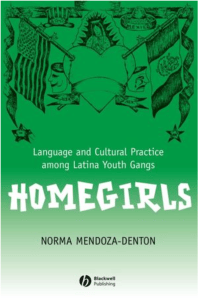
Homegirls joins conversations on Latinas and gang culture (Fregoso 2003; Miranda 2003; Ramírez 2009), which have historically been male-centered. Thelma, one of the Norteña girls, demonstrates in the quotation above her engagement with an aesthetic practice often linked with Latino gang members. Although the topic of language and linguistic identities, specifically bilingualism and translating, are emerging topics within Chicana/o Studies, Mendoza-Denton’s work joins that of a small number of scholars who take on Latina/o language practices and identities as the central focus of their work. She observes, in fact, how identity and meaning-making processes are intertwined to language, as are other social markers of identity such as race, class, gender, ethnicity, and accent. Homegirls joins recent discussions that demonstrate specifically how accents are vocal stand-ins for a person’s racialized, classed, and gendered experience. Where Fregoso and Miranda center their discussion on the cinematic representations of cholas and a historical account of pachucas respectively, Mendoza-Denton’s work is more in line with Miranda’s ethnographic approach to Latina youth gangs. Homegirls listens to the women’s voices and allows them to speak for themselves. This approach yields a work that reminds us how language identities are racialized when conflated with other racial markers, how they negotiate power relations (in/out group dynamics), and how they can also function as political forms of resistance.
“My dad dice que me miro como lesbian (says I look like a lesbian), my mom dice que qué guangajona (complains that it’s baggy). How much you wanna bet that I can go outside like this y no me dicen nada (they won’t say anything)” (151)
Maureen, a 14-year-old participant, speaks above to the code switching that many of the young women in this study practice. Mendoza-Denton re-imagines the chola as an innovator, highlighting the role of language and the body in creating new cultural practices. For example, in Chapter 5, the author heralds an exciting discussion on play and applying makeup as forms of gendered performances expanding on notions of beauty and grooming amongst Latina youth. She writes, “The symbolic and unconventional use of makeup among the girls claiming Norte and Sur at Sor Juana High School literally painted gender and ethnicity on their bodies,” marking a critical intervention in how the chola aesthetic racializes and genders bodies, yet also functions as a self-directed performance (152). In paying close attention to the symbolic meaning of makeup and its application, the ritual of carefully drawing the brow dismantles the mainstream appropriation of this often-criminalized look.
Mendoza-Denton’s close phonetic analysis demonstrates how the visual aesthetic coupled with a sonic aesthetic speaks to the political implications of embodied linguistic and cultural practices. The chola vocal aesthetic challenges traditional notions of femininity, closely associated with politics of respectability through Spanish honorifics like “usted,” within the Chicano family. This idea echoes other studies that show how pachucas, precursors to contemporary homegirls, with their extravagant attire and deviant behavior embody an adolescent rebellion against the patriarchal Chicano family and how pachuquismos forged a stylized linguistic resistance. Such stylized linguistic and embodied resistance can be seen in the excerpt below from T-Rex, one of Mendoza-Denton’s most candid participants in her study.
T-Rex: A girl could be more macha than some guys. For example me.
Norma: You think you’re more macha than guys?
T-Rex: I am more macha.
Norma: What makes you macha?
T-Rex: The way I act. The way I don’t let them step on me. (164)
In this brief excerpt, T-Rex articulates her notions of being ‘macha,’ a prime example of a discursive and material Latina youth practice that transcends the boundaries of normative gendered expressions for Latina youth. We are accustomed to seeing urban cholas with curiosity, envy, or both. Mendoza-Denton allows us to hear them and gain a deeper understanding of their social practices.
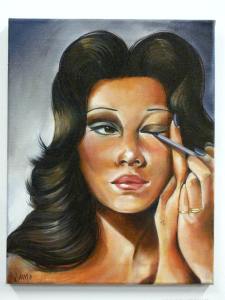
In framing the chola aesthetic as a transgressive type of beauty, Mendoza-Denton poses that the cholas in this study act as cultural producers who assign alternative meanings to femininity through their body and speech. Recalling Xóchitl’s remarks about mascara, the eyeliner serves in one form as a tool for a racialized feminine ideal of beauty, while simultaneously a sign for “willingness to fight” for other girls (154). Eyeliner, in this example, very visibly displays the complex interactions and negotiations of gender norms and agency. In this sense, Mendoza-Denton grants the reader a primary example of how cholas participate in a type of feminine gender expression that challenges expected ways of acting, which includes speech.
From Mendoza-Denton’s conversation with T-Rex, we see that speech and accent are just as meaningful in the construction of this alternative aesthetic. T-Rex, explains how the eyeliner is a “power-based interpretation” that when correlated with a tough, or even threatening, manner of walking—the use of the body—cholas command power and respect. Here, her intervention serves not only to gain a deeper understanding of Latina youth practices but also frames the chola as an empowered, vocal (what some would consider, mouthy) woman. Too often cholas receive harsh criticism or complete disregard for their assumed subversive behavior, criminality, and social deviance. In Homegirls, Mendoza-Denton challenges those notions by finding the symbolic capital in how these young women employ discursive, material, and phonetic practices.
The final two chapters of the book focus on the specific linguistic features relevant to studies of language and sound. Mendoza-Denton highlights phonetic variation among the girls speech in how their realization of /I/ demarcates core speakers from members of the group in the periphery yet points to similar speaking characteristics for girls of both gangs. The author’s focus on the stigmatized Th-Pro set (i.e. something, nothing) in the speech of Latina girls demonstrates how it discursively positions theses young women’s interactions and group affiliation due to its frequency and saliency. These later chapters demonstrate one of the author’s most significant contributions: projecting a specific accent is often linked to the creation of an identity. As Mendoza-Denton writes, “How speakers pronounce their words says a lot not only about the identities that they wish to project, but also about the history of the language(s) that they speak” (231). These linguistic variations give readers insight on the importance of how distinctive discourse markers are vital in the creation of stylized identities for young women of color.
Norma Mendoza-Denton has produced a rich account of a community largely ignored and misinterpreted in the conversations on Latina youth culture in the United States. As she reminds readers in her conclusion, Homegirls is one of the only studies of its kind that documents gang dynamics outside of discussions regarding violence, control over territory, or drug trafficking. While this approach provides a much-needed focus on the self-making and cultural processes amongst youth of color, I wonder if some significant discussions might be left out with this approach. Although there is large need for research on this topic that deviates from traditional approaches (such as criminality, violence, drug trafficking) when working with youth, particularly women of color, in her effort to subvert these sociological mainstays Mendoza-Denton avoids certain experiences that leave out pertinent context.

For example, in her discussion of the young women’s makeup practices, Mendoza Denton mentions the perceived threat they pose to teachers and police at school but does not go into more detail. These questions are not to discount the contributions of the book but rather to introduce future considerations for work surrounding Latina youth gangs. However, for Mendoza-Denton, the focus on the creativity and agency these young women embody is never lacking:
“So when you walk down the street,
you got the special walk, [begins to walk deliberately, swinging her upper body]
you walk like this,
you walk all slow,
just checking it out.
I look like a dude, ¿que no?
I walk, and then I stop.
I go like this [tilts head back – this is called looking “in”]
I always look in, I always look in,
I never look down.
It’s all about power
You never fucking smile.
Fucking never smile” (155-6)

Homegirls is at its finest when the reader is presented with excerpts like the quote above where T-Rex’s assertive physical and mental stance illustrates the linguistic and cultural practices that Mendoza-Denton seeks to highlight in her work. Mendoza-Denton’s contribution to this topic privileges the symbolic capital in linguistic, embodied, and cultural practices which sets up a platform for future work on Latina identities. When we read cholas in popular culture we might think of the aesthetic, the stereotypes, the big hoops, the dark lips, and the mascara. When we read Homegirls, Norma Mendoza-Denton compels us to consider the complex web of how linguistic and cultural practices (through material and vocal embodiments) speaks to the intersections of race, gender, and class amongst Latina youth gangs.
–
Featured image is of Yasmin Ferrada (the author’s sister) as photographed by King Kast. It is used with permission by the author.
–
Juan Sebastian Ferrada is a doctoral candidate in the Department of Chicana and Chicano Studies at the University of California, Santa Barbara. His work investigates the intersections of language and sexuality among LGBTQ Latina/o communities. Specifically, Sebastian explores the politics of Spanglish as a method for articulating ideas of sexuality and family acceptance within an LGBTQ Latina/o community organization. Sebastian earned a B.A. in Global Studies, in addition to a B.A. and M.A. in Chicana and Chicano Studies from the University of California, Santa Barbara.
–
REWIND! . . .If you liked this post, you may also dig:
“Óyeme Voz: U.S. Latin@ & Immigrant Communities Re-Sound Citizenship and Belonging” – Nancy Morales
Listening to the Border: “’2487’: Giving Voice in Diaspora” and the Sound Art of Luz María Sánchez – Dolores Inés Casillas
Deaf Latin@ Performance: Listening with the Third Ear — Trevor Boffone
—
Share this:




Current Top Posts





April 2021

January 2020

November 2019

October 2019

August 2019

April 2014

November 2017

March 2015

December 2017

October 2015


Recent Comments