
‘Corn-ing’ the Suburbs on Halloween, a Sonic Trick and Treat

DOI: https://doi.org/10.59350/vyrdf-50936
It was a crisp Saturday night in late-October. I was probably seven or eight. My brother and I were sitting on the couch watching “It’s the Great Pumpkin, Charlie Brown” for the zillionth time.
And then we heard it.
To our stunned ears, it seemed as though my parents’ bay window, situated directly behind us, had shattered to pieces. But, mysteriously, it was still there, in tact.
Our tiny nervous systems were not prepared for this sonic assault, especially because it didn’t make sense. We stared in disbelief at the window for a minute, waiting for it to spill its shards. When we got enough courage to get up and peer out the front door, we saw the lanky silhouettes of teenagers running away into the dark of the trees. Piles of dried out corn kernels were scattered all over the porch like empty shells. We had been corned.
“Corn-ing,” a longstanding Halloween tradition in the suburbs of western Pennsylvania, is a popular prank in which kids sneak up to houses after dark and throw pre-hardened corn kernels at their windows, producing a truly startling sound effect. Corn-ing’s treat lies in the sonic trick—corn is able to convincingly sound like something else entirely. Thinking back on my experiences as both a victim of and participant in corn-ing, it occurs to me that this prank is sonic through and through—from listening for farmers in the corn fields before snatching husks from their crops, to locating one’s corn-ing partners in pitch black environments by the sound of the kernels bouncing rhythmically in their backpacks.
When early October rolled around each year, it was like an alarm went off in the heads of the kids that lived in my neighborhood. October meant it was time to procure ears of corn from the farms located on the outskirts of our Wonder-Years-ish suburb. In the days before we had our drivers’ licenses, this was an arduous task. We’d have to ride our bikes on the hilly back roads in mid-day (night time was too scary after we’d seen Children of the Corn), ditch them in the woods near the fields, and listen carefully for any signs of life in the corn—farmers, animals, blood-thirsty fundamentalist Christian children named Malachi, etc.
We couldn’t rely on our sight in these instances because the corn was so tall. We had to stop filling our backpacks every so often and listen for sounds of danger—for the rustles and crunches of stalks.
After our backpacks were filled to the brim, the preparation process began. The corn would sit for weeks in our garage, getting harder and harder. Once it became pebble-like in consistency, we’d shuck it back into our backpacks, listening to the pinging sound as it accumulated. On Friday afternoons, anxiously waiting for the sun to go down, we’d talk strategy. We decided that corning old people was out of the question. Even in our pseudo-delinquent state, we realized that sound had consequences—that spooking someone could give them a heart attack. So we mostly stuck to mean neighbors like old man Haybee, who was notorious for the unsightly cursive green “H” that was bolted to his chimney like a garish fast food sign. He never gave out candy to trick or treaters, so he was basically asking for it. Once a plan of attack was developed, it was time to suit up in all-black clothing and put on our packs. As soon as the streetlights came on, we were off.
My memories of these adolescent adventures are predominately sonic—the crunch of the fallen leaves, pounding hearts and nervous breathing, barely muffled laughter, and of course the sound of corn making contact with glass. Indeed, the success of the prank was measured in sound. The louder the sound the corn produced, the louder the aftermath tended to be. It was a true victory if dogs barked, or if people came out of their houses to yell. “You damn kids better run!” they would scream, sometimes only half seriously. And we did. We ran for our lives, despite the oppressive weight of the corn on our backs.
Click for the sound of sorn-ing: corn-ing
I wanted to capture the sounds of a real corn-ing experience to include here, but I quickly realized what an incredibly stupid idea that would be (what you heard, by the way, was the sound of me and my neighbor corning our own apartment building). As an almost 30-year-old Pittsburgher living in a fairly rough neighborhood, sneaking up to people’s houses at night in order to produce startling noises would most likely result in an encounter with police or violence of some kind. In the suburban environment of my adolescence, the sound of corn-ing was associated with a silly prank. Neighbors came to expect (and even get a kick out of) this Halloween tradition. In an urban environment in which the corn-ers are no longer in their teens, however, the sound of corn-ing would most almost certainly be interpreted as an aggressive or threatening act.
This just goes to show that different configurations of sound, spaces, and bodies (particularly raced and classed bodies) can result in vastly different understandings about what it means to share sound in a community. In Pittsburgh, I find myself constantly bombarded with the sounds of emergency and panic—police and ambulance sirens, firetrucks, helicopters. In my community’s soundscape, loud, startling noises are definitely not associated with fun and folly. Rather, they are a constant reminder of the looming danger that apparently surrounds me, as well as the incessant surveillance and policing of the city. This does not leave much room for sonic play.
This is not to say that there was no danger in corn-ing the burbs. For instance, this recent tragedy, in which a corn-er accidentally was hit by a car, happened in a suburb not far from the one where I grew up. Back when I was pitching corn, my best friend Courtney was once tackled by a man who thought she was slashing the tires of his truck (she was really just hiding behind a tire with a fistful of corn). And my brother Matt and I often found ourselves taking cover in the neighbors’ shrubbery waiting for the town patrolman to finish his watch. But I’d imagine that these war stories would not even come close to the dangers of corn-ing in the city. It is clear that the effectiveness of corn-ing as a prank is contingent upon the specific time, season, location, and culture in which its sounds occur.
Perhaps the real trick of sound, then, is that the context of its sounding can completely transform its effects and affects. But if you can get the sounds in sync with the right context, well, then you’ve got yourself a real treat.
—–
Steph Ceraso is a 4th year Ph.D. student in English (Cultural/ Critical Studies) at the University of Pittsburgh specializing in rhetoric and composition. Her primary research areas include sound and listening, digital media, and affect. Ceraso is currently writing a dissertation that attempts to revise and expand conventional notions of listening, which tend to emphasize the ears while ignoring the rest of the body. She is most interested in understanding how more fully embodied modes of listening might deepen our knowledge of multimodal engagement and production. Ceraso is also a 2011-12 HASTAC [Humanities, Arts, Science, and Technology Advanced Collaboratory] Scholar and a DM@P [Digital Media at Pitt] Fellow. She regularly blogs for HASTAC.
—
Share this:

Sound and Sanity: Rallying Against “The Voice”
DOI: https://doi.org/10.59350/g31y2-hdw85
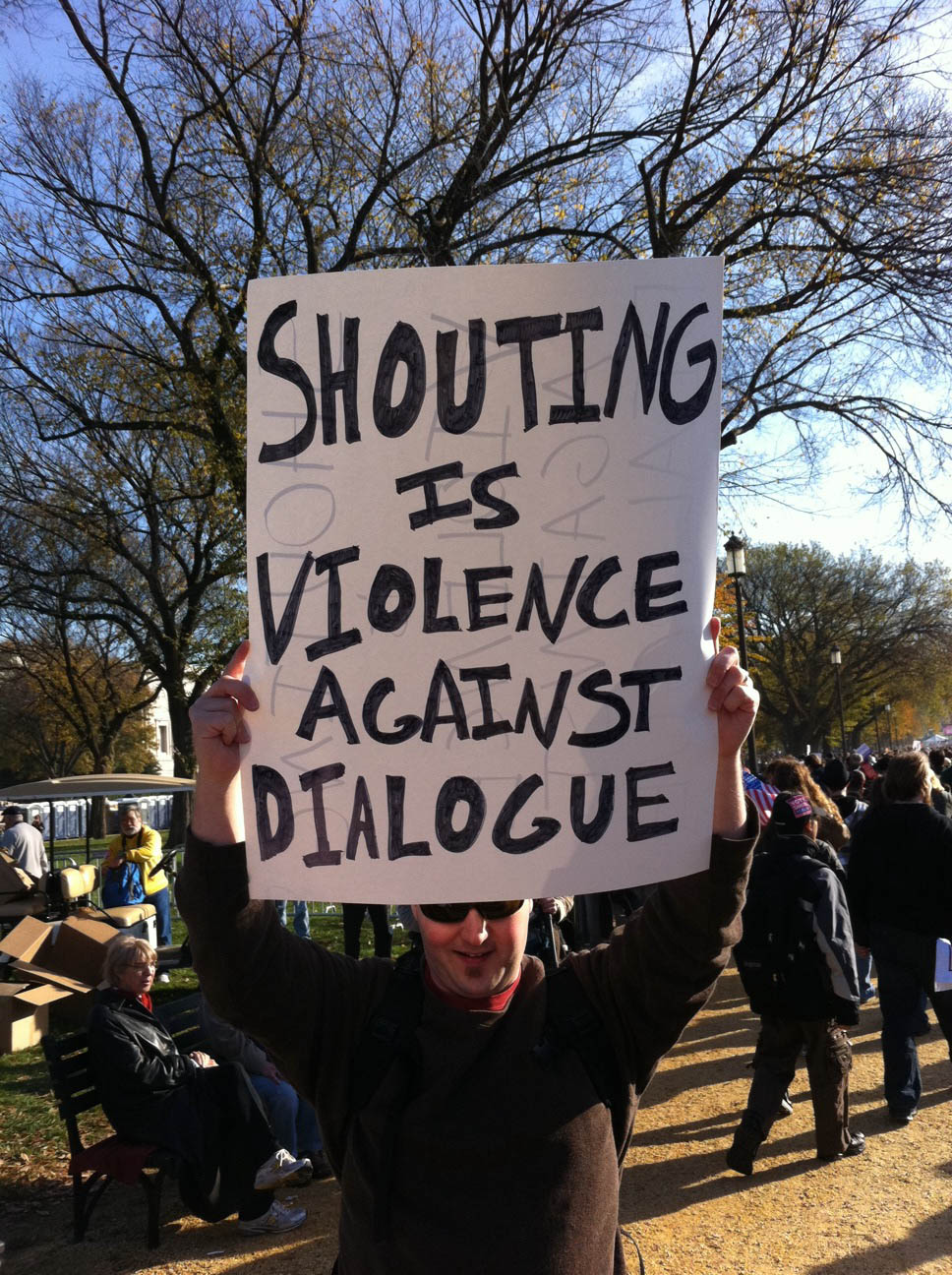
John Stewart’s recent Rally to Restore Sanity was an important political demonstration for all of the fairly-busy people in the USA. It was a moment when those who work forty hours per week or who have too many social bookings were able to come to the United States Capitol in order to proclaim with their “indoor voices” that the current political debates in America are characterized by too much irrationality and fear. As the RTRS website states, Stewart’s rally was expressly for “the people who think shouting is annoying, counterproductive, and terrible for your throat; who feel that the loudest voices shouldn’t be the only ones that get heard; and who believe that the only time it’s appropriate to draw a Hitler mustache on someone is when that person is actually Hitler. Or Charlie Chaplin in certain roles.” It’s interesting that the aim of this rally was ostensibly against the “shouting” and the “loudest voices” rather than any specific ideas, statements, or political positions. In other words, the problem, as Stewart sees it, is that public debates are too full of noise. And it is this noise that must be vanquished—or that, at least, should be modulated to an “indoor” level.
Stewart’s opposition between sound and sanity is actually quite common. Public noise is senseless sound, while rational debate is meaningful sound. The logic goes, then, that public debates need to have less sound or, at least, regulated sound. They must have two people who are willing to speak quietly and rationally, hear each other’s points, and raise and answer each other’s objections until some kind of consensus is built. Good public debates require less sound and more sanity.
But is this sonic modulation the right way to conduct public debate and to persuade others? The truth is that the relation between noise and reason, between senselessness and sanity, is very, very complicated. In fact, although it is a collective national fantasy that good debate is built on reason, there are lots of reasons to suggest that reason doesn’t always (or even predominately) come first. Rather, it’s often the sound that convinces people in an argument—not the reason. And in public debate, the particular sound is “The Voice.”
By looking at an episode of the animated TV show Batman: The Brave and the Bold let’s listen to how The Voice can persuade people to act against their own sanity. In “Mayhem of the Music Meister,” Neil Patrick Harris gives voice to the Music Meister, a singing villain whose tone and rhythm instantly hypnotize those who hear him and bend their actions to his will:

As the opening sequence begins, the audience is prepped for a standard showdown between three villains: Black Manta, Gorilla Grodd, and Clock King, who plan to steal a communications satellite; and three heroes: Black Canary, Green Arrow, and Aquaman, who are prepared to save the day and stop the theft of the industrial hardware. But this showdown is interrupted when–to his surprise and seemingly against his self-control–Black Manta bursts into song, crooning, “I’m sounding shrill against my will.” Soon the other villains and heroes follow suit. All lose control of their voices and begin singing and acting against their own will. What’s interesting about this moment is that losing control of their voices signals a complete loss of self-control. Yet this loss brings with it a division within themselves. On one hand, they recognize that they are singing. On the other hand, they are conscious of the fact that they are equally unable to prevent their own actions. They must sing; they must dance; they must dissolve the initial division between heroes and villains and join together in a revised plan to launch the communications satellite.
From this vantage point, we can return to the alleged difference between sound and sanity. The first problem is that The Voice bypasses reason, making people comply without, or even in spite of, critical reflection. It generally does this in two ways. As the Music Meister episode illustrates, The Voice divides the hearer against himself, taking over his body while he remains fully aware of the situation. In other words, the Voice exerts a direct control over a body while the hearer remains in control of his or her consciousness. The Voice is a science fiction staple. For example, in Frank Herbert’s Dune, the Bene Gesserit are able to speak directly to the unconscious of the hearer while the conscious mind is aware that the body is controlled by The Voice. In the filmed version, an extra quality is added to The Voice in order to highlight the difference between its conscious and subconscious aspects. The Voice must sound different from the voice.
The second way that the Voice bypasses reason is in the way in which a voice– often described musically–makes people lose control of their ability for critical reflection. An example of this form of The Voice also comes from science fiction: the Jedi Mind Trick made famous in Star Wars. In this case, Obi Wan Kenobi bypasses the storm troopers’ ability to recognize the droids they are looking for, even as C3-PO and R2-D2 hang awkwardly from the back of his sandspeeder.

When the logical reasons inevitably fail to account for the act of persuasion in public discourse, others come to the forefront. Often people will say the speaker has charisma, but often they are really referring to The Voice’s role as the persuasive element. What persuades? Not the logical argument, not sanity, but The Voice. And, often, this is against our better judgments or in spite of ourselves. So when Stewart acknowleges the role that “senseless” sound plays in public debates, he goes too far when he calls for “meaningful” sound instead. The two are not in opposition as the RTRS suggested. When all is said and done, sanity almost always depends on so-called senseless sound.
—
Mark Brantner
—
Share this:




Current Top Posts





April 2021

January 2020

November 2019

October 2019

August 2019

April 2014

November 2017

March 2015

December 2017

October 2015


Recent Comments