
Unsettling the World Soundscape Project: The Bell Tower of False Creek, Vancouver

 Welcome back to Unsettling the World Soundscape Project, a series edited by Randolph Jordan that looks critically and creatively at early acoustic ecology along with the writings and subsequent compositions of WSP members, assessing its continuing role for sound studies today. This series follows strongly in the spirit of “Sound Studies 2.0,” a running theme here on SO! this year that Editor-in-Chief Jennifer Stoever has described as “the movement of the field beyond the initial excitement for and indexing of sound toward new applications and challenges to the status quo.”
In the first article of the series, Mitchell Akiyama unpacked the WSP’s monumental ten-hour Soundscapes of Canada of 1974, situating the broadcast’s innovative work historically while also pointing out problems of diversity and representation that could inform how we might listen and create in the future. In this second article, Guest Editor Randolph Jordan offers some of his own highly innovative research, drawing on the notion of “unsettled listening” that he described so vividly here last summer, and focusing on how sound calls attention to territorial boundaries and contested land appropriation from Native peoples of Vancouver.
—
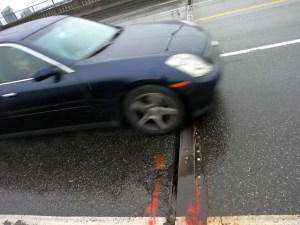 For a few months in 2013, an intense clanging sound emanated from Vancouver’s Burrard Bridge spanning False Creek. A pothole on the surface had opened up next to the metal connector sitting directly atop of the southwest concrete pillar on the shore, activated by passing traffic and intensified by the hollow concrete structures below.
By coincidence, the pothole’s acoustic profile, the “area over which it may be heard before it drops below the level of ambient noise,” was roughly equivalent to the east/west boundaries of Kitsilano Indian Reserve at its peak acreage established in 1877.

Detail of Vancouver map by Shell Oil, 1951, courtesy of the David Rumsey Map Collection
In the century to follow, the reserve would be carved up for a variety of uses and by 1965 it was gone. But in 2013, 100 years after the government – without securing official title to the land – paid the reserve’s residents to leave, the sound of the pothole set the past resonating as the rhythmic clanging reached out to draw the surrounding acoustic environments together while sounding out their roles in contesting indigenous claims to the area. Fitting, then, that the hole sounded loudest directly under the bridge on the south shore, site of newly restituted reserve lands awarded to the Squamish Nation in 2002 after the decommissioning of the railway passage that marked the original reserve’s first transgression in 1899.

People on Kitsilano Indian Reserve beach by Burrard Street Bridge, 1932. Photo credit: City of Vancouver Archives, Item AM54-S4-: Park N9.6
The sound of bridge traffic calling attention to contested land use challenges stereotypical notions about indigeneity in the modern city by upending biases against urban noise pollution typical in early acoustic ecology and exemplified by the work of the World Soundscape Project (WSP). The pothole sound became the locus of my investigation into the value of thinking longitudinally across the Vancouver archive of the WSP, the first assignment given to me by original member Barry Truax as supervisor of my postdoc at Simon Fraser University from 2012-14. I argue that if we use urban noise as a tool for mapping out uncomfortable and subordinated histories, we can rethink the effects of such urban noise on the articulation of cultural space across the WSP archive and imagine new possibilities for future iterations of the project’s Vancouver research.
First question: what documentation of traffic noise around Burrard Bridge exists in the WSP’s three major sets of documentation in Vancouver from the ‘70s, ‘90s and 2010s? Using the Google Map I created to plot recording locations across the archive, I listened to those from which bridge traffic might have been audible. Sure enough, the sound of bridge traffic is present on the original ’73 tapes recorded nearby. In fact, the ‘73 release of The Vancouver Soundscape LP addresses these bridge recordings in a conversation between project director R. Murray Schafer and the recordists, who describe this traffic noise as a source of frustration while attempting to capture the sound of tinkling masts from the boats in the marina beneath.
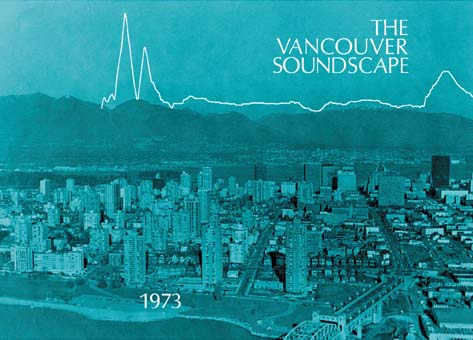
Here the message seems clear: traffic noise is blight upon more valued sounds in and around the city. This position is corroborated by the very cover of the LP that features a graphic representation of a soundwave from a recording of chirping frogs interrupted by a passing car, the example of urban imbalance with which Schafer concludes the final side of the album.
 A few years after the ’73 release, however, Hildegard Westerkamp and Bruce Davis wrote the catalog page for the original set of tapes in which they refer to the traffic sounds as a “noisy, broad wash” that “frames the delicate rigging tinkle of the moored boats.” This is a more aesthetically motivated take on urban din that Westerkamp explores to creative effect in her 1986 piece Kits Beach Soundwalk. A decade after that, Robert MacNevin wrote in the catalog notes for his recording under the bridge that the rhythm of the traffic was part of the “very beautiful” fabric of this sonic tapestry that included the masts swaying in the breeze. This shift in attitude also played into the presentation of the archive on the ’96 Soundscape Vancouver CD. Now under the direction of Barry Truax, this second release featured a selection of soundscape compositions that celebrated all manner of urban sounds as interesting in their own right.
It was very difficult to ascertain whether or not the traffic sounds in these recordings were in any way connected to potholes on the surface. Yet hearing Vancouver’s urban sound through the shifting perspectives of the WSP’s contributing members provided a framework for assessing the value of their work. So I turned to the next question: how might hearing urban noise like bridge traffic, as “staged” by the WSP, contribute to listening to the area in a way that can unsettle its appearance of stability and reveal the tense histories of contestation that have defined it since the time of first contact through to the present day?
On the issue of cultural politics we find less progress across the two official Vancouver releases. Both make some mention of indigenous presence in the land and tie these references to their concerns over urban noise pollution. The ’73 LP opens with the sound of the ocean primordial, lapping against the shore, with wind and birds following in short order. Amidst these, the voice of a Squamish man begins speaking in his native tongue, soon interrupted by an emerging seaplane flying low overhead, ushering in the era of Vancouver’s incorporation as a city and the ensuing industrial development. Only someone who understands the spoken language here will know if the WSP’s narrative runs counter to the story being told by the Squamish man, for no translation is offered either in the grooves or within the jacket.

Display Table for the British Columbia Indian Homemakers Association at Vancouver’s Pacific National Exhibition, 1971. Photo credit: City of Vancouver Archives, Item AM281-S8-: CVA 180-6851
Well-intentioned though they were, the WSP’s problematic construction of machine noise as despoiler of the wilderness is made worse by putting the only voice given to indigenous peoples in the service of this didactic construction. In so doing they contribute to relegating urban indigenous presence to a thing of the past rather than accounting for the consistent and continuing presence of First Nations communities in the city – a luxury they afford to the Greek and Chinese communities later on the disc when these are presented as vibrant and living parts of Vancouver’s modern fabric in a track entitled “The Music of Various City Quarters” (a multicultural gesture they would move away from on the trip across Canada that Mitchell Akiyama unpacked in the previous post in this series).
Similarly, in a brief documentary about Vancouver’s changing sounds on the ’96 release, Westerkamp comments on the intrusive presence of the air conditioning system in the Museum of Anthropology on the U.B.C. campus, marring visitors’ experience of “some of B.C.’s most fascinating Native artifacts.” Westerkamp’s respect for indigenous culture comes through clearly enough. Yet the WSP’s presentation of local indigeneity takes a step backward here as the living voice speaking a dying language heard in ’73 has given way to just plain old dead people in ’96, best contemplated in the quietude of Arthur Erikson’s high modernist design for the building.
 The WSP might just as easily have critiqued this space as an example what Schafer has called the “glazed soundscape” in which sound is cut off from the world visible through large windows, an architectural situation that emphasizes the disconnection between the indigenous culture on display within and the living Native presence in the city outside the museum walls. The fact that the building’s design heightens the perception of the ventilation sound is, like the pothole on the bridge, an example of how urban noise can be heard to mark out indigenous displacement in the city.
Standing under the bridge on the 40th anniversary of the 1973 recordings, and the 100th anniversary of the reserve payouts of 1913, I imagined the pothole as a recasting of the church bell as marker of territorial boundaries, sounding out the colonial encroachment of municipal infrastructure upon 19th Century reserve lands well into the 21st. And so in a multimedia work on the site, I dub the bridge the “Bell Tower of False Creek” for its power to unsettle ideas about the role of urban noise in articulating culture in the modern city, and I wonder what shape the next WSP release might take.
The key lies in deeper consideration of the intersection of soundscape composition and the WSP archive as mutually enriching sites of practice. The positive move on the ’96 release came in actively putting the ‘90s archival recordings in dialogue with the ‘70s material, creatively exploring longitudinal relationships in ways that move in the direction of the post-Foucauldian thrust for artists and researchers to “use archives in a more self-conscious way” as Jaimie Baron puts it (3). Yet they stopped short of “actively promot[ing] a critical attitude towards [the materials] and their uses within the institutions” from which they originate, a key characteristic of archival collage identified by William Wees (47).
The time is right for a critical investigation of the ways in which the WSP’s own construction of the archive itself has delimited its possible uses and how they have controlled the staging of its content these past four decades. In so doing, they might also become more culturally astute in assessing how their biases against certain kinds of urban sound have shaped their presentation of the cultures that live within earshot.
—
Randolph Jordan wanted to be a rock star. Now he teaches cinema and the humanities at Champlain College and Concordia University in Montreal. Draw your own conclusions. After completing his Ph.D. in the interdisciplinary Humanities program at Concordia in 2010 he took up a two-year postdoctoral research fellowship in the School of Communication at Simon Fraser University. There he investigated geographical specificity in Vancouver-based film and media by way of sound studies and critical geography, research that will inform the last chapter of his book An Acoustic Ecology of the Cinema (now under contract at Oxford University Press). If you can’t find him hammering away at his manuscript, or recording his three young children hammering away at their Mason & Risch, look for him under Vancouver’s Burrard Bridge where he spends his “spare time” gathering and shaping film and sound material for his multimedia project Bell Tower of False Creek. Or visit him online here: http://www.randolphjordan.com
—
All images provided by the author, unless otherwise noted.
—
 REWIND! . . .If you liked this post, you may also dig:
SO! Amplifies: Cities and Memory — Stuart Fowkes
Listening to Disaster: Our Relationship to Sound in Danger — Maile Colbert
Unsettled Listening: Integrating Film and Place — Randolph Jordan
Share this:

Twitchy Ears: A Document of Protest Sound at a Distance

“Royal Thai consulate 351 E52 St jeh” on Wikimedia Commons, CC-1.0
“I compare New York to Bangkok all the time,” a young activist told me, just moments before he joined a small, media-ready protest at the Thai consulate in midtown Manhattan. On a pleasant day this past July, along a quiet side street lined with the gold plaques of consulates general, his comparison felt strained—Thailand is currently governed by a free speech-averse military junta that seized power last year, and mourning a deadly terror attack. In Thailand, the tension and fear are acute; in New York, the local delivery driver was whistling.
The young activist, an ocean removed from Bangkok, sought ways of speaking politically, knowing well that he could and would be heard across that ocean When he returns, if he returns, he may be imprisoned, intimidated, or injured. In front of the consulate in New York, those problems were imperceptible to the uninitiated. But they weighed heavily on all of us. Whenever the group chanted or sang, their voices rose through the low ambience like heavy weights, and stopping they fell away without receiving a response. There was a perverse aural disjuncture between the easy rhythms of the day and the harrowing risk that we knew was present in every utterance.
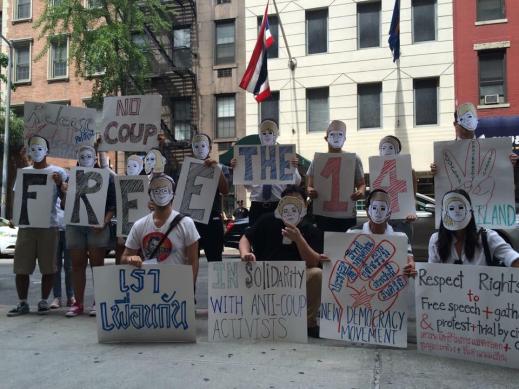
I had come to participate in the event, to speak against the military junta’s recent arrest of fourteen university students for protesting peacefully. I had also come to make a sound recording, and as usual to consider the odd phenomenon of protests staged to create media artifacts rather than to influence people in the flesh. The purpose of the protest was not to negotiate risk but to invite it. It barely mattered that New York City didn’t hear the protest as it occurred. Where it needed to sound potent, it would. Recorded sound surely renders all protest multi-sited; protest sound is a speech-act spatially and temporally deferred.

Picture of #FreeThe14 protest in New York City this past July. From Thai Students Center for Democracy (@TSCD_EN) tweet on July 7, 2015.
However, for protests staged at great physical distance from what’s being protested, the specter of comparison and difference between sites and movements can be profound. New York is in certain ways friendly to protest; the city is liberal with permits, and even unpopular opinions are expressible. Relative to most of Thailand, this is a welcome distinction. Of course, such freedom can blunt the acuity of dissenting speech — protests limited to a specific place and time, accompanied by two polite cops indifferent to the issue at hand, are easy to tune out. The United States has its own instruments of containing dissenting speech.
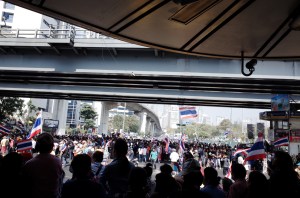
“Protests around Si Lom, Bangkok” by Flickr user
Anton Strogonoff, CC-BY-2.0
Furthermore, as responses to both Occupy Wall Street and the Black Lives Matter movement have shown, organizational structure and subjectivity make some actions more vulnerable to state violence than others. There are moments when a single word can provoke repression here in no less crude a fashion than the Thai junta prefers. But the game has wholly different rules, and these rules engender different strategic responses. Protesting at a distance is both a way of threading multiple sites together and of reflecting on how protesters in different places and movements choose to speak. In the mind of a young activist accustomed to Thailand’s particular labyrinth of political expression, the contrast with his own country can become a source of ideas.
“When I first came here,” the activist continued with a note of awe in his voice, “Occupy Wall Street just started, so it’s like, there is this obvious difference that really intrigued me in how people organize or react to causes. In Thailand we still kind of are using older ways to organize, kind of like really centralized, some figures pretty much
To develop a political movement in the United States is a different challenge than doing the same in Thailand, to put it mildly. In the United States the left risks triviality; in Thailand, it literally risks death. Thai communists were hunted by soldiers in the jungle in the twentieth century, and left-wing political parties are still forbidden today. Republicanism is treason. And with the ascent of the military junta, many trials are now held in secret, and intimidation of political critics is routine. A movement cannot attempt to run headlong toward whatever it wants to topple; circuitous end-runs are necessary. This explains the increased appeal of decentralized protest tactics to Thai activists. The young man I met was far from the first in his country who has espoused such an approach.
***

“Protest Music” by Flickr user killerturnip, CC BY-NC-ND 2.0
The protest began with one woman playing an acoustic guitar, leading the twenty of us assembled in a folk-style singalong. The sincere, uneven rendition of “Song of the Common Man,” currently popular among anti-junta protesters in Thailand, was followed by nervous laughter, and the honk of a nearby taxi. The lyrics are mild and the structure formulaic, but the song has caught on among the junta’s most outspoken critics – notably, one recording available online was made by a band whose songs are strident enough that they were pursued by the military, and forced to flee to Laos. The song lasted less than two minutes, and an American, who worked for a freedom-of-speech NGO in Southeast Asia, ensured that the group moved on to the next part of the tight half-hour schedule. Every moment was brief but assiduously documented.

Picture of #FreeThe14 protest in New York City this past July. From Thai Students Center for Democracy (@TSCD_EN) tweet on July 7, 2015.
We took selfies wearing masks shaped like the faces of the fourteen students who were set to appear before a military court that day. The Thai consulate employees watched with bemusement, and briefly chatted with us in the low, serious hush filled with polite participles that characterizes formal conversation in Thailand. The event ended, and the quiet side street remained undisturbed.
One moment was particularly chilling. The American was leading the group in a series of “what-do-we-want-when-do-we-want-it” chants, which though adapted to concerns of the anti-junta movement felt pro forma and out of place. That cadence and call-and-response pattern is almost never heard at protests in Thailand, and the protesters were not accustomed to it. When someone suggested chanting in Thai rather than English, the group naturally fell into a different rhythm. The repetition of Prayuth aawk bpai, an insulting demand that coup leader General Prayuth Chan-Ocha go away, was much sharper. The chant hearkened to protests of recent years against illegitimate Thai governments. A recording of it would, without doubt, be very risky once heard by the wrong ears in Thailand. Its potency was not only in its direct semantics, but in the connection it formed between the current protest and protests of the recent past. Protest in an age of ubiquitous media tends to form such links across boundaries of time and space.
But a curious thing happens when protest movements can readily observe one another. Comparisons are made all the time, but so are convergences. Rhetoric and strategy become cosmopolitan, not native to any place, and protests increasingly echo other protests. Contemporary Thai dissidents have been influenced by Argentinian horizontalism, and they swap documentaries about the Arab Spring online, for example. The watertight conditions of a geopolitical place have more leaks than was thought. And as ideas travel, the places themselves can become fertile grounds for the growth of those ideas in practice.

“Thailand” by Flickr user Marko Mikkonen, CC BY 2.0
Sound is vital to this process. Perhaps because it is often regarded as the most visceral expression of the body, sound has a special relationship to protest. Sound and self need not be romanticized as coterminous in order to appreciate that speech acts feel very close to the body. But listen again. Sound can both feel immediate and be radically disembodied. It can be a material for experimentation, for feeling out how to speak in the immediate present, and be by the same stroke a final product to be audited by the twitchy ears of the junta. The July protest was and will be both.
—
Benjamin Tausig is assistant professor of ethnomusicology at Stony Brook University, where he works on sound studies, music, and protest in Bangkok and other urban spaces. He is on Twitter @datageneral
—
Featured image: Picture of #FreeThe14 protest in New York City this past July. From Thai Students Center for Democracy(@TSCD_EN) tweet on July 7, 2015.
—
REWIND! . . .If you liked this post, you may also dig:
SO! Amplifies: Cities and Memory-Stuart Fowkes
Toward A Civically Engaged Sound Studies, or ReSounding Binghamton–Jennifer Stoever
Share this:


Current Top Posts





April 2021

January 2020

November 2019

October 2019

August 2019

April 2014

November 2017

March 2015

December 2017

October 2015
 Sounding Out!
Recent Comments