
Shoo bop shoo bop, my baby, ooooo: W.E.B. Du Bois, Sigmund Freud & Barry Jenkins’ Moonlight
 Inspired by the recent Black Perspectives “W.E.B. Du Bois @ 150” Online Forum, SO!’s “W.E.B. Du Bois at 150” amplifies the commemoration of the occasion of the 150th anniversary of Du Bois’s birth in 2018 by examining his all-too-often and all-too-long unacknowledged role in developing, furthering, challenging, and shaping what we now know as “sound studies.”
It has been an abundant decade-plus (!!!) since Alexander Weheliye’s Phonographies “link[ed] the formal structure of W.E.B. Du Bois’s The Souls of Black Folk to the contemporary mixing practices of DJs” (13) and we want to know how folks have thought about and listened with Du Bois in their work in the intervening years. How does Du Bois as DJ remix both the historiography and the contemporary praxis of sound studies? How does attention to Du Bois’s theories of race and sound encourage us to challenge the ways in which white supremacy has historically shaped American institutions, sensory orientations, and fields of study? What new futures emerge when we listen to Du Bois as a thinker and agent of sound?
Over the next two months, we will be sharing work that reimagines sound studies with Du Bois at the center. Pieces by Phillip Luke Sinitiere, Kristin Moriah, Aaron Carter-Ényì, Austin Richey, Julie Beth Napolin, and Vanessa Valdés, move us toward a decolonized understanding and history of sound studies, showing us how has Du Bois been urging us to attune ourselves to it. To start the series from the beginning, click here.
Readers, today’s post by Julie Beth Napolin brings her trilogy to a close, exploring the echoes of black maternal sounding and listening she has amplified in Du Bois in Barry Jenkins’s Oscar-winning film Moonlight (2016).
Essay One: Listening to and as Contemporaries: W.E.B. Du Bois & Sigmund Freud
Essay Two: (T)racing Mother Listening: W.E.B. Du Bois & Sigmund Freud
–Jennifer Lynn Stoever and Liana Silva, Eds.
The theory of the acousmatic—the idea of a sound whose source is unseen, as it comes to us from Barthes, Chion, and Dolar—rests upon the mother tongue and the Oedipal scene, the dyad of mother and father. There is in “Do ba – na co – ba”–his great- great- grandmother’s song Du Bois remembers hearing passed down through his family–a transmission from the mother, but what kind of transmission? “There is no one extant autobiographical narrative of a female captive who survived the Middle Passage,” Hartman writes in “Venus in Two Acts” (3). History becomes, she continues, a project of “listening for the unsaid, translating misconstrued words” (3-4). The word-sounds “Do ba-na co-ba” are not the translation of a misconstrued word and they bolster a song of survival, of living on. But there is a silence there. “Do ba-na co-ba,” in a manner of speaking, survives the Middle Passage, and re-opens it as a primary channel of listening and receiving.
The Bantu woman was Du Bois’ grandfather’s grandmother, so many generations removed.
Returning to the vestiges of black motherhood in recent black cinema (including Jordan Peele’s Get Out and Barry Jenkin’s Moonlight), Rizvana Bradley argues that the loss of the mother “in black life more generally, as it repeats through cycles of material loss, … encapsulates racial slavery’s gendered social afterlife” (51). Bradley’s essay is crucial in retrieving the figure of the lost mother even in moments when the mother is absolutely elided as a character, not to appear visually. Horror more generally owes its immersive quality to the womb (enclosed spaces), but Bradley turns to black film form in particular to find in its mise-en-scène (such as in the gravitational field of the “sunken place”) maternal flesh and form.
In the compositional and formal strategies of The Souls of Black Folk, in the punctuated silences that open each chapter, there is a trace of the elided black maternal. The Bantu woman is lost not because Du Bois did not know her (he could not have), but because something of her song transmits a loss and theft that were not symbolic, but literal—a stolen and kidnapped maternal, rather than simply destroyed, as in the Oedipal mandate. It is crucial that the song that is at the core of Du Bois’ memory is transmitted along the maternal line. This maternal voicing is the unspoken wound of Du Bois’ text.

Spillers begins “Mama’s Baby, Papa’s Maybe” from the premise of non-Oedipal psycho-biographies, and these include not only the single mother, but the kidnapped mother. The quotation marks that surround the figure of the “black woman” for Spillers are “so loaded with mythical prepossession” that the agents it conceals cannot be clarified. Spillers takes particular aim at the infamous conclusions of the Moynihan report of 1965 that trace the roots of African American poverty to the figure of the single mother, the underachievement of lower class black males being linked in the report to black women.
In this way, black culture is thought to operate in a matriarchal pattern essentially out of step with a majority culture where a child’s identity and name, by definition, cannot be determined by the maternal line (66). As Lacan insists, it is the Father who gives a child both the Name and the symbolic Law (language). According to this configuration, Spillers argues, the child of the black mother can only be left in a haunting dis-identity. The implications for psychoanalysis are radical: Spillers begins the essay with a “stunning reversal of the castration thematic,” one that displaces its structure “to the territory of the Mother and Daughter, [and] becomes an aspect of the African-American female’s misnaming” (66). Among these misnamings is that black women are often not seen as “women,” omitted from the category and its political inflections. She is left castrated, politically impotent. For in this displacement, the subject positions of “male” and “female” lose—or fail to adhere to—their traditionally conceived symbolic integrity, and this loss begins with the historical experience aboard ship.

“waves and shadows,” image by Flickr User Albatrail
For Spillers, then, it is essential to trace this misnaming and undifferentiation of black women to the physical and psychic conditions of the Middle Passage. When Freud begins Civilization and Its Discontents, he notes an “oceanic feeling” engendered by religion. The oceanic is the longing for return to a pre-subjective state where one is united with all that is, before the cut that is birth and then language (indeed, the oceanic feeling is often attributed to song). Spillers’ move is to read the oceanic literally and structurally at once: there is the Atlantic Ocean and its Middle Passage. The oceanic, in this way, is de-subjectivating; it casts the subject out of itself in a terror of undifferentiation that does not cease with landfall.
But Spillers also implies that, in that (sexual) undifferentiation, a radical political potential can be retrieved. It is not that black feminism retrieves for her a sexual differentiation after becoming an ambiguous thing. It would not be “woman” in any traditional sense, for that New World category rests upon the violence Spillers seeks to describe. Above all, it would not be easy to name.
Du Bois certainly takes up the Father in his poetic epigraphs. But in ending with the Bantu woman’s song—as it seems to anatomize all of the other songs he describes—Du Bois upholds himself as being named by the maternal line. He is unable or perhaps unwilling to make a clarified place for a black female political agent. If we listen with ear’s pricked, we find that she is the submerged, oceanic condition for his speech.

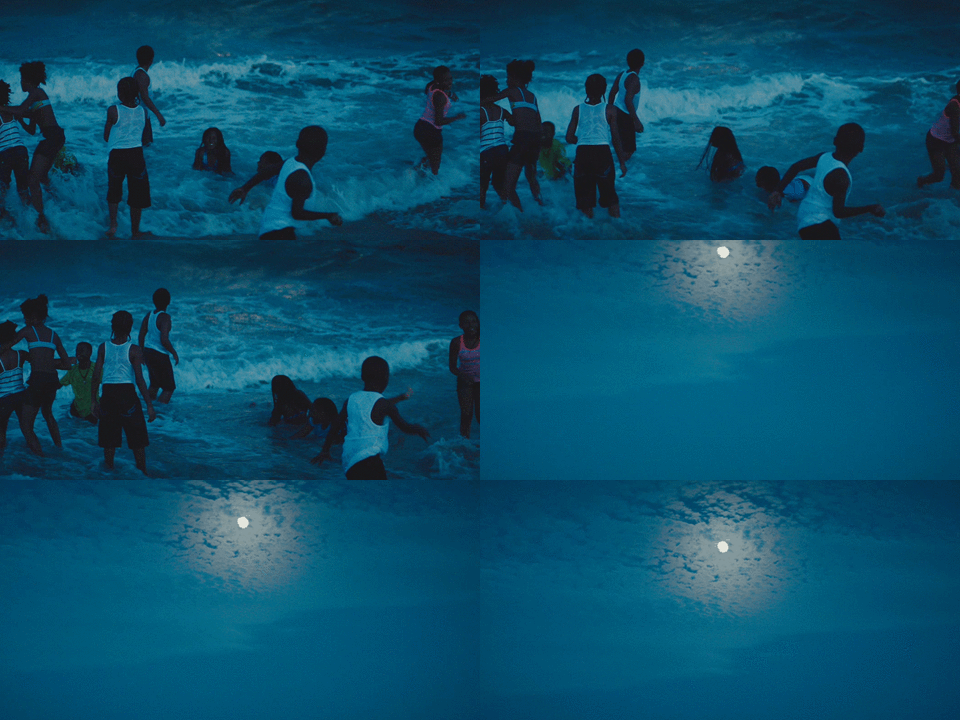
By way of an open-ended conclusion, we can recall the sound of the ocean that punctuates Jenkin’s stunningly lyrical and psychologically complex coming-of-age film, Moonlight. The ocean provides the anchoring location for the psychological action, but also its aesthetic locus, the beginnings of its cinematic language. The sound of the ocean continually marks a desire for “return” to maternal undifferentiation and oneness, and yet, it provides the space for two embodied memories that cannot be compassed by traumatic separation. In the first, a father-like figure, Juan, embraces a young boy, Little, to allow him to float in a nearly baptismal scene of second birth, and in a second scene at the shore, Little experiences with his friend, Kevin, sexual gratification, a coming into his body as a site of pleasure.
The conclusion of the film posits these moments as being in the past. We had experienced them as contemporary, but only later realize they are a well of memory for a now-adult subject who does not know himself. I want to focus, then, on the film’s conclusion, after Kevin and Little (now named Black, his adult re-renaming), meet again after many years. Kevin calls Little/Black on the phone, a defining gesture of reaching out erotically and acousmatically with voices. We later learn that he calls because Kevin has heard an old song that reminded of him of his lost friend. By this voice or call, Black is brought somewhere back to his moment of break to become Little again, as if something in the past must be recuperated for the present. As he drives down the open road to find Kevin, the music of Caetano Veloso soars.
We can’t be sure if this is extra-diegetic or diegetic music. To be sure, Black would never listen to such a song on his stereo. And yet, the song seems to emanate directly from its affective space. In the language of literature, it is a “free-indirect style,” part character and part author; the film is hearing Black/Little feel. He’s in a space of haunting melody, drenched in personal memory, whose principle scene had been the Florida shore, the ocean lapping providing a (maternal) containing motif for the film, now transmuted into song.
The oceanic, Spillers might remind us, is violent, echoing the passages that made it possible for these two black boys to be there. But the sound is also amniotic, a space of maternal longing, particularly for a character who, in Bradley’s estimation, is positioned as pathological, injured by the missing mother who is, in turn, indicted by the film’s imaginary. To some extent, Moonlight participates in the mother’s misnaming: it cannot see the structures that ensure her lostness. But the film does also push towards some mode of melancholia that, as Michael B. Gillespie argues of Jenkins’ earlier work, would cease to be depressive. Jenkins’ aesthetic practice is transformative, Gillespie suggesting that we use Flatley’s term, “antidepressive melancholia,” as it’s with a stake in the personal past but turned towards the collective future (106).
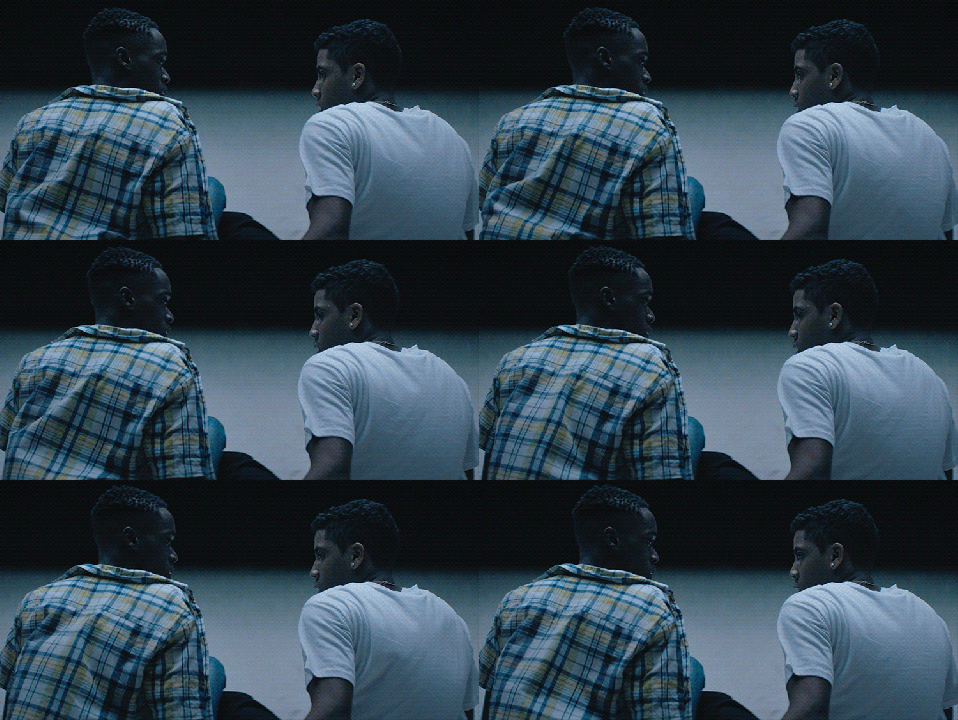
When the two boys, now men, meet again, several sounds punctuate the scene. They are not words or even phonemes, yet “speak” to provide a sonic geography of feeling that includes or “holds” the viewer, as Ashon Crawley might suggest. Among them is the sound of the bell on the door, which marks hello and goodbye, entry and exit, coming and going (or “fort-da” in Freud’s lexicon). When Black enters the diner, he is still “Black.” It is only when remembering what happened at the shore, then to say that no man has touched him since, that he becomes Little. He discloses this truth on behalf of a potential in present and a still-nascent future. Kevin cooks for Black, and Jenkins’ is careful to amplify the sound of the spoon stirring. He provides for Black, the film locating Kevin, a male, within the coordinates of maternal care. The sonic crux of the scene—no longer primal, no longer traumatic—is when Kevin plays the song on the jukebox that had drawn him to call to Little/Black in the first place. “Hello, stranger,” Barbara Lewis croons, “it seems like a mighty long time. Shoo bop shoo bop, my baby, ooooo.”
In listening to a song that is from our past, Newtonian time collapses, a shock running from past to present. The film never discloses whether these two had once heard this song together before. It is more likely that its affective map impacts Kevin, that he hears in its melancholic sound a nascence, and with it, a longing to retrieve his own past and repair. Lewis herself, singing in the sixties, is a recalling an already eclipsed fifties doo-wop. The phonemes circle back to their beginnings in “Do ba- na co-ba.” Such sounds are to be opposed to the shot of Little’s mother yelling at him (presumably a slur). There, the sound had cut out of the scene, which recurs for Little in a traumatic nightmare.
In contrast to that violent naming, the boys’ intimacy was defined by, to use Kevin Quashie’s term, “quiet,” a sense of interiority Michael Gillespie explores in his analysis of Jenkins’ first feature film, Medicine for Melancholy. Shakira Holt and Chris Chien called this dynamic in Chiron and Juan’s relationship “silence as a form of intimate conversance” in their 2017 post about Moonlight. There is a queer intimacy revived apart from trauma, triangulated by a black woman’s voice, paired with male harmonies, that resonate acousmatically from the jukebox to hold and contain the scene. For psychoanalytic theories of voice, containment is the essential maternal gesture of song.
We begin to wonder what might be possible for the feminine were it to be separated from the maternal dimension, a potential that Jenkins does not explore in this particular film in his oeuvre (as he does in Medicine for Melancholy, for example); each of the women in Moonlight “mother” to some extent. Nonetheless, he disperses the maternal function across male and female subjects, particularly in moments when the film resists depression. In listening with ears pricked, as with Du Bois’ epigraphs, the voices cease to belong to an individual, to be male voices or female voices, but become plural and pluralistic. It becomes possible to ground a politics of listening to the past for remaking in the present in that sound.

—
I would like to thank Michael B. Gillespie, Amanda Holmes, and Jennifer Stoever for their incredible scholarly assistance and comments in writing this essay trilogy.
—
Julie Beth Napolin is Assistant Professor of Literary Studies at The New School, a musician, and radio producer. She received a PhD in Rhetoric from the University of California, Berkeley. Her work participates in the fields of sound studies, literary modernism and aesthetic philosophy, asking what practices and philosophies of listening can tell us about the novel as form. She served as Associate Editor of Digital Yoknapatawpha and is writing a book manuscript on listening, race, and memory in the works of Conrad, Du Bois, and Faulkner titled The Fact of Resonance. Her work has appeared in qui parle, Fifty Years After Faulkner (ed. Jay Watson and Ann Abadie), and Vibratory Modernism (ed. Shelley Trower and Anthony Enns).
—
 REWIND! . . .If you liked this post, you may also dig:
Moonlight’s Orchestral Manoeuvers: A duet by Shakira Holt and Christopher Chien
“A Sinister Resonance”: Joseph Conrad’s Malay Ear and Auditory Cultural Studies–Julie Beth Napolin
“Scenes of Subjection: Women’s Voices Narrating Black Death“–Julie Beth Napolin
Share this:

They Can Hear Us: Surveillance and Race in “A Quiet Place”
The family in A Quiet Place (2018) lives a life marked by incessant trauma. Invisible to the hunters who are far more powerful than they are, the family remains safe from direct assault as long as they remain unheard by the hunters, who can’t see them. But that same invisibility means the everyday mundanities of life become a constant struggle marked by the terror of the horrific death that will claim them should they make an errant sound. A trip to the pharmacy could prove fatal; a hungry child could summon the hunters and put in danger the entire family. When sketched out in these broad strokes, A Quiet Place, as Kathryn Adams Burton pointed out to me when we left the theater, summons terror from its viewers by depicting the kind of institutional surveillance and violence that endanger Black lives in the US, without one person of color in the entire movie. Thinking with Simone Browne’s Dark Matters (2015), Jennifer Stoever’s The Sonic Color Line (2016), and Jared Sexton’s Amalgamation Schemes (2008), I argue here that A Quiet Place places white characters in a non-white relationship with surveillance, which they overcome in a way that projects white ingenuity and strength and reinforces the centuries-old notion that those who live under the eye and ear of hyper-surveillance tactics do so because they deserve to and because they are not exceptional enough to evade those tactics.
 The Quiet family’s invisibility is literal: the creatures who hunt them have no sense equivalent to human vision and instead track their prey using hyper-developed listening abilities. They remain vigilant for the audible traces of their victims; sound is the thing that can put the family in trouble. Simone Browne highlights in Dark Matters the significance of visibility and invisibility in the history of antiblack surveillance in the US. Lantern laws in 18th century New York City stipulated that enslaved black and indigenous people must carry a lit lantern if they were in the streets after dark, a regulation that Browne understands as an act of “racializing surveillance,” a “form of knowledge production about the black, indigenous, and mixed-race subject” (79). Specifically, the knowledge created through the lantern laws marked bodies of color as “un-visible,” in need of illumination in order to be properly seen. And here “seen” slips into a couple of different meanings, encompassing not only the ocular but also the notion of “seeing” that connotes understanding and discernment.
The early technology of lantern surveillance, as well as the boundaries delineated by sundown towns, marked black, indigenous, and mixed-race bodies as untrustworthy, scheming, and therefore in need of ongoing surveillance that would make these bodies visible to the eye. At the heart of Dark Matters is Browne’s contention that the history and techniques of surveillance cannot be understood separate from their racializing work: “surveillance…is the fact of antiblackness” (10). So while the Quiet family is white, their relationship to the powerful beings that hunt them–an existence unseeable and unknowable apart from heightened measures of surveillance–appropriates signifiers of racialized surveillance in order to heighten the stakes of the movie’s characters.

The family walks on sand in order to muffle their footsteps.
While Browne focuses primarily on acts of looking as mechanisms for violently enforcing the color line in Dark Matters, Jennifer Stoever traces the history of that same color line through listening practices. Stoever isn’t explicitly engaging surveillance studies the way Browne is, but her theorization of the “listening ear”–the social and political norms that shape how we hear race–includes surveillance acts that, like lantern laws, mark voices perceived to be non-white as always already ready to be monitored, bounded, and eliminated should they exceed their boundaries (13). For both Browne and Stoever, the act of surveilling uncovers a racializing sleight of hand: non-Whiteness is held up as that which stands out, though this racialization is proven backwards if we look and listen a bit closer. US looking and listening norms condition people to organize blackness and brownness and noise as aberrations against natural, invisible, inaudible whiteness, but it takes a good deal of white supremacist work to create this illusion (by “white supremacy,” I mean the social and political practices and institutions that reify and reward whiteness). Looking through brighter lights and sharper camera lenses at non-White subjects and listening through amplification devices and ubiquitous bugs to non-White subjects are both ways of drawing attention away from whiteness–the racialized construct that fuels US social, legal, and political praxis–and toward non-whiteness.
Stoever opens The Sonic Color Line by considering the violence visited upon Jordan Davis, Sandra Bland, and a Spring Valley High School student when each was considered too loud and unruly by white listening ears trained to surveil blackness. The Quiet family is listened to in the same way Davis, Bland, and the Spring Valley student were, in the same way non-whiteness has been surveilled in the US: with dire consequences for being too loud. But, by erasing black and brown bodies and histories from the screen, A Quiet Place divorces these surveillance tactics from their real-world context, where they work as tools of white supremacist systems to “fix and frame blackness as an object of surveillance” (Browne 7). Part of the fantasy of A Quiet Place involves “fixing and framing” whiteness as the objects of sonic surveillance practices that have historically worked to preserve and reward whiteness, not target it.
 While the Quiet family is subjected to antiblack surveillance techniques, they are otherwise marked as white–and not just based on what their skin color looks like. Farmers in a rural, hilly region of Upstate New York, the Quiet family navigates the apocalypse with a libertarian aplomb. They’re stocked and loaded when the government fails to protect its citizens, and they’re also aware of but not in collaboration with other survivors in the surrounding area. Operating outside the bustle of urban noise, which Stoever notes is marked as non-White by the listening ear, the Quiet family likely boasts generations of working class whites who benefited from the kind of social safety nets built by the New Deal, only to mistake the wealth those social programs built to be fully the fruits of their own hard work.

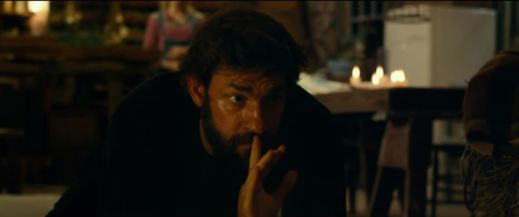
The father, played by John Krasinski, looks over their plot of land.
The independence and autonomy that the Quiet family demonstrates is not on its own a marker of whiteness, but the kind of wealth accumulation that makes non-collaborative survival possible is the kind that’s historically been more readily available to white folks in the US. It’s a history that is flattened, as is the history of the surveillance that shapes their lives. Their wealth simply exists, and viewers aren’t meant to wonder where it came from or at whose expense. Likewise, viewers learn very little about what the hunters are, where they came from, and why they’re here. The hunters just appear, terrifying sonic surveillers who carry signifiers of antiblack listening practices but who remain detached from the antiblack history of surveillance.
The racialized terror at the heart of A Quiet Place grows from the fear of being denied one’s whiteness, being subjected to the same controlling surveillance measures that have helped maintain the color line for centuries in the US. It’s a standard white sci-fi nightmare scenario where technologies spin out of control and subjugate all of humanity, white people included. It’s also a white exceptionalist fantasy, where whiteness–not just white people but the wealth and freedom created for white people by white supremacist systems–conquers the unconquerable. Jared Sexton’s Amalgamation Schemes can prove helpful here, as he outlines the way racial ideology has shifted in recent decades to permit multiculturalism so long as it preserves whiteness. While systems like slavery and segregation were buttressed by explicit white supremacy, where whiteness = good and non-whiteness = bad, contemporary racial hierarchies are maintained by conceding that multiculturalism = virtuous and race-based solidarity = problematic. Here, white supremacy cloaks itself in diversity, hybridity, mixedness and points to any group that coheres around racial identity as regressive.
 Flattening history is crucial to that ideological shift. In order to maintain a racial hierarchy that tips in favor of whiteness, past violence and kleptocratic seizures of money, resources, and lives must be removed from the equation so that the kind of multiculturalism that Sexton critiques can proceed as if all who participate do so on a level playing field. Whiteness becomes “something equivalent to the…ethnicities and cultures of nonwhite immigrants and American Indians” (Sexton 66). The field, of course, isn’t level when white supremacy has funneled centuries of ill-gotten gains to whiteness, so this kind of multiculturalism is a way of gaming the system, mixing up racial signifiers so that white folks can take on just enough racial signifiers to blend into a racially diverse society without giving up the power and privilege that continues to give them a leg up.
A Quiet Place follows a calculus similar to the multiculturalism Sexton describes. First, the movie extracts emotional responses of terror and dread through a mixture of racial signifiers, subjecting white characters to forms of surveillance rooted in antiblackness. With no historical context to explain the forms of surveillance the hunters use or the characters’ previous relationships to surveillance, the Quiet family’s whiteness becomes just another ethnicity, a flattened way of being in the world divorced from the white supremacist context that funnels resources their way. Their privilege and power become as invisible to viewers as they are to the hunters. By masking that privilege, A Quiet Place clears space for a fantasy world where the white heroes have survived by virtue of being simply more clever, more resourceful, more brave, more everything than all the black and brown people who have, by implication of their absence from the film, been killed off by the hunters.
 A Quiet Place, then, takes a family of multiculturally white characters and positions them in roles white characters have become accustomed to occupying: that of world saviors–some of them even martyrs. Here, hyper-surveillance is simply a fact of life, and those who are able to live life free of the dire consequences of that hyper-surveillance are able to do so because they are exceptional. By this logic, what protects you from the police is either your innocence or your guile, not your whiteness. What guarantees your safety when you publicly challenge government policies is the righteousness of your cause, not your whiteness. What allows you to move in the dark without a lantern or to listen to your music loudly in public spaces without being shot or to cross borders without fear is your inherent virtue, not your whiteness. And when surveillance is positioned as a fact of life, and when those who avoid the crushing consequences of surveillance are understood to do so because they are virtuously exceptional, then those who are targeted, hunted, and killed using hyper-surveillance tactics are understood to be deserving of their fate because they are not virtuous or exceptional enough to avoid it. This is the logic that frames slavery as a choice, that cages children at the border, that influences and fixes elections across the globe but takes umbrage when subjected to the same tactics.
One terrible irony of a movie like A Quiet Place is that its flattened hyper-surveillance context makes it incapable of seeing and hearing the deep and rich history of black and brown evasion of hyper-surveillance. There’s an ingenuity coursing through activities of evading surveillance–“looking back,” marronage, and fugitivity chronicled by writers including Sylvia Wynter, Franz Fanon, Katherine McKittrick, and Simone Browne, among others–an ingenuity that evades hyper-surveillance and simultaneously exposes hyper-surveillance as antiblack while arguing against the notion that it is simply a fact of life and signalling avenues to freedom. Instead of those stories, though, the white Quiet family whispers to us a familiarly unsettling refrain: the white Quiet family, alone, can eradicate these terrors. The white Quiet family, alone, can fix this. The white Quiet family, alone, are exceptional.
—
Featured image, and all images in this post are screenshots from “A Quiet Place ALL TRAILERS – Emily Blunt & John Krasinski 2018 Horror Movie” by Youtube user Flicks And The City Clips.
—
Justin Adams Burton is Assistant Professor of Music at Rider University. His research revolves around critical race and gender theory in hip hop and pop, and his book, Posthuman Rap, is available now. He is also co-editing the forthcoming (2018) Oxford Handbook of Hip Hop Music Studies. You can catch him at justindburton.com and on Twitter @j_adams_burton. His favorite rapper is one or two of the Fat Boys.
—

REWIND! . . .If you liked this post, you may also dig:
Teach Me How To Dougie Like A Mediocre White Man–Justin Burton
Resounding Silence and Soundless Surveillance, From TMZ Elevator to Beyoncé and Back Again–Priscilla Peña Ovalle
Quiet on the Set?: The Artist and the Sound of a Silent Resurgence– April Miller
Share this:


Current Top Posts





April 2021

January 2020

November 2019

October 2019

August 2019

April 2014

November 2017

March 2015

December 2017

October 2015
 Sounding Out!
Recent Comments