
SO! Reads: Damon Krukowski’s The New Analog

 Analog revival has gained traction across many media in recent years, but perhaps nowhere so strikingly as in sound. The shifting formats and fortunes of a digitally reshaped music industry invite, for many, the counterposition of a bright nostalgic picture. Yet artists and engineers whose work has spanned the transition from analog to digital sound find that the romanticization of the former can have a weird overreach. For example, when Dave Grohl produced a digital-decrying documentary on the LA studio Sound City, engineer Larry Crane was bemused that “Grohl seems to be attributing the arc of his career to the magic in a Neve console.” Recordists like Crane find themselves in between the Scylla and Charybdis of digital-era music: on one side, the embrace of new tools that are as entangled with corporate control structures as they are convenient; on the other, a skepticism that overshoots its mark, fetishizing old technologies and cementing a previous generation’s in-crowd as gatekeepers. Decades after digital media triggered one of the most momentous transitions in sound recording, the debate around their use is anything but settled. Tied up in this contest are questions of how and what pre-digital media will be preserved, but also problems like whose use of technology in music-making constitutes authentic talent and who has authority in the determination.
 When Damon Krukowski steers into these waters with The New Analog: Listening and Reconnecting in a Digital World (The New Press: 2017), he is quick to qualify that his memorializing of pre-digital practices “is hardly a Luddite’s call” (12). Noting the “all-or nothing response” that “dominates popular discussion of the many anxieties provoked by the digital revolution” (9), Krukowski contrasts the disruption-embracing “clean break” with life on the “technological island” (8) of confining one’s practice to outmoded materials. Addressing a reader who lives more or less contentedly in a contemporary media world, he speaks as a kind of expatriate of the analog island. He, too, lives in the digital present, but he sees it through the lens of decades spent working with and listening through analog machines. His project of defending analog listening practices takes inspiration from the efforts of urbanist Jane Jacobs, who labored to turn back the tide of redevelopment and suburbanization by celebrating the organic functionality of city life. His central argument for preservation is that “what we are losing in the demolition of analog media is noise” (197, emphasis original). Noise becomes a character in The New Analog akin to the city block in Jacobs’s work: a wrongly maligned figure that has quietly formed the basis of experience and utility in the old mode.
Though Krukowski’s definition of noise is flexible in some ways, he casts the digital as its uncompromising antithesis. This position precludes what could make the book more forward-looking in its aim: a consideration that noise might become a new kind of character in the digital realm rather than disappearing at its edge. Noise shows up in analog media as buzzing undercurrents and as modes of distortion when electrical signals exceed their ranges; digital media, while lacking these, are replete with moments of failure when a system is fed the wrong kind of information or pushed beyond its intended bounds. In their repetition, these moments of error become a new kind of noise that, just like analog noise, forms an unremovable layer of our experience in mediated environments. By declining to look for digital noise and instead focusing so squarely on noise as something lost to the digital transition, Krukowski misses a chance to center a more significant linkage with Jacobs: many of the problems he sees in digital-era sound are not due to the inherent nature of digital media but rather to the same motives of control and segregation underpinning the drive toward suburbanization.
Yet his original and thoughtfully cast historical route points us toward these culprits, even when the language drifts toward a more technologically deterministic stance. It is thus that his book still provides a vibrant body of historical consideration we can leverage in using noise to reshape our digital ways of listening. The moments when Krukowski lets technology stand in for the human motives that construct it give unfortunate cover to what should be the targets of such a critique. But his real concern toward the digital era arises from specific changes in the landscape of aural awareness, and he ultimately succeeds in the task of elevating his argument above the cliché of deterministic digital-bashing by setting its true focus not on the digital but on the era.

headphones by Flickr user Chris, (CC BY-NC-ND 2.0)
Readers might be surprised, for instance, to discover that The New Analog’s first chapter covers a development in sound — the transition from mono to stereo — that has nothing to do with digitization at its outset. The chapter narrates the release of Pink Floyd’s The Dark Side of the Moon as a critical moment in consumer audio’s treatment of headphones as the ideal listening space. This movement toward individualized experience becomes a crucial part of setting the stage for the actual entrance of the digital. The design of digital media, Krukowski demonstrates, has not just carried forward this trend but absorbed it as a guiding principle, and has effected the same transformation not just in listening to music but across all kinds of daily situations. “The stream of digital information can put each of us in a different space than the others, even as we hurtle together through a tunnel on fixed tracks,” (49) Krukowski observes of the changed social experience of riding a subway. The comment makes an easy metaphoric return to music: digital design is now funneling sonic experience into a small number of streaming platforms, each promoted on the appeal of moving out of a collective listening space into one of personal curation. Claiming that a dangerous disorientation can arise in the separation of such neatly personalized spaces from their messier surroundings, the chapter closes with a cautionary tone: bad things can happen when we follow along with the digital logic of turning a once noisy situation into “a stream that is signal only” and when we stop “paying attention to noise.” (51, emphasis original).
Noise closes out each chapter, constituting the shared floor on which the book’s arguments stand. This construction calls for scrutiny, because noise is a notoriously slippery figure. As Marie Thompson notes in her recent interview with SO!, subjective and objective definitions both lay claim to noise, bringing along problems of politicized value judgment and erased context. At the same time, the term’s many meanings (electrical, legal, musical, etc.) serve as useful bridges. In Sound Ideas: Music, Machines, and Experience, Aden Evens uses noise as a primary example when he suggests a “productive ambiguity” can prompt connections that help different disciplines approach meeting points. Krukowski would, it seems, endorse this idea. He couples his formulation of noise to that of analog — an analog medium is identifiable by its noisiness, and noise is the substrate by which meaning takes hold in an analog medium.
Is it fair, though, to chain the figure of noise so tightly to analog recording that we must say it is wholly lost in the move to digital? In arguing that digitally mediated communication lacks the analog mode’s quality of perceivable distance, Krukowski lists perceptual coding — the application of “psychoacoustic research to digital sound processing” (75) — as one culprit. Jonathan Sterne, in MP3: The Meaning of a Format, points to perceptual coding’s advent as a moment when noise was domesticated. Where engineers had long sought to minimize noise, perceptual coding meant that “communication engineering exhibited a new attitude toward noise. Once you can use signal to hide noise, the game is up. Noise ceases to matter as a perceptual category.” This change in noise’s status does not eradicate it or lessen its importance, though. According to Sterne, this domestication made noise more available as a site for artistic exploration and subversion. But if noise is a key foundation on which we find meaning through listening, as Krukowski compellingly argues, and noise has been subjected to a great domestication, what does that say about the forces at work upon our listening?
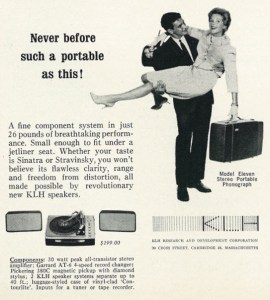 A fascinating answer emerges in a thread that pops up multiple times across Krukowski’s anecdotes: the relationship between patriarchal domesticity and the shaping of digital sound. In the chapter on stereo, he includes an ad from a 1962 Playboy issue where a man carries a woman as if across a threshold; she, in turn, holds a stereo set in its portable case. The ad pairs the stereo and the wife as two laudable choices in the man’s domestic assemblage. Both are manageable enough for him to carry home, yet both promise to extend his control — Krukowski notes that such marketing material touted stereo products as letting their owners occupy “the producer’s chair” (28) by granting listeners new agency over the mix. That focus on idealized male consumers echoes still through gendered suppression in musical exchange: as Elizabeth Newton writes, “Though women have collected vinyl since the inception of the medium, female collectors, like the women musicians being collected, often lack representation in public space that is commensurate with their actual involvement.”
True to the analogy with Jane Jacobs’s struggle against the developer Robert Moses, the patriarchal force that has ingrained itself so thoroughly in digital audio is also a suburbanizing one, keyed to a politics of racial segregation that frequently cites noise as a justification. In “‘Just Be Quiet Pu-leeze’: The New York Amsterdam News Fights the Postwar ‘Campaign against Noise,’” Jennifer Stoever documents how “white press discourse on Puerto Rican migration firmly attached ‘noise’ to the voices, bodies, and neighborhoods of Puerto Rican migrants — portraying white flight to the suburbs as a justifiable escape to suburban refuges of peace and quiet and targeting urban areas such as Harlem in ‘antinoise’ campaigns” (PAGE). Regina Bradley traces this “connection between whiteness and quiet” through to a contemporary moment in her SO! post “Fear of a Black (in the) Suburb.” The history of racially targeted noise ordinances intersects Krukowski’s narration of the proto-digital movement toward private listening. He quotes LL Cool J’s “I Can’t Live Without My Radio” as a noise-ordinance-defying affirmation of boombox listening, the antithesis of headphones and their sonic compartmentalization. Dwelling on the song’s line “Terrorizing my neighbors with the heavy bass,” he points to the artist’s intentional use of noise as a political implement, bound up jointly in his listening and his music making.
For Krukowski, the song is noteworthy in demonstrating a practice lost to the wave of noise-eradicating digital development in sound. If we approach it with the consideration that noise might not have been lost but rather domesticated, however, it serves more as a guidepost. Were he looking to LL Cool J’s example as one in need of a digital-era parallel, Krukowski might arrive at a different treatment of Kanye West’s post-release revisions of his album The Life of Pablo than he gives later in the book. Rather than describing West’s changes as “art severed from its own history” (169), he could instead credit the album’s uniquely digital instability as a moment of usurping the corporate platform as the arbiter of a record’s final version — an instance of harnessing digital noise within a digital environment to reorient its assumed parameters of authority and a prompt for listeners to consider their own role in deciding what version of the text should prevail.
Though Krukowski declines to bring it to the forefront, the involvement of a domesticating and segregating force lends further weight and precision to The New Analog’s historical argument. Returning to his invocation of Jane Jacobs, Krukowski analogizes the dichotomy of street and home with that of analog and digital. “Noise has a value of its own—the value of shared space and time,” he writes. “The urban spaces we occupy are built on that commonality. The street is a noisy place. And the street has value, as Jane Jacobs pointed out” (207, emphasis original). The contrast between analog street and digital home reaches back to rescue the book from the flawed pronouncement that digital tools themselves are the problem. We are left to consider a much richer historical argument about the alarming success that efforts of domestication and power-consolidation have found in intertwining themselves with digital media.
In that light, readers looking for an actionable takeaway from The New Analog shouldn’t just unsubscribe from streaming services and start (or resume) buying vinyl records. They should redirect their attention toward the very thing of whose existence Krukowski seems skeptical: digital noise. Even though the digital home is built to confine, there are new noisy streets outside it to be explored. Krukowski recounts how the band Can endeavored to let their recording studio “compose on its own” and to become an activating, curating conduit for the sounds of tape machines. “In Can’s studio technique,” he writes, “noise and signal are equally significant materials…. the noises in it are no less human than the signals” (138). If we look for digital noise, we will see that it bears no less potential for meaning and beauty than Can’s analog noise, as artists are already proving with techniques like glitch and sampling. We as listeners can do more to help realize that aim by celebrating digital noise, by recognizing what it reveals and critiques. For a project that with less care could have steered off into the welcoming terrain of nostalgic grievance, The New Analog offers a surprising amount to point our way forward.
Holly Herndon’s “Home” uses sonic and visual sampling to turn the surveillant gaze of an intimate digital space back on itself.
—
Featured image: “Scenes From The Recording Studio” by Flickr user G. Dawson, CC BY-NC-ND 2.0
—
Andy Kelleher Stuhl is a writer, sound artist, and software developer focused on creative infrastructures and the politics of mediated sonic exchange. His work looks to musicians for inspiration and aims to apply musical creativity as a model for new paths in such domains as digital humanities and the critique of technology. His research has investigated the phenomenon of analog fetishism from the perspective of sound engineer communities and, more recently, the process and aspirations behind interactive musical works. He holds a master’s degree in Comparative Media Studies from the Massachusetts Institute of Technology and a BA in Science, Technology, and Society from Stanford University.
—
 REWIND! . . .If you liked this post, you may also dig:
SO! Reads: Susan Schmidt Horning’s Chasing Sound: Technology, Culture and the Art of Studio Recording from Edison to the LP— Enongo Lumumba-Kasongo
SO! Reads: Jonathan Sterne’s MP3: The Meaning of a Format–Aaron Trammell
Digital Analogies: Techniques of Sonic Play–Roger Moseley
Evoking the Object: Physicality in the Digital Age of Music–-Primus Luta
Share this:

Beyond the Grandiose and the Seductive: Marie Thompson on Noise

Dr. Marie Thompson is currently a Lecturer at the Lincoln School of Film and Media, University of Lincoln. Her new book Beyond Unwanted Sound: Noise, Affect and Aesthetic Moralism has just been published by Bloomsbury. We’ve been following each other on Twitter for a while(@DrMarieThompson and @AbstractTruth) and I have become very interested in her ideas on noise. I’m David Menestres, double bassist, writer, radio host, and leader of the Polyorchard ensemble (“a vital and wonderfully vexing force of the area’s sonic fringes”) currently living in the Piedmont region of North Carolina.
—
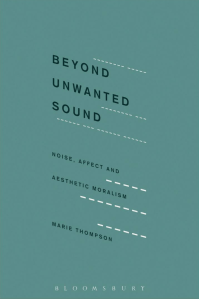
Cover of “Beyond Unwanted Sound Noise, Affect and Aesthetic Moralism,” By Dr. Marie Thompson
In her new book, Dr. Thompson covers a wide variety of ideas from Spinoza to Michel Serres’s cybernetic theory, acoustic ecology and the politics of silence to the transgressiveness of noise music, and many other concepts to show how we are affected by noise. Thompson is also the co-editor of Sound, Music, Affect: Theorizing Sonic Experience (Bloomsbury, 2013). Here is a conversation we had over email in February 2017 about Beyond Unwanted Sound.
David Menestres (DM): Why now? Why did you feel compelled to write this book? What do you hope this book will accomplish?
Marie Thompson (MT): I think my ‘academic’ interest in noise began as an undergraduate music student – I was interested in thinking ‘beyond’ distinctions of avant-gardism and popular culture and noise, as something that traverses such separations became an evermore appealing concept. So I’ve been circling some of these ideas for quite a while.
I felt compelled to write the book partly due to what I perceived as a gap between some of my ‘everyday’ experiences of noise and how noise was represented in discourse – particularly noise’s representation as an essentially negative phenomenon; or as a shocking, sublime, radical, overwhelming, transgressive force. Noise seems to be one of those topics that makes ordinarily quite progressive thinkers revert to quite uncritical and reactionary tropes – there’s something about it that ‘touches a nerve’. Consequently, much of the discourse around noise is underlined by an often-unacknowledged conservatism. I’ve always found the grandiose rhetoric of noise comparatively quite seductive but at the same time, more often than not, noise is quotidian and banal rather than overwhelming or sublime (which isn’t to say it can’t also be those things). Likewise, I felt like this grandiose rhetoric resulted in an amplification of certain sonic arts practices, while silencing others. I guess I was compelled by a desire to expand the (material and discursive) universe of noise while also trying to maintain some consistency in definition.
Quite simply, I hope the book will contribute something helpful to the recent discussions around noise in media theory, acoustic ecology and music.
DM: What is the difference between a subjective-oriented definition of noise vs. an object-oriented definition and how do both lead to the ethico-affective approach that you champion in the book?
MT: When I refer to subject- and object-oriented definitions I’m referring, quite simply, to noise being defined either in relation to the ear of the beholder, or in relation to the sound-itself. [MT also defines her “ethico-affective approach” as a perspective that “recognises the entanglement of the ethical and the affective: affective relations are also ethical relations.” –ed.]
What I think is useful about a subject-oriented definition is that it remains open to what noise might be, what form it might take – it might be your neighbour hoovering, it might be a fellow travelers mobile phone, or it might be a buzzing wasp. However, subject-oriented definitions of noise are typically wedded to liberal notions of subjectivity and the politics that carries. Noise becomes an issue of personal taste – one person’s music is another’s noise etc. Subject-oriented definitions also struggle to account for noise that isn’t ‘unwanted’, ‘bad’, ‘negative’, and so on; and for noise that might not be perceptible, or noticeable.

Noise as Negative. Sound Cancelling
Object-oriented definitions which treat noise as a type of sound are helpful insofar as there is a consistency of definition and it does not assume noise to be a solely negative phenomenon; however, to my mind, they risk losing sight of context: a particular sound is noise irrespective of how it is heard, what it does.
The ethico-affective approach I develop can be understood to maintain aspects of both these definitional approaches. It maintains the separation created by an object-oriented definition of noise between noise and negativity, so that noise’s ‘unwantedness’ becomes secondary and contingent. It also maintains the contextual focus of a subject-oriented definition, so that noise is not tethered to particular types of sound or sound sources.
DM: I’ve been very interested in the idea of noise as a weapon: the use of sound cannons to silence and sicken protestors, the use of the “Mosquito” device (which produces high frequency pitches thought to be audible only to teenagers in order to keep them from loitering), or the use of classical music to annoy young people.
You talk in one section about the noise of neighbors and the “policed silence of the suburbs.” I am also interested in the use of noise as protest. At the Women’s March in Raleigh on January 21, there were so many fascinating sounds: the sounds of thousands of voices bouncing off tall buildings, drummers, people leading chants with the crowd shouting back, the singing of classic protest songs (“A Change is Gonna Come,” “This Land Is Your Land,” etc.).
What do you think the role of noise will be in our current political climate? I can definitely see noise being used as a weapon by both sides: the government trying to use it as a weapon against the people and the people using noise to amplify their voice against the government. But there is a stark difference between these two sides: the use of sound weapons is clearly for their intended negative affect on people (both the physical effects of sound weapons and the psychological effects of the endless noise that comes from Trump’s press conferences and general bullshit), but I see the protestors intending to use sound in a positive way, to amplify their message, to make sure those in charge hear their voices, to ensure the message arrives intact.
MT: As a concept, noise seems evocative of much about our current political climate: be it the ‘noise’ of ‘fake news’, and ‘alternative facts’ (how does one determine ‘signal’ from ‘noise’, and who gets to determine that distinction); be it the ‘white noise’ of the Trump campaign administration (I recently saw a performance lecture with Barby Asante which effectively performed the ‘tuning out’ the noise of recently-bolstered white supremacy); or be it the collective noise of protest against the brutality of borders, white supremacy and police-state violence.
That noise can be both a force of domination and resistance is revealing of its ambiguity more generally – what I refer to as the ‘both-and’ of noise. Of course, that is not to conflate these uses of sonic force. One of the ways in which I’ve thought about this ethico-political difference in sonic forces is through the Spinozist distinction of power-over/power-to. The ethico-political entangles ethical questions (good-bad) with political questions (power over/power to).
So, when sound is weaponized to exert authority, to bring people into line, by diminishing their capacity to act and do, then this can be thought of as an exertion of power-over. Likewise, when sound becomes a means of collective resistance, or of connectivity (I’m thinking partly here of various ‘noise-protests’ at prisons and detentions centres, where sound is used to traverse walls and borders) then it might be understood as an expression of ‘power-to’ – a (collectivized) body’s capacity to act, to be, to do.
DM: You talk in the book of the “conservative politics of silence.” How does this conservativism affect both how people perceive sound and how we relate to it? Is there something at the other end of the scale, a “liberal politics of silence” so to speak?
MT: To my mind, the conservative politics of silence informs a number of assumptions that are frequently made about what are ‘good’ and ‘bad’ sonic environments; it relates to a preference for the simple over the complex, sameness over difference, past over present, predictability over unpredictability, the ‘synthetic’ over the ‘natural’ (whatever that might mean) and, ultimately, quietude over noise. This ideological framework underlines much ‘common sense’ about auditory experience, however it frequently remains unacknowledged.
We might consider a liberal politics in opposition to this conservative politics of silence, which recognises responses to sonic environments as ‘personal’ and therefore refuses overarching moral judgements about ‘good’ and ‘bad’ sound. However, I’m also wary of endorsing a politics that treats the individual, autonomous subject as the primary site of the political. Indeed, the conservative politics of silence that we see in the work of figures such as R. Murray Schafer is often indebted to a liberalism that prioritises control and the freedoms and rights of the individual – I’m thinking here of Schafer’s complaint that you can rid your private property of a physical intruder but not an aural one: “A property-owner is permitted by law to restrict entry to his private garden or bedroom. What rights does he have against a sonic intruder?” (1993, 214)
DM: One of the sections I particularly liked was the “What does noise do?” section where you delved into information theory through the work of Claude Shannon to show how noise was an essential part of a communications system, how noise can be a necessary, amplifying presence, needed to successfully transmit a message (voice over phone lines, data packets over the internet, etc.), how noise can enrich a system. I found myself thinking about this section a lot, often in relation to R. Murray Schaffer’s Platonic ideal state of silence. (“a Platonic, transcendent realm of a pure and ideal sonority, which paradoxically exists as undisturbed and eternal silence”).
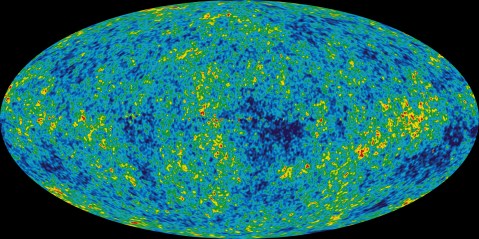
Cosmic Radiation from the Big Bang- Sound Makes Up Our Universe
I was also thinking about Cosmic Microwave Background radiation, the residual signature of the Big Bang, the background noise that carried all the information that formed our universe. It seems like noise is an intrinsic part of our world, both human made and naturally occurring, and fighting against it seems like such a waste of energy.
MT: It strikes me that when Schafer and other acoustic ecologists talk about fighting noise, they’re fighting a symptom rather than a cause. In these discourses, there is much talk of noise and environmental destruction but very little on how these processes relate to capitalism and settler-colonialism. In that regard, while I don’t think fighting against noise in absolute terms is futile, I do maintain that there are still fights to be had against high levels of noise. While I am critical of liberal notions of privacy and control and the ‘right’ to silence, I do also recognise that noise can feel oppressive in some contexts. That said, more often than not high levels of noise is a symptom of bigger social and political problems – for example, of poor quality housing, and a lack of economic choice over where one lives.
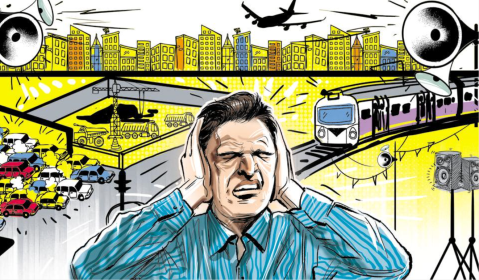
Noise Pollution, Sociological Restrictions, Sound Intrusion. From the Hindustan Times
DM: One of the themes explore in the book is the idea of the parasite, based on the work of Michel Serres. How does the parasite relate to your idea of noise?
MT: I take from Serres’ figure of the parasite the idea of noise as a relational, transformative and ambiguous in its necessity. In Serres’ reading, the parasite changes things, for better or for worse. Either way, the parasite does something, it adds something to the mix. In other words, it is affective. And yet, there is no ‘mix’ without it. Parasitic noise is the ‘excluded middle’ that must be included: it is the necessary ‘third term’, which pertains to the necessity of the material medium/milieu. From this perspective, there is no original state of calm, which is then broken by noise. If there is mediation there is noise, if there is the relation there is the parasite.
DM: Could you talk some about “the poetics of transgression” as you call it? How does this “transgression” relate to your ethico-affective approach?
MT: The poetics of transgression refers to the centrality of ‘line-crossing’ narratives in accounts of noise’s use in the sonic arts and art more generally. It’s predicated on what Henry Cowell calls the ‘time-honoured axiom’ that noise and music are opposites. Bringing noise into music, or music into noise relies on the crossing of boundaries, of material and discursive borders. This ‘line-crossing’ is often accompanied by a rhetoric of extremity and radicalism, shock and awe.
While different notions of transgression have certainly been influential for various noise music practitioners, I seek to decentre it as a way rather than the way of understanding noise’s use as an artistic resource. I argue that the dominance of the poetics of transgression has risked reducing noise music to its most ‘extreme’ manifestations. In light of the ethico-affective approach to noise that I develop throughout the book, which understands noise as a transformative force and necessary component of mediation, I suggest that noise music can be understood as an act of exposure, which, rather than bringing noise into music (or vice versa) exposes, extends and foregrounds the noise that is within the techno-musical system so as to generate new sonic sensations. With this approach, I hope to make more space for noise music practices that do not fit comfortably with the poetics of transgression and its aesthetics and rhetoric of extremity.
—
Featured Image: Noise Music
—

REWIND! . . .If you liked this post, you may also dig:
Sounding Out! Podcast #60: Standing Rock, Protest, Sound and Power (Part 1)–Marcella Ernest
The Noises of Finance–N. Adriana Knouf
Learning to Listen Beyond Our Ears: Reflecting Upon World Listening Day–Owen Marshall
Share this:


Current Top Posts





April 2021

January 2020

November 2019

October 2019

August 2019

April 2014

November 2017

March 2015

December 2017

October 2015
 Sounding Out!
Recent Comments