
Singing The Resistance: January 2017’s Anti-Trump Music Videos

 SO! Amplifies. . .a highly-curated, rolling mini-post series by which we editors hip you to cultural makers and organizations doing work we really really dig. You’re welcome!
—
The US presidential campaigns in 2016 were escorted by a number of songs regarding the person who was recently inaugurated as president. These songs served mostly as a kind of dystopic, fear-indulging, angsty “comedy music”—to reference Frank Zappa’s 1971 “Dental Hygiene Dilemma”—with a perverted thrill, or functioned in the retro manner of balladesque storytelling in songform. Performance art band Pussy Riot’s rather blunt “Make America Great Again” falls in the former category, while many examples from the brave and radiating 30 Days, 30 Songs project fall in the latter, summoning indie-rock icons as Death Cab For Cutie, R.E.M., Bob Mould, EL VY, Jimmy Eat World and Franz Ferdinand.
Lesser known tracks like “Trump,” produced by German DJ and producer WestBam, used a collage with sampled footage organized on a 4/4-beat to uncover Trump’s lies and remodel them into articulations of the vocal intentions of this subject: “We need drugs. We need crime.” However, as horrific and uncanny as this video seems, this subject as head of government then figured only in an unthinkable, impossible world.
In June 2016, Los Angeles rappers YG and Nipsey Hussle apparently sensed the horrible threat so creepily approaching the Oval Office, releasing “Fuck Donald Trump,” which produced a long string of versions, extensions, and new parts in the months afterward: “Don’t let Donald Trump win, that nigga cancer / He too rich, he ain’t got the answers / He can’t make decisions for this country, he gon’ crash us / No, we can’t be a slave for him.” In this song, before the votes were cast, the rappers and the Angelenos in the video address the urgency of a pending openly white supremacist government and the need to publicly resist it. For very good reasons, these musicians did not put the subject now in power into the box of a neglectable funny weirdo candidate. They recognized the threat as being as serious and imminent as it really was. “Fuck Donald Trump / Fuck Donald Trump / Yeah, nigga, fuck Donald Trump/ Yeah, yeah, fuck Donald Trump.”
In the week before the inauguration, artists released a string of music videos that struck very different tones from 2016. A comedy? No more. A gruesome, colorful story to tell? Too vague, too meek. “Hallelujah Money,” sings Benjamin Clementine in the song by the ever-so dystopic anime-band Gorillaz. The new song—the band’s first release in almost 7 years—is a freaked out lament, engendering bewilderment and prayer, taking on a sonic persona that cries out to The One & Only God Of Mammon – the lyrical subject is here the governing subject: “And I thought the best way to perfect our tree / Is by building walls / Walls like unicorns / In full glory / And galore.” In the video, the KKK marches along, the pigs in George Orwell’s animal farm blare, a lone and deathstruck cowboy meditates on the horizon behind Clementine, swinging in distorted rhythms and harmonies. In the end, Clementine burns his hair in a gigantic megaton-explosion while praying for money, praying for the last credible authority: “Hallelujah money (Past the chemtrails) / Hallelujah money (Hallelujah money).”
An angered, revolutionary will also stokes the song “Smoke ’em Out,” released on Jauary 17th, 2017 by a feminist trio consisting of sisters Sierra Casady & Bianca Casady (known as CocoRosie) and transgender singer Anohni (also known as the lead singer for Antony and the Johnsons). The song matches solid beats with serene pizzicatos, creating a surprisingly catchy melody of intriguing courage and uplifting collective resistance: “Burning down the house / The dead girl shouts / Smoke em out!”
Rhythmically demanding and just as sonically unforgiving comes “I Give You Power” by the Arcade Fire featuring Mavis Staples, an amalgamation of anger and the will to move ahead, to transcend current limitations of micro politics into a desired and imagined near future. The song opens with a flat electronic beat that builds up to a fat bulldozing bass sequence with added effects over which Mavis Staples’s multiplied voices lament and demand and call out in grief and angry bewilderment. The song merges disco, soul and funk with traditions of protest chanting, topped off with church organ chords. The music video reveals nothing beyond an older analog mixing desk operated now and then with calm sensitivity and deep knowledge of how this production tosses and turns: bright and glaring lights flicker over the image of the desk.
The Brooklyn-based Sateen, in contrast, perform “Love Makes The World” in a lavish scenery replete with luxurious flashing red gowns of large ruffles. They sing in the woods and in a brick underpass, while joined and complemented by a series of queer singers, dancers & personae presenting themselves, their love and their resistance in public and in private situations. Angelic voices sing over the cycling and motorized club beats, providing electronic sounds of hope whose joyful alien flavors are often in tension with the song’s lyrics: “How can we progress: / When we’re ruled by racists?”
The first music video, however, that drew my attention to this prolific phenomenon of songs against the US’s new governing subject was a cover of Morrissey’s “Interesting Drug” (1989), released by the notorious OK Go:
This time OK Go does not flatter us with their usual acrobatic and meticulously choreographed video performance, but rather present plain white-on-black-text between brief seconds of footage and screenshots of “the bad people on the rise” now in charge of the US, images ready to become the memes and gifs of a resistance movement. The music video ends with an explicit call to action–“It’s a difficult time but fear and anger aren’t the answer. Work to make a better world” followed by a list of five civil rights organizations including the American Civil Liberties Union, the Immigrant Defense Project and Planned Parenthood, headed by an unmistakable imperative: “Volunteer and donate.”
Discovering this song and video, I soon stumbled across yet another song that struck me first of all as a very clever and all too obvious marketing move, Green Day’s “Troubled Times,” which of course resonates with the band’s hit record “American Idiot” about the George W. Bush presidency.
“What good is love and peace on earth / When it’s exclusive.” In the visual style of traditional black and white newspaper collages—with splashes of red that summon Schindler’s List–the band animates the contemporary pandemonium of hatred, racism, sexism and plutocratic sadism to stage yet another traditional Green Day pop punk song, though one with a rather less disruptive, and much more forlorn note. I have to note a ertain awkwardness here, as the business model of lining up with this protest movement seems rather obvious, and many sections of these lyrics and the video’s imagery seems more cliché than genuine. Are these times really only structurally and anonymously “troubled? Are there no actual wrongdoers, criminals and hatemongers to be named, accused, and condemned? Roger Waters truly unexpected—and much more direct—recent live performance of “Pigs” in Mexico City in October 2016 comes to mind, with its massive projection of KKK & TRUMP-imagery as icons of hate – reinvigorating the political urgency present in a song from 1977.
Still, the song by Green Day might get airplay on nationwide rock radio unlike many of other songs of resistance, and by this it could actually succeed in its overstated mission.
The most aggressive and decidedly agitprop-productions come from Moby and Fiona Apple. Collaborating with Michael Wahlen, Apple recorded a chant for the massive Women’s March on Washington (and the many simultaneous marches occurring across the US and the world) the day after the inauguration:
With lines like “We don’t want your tiny pants / Anywhere near our underpants” Wahlen and Apple revive the protest chant traditions of the 1960s with its mean, challenging, and unforgiving humor. Late last year Apple already released a joyful yet sadistic little piece in the style of a sentimental Christmas carol that keeps “Trump’s nuts roasting on an open fire (…) Merry Christmas, Merry Christmas: Donald Trump, fuck you.”
In contrast, Moby merges his 1990s rave skittishness with an unrepentant love for precisely-targeted guitar punk riffs in “Erupt & Matter.” Original footage of demonstrations, resistance gatherings, and a selection of the absurd and terrifying authoritarian and nationalist figures of our time – first Erdoğan, Farage, Assad, then Duterte, Trump, Wilders, Le Pen, Petry, Hofer and many more – alternate with classic performance shots of Moby and his band The Void Pacific Choir, generating a sentiment of accelerating urgency: “WE DON’T TRUST YOU ANYMORE. WE DON’T TRUST YOU ANYMORE.”
But the anger against sclerotic oligarchies and a condescending establishment is ironically mimicked by exactly the most unsettling and authoritarian protagonists of various nationalist parties worldwide. Even as Moby’s aggressive protest chant becomes an infectious and intriguing earworm, does he render such a revolutionary impetus dubious? Pondering this reminded me of the Atari Teenage Riot line from 1995: “Riot sounds produce riots.” (Atari Teenage Riot 1995)
In the first few weeks of January alone, several consortiums have launched protest song campaigns to ensure that songs like these will just keep coming. On inauguration day, the platform “Our First 100 Days” was launched. Here, one new protest song will be released on every day for the first one hundred days of the current president’s administration, with all profits raised from the sales of songs by groups such as PWRBTTM going, as their website states, “directly to organizations working on the front lines of climate, women’s rights, immigration and fairness.” Paste Magazine expanded its “30 Days, 30 Songs” campaign for the long haul, offering up to 1000 Songs in 1000 Days— one song a day for every weekday of Donald Trump’s term.
However, as I write these last lines, the global public is remixing the resistance in its own lightning-fast ways. The recent public sucker-punch of white supremacist neo-Nazi Richard Spencer has already become a legendary object of meme culture. Folks have synched this clip to multiple—and diverse—soundtracks that invite repeated viewings, from Celine Dion’s “My Heart WIll Go On,” Bruce Springsteen’s “Born In The USA,” Queen’s “We Will Rock You,” Gwen Stefani’s “Hollaback Girl,” Pharrell Williams’s “Happy,” The Notorious B.I.G.’s “Hypnotize” to Frank Zappa’s “Black Page #2”. . .and the list continues.
Singing the resistance in the 21st century poses a truly complex task. Artists must sonically navigate a wide array of musical aesthetics—some geared toward more immediate public appeal, while others evoke more erratic and dissonant affects—and keep an eye toward combining sound with impactful media events and artifacts, while never forgetting to consider the critical question “How Does it Feel?”
This blogpost has its own playlist: click here
—
Holger Schulze is full professor in musicology at the University of Copenhagen and principal investigator at the Sound Studies Lab. His research focuses on the cultural history of the senses, sound in popular culture and the anthropology of media. Recent book publications are: American Progress (2015), Sound as Popular Culture (2016, ed.) and Krieg Singen: Singing The War (2017, ed.).
—
 REWIND!…If you liked this post, you may also dig:
On Ventriloquism, Dummies, and Trump’s Voice – Sarah Kessler
À qui la rue?: On Mégaphone and Montreal’s Noisy Public Sphere – Lillian Radovac
The Noise of SB 1070: or Do I Sound Illegal to You? – Jennifer Stoever
Share this:

Listening to the City of Light: An interview with Sound Recordist Des Coulam

How should we take account of, question, describe what happens every day and recurs every day: the banal, the quotidian, the obvious, the common, the ordinary, the infra-ordinaire, the background noise, the habitual?
I’m meeting with the British sound recordist Des Coulam at the brasserie La Coupole on the Boulevard de Montparnasse in Paris. “Just imagine…this place opened in 1927. If you installed a microphone in the middle of this room in 1927 and if it was still there today, how many interesting things could you have recorded in this place? It just begs belief, doesn’t it? François Mitterrand, Picasso, Ford Maddox Ford, Beauvoir, Man Ray, they were all here. They all echo in these walls.”
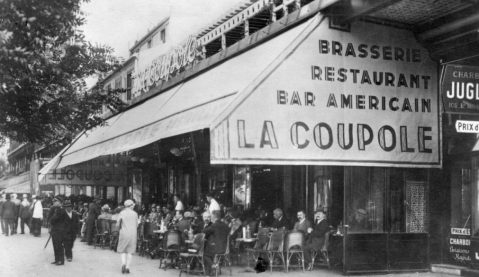
Early photo of La Coupole, date unknown
The sound inside La Coupole by Des Coulam
Des Coulam has been capturing the urban soundscape of Paris for almost ten years. Paris is a city full of mirrors, replicating itself through various mediums. A great archive of the city and its streets, boulevards, arcades and cafés has been written, painted, filmed and photographed throughout the 19th and 20th centuries. However, its aural history is less documented.
“All the archival sounds you find of Paris are adjunct to pictures, so you’ve got television pictures, you’ve got film, you’ve got very few actual recordings of Paris, and I wanted to capture the contemporary soundscape of the city and archive it for future generations to explore, study and enjoy,” explains Coulam. “It’s only on the last few seconds on our historical clock that we’ve been able to capture and archive sounds, so most of our sonic heritage is passed by completely unrecorded. We can get an idea of what nineteenth, eighteenth, and seventeenth century sounds were like from literature and from art in some cases. But the fact is we can’t actually listen to them. All the sounds we hear came from somebody’s imagination.”

Des Coulam, Image courtesy of interviewee.
Coulam’s methodical approach and commitment to the task of recording the sounds of Paris, almost on a daily basis, is helping to create the first comprehensive sound archive of the city. These sounds constitute the Paris Soundscapes Collection and are being archived in the British Library of London.
“Memorable recordings are not limited by your equipment, only by your imagination”
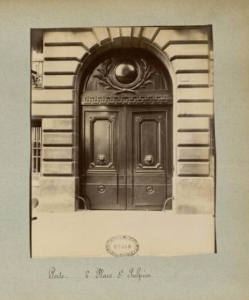
Porte 6, Saint Surplice, Courtesy of Interviewer
“And people forget that,” laments Coulam. “I mean, listening is an art and it’s an art that must be learned. You have to practice, practice, practice to listen. But once you master the art it opens up an all-new world. Because for me, if you give sounds the opportunity to breathe and to speak, they all have a story to tell. We walk along the street and hear a sound and you think: what is that? And you can create a story the sound is telling you. You might hear one of these big Parisian doors bang. What’s behind that door? How many interesting people have walked through that door? And you start to see or experience the place differently.”
Sounds inside l’Eglise Saint-Gervais-Saint-Protais (w/creaking wooden door) by Des Coulam
Des Coulam is of the opinion that the ability to tune into sounds with an inquisitive and imaginative mind can provide better recordings than the most expensive equipment. It’s a skill that he has been developing for over 50 years. “I can tell you the exact day. It was the 25th of December, 1958 when I woke up on Christmas morning and found a tape recorder. And if you had asked me to write a list of 100 things I wanted for Christmas, the tape recorder would not have featured in it. But there it was and I fell in love with it instantly and stayed in love with it ever since. It turned something on in my head that stayed with me all my life. I was 10 years old and now I’m almost 70 years old…I don’t know what I would do without it. I would probably just curl up and die or something…Because now it consumes all of my life. I work seven days a week, but it never feels like work. It’s just fun.”
An aural flâneur in a changing city
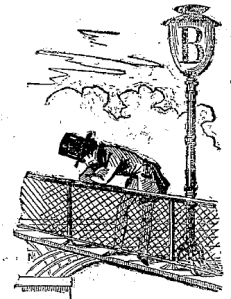
Image from Louis Huart, Physiologie du flâneur (1841)
“Some of my best recordings have come serendipitously when they are not planned.” Most of the time Coulam doesn’t adhere to a strict pathway through the streets of Paris. He follows the background city sounds as someone who follows a river stream. He describes himself as an aural flâneur. The term flâneur (stroller, idler, walker) dates back to the 16th century and was made popular by Walter Benjamin in his 1935 essay “Paris, Capital of the Nineteenth Century” in The Arcades Project. “I’m doing exactly what the 19th century flâneurs did. Observing, that’s all I do. But I observe through sound rather than visually,” says Coulam. “The one thing the flâneur had was time. They had the time to stroll around the streets and observe the everyday life. But in my case I observe listening.” According to Aimée Boutin, the author of City of Noise: Sound and Nineteenth-Century Paris, it is in the writings of Balzac, Louis Huart and Victor Fournel that the flâneur emerges as an attentive listener, an eavesdropper and collector of stories who views the city as a musical score and as a cacophonous/harmonious concert.
19th century images of the flâneur predominately evoke a white male figure of means and privilege who observes and listens to the city from a position of detachment towards the crowd. He is invested in his own anonymity and imagines himself cultivating a sense of neutrality and “objectivity.” Coulam’s active listening practices depart from this perspective by challenging his perspectives and owning the subjectivity of the recording and archiving process. “The way you hear sound changes depending on the circumstances and also the way you interpret sound is different. You and I could walk down the same street and hear it differently. I can walk down the same street twice and hear it differently. There are lots of sounds that I will hear and there are lots of sounds that I won’t hear.” In a recent blog entry Coulam writes that while being “aware that sounds don’t exist in a vacuum, I am always thinking about the social, cultural and historical context of the sounds I find and that has taught me how to explore and appreciate the rich history, complexity and diversity that is Paris.”
Besides his own recordings of the Parisian soundscapes, Coulam has been adding new aural narratives of the city in the series “Paris – A Personal View” inviting guests who live in Paris to visit a place in the city that has a special meaning for them. In this series, Coulam often features the city of the contemporary flâneuse, a radically different form of flâneurie through the steps of the walking woman. In the audio bellow, Monique Wells, an expert on African Diaspora in Paris and founder of the non-profit association Les Amis de Beauford Delaney, explores her favorite place in the city – the Jardin du Luxembourg.
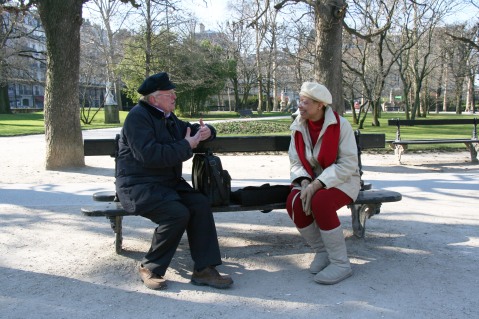
Des Coulam and Dr. Monique Wells, image courtesy of interviewee
Monique Wells, Jardin du Luxembourg, “Paris – A Personal View” Series by Des Coulam
This is a particular time to be listening to the city as a new plan to expand the metropolis of Paris is on its way. “Paris is on the cusp of a huge change. If we look at the history of Paris, it is a history of circles. So you get start with the Romans who invaded and camped out on the Île de la Cité. What did they do? They built a wall around it. And over the years as Paris expanded more walls have been built around the city until today. Now, you’ve got this wall of traffic – the périphérique – and everything within that is Paris and everything without is the suburbs. Nicolas Sarkozy decided, when he was president, that he was going to demolish this invisible wall between Paris and the suburbs. So he gave birth to the Greater Paris Project which is now going ahead. So over the next 10, 20 or 30 years the visual landscape of the city will change and also its sound landscape. And this is a perfect time to capture that change. I won’t live long enough to see it all but I’m already seeing some of it. And what you have right now is that some sounds of Paris are actually disappearing, some are about to disappear, some have stayed remarkably the same and new sounds have appeared.”
Sounds around the Pont National (near Boulevard Périphérique) by Des Coulam
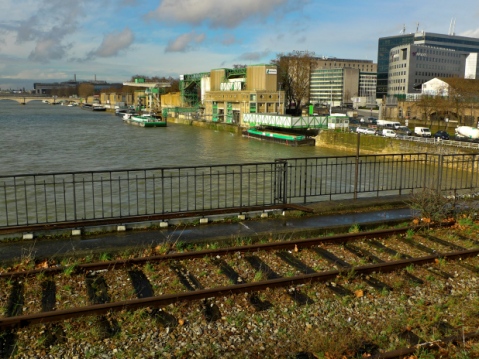
Pont National by Des Coulam
The Vanishing Sounds of Paris
The changes in the visual landscape of Paris and the modernization of its infrastructures will cause a significant change in its soundscape. For instance, Coulam dedicates a lot of his time to recording the changes of the subterranean and aerial soundscape of the Parisian metro lines. “The sounds of the Metro are changing dramatically. If you imagine the sounds of the Paris Metro, you immediately get this picture of the sort of 1950s black and white film, you can hear the sounds of the train rattling over the lines. It’s gone, it’s all completely gone. The last of those trains disappeared in 2012. And I knew this was happening so I recorded a lot of metro line 5 where the old trains were. So I’ve got a stack of recordings of those because nobody else was doing it.”
Sounds of Line 5 at Quai de la Rapée by Des Coulam
“That lovely rattle, these clanking rattling sounds. Just what you imagine it to be!” The old trains on line 5 are now being replaced by modern models with a quieter sound. Also, the trams that covered the city in the 1930s were later substituted by motorized buses. “There are no trams in the center of the city but you’ve got them on the periphery now. There are 8 tram lines. On a lot of the routes they actually go through lot of pains to reduce the amount of noise the tram makes by putting grass down between the tram lines to absorb the sound. So that’s a completely different soundscape than you would have had in this case in the 1930s.”
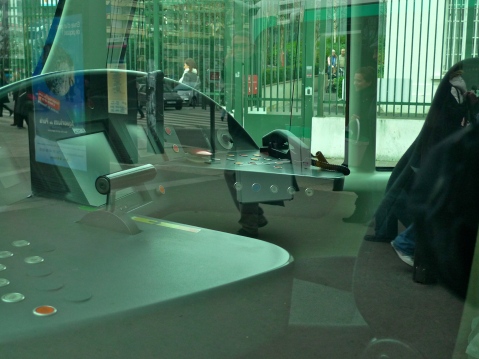
Tram by Des Coulam
Inside a tram on Line T2 from the station Henri Farman to Porte de Versailles by Des Coulam
Coulam has been recording the sounds of the Gare du Nord, one of the six main railway stations in Paris, that is going through some transformations right now. A sign outside the station in the construction zone promises “a brighter and more practically designed hall for enlightened travelling”. The distinctive soundscape of the Gare will certainly change. A new type of pavement is enough to alter the echoing sounds made by footsteps and rolling suitcases.
Inside the Gare du Nord; October 2016
“But on a more human level,” says Coulam, “the street criers, the vagabond man, the knife grinders, people like that who used to come around shouting in the street are completing gone. The only thing you find now are the market traders in the market stores, but you don’t find any of these tradesmen in the streets of Paris.”
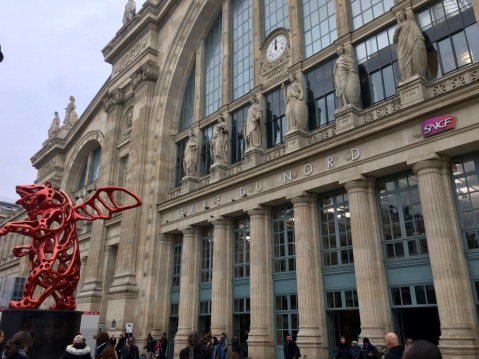
Gare du Nord by Des Coulam
“An attempt to exhaust a place in Paris” in sound
“The only time you really notice the urban soundscape is when isn’t there,” remarks Coulam. On the day we meet, Montparnasse is eerily quiet. There is little traffic and only a few pedestrians are strolling along the Boulevard. “The soundscape you hear is not the normal Montparnasse because this is August and everybody is away on holiday, so you are immediately struck by the relative quiet around here.” It might be difficult to find places of quiet in a city like Paris during the other eleven months of the year.
But even the noise, the chatter and the rumble are important parts of the urban soundscape. “The biggest challenge I face recording the soundscape of Paris is the sound of traffic, and I long ago decided that you couldn’t ignore it. And in a sense, why should you? Because it’s an integral part of the soundscape, so to ignore it is a sort of cheating, really. So, I decided to embrace it and I started to deliberately record traffic and it was absolutely fascinating!”
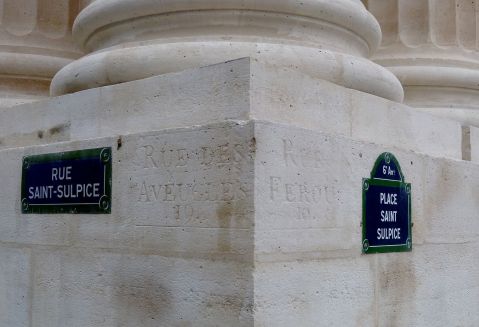
Place Saint Sulpice, courtesy of Wikicommons
The author and filmmaker George Perec once sat down for three days in Saint-Sulpice Square to write down all the non-events around him. “What happens, when nothing happens other than the weather, people, cars, and clouds?” asked Perec. In the same vein, Coulam continues recording the sounds that constitute the backdrop to everyday life and through attentive listening, he weaves the sound tapestry of the city of Paris. “You sit on a Parisian green bench in a busy narrow pavé street and just let the street walk past you. You will hear fabulous sounds.”
“An attempt to exhaust a place in Paris” in sound (Café de la Mairie, Place Saint-Sulpice) by Des Coulam
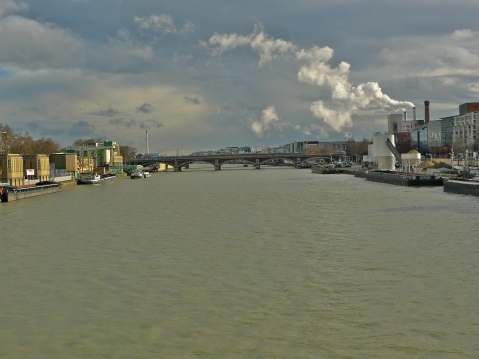
Pont National from the Pont de Tolbiac by Des Coulam
You can hear Des Coulam’s collection of Parisian soundscapes at Soundlandscape or follow him on twitter.
—
Featured Image: Line 5 at Quai de la Rapacca, Image by Des Coulam
—
Carlo Patrão is a Portuguese radio artist and producer of the show Zepelim. His radio work began as a member of the Portuguese freeform station Radio Universidade de Coimbra (RUC). In his pieces, he aims to explore the diverse possibilities of radiophonic space through the medium of sound collage. He has participated in projects like Basic.fm, Radio Boredcast, and his work has been featured in several international sound festivals and has also been commissioned by Radio Arts (UK). He is currently working on a radio show for the Portuguese national public radio station RTP. In addition to his work in radio, he has a master’s in clinical psychology
—
 REWIND! . . .If you liked this post, you may also dig:
Playing with Bits, Pieces, and Lightning Bolts: An Interview with Sound Artist Andrea Parkins — Maile Colbert
(Sound)Walking Through Smithfield Square in Dublin— Linda O’Keeffe
Sounding Our Utopia: An Interview With Mileece— Maile Colbert
Share this:


Current Top Posts





April 2021

January 2020

November 2019

October 2019

August 2019

April 2014

November 2017

March 2015

December 2017

October 2015
 Sounding Out!
Recent Comments