
DIY Histories: Podcasting the Past

 This is article 3.0 in Sounding Out!‘s April Forum on “Sound and Technology.” Every Monday this month, you’ll be hearing new insights on this age-old pairing from the likes of Sounding Out! veteranos Aaron Trammell and Primus Luta along with new voices Andrew Salvati and Owen Marshall. These fast-forward folks will share their thinking about everything from Auto-tune to techie manifestos. Today, Salvati asks if DIY podcasts are allowing ordinary people to remix the historical record. Let’s subscribe and press play. –JS, Editor-in-Chief
—
Was Alexander the Great as bad a person as Adolph Hitler? Will our modern civilization ever fall like civilizations from past eras?
According to Dan Carlin’s website, these are the kind of speculative “outside-the-box” perspectives one might expect from his long-running Hardcore History podcast. In Carlin’s hands, the podcast is a vehicle for presenting dramatic accounts of human history that are clearly meant to entertain, and are quite distinct from what we might recognize as academic history. Carlin, a radio commentator and former journalist, would likely agree with this assessment. As he frequently emphasizes, he is a “fan” of history and not a professional. But while there are particularities of training, perspective, and resources that may distinguish professional and popular historians, an oppositional binary between these kinds of historymakers risks overlooking the plurality of historical interpretation. Instead, we might notice how history podcasters like Carlin utilize this new sonic medium to continue a tradition of oral storytelling that in the West goes back to Herodotus, and has since been the primary means of marginalized and oppressed groups to preserve cultural memory. As a way for hobbyists and amateurs to create and share their own do-it-yourself (DIY) histories, I argue that audio podcasting suggests a democratization of historical inquiry that greatly expands the possibilities for everyone, as Carl Becker once said, to become his or her own historian.

“Modified Podcast Logo with My Headphones Photoshopped On” by Flickr user Colleen AF Venable, CC BY-SA 2.0
Frequently listed among iTunes’ top society and culture podcasts, and cited by several history podcasters as the inspiration for their own creations, the popularity of Hardcore History stems from Carlin’s unconventional and dramatic recounting of notable (but sometimes obscure) historical topics, in which he will often elaborate historical-structural changes through contemporizing metaphors. Connecting the distant past to more immediate analogies of present life is the core of Carlin’s explanatory method. This form of explanation is quite distinct from the output of academic historians, who assiduously avoid this sort of “presentism.” But as the late Roy Rosenzweig (2000) has suggested, it is precisely this kind of conscious and practical engagement with the past – and not the litany of facts in dry-as-dust textbooks – that appeals to non-historians. Rosenzweig and David Thelen claim have found that most Americans perceive a close connection with the past, especially as it relates to the present, through their personal and family life. Using the medium of podcasting to talk about the past is a new way of making the past vital to the present needs and interests of most people. This is how podcasters make sense of history in their own terms. It is DIY insofar as it is distinct from professional discourse, and less encompassing (and expensive) than video methods.
Podcasts can present an alternative model for making sense of the past – one that underscores the historymaker’s interpretive imprints, and which cultivates a sense of liveness and interactivity. Admittedly, Dan Carlin’s own style can be rambling and melodramatic. But to the extent that he practices history as a kind of storytelling, and acknowledges his own interpretive interventions, Hardcore History, like other independently produced history podcasts (I am thinking about a few of my favorites – Revolutions, The History Chicks, and The British History Podcast) give their listeners the sense that history is not necessarily something that is “out there,” or distant from us in the present, but part of a living conversation in the present. Podcasters construct a dialogue about history which, when combined with the interactivity offered by website forums, draws the listener into a participatory engagement. Rosenzweig and Thelen’s explain, Americans interested in popular history are skeptical of “historical presentations that did not give them credit for their critical abilities – commercialized histories on television or textbook-driven high school classes.” Such analytic skills are precisely what we as historians and teachers aim to develop in our students. Podcasting, when it constructs a collaborative dialogue in which audience and producer explore history together, can both be a valuable supplement to traditional historiography, and a way for people to connect with the past that overcomes the abstraction of textbooks and video.

“The histomap – four thousand years of world history” by Flickr user 图表汇, CC BY-SA 2.0
But is the podcast as intellectually freeing as it might seem? Jonathan Sterne (et. al., 2008) notes that podcasting encompasses a range of technologies and practices that do not necessarily determine the liberation of content production from the dominance of established institutions and economies of scale. Indeed, there are many professional historians and media producers who have utilized audio (and sometimes video) podcasting to reach a wider audience. While the History Channel has not (yet) entered the field, one can surely imagine the implications of corporate-produced history content that homogenizes local and cultural particularities, or which present globalized capitalism as a natural or inevitable historical trajectory.
The kind of podcasts I am concerned with, however, are created by independent producers taking a DIY approach to content production and historical inquiry. While their resources and motivations may differ, podcasts produced on personal computers in the podcaster’s spare time have an intimate, handcrafted feel that I find to be more appealing than, say, a podcasted lecture. Ideally, what results is an intimate and episodic performance in which podcasters can, to use Andreas Duus Pape’s phrasing from an earlier Sounding Out! post, “whisper in the ears” of listeners. This intimacy is heightened by the means of access – when I download a particular podcast, transfer it to my iPhone, and listen on my commute, I am inviting the podcaster into my personal sonic space.
Complimenting this sense of intimacy is a DIY approach to history practiced by podcasters who are neither professional historians nor professional media producers. Relatively cheap and easy to produce (assuming the necessary equipment and leisure time), podcasting presents a low barrier of entry for history fans inspired to use new media technologies to share their passion with other history fans and the general public. Though a few podcasters acknowledge that they have had some university training in history, they are usually proud of their amateur status. The History Chicks, for example, “don’t claim to know it all,” and that any pretense toward a comprehensive history “would be kinda boring.” Podcasting and historical inquiry are hobbies, and their DIY history projects allow the relative freedom to have fun exploring and talking about their favorite subject matter – without having to conform to fussy disciplinary constraints. For Jamie Jeffers, creator of the British History podcast, most people are alienated by the way history gets taught in school. However, “almost everyone loves stories,” he says, and podcasting “allows us to reconnect to that ancient tradition of oral histories.” Others justify the hobby in more bluntly. For the History Chicks, women in history is “a perfect topic to sit down and chat about.” Talking about history, arguing about it, is something that history fans (and I include myself here) enjoy. Podcasting can broaden this conversation.
Despite my optimistic tone in this post, however, I do not want to suggest uncritically that the democratizing, DIY aspects that I have noted (among just a handful of podcasts) comprises the entire potential of the format. Nuancing a common opposition between the bottom-up potential of podcasting with the prevalent top-down (commercial) model of broadcasting for example, Sterne and others have asserted that rather than constituting a disruptive technology – as Richard Berry has suggested – podcasting realizes “an alternate cultural model of broadcasting.” Referring to earlier models of broadcasting – such as those Susan Douglas (1992) described in her classic study of early amateur radio – Sterne and company assert that analyses of podcasting should focus not on the technology itself, but on practice; not on the challenge podcasting poses to corporate dominance in broadcasting, but rather how it might offer a pluralistic model that permits both commercial/elite and DIY/amateur productions.

“Podcast in Retro” by Flickr user David Shortle, CC BY-NC 2.0
Adapting these recommendations, I argue that podcasting can help us conceptualize an alternate cultural model of history – one that invites reconsideration of what counts as historical knowledge and interpretation, and about who is empowered to construct and access historical discourse. Rather that privileging the empirical or objective histories of academic/professional historians, such an expanded model would recognize the cultural legitimacy of diverse forms of historiographical expression. In other words, that history is never “just” history, or “just” facts, but is always a contingent and situated form of knowledge, and that, as Keith Jenkins writes, “interpretations at (say) the ‘centre’ of our culture are not there because they are true or methodologically correct … but because they are aligned to the dominant discursive practices: again power/knowledge” (1991/2003, p. 79). But to reiterate Sterne’s (et. al.) caution however, such an alternative model would not necessarily determine a role-reversal between professional and DIY histories. Rather through podcasting, we might discover alternative ways of performing history as a new oral tradition – of becoming each of us our own historian.
—
Andrew J. Salvati is a Media Studies Ph.D. candidate at Rutgers University. His interests include the history of television and media technologies, theory and philosophy of history, and representations of history in media contexts. Additional interests include play, authenticity, the sublime, and the absurd. Andrew has co-authored a book chapter with colleague Jonathan Bullinger titled “Selective Authenticity and the Playable Past” in the recent edited volume Playing With the Past (2013), and has written a recent blog post for Play the Past titled “The Play of History.”
—
Featured image: “Podcasts anywhere anytime” by Flickr user Francois, CC BY 2.0
—
 REWIND!…If you liked this post, you may also dig:
“Music is not Bread: A Comment on the Economics of Podcasting”-Andreas Duus Pape
“Pushing Record: Labors of Love, and the iTunes Playlist”-Aaron Trammell
“Only the Sound Itself?: Early Radio, Education, and Archives of ‘No-Sound’”-Amanda Keeler
Share this:

Radio and the Voice of the Aymara People

 Welcome back to our continuing series on radio in the Caribbean and Latin America: Radio de Acción. A consideration of the multilingual history of radio from Cuba, Jamaica, and Haiti to the Southern Cone and beyond, Radio de Acción turns this week to the Aymara in Peru, Chile, and especially Bolivia in a fascinating piece from anthropologist Karl Swinehart.
If you missed our first post, Alejandra Bronfman’s stunning history of radio and violence in the Caribbean, you can find it here. In the meantime, keep your dials tuned to Karl Swinehart’s study of the micropolitics of language and power on Aymaran radio.
– Guest Editor Tom McEnaney
—
“What do you like most about working at this radio station?” was a simple question I had asked Celia Colque Quispe, an Aymara language radio broadcaster on Radio San Gabriel in El Alto, Bolivia during an interview I conducted in 2007 as part of my dissertation research on Aymara-language media. Her response was simple, but profound.
“Clearly, here, being Aymara. I like to be Aymara.”
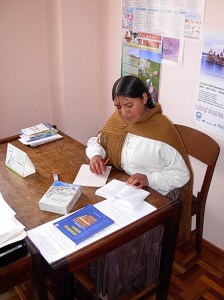
Celia Colque Quispe; photo by the author, all rights reserved
Quispe came to Radio San Gabriel from a small, rural community on the shores of Lake Titicaca. One day, she had heard an announcement on the radio that Radio San Gabriel would be hiring personnel through an open selection process involving an Aymara language fluency assessment. Competing against university-trained linguists and graduates of communications programs, Quispe stood out for her eloquent Aymara speech and was hired, beginning a career in radio where she came to not only to work as an announcer, but as a member of the Aymara Language Department where she wrote and approved scripts for the station’s programs. Stories like this are not unusual at Radio San Gabriel, but are otherwise rare in this multilingual Andean republic, still profoundly marked by anti-Indian racism. What “being Aymara” means in Bolivia remains highly contested. One thing was clear from my conversation with Quispe, however—her work at the radio allows her “to be Aymara.”
The presence of the Aymara language on Bolivian airwaves contrasts sharply with its general absence within other Bolivian media. There are some notable exceptions: Bolivian state television occasionally runs Aymara language programming on programs like Entre Culturas (‘Between Cultures’), and, famously, the neorealist director Jorge Sanjinés’ work has dramatized the struggles of highland Aymara and Quechua Indians in films like Yawar Mallku (Blood of the condor) and Nación Clandestina (Clandestine Nation).
These are exceptions, however, that prove the rule of Spanish language dominance within Bolivian television and film, leaving radio to stand out as the medium that most reflects the country’s multilingualism. In this post we will tune in to Radio San Gabriel, Bolivia’s oldest and most prominent Aymara language radio station, to ask how Aymara language radio might not just reflect Bolivia’s multilingualism, but also actively intervene in it, shaping how Aymaras hear their own language.
Aymaras and Bolivia

Geographic distribution of the Aymara language, public domain
The Aymaras are one of the the largest ethnolinguistic groups within Bolivia, a nation that is now officially a “Plurinational State” in which 36 indigenous languages are recognized as co-official with Spanish. Aymara is among the most widely spoken of these and Aymaras constitute a majority of the population in a contiguous territory surrounding the nation’s capital of La Paz, and crossing national borders into neighboring Chile and Peru. With approximately two and a half million people (and many more than this if speaking Aymara is removed as a criterion of ethnicity), Bolivia has the largest concentration of Aymaras in the region. Perhaps because Bolivia’s political capital sits within Aymara territory or because of their sheer numbers with respect to other indigenous populations, the Aymara have long played a significant role in Bolivian politics. Increasing the presence of the Aymara language in public space, on the airwaves or otherwise, is thus a prominent component of a multifaceted politics of indigenous resurgence in contemporary Bolivia.
Aymar Markan Arupa – “The Voice of the Aymara People” – Radio San Gabriel
As Bolivia’s first and longest running Aymara language radio station, Radio San Gabriel (RSG) calls itself “Aymar markan arupa” (the voice of the Aymara people). In the wake of the 1952 Bolivian revolution, a major social upheaval in which miners’ militias played a crucial role, Maryknoll Jesuit priests founded RSG in 1955 with aims of Christian evangelization within a broader effort at rural uplift. RSG’s mission was also in line with the new government’s hopes of integrating indigenous rural communities into national political life. Jesuits had experience with radio in mining communities, a broadcasting milieu dominated by radical syndicalist and communist political currents, where Jesuits had also founded radio stations of their own. Although miners are remembered as the central protagonists in the 1952 revolution, also crucial to its victory were the highland indigenous communities who overturned nearly feudal relations of the haciendas through insurrectionary land expropriations.

The offices and studios of Radio San Gabriel in El Alto, Bolivia; photo by the author, all rights reserved
In its early days, RSG approached the Aymara language as a bridge to Spanish language literacy and integration into the mainstream of the Catholic faith, an approach consistent with a mid-twentieth century view which formulated the “the Indian problem” as one of national integration. Yet these early assimilationist efforts would quickly change due to both developments in the Catholic Church, such as the Second Vatican Council (1962-1965) and the rise of “liberation theology,” and also political ferment in Bolivia in opposition to military rule. During the 1970s radical Aymara nationalism, or katarismo, was on the rise, finding institutional expression through organizations like the Movimiento Revolucionario Tupak Katari (MRTK, ‘Revolutionary Movement Tupak Katari’), and the founding of the Confederación Sindical Única de Trabajadores Campesinos Bolivianos (CSUTSB, ‘Trade Union Confederation of Rural Workers of Bolivia’) under katarista leadership in 1979.

“Tawa Chakana” by Wikimedia user Huhsunq, CC BY-SA 2.5
Influenced by Aymara nationalism, RSG made a dramatic shift in its orientation towards Aymara language and culture. Their adoption of an Aymara-centric idiom resonated with other nationalist currents, while maintaining Maryknoll Jesuit aims of social justice and service to the poor by reformulating “liberation theology” as a “theology of inculturation.” Practices earlier demonized by the Catholic Church as pagan were now celebrated as being essentially Christian—with the spilled blood of a sacrificed llama, for example, recast as analogous to the wine of the sacrament. This remains in many ways the orientation of RSG today, and the station positions itself as an authority on questions of Aymara linguistic and cultural authenticity.
Broadcast language – dehispanicized “pure” Aymara
One of the ways that RSG’s authority becomes audible to its Aymara audience is through the language used on the air. On RSG, radio announcers speak without using Spanish loan words, using what radio announcers and other Aymaras refer to as “Aymara puro” (pure Aymara). This is ensured through the radio’s Aymara Language Department, which intervenes prior to each broadcast by either writing or editing scripts, and is responsible, along with the radio’s director, for these scripts’ ultimate approval. However, its responsibilities do not end with broadcasts’ content. The department is also responsible for a protocol extending through and beyond the actual broadcasts called seguimiento, or “following.”
Seguimiento involves two procedures: the real-time monitoring of broadcasts for “aberrations,” and a follow-up interaction with those who utter them on air.The department finds alternatives or invents neologisms for the many loan words in Aymara from Spanish. These loan words include words as common as the verb “to speak”—parlaña from the sixteenth-century Spanish parlar—and are testament to 500 years of contact with Spanish. Contact, of course, is a euphemism for what was first colonial and later republican subjugation, making the aberración serve as a linguistic reminder of this painful history. This is why, rather than simply “Aymara puro,” a more apt term might be deshispanized Aymara. While Spanish loan words are purged from the broadcasts, many words shared between Quechua and Aymara escape the protocols of seguimiento, even though these also likely entered the language as the result of earlier subjugation of the Aymara under the Inca Empire. It was not the Inca period, however, but the domination of all Indians, whether Quechua, Aymara, or otherwise, by the Spanish under the colony, then by their descendants during the Republican period and into the 21st century that has most profoundly shaped Bolivia’s dynamics of race and class and, it turns out, the linguistic phenomena that accompanying them, leaving the loan word, the aberración, to be understood as the residue of this history.

Outside the studios of Radio San Gabriel in El Alto, Bolivia; photo by the author, all rights reserved
Decolonization over the Airwaves
Is the linguistic purism of the RSG any different from that of, say, the Academie Française? In terms of aims and procedures, much remains the same—both groups identify loan words and push for consensus to implement neologisms. Such a comparison, however, would obscure the starkly different social context in which this process unfolds in Bolivia. If “protecting” the language is commensurate with protecting the people, at RSG, this means targeting loanwords that serve as reminders of the painful processes of colonialism. In this light, many at RSG understand their work as fitting within a larger project of decolonization, a project not without its contradictions or ironies, particularly considering the role of the Catholic Church in both the past and the present. I explore these ironies more in a longer ethnographic account of the process of seguimiento at RSG.
Whatever the ironies, RSG’s cultivation of a model of refinement in Aymara speech has created opportunities for people who are otherwise profoundly marginalized in Bolivian society, particularly rural women, to advance professionally in a labor market that too often shuts them out. Where Celia Colque Quispe’s wearing of long braids, broached shawl, and full pollera skirt of rural Aymara women, for example, would have her barred from other employment whose job descriptions might demand of employees a euphemistically racist and sexist requirement of buena presencia, at RSG her traditional dress and status as a rural Aymara woman was valued and bolstered her authority within the institution. In a society still steeped in legacies of colonialism, it is no wonder, then, that what Quispe likes most about her work is simply that she can be Aymara.
In the broader media landscape, stations like RSG surely fill a gaping hole of Aymara language programming. Yet as “the voice of the Aymara people” extends across the high plain, radio introduces new absences: the absence of speech deemed too marked by colonialism to appear on air. Linguistically, then, the static on the frequencies of Aymara language airwaves are many. Both the neologisms of the voices cultivated for the airwaves and the incursion of Spanish into the speech of those whose tongues are less trained complicate any notion that the voice of the radio resonates free of the static of history.
—
Featured image: Aymaras marching to commemorate the uprising and massacre of 1921 in Jesús de Machaca, La Paz.
—
Karl Swinehart is Collegiate Assistant Professor and Harper-Fellow at the University of Chicago. He is currently working on a manuscript on hip-hop in Bolivia, Clear, Hidden Voices: Language, Indigeneity and Hip-Hop in Bolivia. He is a linguistic anthropologist with interests in media, popular music, social movements, racialization and multilingualism. He is co-editor of Languages and Publics in Stateless Nations, a special issue of Language and Communication. His work can also be found in the Journal of Linguistic Anthropology, Language in Society, and Social Text.
—
REWIND!…If you liked this post, you may also dig:
“Violent Circuits, Contentious Voices: Caribbean Radio Histories”-Alejandra Bronfman
“Chicana Radio Activists and the Sounds of Chicana Feminisms”-Monica De La Torre
“On the Lower Frequencies: Norman Corwin, Colorblindness, and the ‘Golden Age’ of U.S. Radio”-Jennifer Stoever
Share this:


Current Top Posts





April 2021

January 2020

November 2019

October 2019

August 2019

April 2014

November 2017

March 2015

December 2017

October 2015
 Sounding Out!
Recent Comments