
Fear of a Black (In The) Suburb

 Editor’s Note: This month Sounding Out! is thrilled to bring you a collection of posts that will change the way you hear cities. The Sounds of the City series will prompt readers to think through ideas about urban space and sound. Are cities as noisy as we think they are? Why are cities described as “loud”? Who makes these decisions about nomenclature and why?
We kicked things off two weeks ago with my critical reading of sound in Lorraine Hansberry’s A Raisin in the Sun, a play about African Americans in Chicago that still rings/stings true today. Guest writer Linda O’ Keeffe took readers last week on a soundwalk of Smithfield Square in Dublin, Ireland and specifically of the Smithfield Horse Fair, in order to illustrate how urban renewal disrupts city soundscapes and how sound reclaims those spaces. Next week CFP winner Lilian Radovac will share with us a photoessay on the sound installation Megaphóne in Montreal.
Today’s post comes from regular writer Regina Bradley whose post reminds us of the recent verdict of the Michael Dunn case, the “loud music case” when he shot 17-year-old Jordan Davis at a gas station. She discusses the dichotomy of urban and suburban in the context of sound (noisy versus quiet) and hip hop.
Edited on Feb 17, 2014 at 9:35 am EST: the first published version of this post did not acknowledge Nina Sun Eidsheim as the coiner of the phrase “sonic blackness.” We have added a reference in the post to recognize the work Eidsheim has done in theorizing this concept.–Managing Editor Liana M. Silva-Ford
***
In a recent Chase credit card commercial a white woman pulls up to a gas station and pumps gas into her minivan while blasting loud music. Her windows rattle and the toys of her children vibrate to the beat. After pumping gas, the woman hops into her car, puts on a pair of shades, and bounces to the beat like a “cool mom.” In the context of the commercial, the white suburban mother is not threatening. The commercial reminds me that Jordan Davis’ life ended at a gas station in Jacksonville, Florida. His loud hip hop music was not cool; in fact, he and the music are perceived to be threatening.
The woman in the Chase commercial borrows what is instantly recognizable as sonic black (masculine) cool. Nina Sun Eidsheim, in her article “Marian Anderson and ‘Sonic Blackness’ in American Opera”, theorizes sonic blackness as the racialization of sounds that listeners perceive to be coming from a black body. Borrowing from her concept, I extend sonic blackness as the sound that are perceived as black that enter spaces where physical blackness could be readily refused. Of particular interest for this essay is the connection between black mobility, urban space, and sound. I focus particularly on hip hop as a mobile form of sonic blackness whose origins are based in the city. Hip hop reinforces conceptualizations of contemporary blackness as urban. In this context, sonic blackness collapses the absolute binaries in which blacks are frequently forced to exist, i.e. urban and rural, working class and middle class, silence and noise. Yet when it is situated in hip hop, sonic blackness can also be considered a disruption of suburbia, a dominant trope of white privilege at the end of the 20th century. Using examples from the contemporary cartoon show The Boondocks, I posit that the show’s use of hip hop underscores how the white suburban soundscape is constructed in contrast to black urban sounds.

Screen Shot Leave It to Beaver ending credits
America’s popular imagination portrays the suburbs as white, middle class, and quiet. Constructions of the suburbs in recent history have not strayed far from the idealistic neighborhoods of the 1950s and 1960s portrayed in shows like Leave It to Beaver. Take for example the inclusion of gated communities as the upper echelon of suburbs and white privilege seen in The Real Housewives of Orange County (which opens with the viewer ‘walking through’ opened gates into the Orange County community). I’d like to emphasize the connection between whiteness and quiet, as privilege in these types of spaces is present but often not visible or audible. Suburbs are the result of urban industrialism, anxiety of close association with an increasing minority community, and the need to sustain a romantic ideal of the American dream. A suburb’s physical parameter is a middle-class manifestation of manicured lawns, gates, and homeowner associations. At the level of sound, the suburbs’ class privilege is represented as the hum of lawn mowers, chirping birds, and screeching breaks of school buses. As Steve Macek points out in Urban Nightmares: The Media, The Right, And The Moral Panic Over The City, suburban sensibilities cling to an idealistic notion of a physically and sonically constructed white ambivalence to racial and class anxieties associated with cities. Any dysfunction associated with whiteness is quietly tucked away from public view.
White suburbia sustains its desirability because it is a physically and sonically segregated space. Yet white suburbia is also the site of black Americans’ most recent migratory efforts. In ways that northern cities signified opportunity for blacks in the early 20th century, the ideals of racial progress and class in the late 20th century have shifted to U.S. suburbs. Thoughts of the middle class in the black imagination amplify the suburb as a utopic space because of its initial lack of access. The suburb becomes the mountaintop of racial access and privilege.

“A Raisin in the Sun 1959 2” in the public domain via Wikimedia Commons
Consider the premise for Lorraine Hansberry’s 1959 play A Raisin in the Sun. Hansberry examines in the play the high stakes of home ownership in a ‘good neighborhood.’ The Lee family leaves the Southside for the opportunity at a better life and more space for their growing family. As Liana Silva-Ford pointed in her discussion of A Raisin in the Sun two weeks ago, the Lee family’s decision to move into the Clybourn Park neighborhood disrupts the suburb as a space of white privilege and annotates the cusp of the emerging Civil Rights Movement. Additionally, visual demonstrations of black protest that reach suburban areas are annotated by sonic markers of struggle i.e. the sound of attacking guard dogs, police officers screaming at protestors, spraying fire hoses, and screams and moans of black bodies under attack. The audio-visual representation of the struggle of integration collapses the notions of white suburbia as a site of ‘perfect peace.’ The above referenced sonic markers also destabilize classifications of black trauma as restricted to urban spaces like the inner city, which is believed to embody blacks’ realities.

“Damen – Boondocks” by Flickr user Ian Freimuth, CC BY-NC-ND 2.0
Where Hansberry’s interrogation of space and access in Raisin in the Sun is an initial foray into constructions of white privilege vis-à-vis suburban communities, Aaron McGruder’s 21st century suburban space of The Boondocks pivots on the romanticized ideas of blacks in middle class spaces derived from the 1950s and 1960s. The show introduces viewers to patriarch Robert (Grandad Freeman) and his two grandsons, Huey and Riley Freeman, who have left the south side of Chicago for the white suburb of Woodcrest. McGruder incorporates sonic markers of race and class that collapse suburbs as white only spaces. Aside from lighthearted lounge music style piano riffs during dialogues that indicate whiteness, McGruder incorporates sonic elements of hip hop that interrupt white suburbia. Elements of sonic registers of hip hop, like heavy bass kicks and songs like “Booty Butt Cheeks” or “Thuggin’ Love,” disrupt the quiet of the Woodcrest community.
The clash of hip hop’s loudness with Woodcrest’s quiet demeanor is best demonstrated in the episodes “The Story of Thugnificent” and “The Block is Hot.” In “The Story of Thugnificent,” rapper Thugnificent decides to move to Woodcrest. His presence is heard before it is seen, a caravan of cars with bass systems playing “Booty Butt Cheeks” before he actually appears on screen. Thugnificent’s arrival is striking as he introduces hip hop as a literal and sonically disruptive element of black working class cultural expression. The disruption is celebrated, however, because of Thugnificent’s allure as a rapper. He gets a pass that Grandad Freeman questions because he sees Thugnificient as a threat to what he perceives to be as a delicate existence of his blackness in a white community.
Grandad Freeman’s vehement opposition to embrace “the homie” Thugnificent destabilizes notions of policing as a one-sided scare tactic by whites. Yet to repel Thugnificent’s physical and sonic presence, Grandad resorts to hip hop and records a diss record that demands Thugnificent to leave Woodcrest. The diss record parodies the sonic notes of a rap battle: Grandad starts the track with ramblings of “yeah” and “uh.” Where these terms are used in a rap battle to try to “catch the beat,” Grandad’s use of these words is an offset attempt to try to find something to say. The result of Grandad and Thugnificent’s rap battle on wax is a rise in physical violence against senior citizens in Woodcrest. The awkwardness of Grandad’s diss track parallels not only a generational dismissal of hip hop as an outlet of protest but the sonic awkwardness of hip hop being the voice of protest for a suburban space.

“Fight the Power” single cover, by fair use under US copyright law
In the episode “Block is Hot,” a nod to rapper Lil Wayne’s same titled track (although he nor the song are mentioned anywhere in the show), Huey Freeman blasts rap group Public Enemy’s pro-black and anti-police brutality anthem “Fight the Power” to remind his neighborhood he is a black nationalist. He is also dressed in a black hoodie and black timberland boots. Huey is undeniably hip hop in a privileged white space. Huey’s physical apparel, a nod to the Black Panther party and the hip hop fashion affinity for wearing the color black is amplified by “Fight the Power.” Huey’s posturing can also be read as a homage to Radio Raheem from Spike Lee’s 1989 film Do the Right Thing because like Radio Raheem, Huey lugs around a large boombox to play “Fight the Power.” Particularly striking is the overlap of the urban hip hop masculinity Raheem signifies with Huey’s own hip hop posturing in Woodcrest. While Raheem remains in the ‘hood, Huey doubly signifies hip hop’s migration from the city into suburban areas as well as his own migration to Woodcrest from Chicago. Huey uses hip hop as a site of social-political resistance and as a way to remain attached to his urban roots. Blasting “Fight the Power” shows how Huey remains conscious of white privilege in Woodcrest. He recognizes the need to identify black agency – even if it is only emphasized through sound – while reflecting on the “new” suburb as a racially ambiguous space.
The most jarring use of sound to reflect on the racial politics of the new suburb is the shooting of Uncle Ruckus by police officers. The ricochet of the bullets can be heard against cars and other inanimate objects but the bullets miss their target, Ruckus. The gun shots mark an interruption of the suburban soundscape. Gun shots, sonic signifiers of power, death, and trauma, are also markers of black violence as an urban phenomenon. However, negotiations of power shift to speak to reclamation of white privilege in sonic and physical spaces . The gun shots inflicted upon black bodies in suburban spaces could also be read as a subversion of gun shots heard in hip hop. While the sound of a firing gun in the hip hop imagination is expected and acceptable, gun shots in white suburbia are disruptive and displaced because they contest its appearance as a quiet and respectable space. Further, the sonic significance of the bullets riddling everything around Ruckus is the messiness of the hit-or-miss surveillance of black bodies, particularly black men, as necessary in privileged white spaces.

“Jacksonville Florida Sheriff’s Office Impala” by Flickr user Dfirecop, CC BY-NC-ND 2.0
The policing of black bodies in suburban spaces, especially over the past two years, begs the question of how suburban soundscapes serve as backdrops of 21st century racial anxieties and whiteness. The centrality of sound in the deaths of Trayvon Martin, Renisha McBride, Jordan Davis, and Jonathan Ferrell,– i.e. 911 tapes and banging on house doors – is critical in identifying race and space. Sonic markers of racial anxiety in their deaths devastatingly reemphasize the connection of race and sound in white privilege spaces. For example, Davis’ killer Michael Dunn stated to his girlfriend that he “hate[d] that thug music.” Unlike the suburban mom in the Chase commercial, Dunn is threatened by the sonic blackness and hypermasculinity associated with loud [hip hop] music. The negative connotations of hip hop as “thug music” and Davis’ mere presence as a young black man trigger a devastating response to the disruption of white privileged space.
As I work through my visceral response to Michael Dunn’s not guilty verdict for the actual slaughter of Jordan Davis, I think about the frivolity of the suburban mom in the Chase commercial and her enjoyment of loud music. The overlap of her whiteness, gender, and status as a suburbanite protect her from any inclinations of being a menace. She uses loud music as a sense of liberation – a premise for the Chase Freedom card being promoted in the commercial. Unlike Chase’s suburban mom, Jordan Davis’ use of loud music is not freeing – it contextualizes him in a rigid space of hypermasculinity and pathology that is all too often associated with hip hop culture. As I discuss previously, the traumas associated with black bodies that cannot be literally articulated take place in nonliteral spaces like sound. Utilizing sound is particularly useful in situating blackness in privileged white spaces like suburbs that displace their agency and significance because of racial anxieties associated with space and class.
—
Regina Bradley recently completed her PhD at Florida State University in African American Literature. Her dissertation is titled “Race to Post: White Hegemonic Capitalism and Black Empowerment in 21st Century Black Popular Culture and Literature.” She is a regular writer for Sounding Out!
—
Featured image: “Dead End in the Burbs” by Flickr user Vox Efx, CC BY 2.0
—
 REWIND!…If you liked this post, you may also dig:
“Death Wish Mixtape: Sounding Trayvon Martin’s Death”-Regina Bradley
“From Illegitimate to Illmatic: On Tiger Mothers, Ethnoburbs, and Playing the Violin While Dreaming of Nas”-Christie Zwahlen
“Sound Off! // Comment Klatsch #7: #RachelJeantel asks: Are you Listening?”
Share this:

A Tribe Called Red Remixes Sonic Stereotypes


Welcome back to “The Wobble Continuum,” a three part series here on Sounding Out!. When we last left you, Mike D’Errico had brought us to the intersection of patriarchal cultural norms, music production practices and aesthetics, and the Military Entertainment Complex. His particular focus was on the sounds and practices of brostep (be sure to check out D’Errico’s SO! Comment Klatsch from last week on gendered sounds, too), and some of those sounds leak through to today’s post from Christina Giacona. Giacona turns her ear to the group A Tribe Called Red in order to hear how they reappropriate and redress the sounds of colonization and racism.
As the series’ title suggests, her essay entails another journey to the low end, where things will once again get wobbly.
Guest Editor Justin D. Burton
—
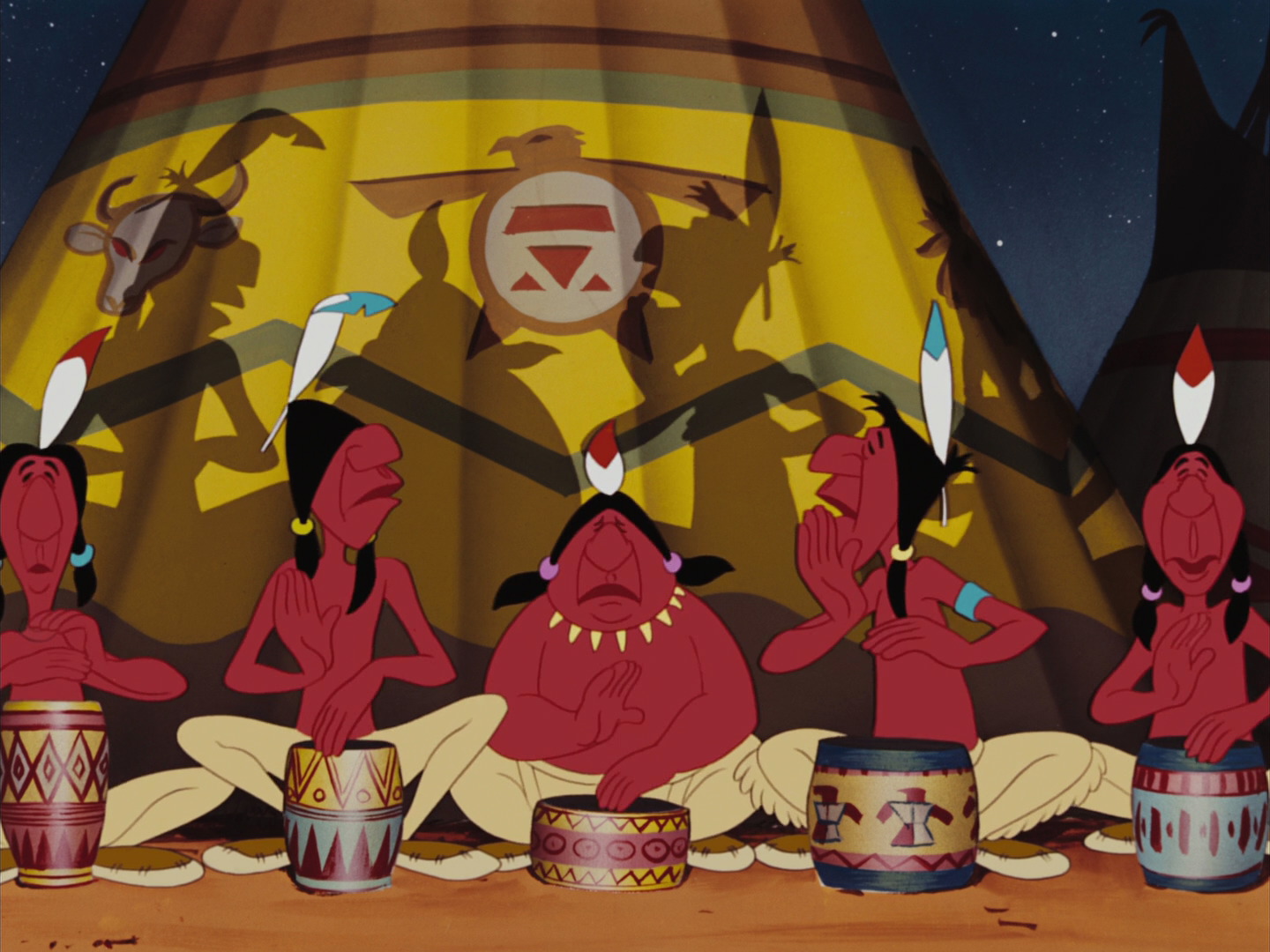
Since first contact, Native Americans have consistently needed to combat the European stereotypes that portray them as inferior and uncivilized. Barraged with echoes of the same handful of Native tropes since Buffalo Bill’s Wild West Shows, contemporary American society often treats the stereotypical Native American princess, chief, and savage as historical truths, represented recently in Johnny Depp’s portrayal of Tonto in The Lone Ranger. But it is not just the visual image of the Native American that has been stereotyped, so has their sonic sensibility. As documented in the film Reel Injun, Native languages and musics have consistently been “faked” by Hollywood with tricks like backwards English, pig-Latin, and Westernized imaginings of a ubiquitous Native music based on a pan-Indian society that never actually existed. Hollywood often uses Native American music to show a “primitive” society where music’s sole function is to prepare for war. However, the “Indian” drumbeat that accents the first beat of a group of four cannot be found in any traditional Native American or Aboriginal music.
While Native American-directed motion pictures such as Smoke Signals, Powwow Highway, and Atanarjuat: The Fast Runner finally gave agency to Natives in film, it was the all-Native DJ collective A Tribe Called Red’s self-released album and popularization of the Electric Powwow that directly challenges the perception of Native American music in modern society. In this post, I analyze the sonic composition of ATCR’s song “Braves,” exploring how A Tribe Called Red challenges North American stereotypes of Native Americans through the cultural re-appropriation of racist sounds.

“A Tribe Called Red – Hall 4 (1)” by Flickr user Trans Musicales, CC BY-NC 2.0
After World War I, intertribal powwow gatherings served as a place to celebrate newfound unity among Native Nations returning home from the war. By the 1950s intertribal powwows had spread throughout North America. With the continued strength and importance of the powwow in contemporary Native society, urban Natives in locations like New York City and Ottawa, Canada, have begun to search for ways to create the same sense of unity in urban venues. In 2008, DJs NDN and Bear Witness formed the DJ collective “A Tribe Called Red” and began curating performances in Ottawa the second Saturday of every month called the Electric Powwow: a “wild party” focused on showcasing native talent and aboriginal culture. ATCR’s website describe the music as “ the soundtrack to the contemporary evolution of the powwow.“ Bear elaborates in an interview with NOW magazine, “[the Electric Powwow] was also about creating a space for our community within the club environment.” Hip-hop DJ and turntable champ DJ Shub was invited to join the group in 2010, and the trio spent the next two years evolving the sound of the Electric Powwow into a mash-up of powwow and First Nations music with contemporary club sounds including hip-hop, dubstep, and dance hall.

“Tribe Called Red” by Flickr user Dav Yaginuma, CC BY-NC-SA 2.0
Much like Fela Kuti’s popularization of Afrobeat in the 1970s, made up of a combination of traditional Nigerian Yoruba polyrhythms with a blend of Western jazz and funk, and Reggaeton’s fusion of Caribbean rhythms with the aesthetics of American hip-hop in the 1990s, the Electric Powwow merges a historically traditional and non-syncretic music with popular and cosmopolitan music in a way that both honors cultural heritage and makes it relevant to a new generation. As NDN points out on Noisey, even their name follows this trend, simultaneously referencing the introduction of Nations at powwows and famous Afrocentric hip-hop group A Tribe Called Quest. The Electric Powwow events are not just about the creation of a new genre of music, but they also serve as a site for ATCR to speak publicly about aboriginal issues and represent themselves as a contemporary face for the urban Native youth renaissance. ATCR’s music videos and live-show projections extensively sample racist imagery from movies and cartoons including old westerns, Back to the Future III, Bugs Bunny, and Disney’s Peter Pan. As a result of their audio-visual activism, the group has become the unofficial soundtrack for the Idle No More movement, which is attempting to reassert Indigenous sovereignty rights and previously signed treaties in Canada.
By taking both visual and sonic symbols that depict racist stereotypes out of their cultural contexts, ATCR draws attention to both the specific racism of each individual image and the ubiquity of racist stereotypes. In their track “Braves,” A Tribe Called Red takes on the U.S. baseball team the Atlanta Braves by remixing the baseball organization’s Tomahawk Chop anthem, itself adopted from Florida State University.
ATCR’s version transforms the innocuous-sounding chant by showcasing its core as a Hollywood-esque stereotype of Native American song. By re-contextualizing the anthem, “Braves” prompts listeners to reinterpret this facet of American sports culture as a racist pageantry of “savage violence.”
The association of the “war chant,” the motion of the Tomahawk Chop, and the fact that these actions call for one team to attack all make it clear that American sports culture appropriates Native Culture as an example of “savagery” and “uncivilized” behavior. The Tomahawk Chop also forgoes the use of a language-based text entirely and instead chooses to use vocables that cannot be attributed to any particular Native nation, ceremony, or meaning. Like Hollywood’s use of backwards English and the war drumbeat to represent “Indians,” the Tomahawk Chop bears no resemblance to any real Native Nation’s music, acting as yet another imagined primitive stereotype that marginalizes actual Native American music.
On A Tribe Called Red’s SoundCloud page, “Braves”’s description reads, “We wanted to make a song for all the racist and culturally inappropriate sports teams that are still used today!” The group accomplishes this by creating dissonance between contemporary electronic drumbeats and the “traditional” paramilitary marching band arrangement of the “Tomahawk Chop.” “Braves” utilizes a standard dubstep song structure in 4/4 at 140 beats per minute that includes an intro, two main sections that include melodic materials, a breakdown/buildup section, a vocal “drop” which announces and is followed by the climax of the piece, and an outro that brings the track to a close. However, “Braves” does differ from other dubstep songs in the marked separation and interaction between the Tomahawk Chop samples performed by voices and marching band and the composed elements of the song performed as the Wub—a deep, wobbly synthesized sound—and accompanied by a HiHat cymbal pecking away at syncopated rhythms. Even though all the melodic content of “Braves” is based on variations of the Tomahawk Chop melody, ATCR never fully integrates actual samples of the Tomahawk Chop into the composition. The marching band and chant samples are treated as an unwanted and unexpected visitor to a party; they seem important at the entrance, but they are given an increasingly diminished role until they finally exit with a whimper.
Written as a protest against racist sports organizations to help convince them to stop using characterized ceremonies and mascots, “Braves” contains that struggle within the composition itself: dubstep, sounded as the Wub and HiHat, eventually renders the Tomahawk Chop sonically impotent. The “Tribe” drop, when ATCR marks the song by saying “tribe,” acts as the turning point in “Braves.” After this point the Wub and HiHat consistently overwhelm the sampled material. In a standard dubstep song, the tribe drop would be followed by the climax: the strongest, most complex musical section of the piece. However, the Tomahawk Chop sample that follows this drop is immediately swallowed up by a low-pass filter that rubs out the tune, starting with the highest pitched sounds, over the course of sixteen measures, heightening the lower end of the sonic spectrum. Only then does the true climax occur. The Wub and HiHat appear here for the first time without the sample band or vocalizations. After the “Tribe” drop, the samples of the Tomahawk Chop are either dominated by the Wub or swallowed up by low-pass filters and fades.

“Tomahawk” by Flickr user Lorianne DiSabato, CC BY-NC-ND 2.0
In this way, “Braves” acts as a three-minute sonic story of reappropriation. The marching band arrangement and vocables represent the common stereotypes of Native American music perpetuated by Western Culture. The Wub and HiHat act as disapproving commentary on these stereotypes. “Tribe,” the only word used in the entire song, not only sounds ATCR as a group, but also marks the point in the song when ATCR begins to create their own image of Native music while simultaneously disempowering the strength of the marching band.
Just like the rebel American marching band’s reappropriation of the song Yankee Doodle in the Revolutionary War, A Tribe Called Red employs irony: in order to get the song the audience has to understand the racism, and while that sort of understanding seems to represent a steep learning curve for a culture so saturated in racist stereotypes, it is also exactly the sort of understanding a multicultural nation needs in order to thrive. Like Afrobeat, Reggaeton, and the more recent alternative hip-hop group Das Racist, ATCR is an underground voice within American popular culture that speaks with reverence for its own traditions while challenging the popular perception of race relations and breaking new ground in contemporary art. “Braves” proves that the reappropriation of sonic space is a powerful tool in the fight for cultural agency.
—
Featured image: “ATCR 4” by Flickr user MadameChoCho, CC BY-NC-SA 2.0
—
Christina Giacona is the Director of the Los Angeles New Music Ensemble and Instructor of Music at the University of Oklahoma. Dedicated to performing and researching the music of her generation, Christina teaches courses in Native American, World, and Popular Music. Since founding the Los Angeles New Music Ensemble in 2007, Christina has commissioned and premiered over twenty new works for the ensemble; run an international composers competition, recorded three albums, and collaborated with DJs, MCs, animators, choreographers, projectionists, and film producers.
—
REWIND!…If you liked this post, you may also dig:
“One Nation Under a Groove?: Music, Sonic Borders, and the Politics of Vibration”-Marcus Boon
“Live Electronic Performance: Theory and Practice”-Primus Luta
“Remixing Girl Talk: The Poetics and Aesthetics of Mashups”-Aram Sinnreich
Share this:


Current Top Posts





April 2021

January 2020

November 2019

October 2019

August 2019

April 2014

November 2017

March 2015

December 2017

October 2015
 Sounding Out!


Recent Comments