
Straight Leanin’: Sounding Black Life at the Intersection of Hip-hop and Big Pharma
 Marginalized bodies produce marginalized sounds to communicate things that escape language. The queer body is the site of sounds that engage pleasure, repression, rage, isolation, always somehow outside of dominant language. Sound Studies tells us that we should trust our ears as much as our eyes, justifying our trust in sound, and of the resonating body. Affect Theory goes further, saying that all senses play into a body that processes input through levels of response, experience, and anticipation. Affect is the vibrational space that is both bodily memory and anticipation. So where do sound and affect meet in queer bodies? How do marginalized peoples use sound and the body to express liberation, objectification, joy, and struggle?
Our writers in Sound and Affect tackle these questions across a spectrum of the marginalized experience. Last week, I opened by offering the concept of the tremble, a sonic form of affect that is necessarily queer in its affective reach. Next week, Maria Chaves explores the connection between voice, listening, and queer Chicana community formation: through space, across time, and with laughter. The series finishes with Justyna Stasiowska bringing the noise in a discussion of the trans body and the performance work of Tara Transitory. Today, Kemi Adeyemi, sloooooooows thingggggggggs doooooooooownnnnn so that we can hear the capitalist connections between the work expected of black bodies and the struggle for escape from this reality through the sonic affects, temporal shifts, and corporeal elsewhere of purple drank. —Guest Editor Airek Beauchamp
—
The first track on Future’s 2015 album Dirty Sprite 2 opens with the gassy sounds of the rapper preparing “lean”: a prescription promethazine and codeine cough syrup mixture that is cut with sweet sodas and candies. He vigorously shakes the syrupy Sprite together before cracking the bottle open and pouring the fizzing drink over ice likely held in two stacked Styrofoam cups, the vessel of choice for hip-hop’s most audible drug. As Future takes his first sips his mouth puckers with the sweetness. He swirls and sips again, sighing with pleasure as he begins boasting “…I just took a piss and I seen Codeine coming out/We got purple Actavis, I thought it was a drought.”
Otherwise known as syrup, sizzurp, purple stuff, drank, Texas Tea, and barre, lean is a highly addictive concoction that is sipped slowly to release a potent blend of euphoria, hallucinations, and motor impairment—especially when consumed in conjunction with alcohol. Lean slows you down, muddies your perception, and makes you physically sway, recline, lean. Future’s album, like much of his oeuvre, pays homage to lean and this particular song, “Thought It Was a Drought,” flies in the face of the pharmaceutical company Actavis that stopped producing the drug in 2014 amidst fears that it was being illegally distributed to and consumed by non-prescription holders. The lack of production has apparently not stopped Future’s consumption, however. On 2014’s “Codeine Crazy” he explains in a lean-fueled cadence that trails into his Southern accent that “I’m an addict and I can’t even hide it.”
Future’s demonstrations of addiction speak to a significant strain of hip-hop’s cache that stems from the genre’s long engagement with the terse intersections of drugs and black life. As Touré succinctly described in a 2012 piece in the Washington Post, early hip-hop often charted the realities of the drug-addled inner city that arose in the 1970s and ‘80s. “If you’re wondering why hip-hop has often been angry, sneering, nihilistic and dystopic,” he explains, “you can blame the war on drugs, and how it feels to be on the wrong side of it.” Rappers such as Future continue to bolster their legitimacy by narrating their functional (if fabricated) knowledge of selling drugs and thus being on the “wrong side” of this so-called war. But where the crack/trap rap genre documents the rapper’s mastery of the war by espousing the maxim that you never snort what you sell, the acceptance of prescription drugs as a product the rapper can hustle and consume has become commonplace.

Spotted at SXSW 2008, Image by Jazzbeezy
The hardest working people in hip-hop are at the forefront of their craft, and they are seemingly wasted every step of the way. In this, the mainstreaming of lean within contemporary hip-hop tells a familiar story of how embedded prescription drugs are within and across USAmerican societies. This essay offers a cursory glance at the sonic, physical, and affective terrain of lean in mainstream hip-hop, however, to query how prescription drugs are seen to generate productively intoxicated states that counter the violent realities of a particularly black everyday life. Contemporary soundscapes of lean have taken hold at a point when the intersections of neoliberalism and Big Pharma circumscribe particularly black ways of being. Beginning the work of understanding the discursive entanglements of race, labor, and drugs that are sounded by lean reveals larger questions about the subtle and covert ways that black consciousness itself is produced and policed in the neoliberal state.
As has been well documented by popular news outlets such as The Guardian and scholars such as Mac McCann, the sounds of lean were developed in the 1990s by Houston’s DJ Screw, who worked to record the loosened, detached body-feeling accessed through lean with his “chopped and screwed” productions. He slowed the tempo of whole songs to around 60 bpm, which elongated the vocals to an underwater slur, and chopped the rhythm up with strategic pattern interruptions that created even more goopy space between beats. Swishahouse Records took this droning Houston sound mainstream in the early 2000s with Top 40 radio hits by artists such as Mike Jones, whose song “Back Then” paired slow and guttural choruses that maintained the core elements of the chopped and screwed sound with bouncy lyrics about girls, cars, and money that trended toward mainstream pop rap.
By 2011, gesturing to the sounds of lean become a virtual guarantor of mainstream hip-hop success. This was evidenced in part by Harlem’s A$AP Rocky, who compiled the essential audio components of lean for his debut mixtape Live.Love.ASAP—which sampled Mike Jones on the ode to lean,“Purple Swag”—and immediately nabbed a $3 million dollar deal with RCA.
While the chopped and screwed aesthetic fell a bit by the wayside in ensuing years, recording the literal sounds of lean being poured, swirled, and sipped became increasingly common in hip-hop recordings—as did capturing the swooning effects the drug has on rappers’ flow. Lil Wayne’s public addiction to lean took center stage on his prolific and sometimes-erractic mixtapes such as Dedication 5 that feature many interludes where his words bleed into one another or trail off altogether following the droopy intoxication promethazine was having on his body. The devastating effects of the controlled substance became starkly clear when Wayne suffered multiple seizures, and when Rocky’s manager, A$AP Yams, passed away following complications with drugs—a fate Houston’s own DJ Screw and the beloved Pimp C had already met.
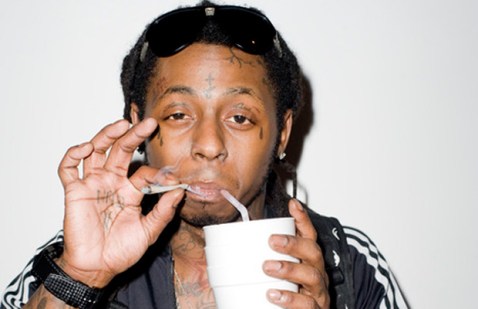
Lil Wayne
Despite the physical risks of consuming lean, the drug appears to be a stalwart coping mechanism for artists whose work ethic has led to extravagant excesses that are balanced by the increasingly visible violence done onto black bodies. Future himself repeatedly strikes a balance between his addiction to lean and the conditions of his particularly black stardom. His video for “Codeine Crazy” is a swirling, purple-inflected picture of the artist in various states of repose: the video opens with him in a club attempting to hold his head up straight, taking his first wobbling steps after lying down in a field once populated by purple horses, and being shaken awake on an Atlanta porch while holding Styrofoam cups full of lean.
The production, lyrics, and imagery underscore his apparent struggles balancing celebrity life with the realities of his difficult upbringing, encapsulated in the admittance that he is “Drowning in Actavis suicide.” The sentiment is exacerbated in the video for “March Madness,” where iconic clips of Civil Rights Movement protesters being beaten by the police provide visual background while Future intersperses dedications to lean and exaltations of the good life with lamentations of the loss of black civil rights: “Ballin’ like the March Madness/All these cops shooting niggas, tragic/I’m the one that’s living lavish.” In these works, Future paints a picture whereby the entire spectrum of black life from extraordinary celebrity to mundane tragedy can only be understood in and through drug-induced states.

Schoolboy Q show at The Door in Dallas 6/30/12, Image by Flickr User Mikel Galicia
Future’s balancing act is common among artists for whom prescription drug abuse is both a status symbol and a requirement of black everyday life where maintaining success requires that you work nonstop. When Hot 97s Angie Martinez queried the relationships between lean and seizures, the self-confessed functional addict Schoolboy Q responded with incredulity: “Man that shit ain’t from no lean, man…Bro, we are rappers; we don’t sleep. People don’t understand.” His story of churning out features, mixtapes, albums, and tours for Interscope Records reflects our larger neoliberal economy that places a premium on the individual’s maximum, efficient output. As Q suggests in his interview, prescription drug use has blossomed under these conditions whereby the individual is made to feel perpetually behind, as Joanna Moncreiff writes in the essay “Psychiatric Drug Promotion and the Politics of Neoliberalism.” Prescriptions are marketed to stabilize, enhance, and/or find relief in one’s productivity in an age where individual entrepreneurship and competition are rewarded. Set against a larger national reliance on prescriptions to remain physically and mentally “stable” enough to remain efficient under this intensity, the black coping strategies heard through lean are innately USAmerican coping strategies.
At the same time, the slowed pace of lean is also attuned to the national epidemic whereby black people are routinely killed whether they are working or not. The racialized politics of productivity required by neoliberalism are thrown into relief as black people such as Eric Garner are killed because of their entrepreneurial efforts. As a result, attending to the sounds of lean must necessarily reflect gaps in our understanding of how particular patterns in drug use do and do not render black people intelligible as functional citizens worthy of life. Rappers like A$AP Rocky, Schoolboy Q, Future and others create musical odes to and demonstrations of the slowed pace of lean as it provides them a break from norms of physical and affective comportment. The drug incurs simultaneous sensory overload and the critical detachment from their bodies that allows them to experience (and potentially control) this overload at a slower pace—a physical and affective space that several rappers discuss in the Vice article “Lean on Me.” Lean radically grounds them, in other words, in an alternative body-space-time continuum that converses with the demands the neoliberal state places on the black body.
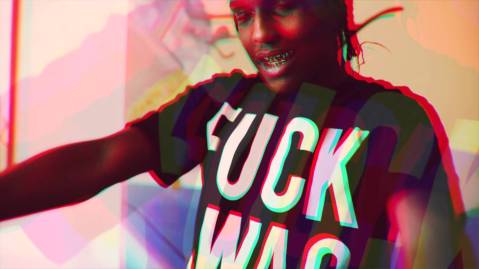
A$AP Rocky, Still from “Purple Swag Bootleg” (Director’s Cut)
The dissociative pleasures controlled substances offer to black people have been historically criminalized, and radically different sentencing guidelines continue to be handed down for the perceived consumers of “crack” (black people) versus “cocaine” (white people). In this milieu, black reliance on prescription drugs for pleasure, physical ailments, mood stabilization, or otherwise has proven to be dangerously unintelligible. Sandra Bland and Ralkina Jones died while their requirements and requests for the proper prescription meds they took to remain alive were ignored if not refused outright by the police. The question of whether or not black people experiencing alternate states of reality are more or less deserving of death is further triggered by the murders of people who may have been knocked into “discombobulated” states following car accidents, such as Renisha McBride and Jonathan Ferrell. The many deaths of black transpeople killed in the midst of various stages of medical reassignment further underscores a need for larger awareness of the ways that alternative conceptions of reality and consciousness map onto black life.
A critical history of hip-hop’s pharmaceutical undercurrent is not just an exercise in examining aesthetics. We can examine how lean is Auto-Tuned, chopped and screwed, and lyricized until we’re blue in the face. Sitting in the muck of lean-addled songs—theorizing how it feels to lean back and let our heads roll off our necks while we watch our surroundings fade and sway to purple—reveals a critically important rubric of black bodies, sounds, and affects that are wholly circumscribed by the entanglements of race, political economy, and the medical industrial complex. Reading black life against the sounds of lean subsequently makes the intersections of black labor, joy, and depression audible. This reading will not only take prescription drugs and hip-hop seriously within the canon of music and sound studies, but will also raise questions about intoxication—in its most expansive definition—as a critical component of black labor and survival from slavery to the neoliberal moment.
—
Featured Image: A$AP Rocky, Image by Flickr User Mira Shemeikka, Extra-swagged by SO!
—
Kemi Adeyemi is about to complete her PhD in Performance Studies at Northwestern University. Her dissertation examines how blackness is produced as an aural, visual, and embodied economy in the white nightlife scenes of Chicago’s gentrifying neighborhoods; the work illuminates how a small community of queer women of color that circulates through these scenes mobilize black sound as a theory and method taking pleasure therein.
—
 REWIND!…If you liked this post, check out:
“This is Your Body on the Velvet Underground“-Jacob Smith
“The (Magic) Upper Room: Sonic Pleasure Politics in Southern Hip Hop“–Regina Bradley
“Tomahawk Chopped and Screwed: The Indeterminacy of Listening“–Justin Burton
Share this:

Beyoncé’s New Weave Swing, or How to Snatch Wigs With Hair Choreography
 This September, Sounding Out! challenged a #flawless group of scholars and critics to give Beyoncé Knowles-Carter a close listen, re-examining the complex relationship between her audio and visuals and amplifying what goes unheard, even as her every move–whether on MTV or in that damn elevator–faces intense scrutiny. Last week, Regina Bradley (writer, scholar, and freelance researcher of African American Life and Culture) introduced us to the sonic ratchetness of Baddie Bey; the week before you heard our Beyoncé roundtable podcast featuring our first two writers, Priscilla Peña Ovalle (English, University of Oregon) and Kevin Allred (Women and Gender Studies, Rutgers)–as well as Courtney Marshall (English, University of New Hampshire) and Liana Silva (Editor, Women in Higher Education, Managing Editor, Sounding Out!), who will close out our series next week. Today, madison moore gives us not only great face but killer hair choreo. Mic drop. Hair flip.–Editor-in-Chief Jennifer Stoever
—
“Which Beyoncé are you trying to do?,” a sale associate at Beauty Full, the largest beauty supply house in Richmond, Virginia, asked me. It was a good question, because the shop had whole rows of wigs and ponytails that conjured Beyoncé enough for what I needed to do. Choosing just one would be tough.
“This one is very Beyoncé,” he said, pointing to a style reminiscent of the huge, teased out curly Afro Beyoncé worked in the early 2000s. I wasn’t really feeling this particular style but I could tell my sales guy was living it. “It’s not fierce enough!” I told him. “I need something that really moves!” I’d been invited to give an hour-long lecture on Beyoncé at a university, one of my first gigs, and I was out at the last minute shopping for a wig to wear during my talk so that I could give the children a little sip of Beyoncé. That’s when I saw it: a long, black and dark brown two-toned wig with curls for eternity that I knew would look great on stage. Come on, wig!
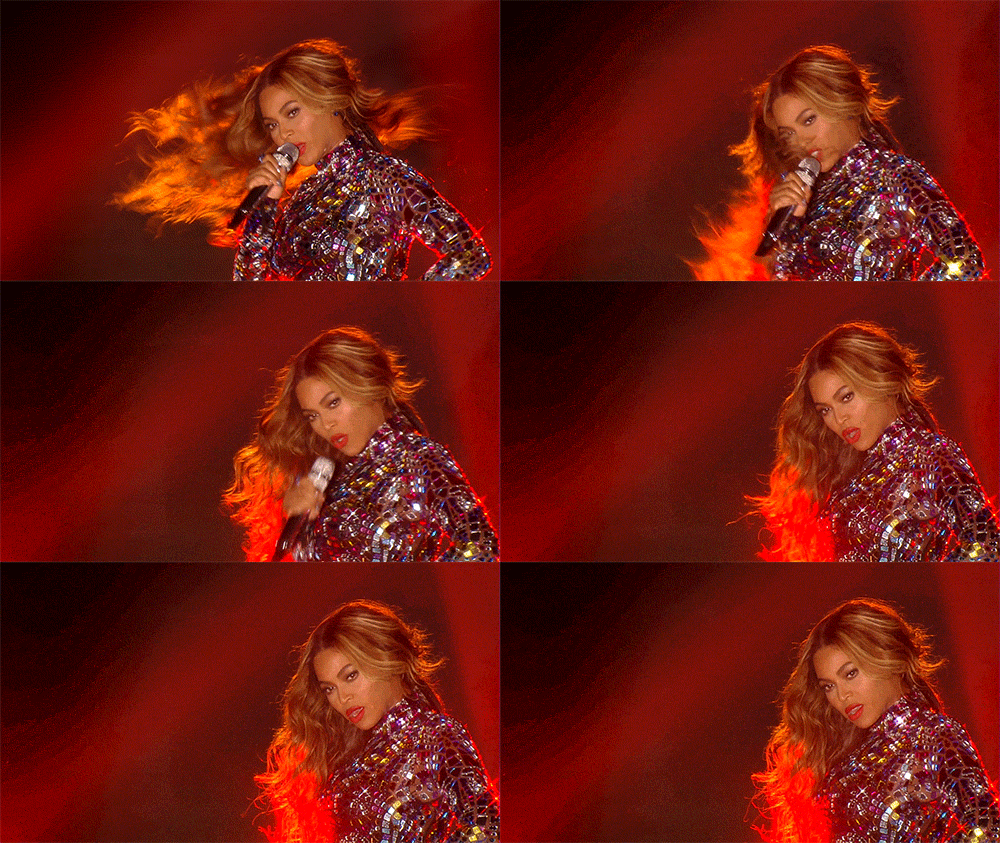
 I wanted to wear a wig “that really moves!” during this talk to demonstrate what I feel is the creative genius of Beyoncé’s performance persona: what I call “hair choreography.” Not unlike dance moves intended for the body, “hair choreography” is a mode of performance that uses hair to add visual drama to the overall texture of sound and it’s the special genius of Beyoncé’s stagecraft. On one occasion some friends and I were drinking wine and downing live Beyoncé videos on YouTube when one of us was like “I am living for her hair choreography!” I’m not sure we invented the concept but the phrase “hair choreography” has certainly stuck with me. Hair choreography is one of the secret weapons of the pop diva, those places in a live performance where she flips and whips her hair in exactly the right point, using “haircrobatics” to punctuate a moment, a feeling, raising the stakes, the sex appeal, and even the energy in the audience.
Hair choreography is exciting because it tells a story, but even more than telling a good story in performance “hair choreography” punctuates everything else happening on stage: the lights, the dance moves, the glitter, the sequins, the music. In this way, “hair choreography” becomes part of the spectacular offering of stage presence; a type of magnetism that, despite everything else happening on stage, draws us into a single performer – the star – whose single energy needs fill up the whole space. “Hair choreography” occurs in those moments of a live performance where the hair is flipped, whipped, dipped, spun and amplified during the most exciting, emotion-filled sounds and dance moves.
Even though many scholars still often approach them as separate practices, sound and motion are so fluidly entangled, as Jennifer Stoever has revealed. In this way, “hair choreography” builds on performance studies scholar Imani Kai Johnson’s call for the “aural-kinesthetic.” The “aural-kinesthetic” is not a method or a theory but simply a way for scholars to think about how music and movement happen at the same time. “Hair choreography” is about the relationship between sound, body and movement, and how each of those comes together to leave a visceral impact on an audience.
One video that shows the importance of hair choreography to Beyoncé’s package is her medley “If I Were A Boy/You Oughta Know,” a mélange of the soft hard rock her own track coupled up with the aggressive rock of Alanis Morissette’s iconic break-up jam of the same title. In the clip, as Beyoncé segues from “If I Were A Boy” into “You Oughta Know” the wind machines appear to blow her hair faster, and with every emotional note or beat she knocks her head to the side with attitude, forcing her straight hair with it. By the time Beyoncé sings “And I’m here, to remind you…,” the most emotional (and recognizable) transition of the song, the hair is already going full blast. Guitars and drums go off while strobe lights engulf the stage in a frenzy of chaos.
At “You, you, you oughta know” she falls to her knees and performs a choreographed head bang while sliding across the floor using only her knees. It’s important to note here that the singing has stopped because this is a moment of “hair choreography,” a transition indicating an impending change in mood.
Everyone loves Beyoncé’s hair. In her will the late comedian Joan Rivers requested “a wind machine so that even in the casket my hair is blowing just like Beyoncé’s.” There are countless YouTube tutorials showing young girls how they too can achieve that Beyoncé look with weaves, wigs and lace fronts. Even the comedian Sommore, who stared in the 2001 film Queens of Comedy , had something to say about Beyoncé’s hair:
Beyoncé is a bad motherfucker. Oh this bitch bad. Let me tell ya’ll how bad this bitch is. I went to see her concert in Atlantic City after she had her baby. I sat in the second row – this bitch was flawless. I mean I’m talking about the bitch was flawless. Only problem I had with Beyoncé…she had on too much hair! This bitch came out she had at least 18 packs of hair on. She came out I thought the bitch was the cowardly lion from The Wiz. I’m sitting there in awe of this bitch neck, I’m like, “This bitch neck is strong as a motherfucker!”
All jokes aside, the mystery of Beyoncé’s hair-–and all of the technologies involved in keeping it moving–is part of the genius of her brand image, particularly because it works to make her ethnically ambiguous.. Having various types of hairstyles allows her creole body to infinitely play with race, and this makes her marketable to nearly everyone. Is she black? Is she Spanish? Is she biracial? Could she be Brazilian or from Latin America? Yes. In this way, her hair choreography not only punctuates her sound, but it shapes the very way it is heard, enabling her to morph into more personalities and fit into more demographics than even Lady Gaga or Madonna. It’s why she’s able to sound sexy or inspirational, “hood” or “classy,” vampy or masculine, vocal or dance-y. Look at a video like “XO,” to me the most mass-marketable song on BEYONCE. First of all she looks fabulous, but I think it’s hard to watch that video and not feel like it’s specifically pitched to 15-year-old white girls in Connecticut. Everything about the video, especially her sweeping hair flourishes, positions Beyoncé as relatable to teenage girls all over the US.
As dance studies scholar Melissa Blanco Borelli sees it the mulatta body engages with a practice she calls “Hip(g)nosis,” or a type of hypnosis enacted by the yellow-bodied performer on fascinated audiences. This type of hypnotics, via the hips, “exposes the male gaze” by thinking through the “pleasure and consumption of the mulatta…” (She Is Cuba, forthcoming, Oxford University Press). Through hip(g)nosis Beyoncé has learned to use her ambiguous skin color and hair optics to her (monetary) advantage as a way to slide in and out of ethnic categories. Indeed, what does the fact that she is the lightest member of Destiny’s Child and also the groups’ most successful member have to do with her celebrity? The irony in all of this race play is that she was recently awarded the Michael Jackson Video Vanguard Award after her jaw-dropping 15-minute performance at the MTV Video Music Awards, and she is one of the few contemporary black pop singers who can play with race in the same way Michael Jackson did.
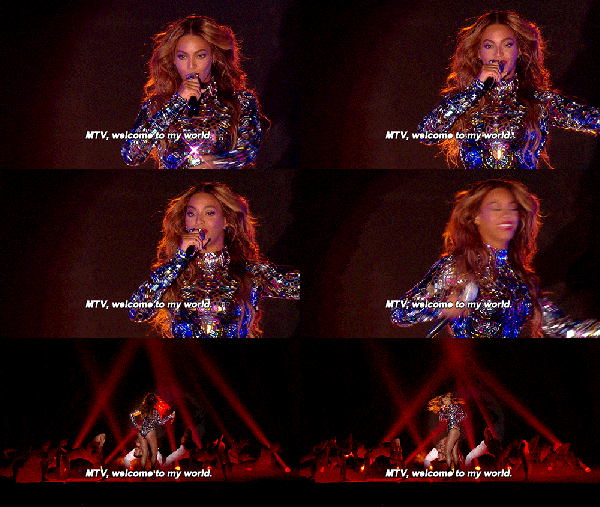 When I watched her recent MTV VMA performance I screamed a lot during her show, but the one moment I remember specifically, and still keep rewinding back to, happened right at the end of “Mine,” to me the best track on BEYONCE. She vamps “MTV, Welcome to My World,” and quickly spins and flips that hair back around baby, giving face to the camera, making millions of queens all over America scream YAASSS!!! at the top of their lungs. Beyoncé herself nodded back to queer performance and performers during a performance of “XO” this year on February 28th 2014 at the O2 Arena in London, after one overzealous fan threw a wig at Beyoncé as she sauntered off the stage and into the crowd (3:17).
When she turned around to pick the wig up she ad libbed “You got me snatching wigs, snatching wigs” into her microphone, knowing perfectly well that “Beyoncé snatching wigs” is one of the most popular fan-created Internet memes. In black gay male performance culture people often talk about “snatching wigs” or “coming for your wig,” and to this end scholars like E. Patrick Johnson and Marlon Bailey have done important work in theorizing the interplay between black gay colloquialisms and performance. If you’re “snatching wigs” then you’re performing better than everybody else while completely eradicating the competition. You’re seemingly indefatigable. Snatching a wig means a particular performance was highly effective or unique, and a snatched wig implies how an audience might surrender itself to a strong performer, as was the case with the aforementioned wig thrower. Beyoncé definitely understands the power of stage presence; a type of magnetism that, despite everything else happening on stage, draws us into a single performer – the star – whose single energy needs fill up the whole space. Filling up an empty stage with a single body is a lot of space to fill if you think about it. And making an audience focus on you when there are 10,000 other things are happening around you is an even more challenging task.
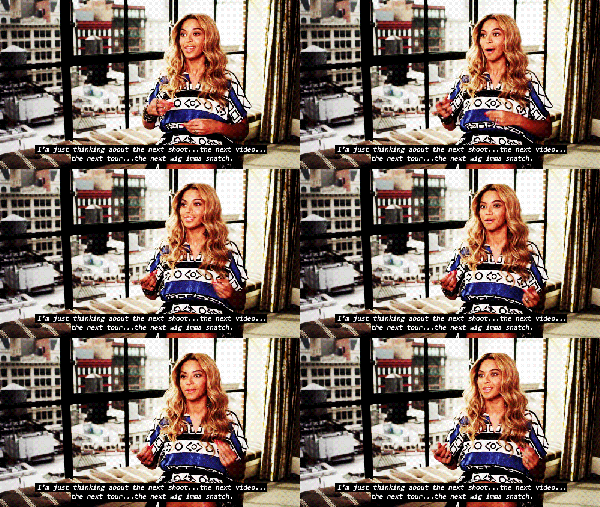 But “snatching wigs” can also mean you’re revealing someone’s deepest secrets, something you know they’re hiding. What’s underneath a wig but a secret – your real hair texture, a bald spot you don’t want anyone else to know about. A snatched wig can mean a break of the illusion. When I wore that wig during my Beyoncé talk to demonstrate hair choreography everyone knew it was fake – I put it on in front of them – but if the wig came off the illusion would have been broken nonetheless.
Part of Beyoncé’s monumental fame has to do with the fact that while she synchronizes, punctuates, captivates, and performs, she never lets us see underneath her wig. She just lets it whip.
—
madison moore (Ph.D., American Studies, Yale University, 2012) is a research associate in the Department of English at King’s College London. Trained in performance studies and popular culture, madison is a DJ, writer and pop culture scholar with expertise in nightlife culture, fashion, queer studies, contemporary art and performance, alternative subcultures and urban aesthetics. He is a staff writer at Thought Catalog, Splice Today, and his other writing has appeared in Vice, Interview magazine, Art in America, Dancecult: Journal of Electronic Dance Music Culture, the Journal of Popular Music Studies and Theater magazine. He is the author of the Thought Catalog original e-book How to Be Beyoncé. His first book, The Theory of the Fabulous Class, will be published by Yale University Press.
—
–
REWIND!…If you liked this post, check out:
Karaoke and Ventriloquism: Echoes and Divergences–Karen Tongson and Sarah Kessler
– Yvon Bonefant
“New Wave Saved My Life*”-Wanda Alarcon
Share this:


Current Top Posts





April 2021

January 2020

November 2019

October 2019

August 2019

April 2014

November 2017

March 2015

December 2017

October 2015
 Sounding Out!
Recent Comments