
Further Experiments in Agent-based Musical Composition

Photo by whistler1984 @Flickr.
Editor’s Note: WARNING: THE FOLLOWING POST IS INTERACTIVE!!! This week’s post is especially designed by one of our regulars, Andreas Duus Pape, to spark conversation and provoke debate on its comment page. I have directly solicited feedback and commentary from several top sound studies scholars, thinkers, artists, and musicians, who will be posting at various times throughout the day and the week–responding to Andreas, responding to each other, and responding to your comments. Look for commentary by Bill Bahng Boyer (NYU), Maile Colbert(Binaural/Nodar, Faculdade de Belas Artes da Universidade do Porto), Adriana Knouf(Cornell University), Primus Luta (AvantUrb, Concrète Sound System), Alejandro L. Madrid (University of Illinois at Chicago), Tara Rodgers (University of Maryland), Jonathan Skinner (ecopoetics), Jonathan Sterne (McGill University), Aaron Trammell (Rutgers University, Sounding Out!) and yours truly (Binghamton University, Sounding Out!). Full bios of our special respondents follow the post. We wholeheartedly wish to entice you this Monday to play. . .and listen. . .and then share your thoughts via the comment page. . .and play again. . .listen again. . .read the comments. . .and share more thoughts. . .yeah, just go ahead and loop that. –JSA, Editor-in-Chief
—
I’m a musician and an economist. Sometimes you will find me playing acoustic folk rock and blues on guitar, harmonica and voice. And at other times I will be at work, where I apply my expertise in game theory to the computer modeling of social phenomena. I create simulations of people interacting – such as how people decide which way to vote on an issue such as a tax levy, or how people learn to sort objects given to them in an experiment. In these simulations, the user can set up characteristics of the environment, such as the number of people and their individual goals. After things are set up, users watch these interactions unfold. The simulation is a little story, and one need only tweak the inputs to see how the story changes.
As a musician, I was curious if a program that generates social stories could be refashioned to generate musical pieces. I wanted to build a music-generation engine that the listener could tweak in order to get a different piece each time. But not just any tune – a piece with some flow, some story. I like that tension between randomness and structure. On one hand, I want every song to vary in unpredictable ways; on the other hand, I want to create music and not structureless noise.
I created a basic story of predators and prey, whimsically naming the prey “Peters,” represented by rabbits, and the predators “Wolves.” My simulation depicts a plain in the savannah with a green oasis. The prey seek the oasis and the predators seek the prey. Each character has its own goals and the closer they are to achieving them, the happier they are. Both predators and prey want to have stomachs full of food, so naturally they want to be close to their target (be it prey or oasis). As they travel through the savannah, they learn what choices (directions of movement) make them happier, and use this experience to guide them.

Photo by bantam10 @Flickr
So how does this story become music? To this question there are two answers: a technical one and an intuitive one. The intuitive answer is that in real life the story of predators and prey plays out geographically on the savannah, but musically this is a story that plays out over a sonic landscape. To elaborate, I abstracted the movement of the prey and predator on the geography of the plain into the musical geometry of a sonic landscape. The farther north an agent travels, the higher the pitch. And, the farther east an agent travels the longer the duration. In other words, as an agent travels to the northwest, she makes longer-lasting tones that are higher pitched. I also mapped happiness to volume, so that happy agents make louder tones. Finally, so that each agent would have a distinct voice as they traveled through this space, I chose different instruments for each agent.
In the video below I assigned the “church organ” sound to prey, and the “brass section” sound to predators.
Ultimately, there are some things that I like about this piece and others that I do not.
As a harmonica player, I improvise by creating and resolving tension. I think this piece does that well. The predator will pursue the prey into a quiet, low-pitch corner, creating a distant, rumbling sound – only to watch prey escape to the densely polyphonic northwest corner. There is an ebb and flow to this chase that I recognize from blues harmonica solos. In contrast to my experience as a harmonica player, however, I have found that some of the most compelling parts of the dynamics come from the layering of notes. The addition of notes yields a rich sonic texture, much like adding notes to a chord on an organ.
Unfortunately, for largely technical reasons, there is a lack of coherent rhythm and pacing. The programming platform (agent-based modeling software called NetLogo) is not designed to have the interface proceed in real-time. Basically, the overall speed of the piece can change as the processing load increases or decreases. I found that as agents learnt more about their surroundings (and more system resources are allocated to this “memory”), they became slower and slower. To fix this, I capped the size of their memory banks so that they would forget their oldest memories. The closest I have come to a rhythmic structure is by ordering the way that the agents play. This technique makes the piece have a call-and-response feel. If only the piece to had a coherent rhythm, then I could imagine playing harmonica along with it.
One last comment on pitch: while an earlier version of this piece mapped each step in space to a semitone, things sounded too mechanical. Even though this was the easiest and most intuitive decision from a technical standpoint, it was aesthetically lacking, so I have now integrated traditional musical scales. The minor scale, in my opinion, is the most interesting as it makes the predator/prey dynamic sound appropriately foreboding.

Photo by deivorytower @Flickr.
You can play this piece yourself. Simply go to this link with Java enabled in your browser (recommended: Google Chrome). Pressing “Setup” then “Go” will create your own run of the piece. As it is running, you can adjust the slider above the graphic window to change the speed. Press “Go” again to stop the model, adjust any parameters you wish and press “Setup” and “Go” again to see how the piece changes. Here are some parameters to try: instA and instB to change the instruments associated with prey and predators; PlayEveryXSteps to change the pace of the piece (higher results in a slower paced piece); Num-PackAs and Num-PackBs changes the number of prey and predators; the vertical PeterVol and WolfVol adjust the overall volume of prey and predators.
In regards to my version of “Peter and the Wolf,” I have a number of things that I’m curious about.
First, how does this relate to what you think of as music? Do you like listening to it? Which elements do you like and which do you dislike? For example, what do you think about about the tension and rhythm – do you agree the first works and that the second could be improved? Would you listen to this for enjoyments’ sake, and what would it take for this to be more than a novelty? What do you think about the narrative that drives the piece? I chose the predator and prey narrative, admittedly, on a whim. Do you think there might be some other narrative or agent specific goals that might better drive this piece? Is there any metaphor that might better describe this piece? As a listener do you enjoy the experience of being able to customize and configure the piece? What would you like to have control over that is missing here? Would you like more interaction with the piece or less interaction?
Finally, and perhaps most importantly, what do you think of the premise? Can simple electronic agents (albeit ones which interact socially) aspire to create music? Is there something promising in this act of simulation? Is music-making necessarily a human activity and is this kind of work destined to be artificial and uncanny?
Thanks for listening. I look forward to your thoughts.

“The Birth of Electronic Man.” Photo by xdxd_vs_xdxd @Flickr.
– – –
Andreas Duus Pape is an economist and a musician. As an economist, he studies microeconomic theory and game theory–that is, the analysis of strategy and the construction of models to understand social phenomena–and the theory of individual choice, including how to forecast the behavior of agents who construct models of social phenomena. As a musician, he plays folk in the tradition of Dylan and Guthrie, blues in the tradition of Williamson and McTell, and country in the tradition of Nelson and Cash. Pape is an assistant Professor in the department of Economics at Binghamton University and is a faculty member of the Collective Dynamics of Complex Systems (CoCo) Research Group.
– – –
Guest Respondents on the Comment Page (in alphabetical order)
Bill Bahng Boyer is a doctoral candidate in music at New York University who is completing a dissertation on public listening in the New York City subway system.
Maile Colbert is an intermedia artist with a concentration in sound and video, living and working between New York and Portugal. She is an associated artist at Binaural/Nodar.
N. Adriana Knouf is a Ph.D. candidate in information science at Cornell University.
Primus Luta is a writer and an artist exploring the intersection of technology and art; he maintains his own AvantUrb site and is a founding member of the live electronic music collective Concrète Sound System.
Alejandro L. Madrid is Associate Professor of Latin American and Latino Studies at the University of Illinois at Chicago and a cultural theorist and music scholar whose research focuses on the intersection of modernity, tradition, globalization, and ethnic identity in popular and art music, dance, and expressive culture from Mexico, the U.S.-Mexico border, and the circum-Caribbean.
Tara Rodgers is an Assistant Professor of Women’s Studies and a faculty fellow in the Digital Cultures & Creativity program at the University of Maryland. As Analog Tara, she has released electronic music on compilations such as the Le Tigre 12″ and Source Records/Germany, and exhibited sound art at venues including Eyebeam (NYC) and the Museum of Contemporary Canadian Art (Toronto).
Jonathan Skinner founded and edits the journal ecopoetics, which features creative-critical intersections between writing and ecology. Skinner also writes ecocriticism on contemporary poetry and poetics.
Jonathan Sterne teaches in the Department of Art History and Communication Studies and the History and Philosophy of Science Program at McGill University. His latest book, Mp3 The Meaning of a Format comes out this fall from Duke University Press.
Jennifer Stoever-Ackerman is co-founder, Editor-in-Chief and Guest Posts Editor for Sounding Out! She is also Assistant Professor of English at Binghamton University and a former Fellow at the Society for the Humanities at Cornell University (2011-2012).
Aaron Trammell is Multimedia Editor of Sounding Out! and a Ph.D. Candidate in Media and Communications at Rutgers University.
Share this:

Could I Be Chicana Without Carlos Santana?
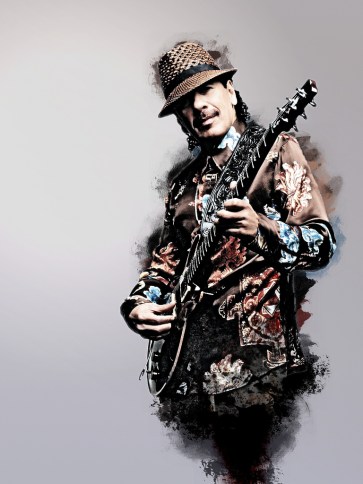
Carlos Santana by Flickr User Momez
This may be a given but I have to ask: Why is the music of Carlos Santana considered “Chicano music?”
It’s true; I am a fan. And as a fan I never question why I love the music, but I often ask myself what it is specifically about the music that resonates so strongly with me. I could say that I love Santana because I love a soulful electric guitar voice, because I admire the musicianship of the band, because I feel the “sabor” they sing about, because I’ve always loved Santana. But these parts surely do not make up a satisfying the “whole.” There is something else, something about listening to the music that amplifies my sense of identification as a Chicana with other Chicanos and Mexicanos. This happens whether I’m among raza, in the various communities I call home, or whether I find myself feeling very far from Aztlán. I’ve witnessed the effect of the music – maybe you have too – when it comes on the car radio, at backyard family BBQs, and friend’s living room dance floors, the music gets your body up and connects you to your Chicano roots.
In this sense, Santana is forever part of the Chicano sounded imaginary. For Chicanos, identifying with the music of Carlos Santana may have a special meaning that has something to do with a particular Chicano/Mexicano subjectivity. Yet, for non-Chicanos, Santana still retains their quintessential American rock band status. Most of their airplay is on mainstream radio, rarely if ever on Spanish-language stations. So Santana can be thought of at once as “puro” Chicano or “classic rock,” except that Santana is a straight up fusion band. This is why I have to ask, is the music of Santana “Chicano” music? And I further wonder, could I be Chicana without Carlos Santana?
…Oye Como Va…
Before the Rob Thomas & Carlos Santana collaboration on the Grammy award-winning album Supernatural (1999), before the phenomenon of “Smooth,” there was classic Santana. The Santana that produced the self-titled debut album Santana (1969) and Abraxas (1970). The songs “Evil Ways,” “Black Magic Woman,” and “Oye Como Va” from these two albums are on constant rotation on “classic rock” stations well after forty years since they first hit the airwaves. Even if you’re not a fan or a music connoisseur, when listening to “Oye Como Va” or “Smooth” it’s easy to recognize a distinct “Latin-ness” about them. In part, this is because of the fusion of Spanish and English lyrics with rock, blues, jazz, and Afro-Latin musical styles. For Chicanos, this particular fusion of language and sound might also resonate as something familiar and close to home – if sound can be a home. A quick search on YouTube will lead you to the classic 2000 Grammy Awards Performance of “Smooth” and a wealth of competing claims by fans (and foes) in the comments section.
Fan 1: “SANTANA ERES LO MAXIMO, VIVA MEXICO!!!!!!!!”
Fan 2: “Salsa baby, Oye Como Va is universal, Carlos is the man!!!!”
This was a special and high-profile performance so these comments are exceptionally spirited. But, YouTube is full of spontaneous, impassioned, (albeit anonymous) examples like this on any given day. I highlight these two as sort of placeholders for the idea of how sound and music mighty carry significant meaning toward subject formation in an everyday sense. These fans claim Santana both for Mexico and for the world, respectively, because they reflect a strong sense of Mexican or Chicano pride. In the first comment, the very enthusiastic fan could easily be a Mexico City native, maybe a Chicano wanting to sound like a Chilango –“ERES LO MAXIMO” is not a Chicano Spanish expression. The second fan’s comment is all in English and could be Chicano simply based on that—but those are slightly secondary points. As I suggested earlier, for Chicanos, Santana’s music has the potential to reflect a sense of ethnic history and culture. Sound can be a home. After all, the first comment claims Santana’s music for a whole country with “VIVA MEXICO!” helping to affirm the feeling that this fan and Carlos are Mexicanos together, across time and place.
When I was studying music in college, Mexican, Chicano, or Latino music was not part of the curriculum. Instead, in my private piano lessons, I would gravitate toward pieces by Spanish or Latin American composers as a sort of “good enough” way to stay in touch with my latinidad. This helped, but the fact is that Latin American art songs have much more in common with the Western musical canon than they do with my experiences and Chicana consciousness. In other words, it was a reach to identify with these composers solely because we shared a language. What would I miss in a too quick move to identify with the Latin-ness of Santana’s music this way? Would I hear only the Spanish spoken in the song? If so, then gaining a sense of my Chicana/o subjectivity by claiming “Oye Como Va” (for Aztlán?) relies on partially subsuming the specific Caribbean contexts and poetics of the song. Is this song originally Cuban, Puerto Rican? It’s really just a party song. “Oye como va, mi ritmo, bueno pa’ gozar, mulatta” Eso! Does it really matter now if Santana’s version has re-defined it for all time?
In a way, the second fan expresses a more complex desire: “Oye Como Va is universal.” Everyone knows that Carlos Santana is Mexican, some know that he is also an immigrant, and still others may have read that he grew up in Tijuana. As part of American rock music history, Santana’s roots are firmly planted in San Francisco and the Bay Area and it is well known that Santana played at the historic Woodstock Festival of 1969. Clearly, amongst other identities, Santana is a classic American rock band with long and wide appeal. But from the beginning, along with creative fusions of rock, jazz, blues, and salsa, it has been the distinctly Afro-Latino percussion core that defines their emblematic sound. And this is exactly how and why dwelling on these details in the sound of Santana matters. If Santana comes to mean or signify something like “pur0 Mexicano” or “pur0 Chicano” (in a brown pride or brown power sense) then that purity is already so productively and interestingly troubled because there is nothing remotely “pure” about Santana’s music.
Therefore, to identify with the music means confronting those complex fusions of language, race, and music that make up the Santana “sound.” To partly answer my earlier question, “Oye Como Va” is a composition by the renowned Puerto Rican timbalero and band leader Tito Puente, but the musical form, a basic cha-cha-cha, is Cuban. The song has other authors as well, that both Santana and Puente name. But ultimately, this song and indeed much of Santana’s music, comes in wake of much older histories of African diaspora, migration, colonization, artistry and spirituality.
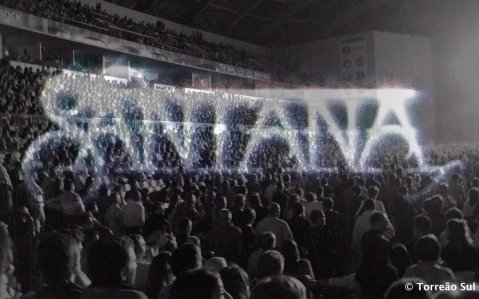
Santana fans. Image by Torreãu Sul.
…Sounding Home…
In a way, I’ve always felt that Santana’s music was making a black/brown connection, that racial boundaries were necessarily crossed or brought together because of the many histories that flow through the music. As a child of Mexican immigrant parents, I grew up listening to a wide repertoire of Afro-Latino music – elegant danzónes, romantic boleros, joyous cumbias, mad mambos, as well as more traditional Mexican music. Maybe that is also part of why listening to Santana reminds me of home. But this is perhaps too simple a response.
Santana’s music and popular image has been engaged in positive but also problematic ways in Chicana/o cultural production. Most recently, I noted this in a performance of the play New Fire, by Cherrie Moraga, in San Francisco. At a critical point in the drama, the evocative love song “Samba Pa’ Ti” is used to introduce a male character and a difficult, sexually violent scene. Moraga’s larger critique is of violent Chicano patriarchy and masculinity. The play is offered as a healing ceremony. But the association of this song, which features a famous guitar solo, with that specific scene is profoundly jarring. My sense was that Moraga selected Santana for the play’s soundscape it served as a shorthand for “Chicano.” Here, it was made to bear the history of violence of brown men against brown women and girls. This made it difficult for me to identify as a Chicana–queer and feminist–with Carlos Santana at that moment, and some time after. Surely this is also part of what “home” means.
Santana’s music interests me for these reasons, which go beyond the sounded Chicano imaginary in my headphones. What I find worthwhile in thinking further about Santana’s “sound” is how in the many acts of claiming Santana for oneself, one’s country, or one’s community, I can trace the way in which Chicano and Caribbean histories, both racialized and gendered, touch and cross in the music. That is, I see this as an invitation for the listener to reimagine notions of race, nation, gender, and sexuality even while dancing and singing along. In these ways, I see meaningful possibilities for imagining Chicana/o as a sounded subjectivity. I am certain that my sense of who I am, how I think, and how I walk in the world has been shaped by a life-long relationship with music and sound. And although being “Chicana” to me is not the same for anyone else, Santana’s music helps me to imagine a connection, a musical lineage I can trace and take part in. Santana is not my parent’s music. It’s not even my generation’s music. And, it’s not my only musical identity. But, even so, I couldn’t imagine being Chicana without Carlos Santana. Because when I listen, I do hear it, I hear how it all goes, together, and that is so, so good. “Give me your heart, make it real, or else forget about it!”
—
Wanda Alarcón is a PhD student in Ethnic Studies at UC Berkeley where her research involves reading Chicana and Caribbean “stories” together in a decolonial feminist vein. When she’s not living the glamorous grad student life she likes to make zines about po’try, learning new songs on her childhood piano, cooking for her loved ones, and exploring NorCal with her main squeeze. A native Los Angelena, she is beginning to appreciate thinking and writing about her beloved hometown from afar. Music helps bridge that distance. So do the trees and ocean breezes. She lives and loves kibbutz-style in Santa Cruz with her partner por vida, Cindy, their two sassy cats Lucy & Mona, and dear housemate, Ella.
Share this:


Current Top Posts





April 2021

January 2020

November 2019

October 2019

August 2019

April 2014

November 2017

March 2015

December 2017

October 2015
 Sounding Out!
Recent Comments