
SO! Reads: Jonathan Sterne’s MP3: The Meaning of a Format


DOI: https://doi.org/10.59350/stkk3-b2383
The point that had lingered with me after first reading Jonathan Sterne’s essay “The mp3 as Cultural Artifact,” was the idea that the mp3 was a promiscuous technology. “In a media-saturated environment,” Sterne writes, “portability and ease of acquisition trumps monomaniacle attention . . . at the psychoacoustic level as well as the industrial level, the mp3 is designed for promiscuity. This has been a long-term goal in the design of sound reproduction technologies” (836). A technology, promiscuous? I did not have to look far to find support. Like germs, I could find copies of mp3s that I had downloaded from Napster in 2000 scattered across generations of my old hard drives. Often they were redundant, too – iTunes having archived a copy separate from my original download.
But, for Sterne, mp3s are also socially promiscuous. They accumulate in the hard drives of the working class and are shared, almost anywhere, through the branching left/right wires of iPod earbuds. Since the popularization of the mp3, there have been new opportunities to share how we listen with others. This is promise of the mp3, and the reason it forms such a key point of scholarly meditation.
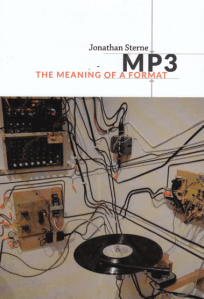
MP3: The Meaning of a Format (Duke University Press, 2012) finds Sterne revisiting many of these key themes, with a larger focus on the genealogical beginnings of the mp3 technology. While many of the book’s chapters are extrapolations of prior work Sterne has done regarding the genealogy of listening practices, this work concerns itself less with the 19th century, and more with the 20th century. Perhaps this is related to some of the methodological decisions Sterne has made in planning the book – in seeking out the genealogical origins of the mp3, Sterne worked from archives and manuals described in interviews by engineers who were fundamental to the technology’s production. As such it finds much in common with Trevor Pinch and Frank Trocco’s Analog Days and Dave Tompkins’ How to Wreck a Nice Beach but incorporates the genealogical methods regarding sonic technology present in Sterne’s earlier work The Audible Past and Emily Thompson’s The Soundscape of Modernity. In MP3 Sterne positions himself as a critical cultural studies scholar working between the humanities and sciences, focusing specifically on the mp3 due to its social and technological relevance today. The critical is key here as MP3 is truly a work devised to underscore the economic connections between the construction of our selves as “hearing subjects” and the media industries.
Certainly, the mp3 can still be considered a promiscuous technology, but it is corporate capitalism that had failed to recognize the extent to which it relies on technological promiscuity to support its infrastructure. This focus, ironically, displaces the mp3 as the main object of Sterne’s analysis. It highlights instead the pathological logic of corporate capitalism, and the ways that this rationality has mutated, now, in the wake of mass replicable, malleable, and iterative digital culture. In other words, the mp3 is endemic to a much larger plot, wherein the culture industries adapt to their own deus ex-machina. The naive development of the mp3 by the motion picture industry is a large part of the story here, but it is only a small bit of a much larger whole. The real story involves understanding how a handful of vested corporate interests have shaped the ways that we interpret and understand what listening is. In MP3 Sterne addresses one of the great questions of sound studies: What are the politics of listening? Or, which individuals and institutions have a vested economic interest in questions of how we hear?
Sterne recalls this drama in three parts, each unfolding in a somewhat autonomous fashion, but unified in so far as they explore the economic interests behind the scientific construction of “hearing subjects.” In the first part, Sterne is at his best exploring AT&T’s (and the affiliated Bell Laboratories’) role in funding psychological, physiological, and cybernetic research on hearing. In the second, Sterne explains how this early research has been applied to the visual and technical abstraction of sound in the 1970s. And, in the third part of this genealogy, he explains how these analogs were made digital, specifically the corporate politics which went into the construction of the mp3 standard. Throughout this surprising and detailed trajectory, Sterne makes the invisibility of corporate interests apparent and explicit.

Sterne also hints toward several powerful economic rationalities that have guided the construction of the mp3. Key among these insights is the monetization of cybernetic discourse, or the incorporation of the human body within a scientific understanding of technical systems. In order to engineer an efficient technical system, the capacities and limits of how we interact with (or serve as parts of) these systems must be taken into account. Sterne refers to this mode of engineering as “perceptual technics,” and he goes to great lengths to explain it.
Basically, at the turn of the 20th century, AT&T had taken a keen interest in the science of how people listen because they wanted to maximize the amount of simultaneous conversations broadcast through a single telephone wire. More conversations meant the purchase of fewer wires, and therefore greater profits. Eventually, drawing on the research of the oft-cited Claude Shannon and Warren Weaver (within SO!: What Mixtapes Can Teach Us About Nois and Pushing Record; and soundBox: Mapping Noise), AT&T recognized an economic problem of technical efficiency within their wires – there was too much ambient noise. Because of this, AT&T sought to limit the audible signal transmitted from one phone to another. This would allow for more signals (and therefore conversations) to be transmitted through the same wire. Physiological research provided clues that some frequencies were more audible than others, so engineers worked to compress audio signals to reflect this scientific abstraction of hearing.

The reduction of listening–as an embodied practice–to the quantification and control of the audible spectrum, is, in other words, the history of compression. Which, according to Sterne, should be understood as the true meaning of the mp3. While the mp3 format, like the CD or cassette, may become obsolete, technologies of compression will not. Sterne argues convincingly that most advances in compression technologies have been guided by the invisible logic of corporate capitalism. It is this exact tendency of compression–to make things smaller and more efficient–that threatened to undo the entire project of corporate and branded music distribution in the year 2000, via platforms like Napster. Sterne is well aware of this irony throughout MP3, and uses the final chapter to discuss, briefly, the moment of cultural transformation that is defined by file-sharing and mass distribution.
Bringing things full circle with a somewhat stoic conclusion about the democratic potentials of this moment, he remarks: “The end of the artificial scarcity of recording is a moment of great potential. Its political outcome is still very much in question, but its political meaning should not be” (224). Sterne points to the globalization and ubiquity of mediated listening as a sign that things may not have changed much even though mass networked society at one point promised freedom from a commodity form which privileged things like “liberal notions of property, alienated labor, and ownership” (224). He argues that even the music industries shall persevere, mostly because people have a sublime attraction to listening and music. In other words: Meet the new boss, same as the old boss. There are few moments of liberation to be found within MP3; it is instead a drama of the status quo where the conspirators of corporate capitalism succeed in spite of themselves.

The disparity in Sterne’s tone, when juxtaposing the nefarious and efficient dispositifs of capitalism with an untroubled and authentic construction of music is striking to say the least. And although Sterne is clear to explain that he locates his scholarship as work on a container technology (the mp3) and not its content (the music), this is a somewhat unsatisfying distinction as an embodied practice, such as listening, must take both into account. And while I agree that the mp3 reflects the promiscuity of corporate capitalism, is this challenged by the plethora of ideological nuance coded into song lyrics and arrangements? Do the corporate ideologies of the music industries flow beyond the container of the mp3 into the music itself? Is there any crosstalk, or overlap between these historical constructions? In other words, what are the limits to theorizing a container technology, and how much does the discursive path of the mp3 sculpt the content of what we listen to?
Despite, or perhaps, because of the rather dystopic scene that Sterne alludes to at the end of MP3, it falls nicely in the space between Sound Studies and Critical Information Studies. It bridges humanistic scholarship on embodied listening practices with a critique of the economic interests that have funded much of the scientific research relating to the phenomenology of sound. To that end, MP3 reveals much about the social construction of hearing and the ways that the familiar mythology of audio fidelity has been produced, discussed and exploited by several communication industries. Even though the mp3 may have been eclipsed by industry as the main object of inquiry in the eponomously titled MP3, Sterne succeeds admirably in detailing the promiscuity of corporate capitalism in the listening practices of our everyday lives.
–
Aaron Trammell is co-founder and Multimedia Editor of Sounding Out! He is also a Media Studies PhD candidate at Rutgers University.
—
Share this:

Sound-politics in São Paulo, Brazil
When I got to São Paulo in January, 2012, I had only a slight idea of how my fieldwork would unfold. Even though I had planned to investigate the relationship between everyday sounds and ways of using public spaces in São Paulo, Brazil, I was certain that that I wanted to observe São Paulo’s Anti-noise Agency (known as PSIU), responsible for supervising noise emission from bars, restaurants, nightclubs, and other commercial establishments. My original idea was to consider noise from an anthropological perspective – as a point of entry to discussions regarding social problems in the city. To meet this end, I began to focus on ‘controversial’ sounds. ‘Controversial’ sounds are interesting to study because they make audible the question of spatial rights and the intersections of private, public, and civil spheres in the constant (re)construction of a city.
More than 11 million people live in São Paulo; on average 110,ooo in each of the city’s 96 districts, a population higher than that of 95% of Brazilian cities. São Paulo is known for being Brazil’s economic hub. It boasts the highest rate of migrants from other countries and from other Brazilian cities (including many from the northeast of Brazil, which is a notably impoverished region). There is a striking economic disparity: 1.3 million people live in slums spread throughout the city. While the richest district holds 300 thousand jobs, in the poorest there are only 136. While some can afford to pay R$ 500 (roughly 245 US dollars) just to get into a nightclub, others will spend that amount over the course of a year, going to unlicensed bars in peripheral districts. São Paulo has more helicopters per capita than any other city in the world; and one third of its residents spend more than 1 hour commuting to work, usually in overcrowded busses and trains. There are two very different cities here – one which is impoverished, and the other wealthy.

Sao Paulo, Brazil. Borrowed from Fernando Stankuns on Flickr.
Within the context of a broader discussion of citizenship, controversial sounds need to be studied across social sectors. These sectors work in tandem to form the democratic society of São Paulo. For this reason, I have focused my research on four interrelated social branches.
As I said, first I went to PSIU, the executive branch of São Paulo. At PSIU I learned how certain sounds are regulated and how those responsible for making loud sounds are punished. I accompanied the agency’s engineer to a routine weekly inspection, and learned that people do not know much about legislation (sound limits allowed, zoning law, etc.), and that they know even less about what they need to do to achieve the sound pressure limits established by law.

Street art by El Bocho in São Paulo “shhhh…”. Borrowed from barretto-rodrigo on Flickr.
I also observed the legislative branch. There, I was happy to discover that the technical standards most related to urban noise and acoustic quality were going through a major revision in 2012. These standards are important because most city ordinances are modeled after their criteria of measuring and evaluating sound.
The third branch is economic. In 2010, a coalition of professionals (mostly from São Paulo) specializing in ‘acoustic quality’ created ProAcustica, a non-profit organization whose mission is “to disseminate the benefits of acoustic solutions in civil construction as a primary factor for comfort and health of users at home, work, or any other urban space, and also as a element for sustainability of enterprise and of the environment.” ProAcustica’s constituents are mainly architects, acousticians, civil constructors, engineers, and building material developers.
Over the course of my fieldwork, I have attended many ProAcustica meetings and interviewed many of its members. Only in the last few years has there been an articulation of acoustics and economics that demands more effective urban planning and, most importantly, quantitative criteria that can encourage civil constructors to deliver acoustically comfortable dwellings. ProAcustica members want to relate the risks of noise pollution to the greater public in order to expand their market. ProAcustica is particularly interested in traffic noise as a critical aspect of our urban soundscapes. Still, most people seem to consider traffic noise an inevitable consequence of urban life. They either get used to it or move somewhere else. For example, I live with my cousin next to Congonhas Airport. I can see the airstrip from my window. Even though he spent a few thousand dollars installing noise-isolating windows, I still wake up everyday when the first planes landing at 6AM. Thanks to these planes, the sound in my bedroom reaches 90 dB(A) with the windows open. My cousin says that he has gotten used to it. But if we leave the windows opened it is impossible to listen to the TV.
The last social branch that I examined was civil society. What is the practice of making and listening to sounds in São Paulo? Are there localized ‘controversial’ sounds? In 2012 loud music in public spaces has been at the center of debates in the press and community meetings.
The pancadão (‘big punch’ in Portuguese) are parties that happen mostly in the peripheral neighborhoods of São Paulo, where very little leisure space is able to accommodate large numbers of people. For this reason, these parties happen on the streets and plazas, attracting thousands of youngsters that go to flirt, drink, and dance to the sound of Brazilian funk. The music comes from car speakers. Sometimes three or more cars will park a few feet from each other, blasting Brazilian funk throughout the night. Most of the lyrics contain metaphors referring to sex, but recently there has also been a wave of more extreme “ostentatious funk” (funk ostentação) coming from São Paulo. Here are two examples of popular funk ostentação songs that can be heard emanating from the pancadão, the first is MC Guime’s “Tá Patrão,” and the second, MC Rodolfinho’s “Como é Bom Ser Vida Loca.”
There has also been a link between the pancadão and drug traffic. Tellingly, there is branch of ‘forbidden’ funk that exalts drug dealers and robbery while also affronting the police. These parties persevere because everything is mobile: the music, the drinks, the drugs, and even the place for having sex – everything is supplied by the cars and can move around whenever there is a risk of conflict with the police.
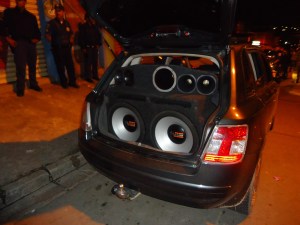
An example of a pancadão car. Photo by Leonardo Cardoso.

Other things kept within a pancadão car. Photo by Leonardo Cardoso.
Presently, I am conducting research in two peripheral regions. One is the place where most funk MCs originate, and the other is where new strategies of shutting down these parties have been implemented by the police. The Operação Pancadão is an operation that gathers military and civil police, PSIU agents, and other administration officers. This task force measures sound emissions, apprehends and punishes the responsible, then impounds the cars. Once you cut the sound, partygoers disperse – often seeking another pancadão close by. One police chief reports having mapped more than 200 places of pancadão in São Paulo.
Because of this fieldwork, I believe that the field of ‘applied sound studies’ needs to be developed further, both inside and outside of the academy. It is crucial for urban planners to develop qualitative methods to understand how residents evaluate the everyday soundscape. In Europe , for example, there is a group of scholars working on new methods for assessing and improving soundscapes based on how residents perceive the environments in which they live. I also see the potential for scholars interested in sound-related nuisance to work with conflict mediation. During the weekend 60% of all calls received by the police dispatcher (equivalent to 911 in the U.S.) are from people complaining about some nuisance, usually loud sounds. Understanding urban sounds as a phenomenon which impacts several different social sectors can empower interested parties to put forward alternatives. Ideally, these alternatives will allow marginalized youth to enjoy their music without being bullied by drug dealers or assaulted by policemen. At the micro level, conflict mediation scholars could provoke a sense of dialogue between neighbors and help them to find solutions for conflicting sonic behaviors.
Please listen to the accompanying podcast, “Listening to São Paulo, Brazil,” for the opportunity to listen to the soundscape of São Paulo, as I walk you through these spaces of sonic conflict.
—
Leonardo Cardoso was born in Porto Alegre, Brazil, where he studied music composition at UFRGS (Federal University of Rio Grande do Sul). In 2005 he entered the Ethnomusicology Group at UFRGS as a research assistant. From 2005 to 2008 he participated in projects with indigenous communities in Rio Grande do Sul. In 2008 he started his Master’s in ethnomusicology at the University of Texas at Austin under Prof. Veit Erlmann’s advising. His interest in film music led him to write his thesis on the experimental field of visual music in Los Angeles. He is working in São Paulo, where he is currently conducting fieldwork on urban noise, for his PhD. Leonardo is also a photographer, composer, and sound collector. Contact: cardoso@utexas.edu
Share this:




Current Top Posts





April 2021

January 2020

November 2019

October 2019

August 2019

April 2014

November 2017

March 2015

December 2017

October 2015


Recent Comments