
“Once the word ‘sound’ was in the title, it opened up a kind of door”: A Conversation with Eric Weisbard

“Eric Weisbard” by Flickr user Joe Mabel undre Creative Commons 2.0 License
Last March, I attended the first Experience Music Project (EMP) Pop Conference in New York City. (See my pre-conference round-up for SO!, and my blog post for IASPM-US on my post-conference impressions.) Post-conference, I had the opportunity to interview Eric Weisbard, co-founder and organizer of EMP Pop Conference. One late March morning, we talked via phone about the story behind Pop Con, rock critics and academics, and the intersection of Sound Studies and Popular Music Studies.
Weisbard is currently a professor at the University of Alabama’s American Studies department. In addition to organizing Pop Con, he is also the Vice President of the International Association for the Study of Popular Music (US Branch) and Associate Editor of the Journal of Popular Music Studies. He has also edited three collections of essays drawn from Pop Con presentations: This Is Pop: In Search of the Elusive at Experience Music Project (2004), Listen Again: A Momentary History of Pop Music (2007), and Pop When the World Falls Apart: Music in the Shadow of Doubt (2012).
In 2001, Weisbard was invited, along with his wife (rock critic and journalist Ann Powers), by the Experience Music Project Museum in Seattle to organize their first rock music conference. “I was a grad-school-dropout turned New-York-media-rock-critic-guy” Weisbard explained, “and when I was asked to work on a conference my one framing idea was we will mix academics and non-academics.” The conference has been going strong for ten years now, and has expanded from Seattle to Los Angeles and, this year, New York City.
Part of Weisbard’s approach to Pop Con is rooted in his move from self-declared “grad-school-dropout” to music editor at The Village Voice and SPIN. Weisbard created the well-known Village Voice column “Sound of the City,” which he admits was inspired by Charlie Gillet’s 1970 book The Sound of the City. (Gillet’s book also inspired the theme of this year’s conference.) Weisbard saw in the conference a place where academics and non-academics alike could converse together about music. He pointed out, “this is a place where there’s room for enthusiasm, for intellectual work, but we call it a pop conference; we won’t put barriers to the ability of the ordinary person to come and put something out. The last few years it’s become a free conference, an important step to making it accessible and not just for academics.”
Considering the location of the conference, I asked him what the soundscape of this year’s Pop Con sounded like to him, in retrospect. Three things stood out to Weisbard: the collision of cultures in New York City’s soundscape, the sound of media (embodied in the voices present at the conference), and the music that came from the conference rooms. Weisbard reflected:

“Kimmel Center” by Flickr user edenpictures under Creative Commons License 2.0
“For me, I might point to three things: the most familiar and most cliché is the cultural collision side of the New York City soundscape. You’d have a conference panel at 905/907 [at the Kimmel Center, where the conference was held]; every time I was there I’d hear music from below [….] Another aspect, which is more specific and maybe undertheorized, is the sound of media. I don’t mean media as abstract tools for disseminating information but media in terms of people who have to say clever things on a regular basis and who have to use words all the time. To me, that’s a very particular kind of sound. One of the things that’s interesting of being in New York, and having the non-academic side of the conference (which had been ebbing and is suddenly coming back full swing) is that from academics to journalists to people in the business, [it] was a loud version of my sonic memory of being a media guy in New York. Media chatter, a kind of chatter that’s loudest in New York. New York allows you to be face to face with people all the time [….] Number three is how music itself floated through the other two realms. You might hear a song, as an example, or one night I saw vaudeville songs of the bowery, a late night offering. [This could be in reference to Poor Baby Bree’s presentation during the conference.–Ed.] We’re not a music conference, we are a music writing conference, but nonetheless music is at the core. That would be third thing; typically you listen to music at a conference, at home, in car, and there are all more directly ways of listening to music. Music permeated things but at intervals. It’s appearance was not predictable. You didn’t know where it would pop up.”
Yes, music was everywhere, and so was sound. The title of this year’s conference opened up the conversation to Sound Studies Scholars. Weisbard pointed out, “when we came up with the theme, which is a riff on Charlie Gillett’s line on “the sound of the city,” we recast it as ‘Sounds of the City,’ in keeping with what we’ve always wanted to do at the conference, which is emphasize different kinds of music. In an interesting way, once the word ‘sound’ was in the title, it opened up a kind of door: in exactly the same way that being in New York we think about the city, when you think about cities you think about sound.”
From the beginning of the interview, Weisbard explained that he was still trying to understand what Sound Studies comprises and where it intersects with Popular Music Studies. More importantly, Weisbard pointed out that some may talk about Sound Studies to avoid associating with Popular Music Studies, which may point to a tension between the fields: “My biggest concern about the phrase ‘Sound Studies is that it is a defensive way for critics who think that if they talk about ‘Popular Music Studies,’ they won’t sound as serious.” Weisbard acknowledged that these questions of legitimacy have plagued Popular Music Studies for a while.
When I asked Weisbard about what Sound Studies can learn from Popular Music Studies, he admitted that he still didn’t have a clear grasp of Sound Studies to be able to offer a strong opinion. However, he shared an example of what he thought was a strong contribution to the field that was, also, accessible to people outside of the field: “The latest pop music collection, Pop When The World Falls Apart, has an essay from Martin Daughtry on listening as it’s undertaken by soldiers in Iraq. That was a presentation. When I saw the presentation as a 20-minute talk, I remember feeling more moved than any presentation on music I had ever heard. That’s where I feel like Sound Studies work can be as satisfying as any work on music [….] Daughtry wrote with a sense of almost confronting something terrifying, while trying to understand how people listen.”
The tension between the academic and the popular is something Weisbard grapples with in his own work. (He stated, “Anything that’s a purely academic version of how to present work is flawed and has to be challenged”). At the moment he is working on a book on commercial radio formats. He describes it as such: “I’m interested in how formatting music (different from genres) creates parallel mainstreams. I’m interested in how every button can represent a different construction of the middle.” For Weisbard, his academic work and the work he does as a rock critic bleed into one another. “It’s about using the rock critic’s ability to enjoy cultural weirdness” he said, “and the historian’s tendency to keep on digging and get to the bottom of it. I definitely see my work in conversation with people who are grappling with the nature of pop music in general. I love that the word “pop” emphasizes the commercial, trashy, places where it’s least likely called authentic, or [seen as an] embodiment of progressive values. It simply has to live or die on its own. I think academic work should too.”
What’s next for EMP? It will return next year to Seattle, but the theme has not yet been decided. In fact, Weisbard says that EMP’s return the year after is never a sure thing:”There was no guarantee in 2002 that we’d become big [….] The provisional nature [of the conference] is one of its best qualities. There’s absolutely nothing guaranteeing whether it comes again. There’s no organization attached to it, you don’t have a job from it. It depends on the people working. A gathering doesn’t work if people don’t come.”
—
Liana M. Silva is co-founder and Managing Editor of Sounding Out!
Share this:

Sound + Vision: Andy’s Mick

Andy Warhol – Mick Jagger 1975, Image by Flickr User Oddsock
 Hello Internet! It’s great to be here in cyberspace! Are you ready to rock? Today’s dispatch from our Spring Series, Live from the SHC, finds Cornell’s Society for the Humanities Fellow Eric Lott jamming it out on the relationship between the early 70s sound and vision of one Sir Mick Jagger. If you happen to be thinking that Monday morning at 9:00 a.m. is the least rock and roll time slot possible, just remember that’s when Jimi Hendrix gave “The Star Spangled Banner” the business at Woodstock. To give earlier installments by Damien Keane, Tom McEnaney, and Jonathan Skinner a listen, click here. As May comes to a close and the “Sound: Culture, Theory, Practice, Politics” fellows reluctantly break up the A.D. White House house band, look for our final two dispatches from Jeanette Jouili and Society Director Tim Murray. Until then, we’ll keep turning it up to 11 here at Sounding Out! –JSA, Editor in Chief (and 2011-2012 SHC Fellow)
—
After we left the Carlyle I told Jerry I thought Mick had ruined the Love You Live cover I did for them by writing all over it—it’s his handwriting, and he wrote so big. The kids who buy the album would have a good piece of art if he hadn’t spoiled it. –Andy Warhol
Andy Warhol’s complaint in his Diaries captures the almost cartoonish play for artistic control between himself and Jagger in the 1970s—between painter and singer, portrait artist and subject (Jagger and the other Stones biting each other), the visual and the verbal (“he wrote so big”!): between sight and sound in the realm of popular music. Warhol was no stranger to sound artistry, of course, from his work with the Velvet Underground to the everyday taping he did with his portable cassette recorder, the machine he called his “wife.” But Warhol as visual conceptualist returns us to a moment when, through album art and other commercial iconography, the visual domain shaped our sonic experiences perhaps more immediately than it does in these digital days. At the recent EMP conference in New York, I raised the question of the visual/conceptual from the perspective of sound, looking and listening to how the modalities were conjoined during an excellent and rather brief (and nowadays mostly scorned) passage of Jagger time in the middle 1970s: Jagger in his thirties.

Andy Warhol designed cover for Sticky Fingers (1971)
A funny thing happened after Exile on Main St. in the early 1970s: the Rolling Stones became a New York band instead of a London and L.A.-based one, and their frontman Mick Jagger, always an outlandish presence, became a swishier one. The manner in which this happened owes a lot to their encounter with Andy Warhol. From his cover designs for Sticky Fingers (1971) and Love You Live (1977) to the Stones’ renting of his Montauk house to rehearse for their 1975 tour to conspicuous late-70s hanging out together at Studio 54 and New York dinner parties of the rich and not so fabulous, it’s clear the Stones, or at least Jagger (and for sure his wives, Bianca and Jerry Hall), steered ever closer to Warhol’s orbit.
Good writing about the Stones’ New York phase has recently begun to appear, including Cyrus Patel’s 33 1/3 book on Some Girls (2011) and Anthony DeCurtis’s liner notes to that record’s 2011 deluxe re-release; Ron Wood’s Ronnie: The Autobiography (2008) opens with the band’s famous promo stunt playing on the back of a flatbed truck rolling down lower Fifth Avenue on 1 May 1975 to advertise their upcoming tour.
.
But the influence on them of the Andy aesthetic has gotten far less attention, at least in pop music criticism (the Warhol Museum mounted a show, Starfucker: Andy Warhol and the Rolling Stones, in 2005, full of great stuff). In particular, Warhol’s 1975 Ladies and Gentlemen black drag queen series, and the draggy portrait series of Jagger done at the same time and in the same way, attest to their mutual influence on each other. The gain for the Stones was exponential: a new persona for a new decade and indeed a new town.
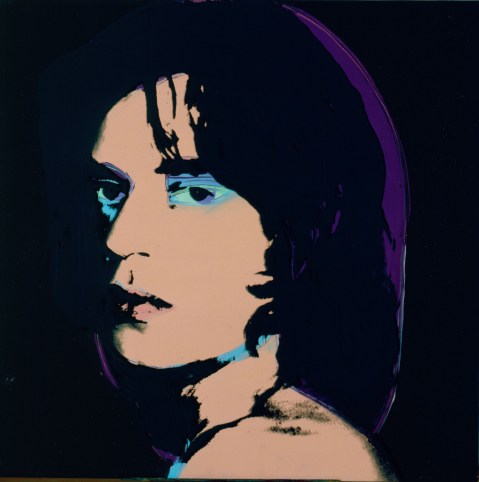
Andy’s Mick, Image by Flickr User Shreveport Bossier
The persona as influenced by Warhol arrives at the nexus of drag, hustling, and stardom, and Jagger in the 70s can be seen to be addressing and/or capitalizing on all three. Warhol’s Ladies and Gentlemen was originally referred to as simply the Drag Queen series. As Bob Colacello tells the story in Holy Terror: Andy Warhol Close Up, some Factory workers were sent to the Times Square gay bar The Gilded Grape to hire several hustlers there to sit for some Warhol Polaroids for fifty dollars a pop. (They later quipped that they were used to doing a lot more than that for fifty bucks.) As was his practice at the time, Warhol transferred these images to silkscreen for mechanical reproduction, over (or under) which he painted in unusually expressive fashion, at times applying collages of torn paper as well. Geometries of color in these pictures war with the photographic image; they signify on race as well as the drag queen’s everyday glamour and its defensive-aggressive thrust-and-parry. In any case, Times Square hustlers of color became stars in Andy’s hands. At this point the title was changed to Ladies and Gentlemen—perfect, since his subjects in the works can be thought of as both—and it may be that the title was taken from the 1974 Stones film of their celebrated 1972 tour, Ladies and Gentlemen, the Rolling Stones (it’s worth recalling lest we be tempted to discount such a film that almost everyone in a broad swath of the New York milieu saw it—in Just Kids (2010), for example, Patti Smith writes of seeing the film with Lenny Kaye and then going off to CBGB to catch a set by Television). What is certain is that Warhol at this same moment was giving Polaroids he had taken of Jagger in Montauk the exact treatment he gives the drag queens in Ladies and Gentlemen.
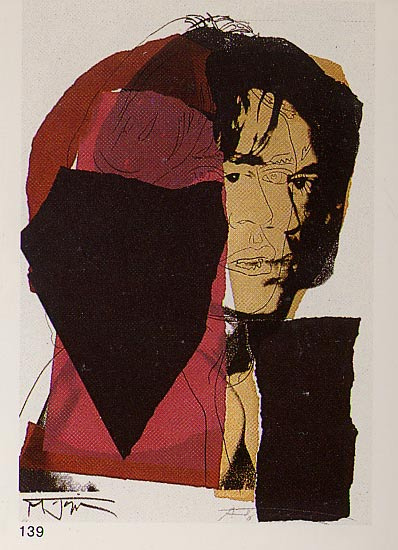
Andy Warhol’s Mick, 1975, Image by Flickr User Thomas Duchnicki
Being a drag queen is really hard work, Warhol famously wrote in The Philosophy of Andy Warhol (1975), and it is in part the connections between hard work, its celebrity remuneration, drag, and prostitution that link the Ladies and Gentlemen series with the portraits—paintings and then prints—of Jagger. These connections link this output with Warhol himself, making the portraits a sort of displaced self-portraiture. Their mechanics, if you will, seem homologous with drag, in fact. Starting with the Warhol-snapped Polaroid—not, say, with newspaper photos or commercial iconography as in Warhol’s 60s silkscreens—the works depend on Warhol’s presence, which then puts the images through the silkscreening process, after which (or before it) an uncharacteristically painterly (or collagist) procedure is applied, the latter akin to make-up itself. Where in some of the series the paint obscures the face, acting as a kind of negation or comment on the negation behind black queer hustling, in most of it the faces rise to a new form of presence or fabulousness, as if by repeating the act of drag the portraits affirm its “success.” Warhol’s make-over of Jagger, meanwhile, both drags the singer and makes him Warhol’s: Andy’s Mick.
According to a scheme worked out by Warhol and Jagger, the latter signed the portraits so that they could promote both artists. Which, if it doesn’t exactly make Jagger a co-author of the works, does signal his endorsement of Warhol’s vision of him. (Indeed the Warhol Museum has a facsimile of a 1983 letter from Jagger to Warhol asking for his assistance with Mick’s autobiography—a collaboration that boggles the mind.) As John Ashbery had it in Self-Portrait In a Convex Mirror, his multiple-prize-winning long poem of 1975:
Your [the artist Parmigianino’s] eyes proclaim
That everything is surface. The surface is what’s there
And nothing can exist except what’s there;
It [the surface] is not
Superficial but a visible core. . .
Your [Parmigianino’s] gesture . . . is neither embrace nor warning
But . . . holds something of both in pure
Affirmation that doesn’t affirm anything.
Not a bad definition of the Warholian image, this, and in the 1970s, as the Rolling Stones entered their second decade of performance and stardom, Jagger took the lesson and ran with it. A new self-consciousness about his own stardom enters Jagger’s (underrated) lyrics in the 70s; while self-reference is not unknown in the band’s 60s work (cf. 1968’s “Street Fighting Man”), and while one of their first hits takes on the culture industry itself (“Satisfaction”), in the 70s a new kind of meditation on rock-star celebrity enters the picture—I have seen the culture industry, and it is me: Jagger begins to write about himself as the culture industry. And this under the sign of Warhol, I think, which is to say, with a queerly knowing intimacy informed by a sense of the artist-star as a hustler for money in what we might call image-drag. Everything is surface, the surface is what’s there and nothing can exist except what’s there, and it’s not superficial but a visible core.
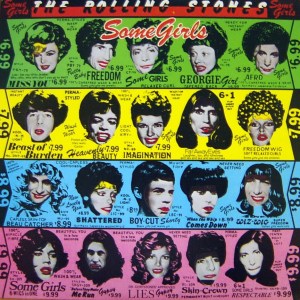
From 1973 forward, in the music from Goat’s Head Soup to Tattoo You (with It’s Only Rock n Roll, Black and Blue, Some Girls, and Emotional Rescue in between), and even more on the covers of these albums, culminating in the one for Some Girls with the Stones in drag—Andy in the Warhol Diaries: “[Mick] showed me their new album and the cover looked good, pull-out, die-cut, but they were back in drag again! Isn’t that something?”; the Some Girls cover, though Warhol didn’t do it, really does recall his drag queens, right down to the double drag of the inner-sleeve pull-out—to say nothing of the made-up glam of the 1975 and 1978 tour performances: in all this one sees a flouncier, queerer Mick, one that Jagger nodded to in various lyrics (for that demonstration you’ll have to wait for the longer version of this piece!). What this means in part is that the cliche we have of Jagger strutting like a neo-blackface soul man is due for revision: it’s much more precise to think of his aura as proximate to black femininity (icons like Tina Turner, say, who of course opened for the Stones), which he (re-)crafted through the adoption of a persona right out of Warhol’s colored drag queen sensibility.
.
So why the now-canonical assumption of the Stones’ decline at just this moment? Is their 70s sound discounted because of the queer reinvigoration of their visual/conceptual appeal? (One counter to this hegemony is Ellen Willis’s fine 1974 review of It’s Only Rock n Roll, included in her Out of the Vinyl Deeps.) Did the Stones’ sound change all that much, beyond new acquisitions of this reggae vibe or that funk riff or the other disco groove, or does the insistence on their fall come from a sense of their queening around? Is it this—not only this, I know, I know, Mick’s such an asshole, but still—that lies in part behind the (particularly post-Life) cult of Keith?
—
Eric Lott teaches American Studies at the University of Virginia. He has written and lectured widely on the politics of U.S. cultural history, and his work has appeared in a range of periodicals including The Village Voice, The Nation, New York Newsday, The Chronicle of Higher Ed, Transition, Social Text, African American Review, PMLA, Representations, American Literary History, and American Quarterly. He is the author of the award-winning Love and Theft: Blackface Minstrelsy and the American Working Class (Oxford UP, 1993), from which Bob Dylan took the title for his 2001 album “Love and Theft.” Lott is also the author of The Disappearing Liberal Intellectual (Basic Books, 2006). He is currently finishing a study of race and culture in the twentieth century entitled Tangled Up in Blue: The Cultural Contradictions of American Racism. This post is adapted from a talk Eric gave at the 2012 EMP POP Conference in New York City entitled “Andy’s Mick: Warhol Builds a Better Jagger.”
Share this:


Current Top Posts





April 2021

January 2020

November 2019

October 2019

August 2019

April 2014

November 2017

March 2015

December 2017

October 2015
 Sounding Out!
Recent Comments