
Into the Woods: A Brief History of Wood Paneling on Synthesizers*

Various Species for the Prophet 08, Analogics
*a companion piece of this research, on electronic sounds as lively individuals, is forthcoming in the American Quarterly special issue on sound, September 2011.
Not long ago, while researching the history of synthesized sound—or taking a break to troll for interesting synthesizers for sale online (activities that, for me, inevitably blend together)—I came across a thriving industry of small companies that offer custom-made wood panels to adorn the sides of old and new synths, like Synthwood, Custom Synths, Analogics, and MPCStuff.
As Trevor Pinch and Frank Trocco note in Analog Days, their history of Moog synthesizers, an “analog revival” is underway: “Today in the digital world, there is a longing to get back to what was lost” (9). The music technology magazine Sound on Sound concurs, documenting a renewed interest among electronic music-makers in modular synthesizers like those popularized by Moog and others in the late-1960s. Yet there seems to be more at play with this proliferation of wood customizations than merely nostalgia for analog synths, Hammond organs, and hi-fi cabinetry. How might we interpret this desire to adorn—lovingly, even obsessively—steel-encased machines that produce sound by electronic means, with various species of wood? What does this realm of audio esoterica reveal about material and social aspects of musical instruments, and the workings of contemporary media cultures more broadly?
On Contingency and Faith: Walnut, Purple Felt, and the True Cross
Pinch and Trocco describe the Minimoog as the first synthesizer to become a “classic,” due to its relative ease of use, widespread availability, portability and compact design (214). In the retrospective imaginations of historians and musicians, a significant feature that established its classic design was the walnut wood case on an early generation of Minimoog models.

The Moog Minimoog B (with walnut case), ca. 1970, Audities Foundation
However, Bill Hemsath, an engineer who assembled the first Minimoog prototypes in 1969-70, told Pinch and Trocco that these instruments were assembled from “junk I found in the attic” and an assortment of affordable materials cobbled together in the moment (214). Jim Scott, another engineer who worked on developing the Minimoogs, explained in a 1997 interview: “the reason we made it walnut [was] because Moog had gotten a deal someplace and had a whole barnful.” He noted that “the musicians certainly appreciated the fact that it was made out of walnut,” but eventually the designers “ran out of walnut and started buying something else and slapping paint on it to make it look like walnut.” The various kinds of wood used on models from different years, and the exact start and end dates of the coveted walnut models, remain contested matters among Moog enthusiasts.
Hemsath elaborated on this history in a 1998 interview by making an analogy to “classic” piano design: “There’s a similar story from Steinway. Back when they first got started in the U.S. they used to buy their felts from a feltmaker in Paris… And they got a lot of purple felt because [the supplier] used to be the felt maker for Napoleon’s army, and had a lot left over. So the colored cores in the hammers of those old Steinways were purple because of Napoleon’s army. Well, [the supplier] ran out, and [Steinway] said, red’s fine. They started making pianos with red felt, which is what they have today, and people started complaining, saying, it’s not a real Steinway, it’s not purple.” Like the proverbial purple felt on original Steinway pianos, walnut panels on synthesizers became “classic” because of their association with an originary moment, however happenstance, in the history of a particular instrument, and a limited supply and production run that rendered the material in question relatively rare.
So, a contemporary synthesizer enthusiast’s desire to acquire a “classic” walnut Minimoog, or to commemorate its aesthetic with customized wood panels, is in part an effort to establish a material connection to history. Synthesizer history unfolds in the deep time of technoscience which, as Donna Haraway has argued, often “barely secularize[s]” Judeo-Christian narratives of first and last things, of figural anticipation and fulfillment (9-10). The concern among some synthesizer enthusiasts to possess either the actual wood of an early-model Minimoog, or a faithful substitute for it, indeed resonates with Christian material cultures around relics of the True Cross and next-best artifacts with suitable provenance. A historical conjuncture that is contingent on otherwise unremarkable circumstances (e.g., Bob Moog’s good deal on a barnful of walnut in upstate New York) is marked as an originary or otherwise defining moment (the “invention” of a “classic” synthesizer) for a culture that defines itself as proceeding from it; the former is made to anticipate the latter, and the latter comes to fulfill the former.
Taking Stock: Materialities of Instruments, Sounds, Ecosystems
What kind of wood panels live in my studio? The manual to my Jomox XBase 09 drum machine, from 1999, details that its “steel sheet body” is bookended by “varnished side panels made of alder wood.” Wikipedia‘s pop-anthropological roundup of alder’s “use by humans” includes smoking various foods, treating skin inflammations and tumors, and building electric guitars. Fender Stratocasters have been built with alder since the 1950s. Guitar enthusiasts are notoriously fussy about which type of wood comprises the instrument’s body because of its effect on tone. Scientists, meanwhile, have taken to applying medical imaging techniques to Stradivarius violins, trying to “crack the mystery” of its prized tone. (Some say it’s due to the particular density of slow-growing trees in the Little Ice Age; others conclude it must be the varnish.)

The author
Given these interconnected concerns with instrument materials and the composition of tone, one might venture an etymological connection between timbre—which the Oxford English Dictionary describes as the character or quality of a musical sound depending upon the instrument producing it—and timber, which references “the matter or substance of which anything is built up or composed.” Music scholars often characterize timbre as the materiality of sound. Despite longstanding knowledge of the relationships of timber and timbre among instrument builders and musicians, and possible overlaps in historical applications of these words, placing wood panels on the sides of synthesizers surely has no effect on the resulting tone. Or does it? Audiophiles are prone toward occult-like habits, such as placing a single coin on top of a speaker to absorb vibration; and wood panels may well have subtle effects on the overall stability of an electronic instrument, resulting in barely perceptible sonic artifacts.
My Virus B synthesizer from the late-1990s has darker wood side panels than the Jomox, sort of a faux mahogany. Recently I wrote to Access Music, explaining my research on synthesizer history and inquiring what kind of wood they used. They replied that the B series featured stained beech wood (also commonly used and appreciated for producing smoked German beers and cheeses). Virus volunteered that they “in general do not use any kind of tropical wood for our devices.” Using sustainable wood has become a mandate and marketing concern at the Moog company as well; Moog’s wood “comes primarily from Tennessee. Hardwoods in Tennessee are growing faster than they are being harvested… US hardwoods are a world-wide model of sustained forest management.” Among contemporary synthesizer companies, there is often a selective eco-consciousness; as synthesizer designer Jessica Rylan suggested in our interview for Pink Noises: Women on Electronic Music and Sound (Duke: 2010), it is arguably impossible to build a synthesizer that does not incorporate at least some materials that are toxic in stages of manufacturing and/or disposal.

A Flashstick USB drive that incorporates wood from Berkshire, England
The paradox of dressing up an electronic machine made partly of toxic materials and processes with a sustainable-wood exterior is a fitting metaphor—like a contemporary fig leaf—for how we outwardly express environmentalist concern, despite plenty of contradictions in practice. Wood-adorned electronic devices, in all their glorious contradictions, are especially resonant in this cultural moment; see Asus’s EcoBook, Karvt’s lineup of custom wood skins for MacBooks, and, my favorite, Flashsticks: handmade wood USB “sticks” that combine “the high tech world of computing with the simplicity of the world of nature.” The story of Flashsticks’ handmade creation is a case study in eco-contradiction: the website implies that no trees were harmed in the making of their USB sticks—the company uses locally-sourced, “fallen wood from the previous winter’s storms”—yet we do not hear of the toxic materials that may comprise the drive itself.
Wood panels indeed work to conceal inconvenient truths. As Ruth Schwartz Cowan pointed out, the midcentury aesthetic of hiding household appliances behind wood paneling typified a culture that concealed gendered divisions of domestic labor (205). Lisa Parks has documented the similar recent phenomenon of dressing up cell towers as trees, which obscures the politics of media infrastructure behind a cloak of “nature.”
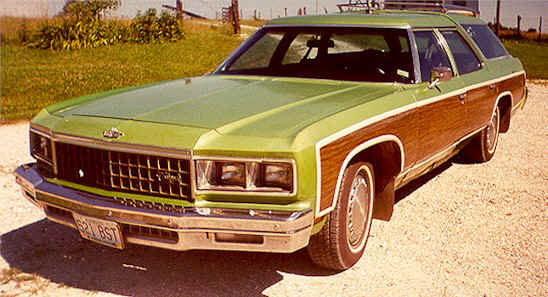
This is also a story about the mirage of a space between nature and artifice. Retro-culture enthusiasts celebrate that “real cars have fake wood paneling.” Meanwhile, a company called iBackwoods has engineered a “real wood” iPhone case that pays tribute to “timeless style of a wood panel station wagon.” Moog’s new Filtatron application for iPad, a software emulation of the company’s Moogerfooger filter pedal, is rendered authentic by its virtual wood panels. All of these examples reveal the “nature” of wood paneling to be cultural all the way down.

Washington DC - National Museum of American History: America on the Move - Park Forest, Illinois 1950s by Wallyg (via Flickr)
Ultimately, wood paneling might prompt us to recognize the interconnectedness among seemingly divergent materials, environments, and social practices. Consider, as a useful comparison to the climate-forged Stradivarius, the ash baseball bat: cherished by players for its “magical” effects on hitting, and now threatened by a warming climate and killer beetle in its source forests in Pennsylvania. Every synthesizer likewise holds and explodes into an ecosystem, and sometimes sounds like one too. The composer Mira Calix has suggested that analog synthesizers, with their individual quirks that increase with age, are much like wooden instruments; both seem to breathe like “little creatures” and take on a unique character, like a human voice. Our synthesizers, our kin.


Share this:

Hearing Queerly: NBC’s “The Voice”

“Brittany and Santana Lesbian Kissing Scene from Glee” by Flickr user LesMedia available under Creative Commons license 2.0
Tuesday, April 26, 2011 turned out to be a red-letter day for prime time Sapphism. The Fox smash, Glee, continued its hamfisted campaign against teen bullying with a subplot about the label-averse Santana scheming to bring her lesbian (or “Lebanese”) love for Britney to fruition. Airing opposite this “Born This Way”-anchored, supersized Glee, was the debut of the vocal reality competition series, The Voice on NBC. Remarkably, not one, but two out lesbians survived the first elimination round of the show’s blind auditions: Vicci Martinez from Tacoma, WA, and Beverly McClellan from Ft. Lauderdale, FL.
The Voice pitches itself as the democratic alternative to FOX’s American Idol. Whereas Idol’s early audition rounds derive considerable schadenfreude from oddball characters excluded from the expansive realm of what is deemed “pop hot”–remember Kenneth Briggs, the infamous “Bush Baby”?–The Voice eliminates looks altogether from the audition process, including the panel’s ability to look at the singers onstage. Seated in hydraulically-controlled swivel chairs evocative of Dr. Evil’s high-backed perch, the celebrity panel of coaches (not “judges”)–Christina Aguilera, Cee Lo Green, Adam Levine of Maroon 5, and country hunk, Blake Shelton–have their backs to the stage at the beginning of each performance. Only when the singer’s voice sufficiently moves a coach does he or she press a button to swing around and face the talent. If none of the four coaches turns around before the song ends, the singer is eliminated and sent away with only two-and-a-half glorious minutes on national TV as a consolation prize.

Vicci Martinez
While latter-day Idol has increasingly focused on the “total package,” sometimes excusing vocal defects for good looks, performance prowess, and passion (“I had fun with it” is the mantra of anyone who’s suffered a tepid response from the judges, and “you look great tonight” is what a judge says when someone biffs their vocals), The Voice purports to strip away the smoke and mirrors of performance—at least in the live selection process—in order to focus exclusively on vocal talent. Furthermore, as “coaches,” the celebrity panel is meant to cultivate talent rather than simply eviscerate bad performers for the audience’s amusement. As Cee Lo opines in the premiere episode: “it’s not about the judgment; it’s about the journey.” (Has reality competition taken a critical turn from the critical turn? But that’s another topic.) Idol has been explicitly called out on the show, from Adam Levine’s reassurance to dejected contestants that “The people we are not turning our chairs around for could win American Idol,” to the sensational rehashing, ad nauseum, of Frenchie Davis’s disqualification from the Idol competition for nude photos nearly a decade ago.
As the anti or alterna-Idol, The Voice–complete with kitschy, faux Futurist set pieces–would have us believe that truly anyone from anywhere could be a vocal superstar, whether they’re fat, thin, chinless, hirsute, gorgeous, hideous, straight, gay, Mormon, or dykey. The disparate optics offered by Vicci Martinez and Beverly McClellan, the two lesbians who won the celebrity panel over with their raw-throated rock vocals (right in the pocket of what we might call the Etheridgean mode), would seem to affirm the show’s “blind” ethos. Martinez’s audition was shot so that just like the coaches, the TV audience couldn’t see the singer until she was selected. In the package leading up to her performance, we are made privy to her coming out story, offered a glimpse of her skinny jeans and boots, and invited to “listen along with our coaches and see if you would pick Vicci Martinez.”
As it turns out, Martinez is quite a little hottie: a lesbian heartthrob in the making with a cute asymmetrical shag, winning smile and sensibly curated fashion (think PacNorthwest sportif meets urban hipster enclave).
McClellan, meanwhile, offers an “edgier” look that complements her ethos of fighting–in her own words–“against the man.”
TV audiences see McClellan before hearing her, creating some element of narrative suspense: we anxiously await “the reveal” should one of the coaches select McClellan for their team, only to swivel around to confront a bald, bad-ass dyke with ample tattoos, piercings and leather wrist accoutrement, chewing on Janis Joplin’s “Piece of My Heart” with barroom tenacity.
The queer blogosphere has certainly picked up on Martinez and McClellan’s success on the show. (As of this writing, Martinez has already advanced passed the “Battle Rounds” to the live shows where audience members are are allowed to vote). After Ellen and Unicorn Booty posted items immediately, encouraging queer audiences to tune in, while After Ellen followed up with extended interviews, first with Martinez, then with McClellan. Both were asked about whether or not the format of The Voice made it “easier” for queer contestants to succeed without being judged for their appearance. Martinez famously bowed out of the Hollywood rounds of American Idol because producers asked her to buy a new wardrobe (read, “femme up” a bit), so she offered a more affirmative response in line with The Voice’s own rhetoric of leveling the playing field. McLellan, meanwhile, offered a goofy “one love” answer to the question, evoking a universal vibe of human generosity. Different as their public temperaments may be, both have been praised for amplifying lesbian visibility on network television.

Levine listens to McClellan on
Though some robust, “score two for the team” chest-bumping is surely in order after the success of these Sapphic sirens, how might we actually move past the greater frenzy for queer visibility to better grasp how lesbianism fits, or inevitably fails to fit, within the pop landscape? In other words, what would happen if we weren’t so quick to celebrate these “aren’t-we-GLAAD?” moments of prime time visibility, but instead took to heart The Voice’s premise about prioritizing listening?
Throughout the institutional life of queer studies, debates about lesbian visibility have unfurled in elaborate fugue-like variations. Rather than rehash them here, allow me to commit the theoretical heresy of constructing a binary in order to highlight some key positions. In the “real” world of mainstream LGBTQIA organizations and cultural producers, quantifying positive representations of queer folk qualifies as measuring progress. The more gays and lesbians we see on screens big and small, the logic goes, the better the world gets. In the more rarified realms of queer theory (my own habitat), this desire for representation and belonging calls forth the very crisis inherent in politicizing visibility as an end in itself. Film and media scholar, Amy Villarejo, explains this dynamic best when she remarks in Lesbian Rule that “the common sense of visibility is that it does both [parlays representation’s double meaning as ‘portrait’ and ‘proxy]: by appearing, so it would go, we belong…[but]…to present lesbian as image is to arrest the dynamism such a signifier can trigger” (14).
What, then, would be the sonic dynamism of lesbianism? Is it a transformative “grammar” that modifies the terms with which it becomes intimate? (Villarejo explores this possibility in her book.) Is it in the grain of a voice?
Far be it from me to theorize the “butch throat” here, as my dear pal and colleague Elena Glasberg already has with more eloquence and profundity than my mind can muster these days; but even if we hadn’t been primed by the show’s intro packages, might we not have heard the lesbianism in Martinez and McClellan’s throats? In their urgent, tremulous and toothsome strivings through the repertoires of “fierce females” like Adele and Janis Joplin?
There is something marked, and remarkable, in the yearning and temporal drag (see Elizabeth Freeman’s work) modeled by Martinez and McClellan’s respective vocalities, voices that could only break the surface in a format that (at least initially), thwarts the edicts of visibility: of fashion, generic niches, and the avant sensibility demanded by pop. Instead of being one step ahead, Martinez and McClellan constantly pull us back to something we’ve heard before, often in a half-empty bar that reeks of Bud and Marlboros (both Light). And for letting us hear this again, I’m willing to give The Voice the benefit of the doubt, despite its unwieldy format, liberal use of Carson Daly, and trumped up feud between Adam Levine and the real Xtina. Just maybe in this singing competition’s overdetermined relationship to blindness, we will find enough insight to hear queerly.


Share this:


Current Top Posts





April 2021

January 2020

November 2019

October 2019

August 2019

April 2014

November 2017

March 2015

December 2017

October 2015
 Sounding Out!
Recent Comments