
“Take ‘Em to Chuch”: OutKast and the Sounds of the Southern Black Church
DOI: https://doi.org/10.59350/3kmg9-dn235
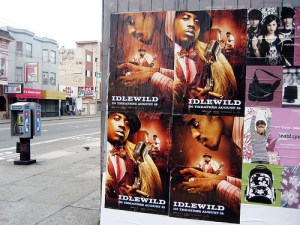
In 2006, I ventured into Hoosier Country. I found myself in the middle of…nowhere. And I was depressed. No, not because I decided to move to Indiana all by my lonesome on a huge leap of faith to pursue a graduate degree – I was too smooth for that – but because I found myself in a town where I couldn’t watch Outkast’s debut film Idlewild. Where they do that at? I am a Southern-bred, Southern-fed kinda girl. And Outkast was my muse. Hell, as a certified Down South Georgia Girl, all things Georgian were my muse. I planted my feet in red clay. My soundtrack was Organized Noise, the production team and heavy hitters that worked with OutKast, Goodie Mob, and a slew of other folks out of a rinky dink house basement that would later become known as the Dungeon (Family). I took pride in being from the Dungeon. And here I was, hundreds of miles away, frantically trying to find a theatre that would, if only for a brief 90 minutes, thrust me back into that familiarity of Southern life.
Of course, OutKast (comprised of members Andre Benjamin and Antwan “Big Boi” Patton) is hardly considered strictly Southern today. However, their 1994 release Southernplayalisticadillacmuzik shattered perceptions that Southern Rap was an oxymoron. In fact, OutKast’s initial sound updated tropes of southern black resistance and retaliation, fusing a lethal mastery of lyricism and flecks of a contemporary Southern culture too easily dismissed by non-Southerners. Calling upon and subverting the stereotypical traits of the Southern black voice – drawn out, slow, and heavy – OutKast sets up shop in hip hop by showcasing a rich history of Southern flair and homegrown sounds. The album made this intervention at the precise moment when hip hop became much more accessible to a mainstream white American market and the idea of being “post-Civil Rights” gained cultural traction. Combining narratives of being young, black, and frustrated with a sonic backdrop that includes an instrumental arsenal of horns, harmonicas, organs, drums, and bass, OutKast challenged and reconfigured how Southernness, Americanness, and contemporary black experience sounded at the turn of the millenium. Their initial releases seem to pick up the question of what it means to be displaced, Southern, and black after the South settled from its liberatory movements, pulling from the voices, images, and music of Southern protest like the Freedom Singers or Sweet Honey in the Rock and fusing these sounds with hip hop.

In order to discuss how they challenge and reconfigure notions of Southerness, Americanness, and contemporary black experiences, we should look at their musical nods to the black church. OutKast draws heavily on the Southern black church through sermon-esque flow, call and response, and snatches of “chuch” (lose the ‘r’) music. The black church is a staple in OutKast’s sound, reflecting what Guthrie Ramsey refers to in Race Music as community theatre, a site where “cultural, communal, and family memories associated with forms like music often become standards against which many explore and create alternative and highly personal identities for themselves” (33). The Southern black church provides such a site for communal and collective memory not only in Outkast’s music, but in African American history. Celebrated and upheld as a site of refuge from an abrasive and openly racist white supremacist environment, the black church provided a safe haven for freedom of cultural expression and social commentary unavailable in Southern white public space and discourse. OutKast challenges this older, static definition by updating its purpose to reflect the shifting social climate of the late-20th century American South. While they continue the resistance narrative tradition by bringing their marginalized experience to the forefront, they also sonically reorient mainstream views of contemporary Southern black life.
Instantly recognizable across OutKast’s recordings, their funky blend of sacred and secular musics–the blues, gospel, and hip hop–give sonic texture to something quiet-as-its-kept in black churches, how the so-called “bad” folks still come to church on Sunday, even if they were unholy on Saturday night. OutKast plays upon this unspoken understanding in songs like “Jazzybelle” from 1997’s ATLiens, “B.O.B. (Bombs Over Baghdad)” from their 2000 release Stankonia, and the straightforward “Church” from SpeakerboXXX/The Love Below (2003).
A particularly striking instance is heard on “B.O.B.,” a song which brazenly discusses issues that are often reserved for closet prayer and silent suffering. As Andre weaves a lyrical assault on the poor conditions of living in the black working class:
One-Nine-Nine-Nine, Ano Domini, anything goes, be whatchu wanna be
Long as you know consequences are given for livin – the fence is
too high to jump in jail
Too low to dig, I might just touch hell – HOT!
Get a life, now they gon’ sell
Then I might cast you a spell, look at what came in the mail
A scale and some Arm and Hammer, slow grow grid and a baby mama
Black Cadillac and a pack of pampers
Stack of question with no answers
Cure for cancer, cure for AIDS
Make a nigga wanna stay on tour for days
Get back home, things are wrong
Well not really, it was bad all along
Andre rhymes across an instrumental blend of bass and the church organ, inundating his listener’s ear with agency and anger. The church organ is as angry and explosive as his flow, with riffs and keys banged out loudly, quite different from the soft accompaniment often heard in a church setting. By heavily utilizing the organ and church choir at the end of the track, chanting “Bible music electric revival” OutKast subverts and updates the celebrated Black Church Revival, a gathering of church folk and the lost, swinging church music to give a voice to the marginalized black working class. The hybrid, urban sound of “B.O.B.” provides a space for the reclamation of a disenfranchised southern African American narrative that blends the suffering trope mandating much of African American religion with current trends in cultural expression reflected in Hip Hop. In Idlewild (which I FINALLY saw a year later, by the way), Andre and Big Boi visually annotate their secularized black church by creating an imagined community in rural Georgia that revolved around the jukejoint Church. OutKast’s audio-visual syncretism paved the way for later acts like Pastor Troy, who secularizes tropes of black masculinity and leadership in the black church, likening them to the struggles of being at war with those who don’t understand the struggles of a young black south.
The black church provides OutKast with a blueprint for reconciling displacement and authenticity by creating a sound that maneuvered a Post-Civil Rights landscape of shifting markers of social-economic identities and race. By connecting the historical context of the Southern black church with Hip Hop, OutKast’s sound reflects not only the historical residue of a pre-Civil Rights Movement South but also the constant search for a space of expression in an era where a stagnant or nonexistent “modern South” is a popularly comfortable disbelief. Perhaps this is why I was so desperate to find a theatre showing Idlewild; I found myself a geographically displaced Southern black youth searching to situate and sustain a new layer of my own post-Civil Rights narrative.
—
Regina Bradley
—
Share this:

Into the Woods: A Brief History of Wood Paneling on Synthesizers*

*a companion piece of this research, on electronic sounds as lively individuals, is forthcoming in the American Quarterly special issue on sound, September 2011.
DOI: https://doi.org/10.59350/ckga8-e6z98
Not long ago, while researching the history of synthesized sound—or taking a break to troll for interesting synthesizers for sale online (activities that, for me, inevitably blend together)—I came across a thriving industry of small companies that offer custom-made wood panels to adorn the sides of old and new synths, like Synthwood, Custom Synths, Analogics, and MPCStuff.
As Trevor Pinch and Frank Trocco note in Analog Days, their history of Moog synthesizers, an “analog revival” is underway: “Today in the digital world, there is a longing to get back to what was lost” (9). The music technology magazine Sound on Sound concurs, documenting a renewed interest among electronic music-makers in modular synthesizers like those popularized by Moog and others in the late-1960s. Yet there seems to be more at play with this proliferation of wood customizations than merely nostalgia for analog synths, Hammond organs, and hi-fi cabinetry. How might we interpret this desire to adorn—lovingly, even obsessively—steel-encased machines that produce sound by electronic means, with various species of wood? What does this realm of audio esoterica reveal about material and social aspects of musical instruments, and the workings of contemporary media cultures more broadly?
On Contingency and Faith: Walnut, Purple Felt, and the True Cross
Pinch and Trocco describe the Minimoog as the first synthesizer to become a “classic,” due to its relative ease of use, widespread availability, portability and compact design (214). In the retrospective imaginations of historians and musicians, a significant feature that established its classic design was the walnut wood case on an early generation of Minimoog models.

However, Bill Hemsath, an engineer who assembled the first Minimoog prototypes in 1969-70, told Pinch and Trocco that these instruments were assembled from “junk I found in the attic” and an assortment of affordable materials cobbled together in the moment (214). Jim Scott, another engineer who worked on developing the Minimoogs, explained in a 1997 interview: “the reason we made it walnut [was] because Moog had gotten a deal someplace and had a whole barnful.” He noted that “the musicians certainly appreciated the fact that it was made out of walnut,” but eventually the designers “ran out of walnut and started buying something else and slapping paint on it to make it look like walnut.” The various kinds of wood used on models from different years, and the exact start and end dates of the coveted walnut models, remain contested matters among Moog enthusiasts.
Hemsath elaborated on this history in a 1998 interview by making an analogy to “classic” piano design: “There’s a similar story from Steinway. Back when they first got started in the U.S. they used to buy their felts from a feltmaker in Paris… And they got a lot of purple felt because [the supplier] used to be the felt maker for Napoleon’s army, and had a lot left over. So the colored cores in the hammers of those old Steinways were purple because of Napoleon’s army. Well, [the supplier] ran out, and [Steinway] said, red’s fine. They started making pianos with red felt, which is what they have today, and people started complaining, saying, it’s not a real Steinway, it’s not purple.” Like the proverbial purple felt on original Steinway pianos, walnut panels on synthesizers became “classic” because of their association with an originary moment, however happenstance, in the history of a particular instrument, and a limited supply and production run that rendered the material in question relatively rare.
So, a contemporary synthesizer enthusiast’s desire to acquire a “classic” walnut Minimoog, or to commemorate its aesthetic with customized wood panels, is in part an effort to establish a material connection to history. Synthesizer history unfolds in the deep time of technoscience which, as Donna Haraway has argued, often “barely secularize[s]” Judeo-Christian narratives of first and last things, of figural anticipation and fulfillment (9-10). The concern among some synthesizer enthusiasts to possess either the actual wood of an early-model Minimoog, or a faithful substitute for it, indeed resonates with Christian material cultures around relics of the True Cross and next-best artifacts with suitable provenance. A historical conjuncture that is contingent on otherwise unremarkable circumstances (e.g., Bob Moog’s good deal on a barnful of walnut in upstate New York) is marked as an originary or otherwise defining moment (the “invention” of a “classic” synthesizer) for a culture that defines itself as proceeding from it; the former is made to anticipate the latter, and the latter comes to fulfill the former.
Taking Stock: Materialities of Instruments, Sounds, Ecosystems
What kind of wood panels live in my studio? The manual to my Jomox XBase 09 drum machine, from 1999, details that its “steel sheet body” is bookended by “varnished side panels made of alder wood.” Wikipedia‘s pop-anthropological roundup of alder’s “use by humans” includes smoking various foods, treating skin inflammations and tumors, and building electric guitars. Fender Stratocasters have been built with alder since the 1950s. Guitar enthusiasts are notoriously fussy about which type of wood comprises the instrument’s body because of its effect on tone. Scientists, meanwhile, have taken to applying medical imaging techniques to Stradivarius violins, trying to “crack the mystery” of its prized tone. (Some say it’s due to the particular density of slow-growing trees in the Little Ice Age; others conclude it must be the varnish.)

Given these interconnected concerns with instrument materials and the composition of tone, one might venture an etymological connection between timbre—which the Oxford English Dictionary describes as the character or quality of a musical sound depending upon the instrument producing it—and timber, which references “the matter or substance of which anything is built up or composed.” Music scholars often characterize timbre as the materiality of sound. Despite longstanding knowledge of the relationships of timber and timbre among instrument builders and musicians, and possible overlaps in historical applications of these words, placing wood panels on the sides of synthesizers surely has no effect on the resulting tone. Or does it? Audiophiles are prone toward occult-like habits, such as placing a single coin on top of a speaker to absorb vibration; and wood panels may well have subtle effects on the overall stability of an electronic instrument, resulting in barely perceptible sonic artifacts.
My Virus B synthesizer from the late-1990s has darker wood side panels than the Jomox, sort of a faux mahogany. Recently I wrote to Access Music, explaining my research on synthesizer history and inquiring what kind of wood they used. They replied that the B series featured stained beech wood (also commonly used and appreciated for producing smoked German beers and cheeses). Virus volunteered that they “in general do not use any kind of tropical wood for our devices.” Using sustainable wood has become a mandate and marketing concern at the Moog company as well; Moog’s wood “comes primarily from Tennessee. Hardwoods in Tennessee are growing faster than they are being harvested… US hardwoods are a world-wide model of sustained forest management.” Among contemporary synthesizer companies, there is often a selective eco-consciousness; as synthesizer designer Jessica Rylan suggested in our interview for Pink Noises: Women on Electronic Music and Sound (Duke: 2010), it is arguably impossible to build a synthesizer that does not incorporate at least some materials that are toxic in stages of manufacturing and/or disposal.

The paradox of dressing up an electronic machine made partly of toxic materials and processes with a sustainable-wood exterior is a fitting metaphor—like a contemporary fig leaf—for how we outwardly express environmentalist concern, despite plenty of contradictions in practice. Wood-adorned electronic devices, in all their glorious contradictions, are especially resonant in this cultural moment; see Asus’s EcoBook, Karvt’s lineup of custom wood skins for MacBooks, and, my favorite, Flashsticks: handmade wood USB “sticks” that combine “the high tech world of computing with the simplicity of the world of nature.” The story of Flashsticks’ handmade creation is a case study in eco-contradiction: the website implies that no trees were harmed in the making of their USB sticks—the company uses locally-sourced, “fallen wood from the previous winter’s storms”—yet we do not hear of the toxic materials that may comprise the drive itself.
Wood panels indeed work to conceal inconvenient truths. As Ruth Schwartz Cowan pointed out, the midcentury aesthetic of hiding household appliances behind wood paneling typified a culture that concealed gendered divisions of domestic labor (205). Lisa Parks has documented the similar recent phenomenon of dressing up cell towers as trees, which obscures the politics of media infrastructure behind a cloak of “nature.”
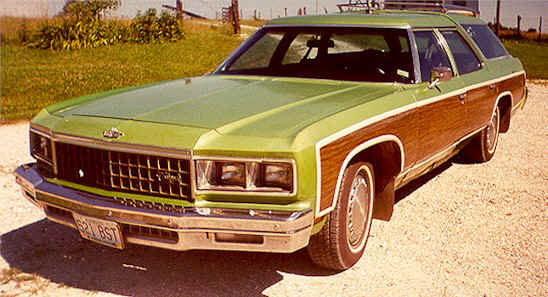
This is also a story about the mirage of a space between nature and artifice. Retro-culture enthusiasts celebrate that “real cars have fake wood paneling.” Meanwhile, a company called iBackwoods has engineered a “real wood” iPhone case that pays tribute to “timeless style of a wood panel station wagon.” Moog’s new Filtatron application for iPad, a software emulation of the company’s Moogerfooger filter pedal, is rendered authentic by its virtual wood panels. All of these examples reveal the “nature” of wood paneling to be cultural all the way down.

Ultimately, wood paneling might prompt us to recognize the interconnectedness among seemingly divergent materials, environments, and social practices. Consider, as a useful comparison to the climate-forged Stradivarius, the ash baseball bat: cherished by players for its “magical” effects on hitting, and now threatened by a warming climate and killer beetle in its source forests in Pennsylvania. Every synthesizer likewise holds and explodes into an ecosystem, and sometimes sounds like one too. The composer Mira Calix has suggested that analog synthesizers, with their individual quirks that increase with age, are much like wooden instruments; both seem to breathe like “little creatures” and take on a unique character, like a human voice. Our synthesizers, our kin.
—
Tara Rodgers
—
Share this:




Current Top Posts





April 2021

January 2020

November 2019

October 2019

August 2019

April 2014

November 2017

March 2015

December 2017

October 2015


Recent Comments