
“To Unprotect and Subserve”: King Britt Samples the Sonic Archive of Police Violence
Author’s note: In line with the ethics of listening considered below, I’ve chosen not to embed the videos of police violence that I discuss. But I’ve linked to them when available for readers who’d like to see/hear their content.–Alex Werth
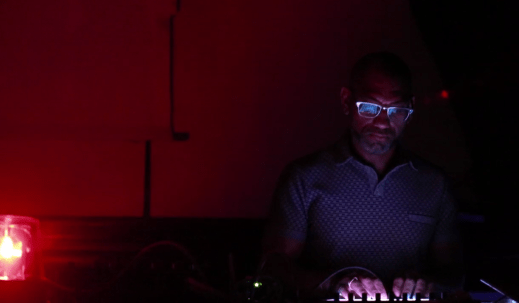
“I’m scared to death of these police.” Dave Chappelle’s voice—pitched down, but nonetheless recognizable—calls from the speakers, cutting through the darkness of Oakland, CA’s Starline Social Club. It’s closing night of the 2016 Matatu Festival of Stories, an annual celebration of Black diasporic narratives, technologies, and futures routed through the San Francisco Bay Area. King Britt—an eclectic electronic pioneer and producer, and former DJ for Digable Planets—has landed with the third version of “To Unprotect and Subserve: A Sonic Response.” (It was first performed after a march for Mike Brown in Ferguson in 2014.) I can barely see Britt, his solemn look bathed in the dim glow of electronic consoles and the red-and-blue pulse of police lights. “First money I got,” Chappelle continues, “I went out and bought me a police scanner. I just listen to these mothafuckas before I go out, just to make sure everything’s cool. ‘Cause you hear shit on there: ‘Calling all cars, calling all cars. Be on the lookout for a Black male between 4’7” and 6’8”.’” With this double invocation, Britt invites us to listen. Specifically, à la Chappelle, he invites us to listen back—to attune to the agents of a racialized security state that, from ShotSpotter to CIA surveillance, profile and police the world’s sonic landscapes.
This essay considers the ethical effects/affects in King Britt’s work of sampling what I call the sonic archive of police violence. From Oakland to Ferguson, the Movement for Black Lives has raised critical questions about the mass surveillance of Black and Brown communities, the undemocratic control of data in cases of police misconduct, and the use of smart phones and other recording devices as means to hold the state accountable. But the failure to indict or even discipline cops in police killings where audio/video evidence was not only available but overwhelming, from Eric Garner to Tamir Rice, casts doubt upon the emancipatory power of simply recording our race-based system of criminal (in)justice. And when re-presented ad nauseum on the news and social media, these recordings can retraumatize those most vulnerable to racist state violence. Indeed, at a discussion among Black artists at Matatu, each panelist admitted to limiting their exposure to what poet Amir Sulaiman called “e-lynching.”
What, then, can we learn from Britt about the praxis and politics of listening back when the circulation of what KRS One dubbed the “sound of da police” is now daily, digital, and ubiquitous? How can we make sense of audio recording when it’s come to signal repression, resistance, and painful reprisal all at the same time?
Back in the darkness of the club, Chappelle’s voice dissolves into a conversation between Darrin Wilson and a dispatcher from the Ferguson Police, who sends him to find the body of Mike Brown—a “Black male in a white t-shirt,” reportedly “running toward QuikTrip” with a stolen box of Swishers. The optimistic waves of sound that open the piece resolve into a throbbing pulse of 1/32nd notes that sounds like a helicopter. Britt begins to loop in other elements: a low bass tone, a syncopated stab. With kicks and reverb-heavy snares, he builds a slow, head-nodding beat (60 bpm) that coalesces around the vocal sample—swaddling, softening, and ultimately subsuming it with high-pitched legato tones. The synths are sorrowful. But the mesmerizing beat embraces listeners in their mourning.
This act of listening to the state differs from the one parodied at the start. Chappelle attends to the police scanner as a form of precaution, checking whether it’s safe for him to enter a realm where he can be marked as criminal (“Staying in the crib tonight! Fuck that!” he concludes). But Britt’s sonic bricolage is more therapeutic than protective. He uses repetition, reverb, and improvised melody to score a sonic altar—to open space, rather than control time—where we can meditate on the archive of police violence with the intention to heal. “Sometimes to push through the trauma we need to experience it in a different context,” he tells me over email. “There is room for healing within the chords and sounds that are carefully curated.” Britt thus reactivates the pathos buried inside this archive—reclaiming what Susan Sontag, in “On Photography,” recognizes as an “ethical content” of representational form that can fade from careless repetition (21).
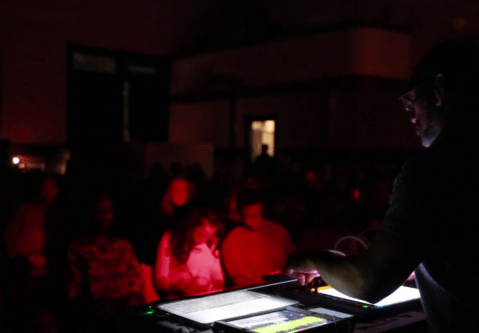
Picture of King Britt courtesy of Eli Jacobs-Fantauzzi for the Matatu Festival of Stories.
After removing the loops one-by-one, until the helicopter sound is all that remains, Britt releases a new sample into the mix. It’s audio from a cell-phone video taken in 2013 by two Black men as they’re harassed by White cops during a stop-and-frisk in Philadelphia (Britt’s hometown). He scores the somber scene with dissonant organs and an offbeat percussive note that reminds me of stress-induced arrhythmia—a heartbeat out-of-place, aggravated, precarious . Vibrating with anxiety, the soundscape temporarily snatches listeners from mourning, demanding that we listen in witness, instead.
The video reveals that the police tear the two men apart, pinning them to the cruiser. But the violence of the encounter is verbal as much as physical. The cops’ language and tone become increasingly abusive as the men contest their treatment in a sounding of agency that Regina Bradley, writing about Black women, calls “sonic disrespectability.” Philip Nace, the more audible of the officers, embodies a double bind built into what Jennifer Lynn Stoever calls the “sonic color line.” He threatens one of the men when he speaks out (“You’re gonna be in violation if you keep running your mouth when I split your wig open.”). But he turns around and ridicules him when, instead, the man refuses to speak (“You don’t know what we know…Right? Right?! What, you don’t hear now?”). As Stoever notes, the demand that African Americans speak when spoken to, but in a way that sounds their submission to Whites, is a feature of anti-Black oppression stemming from the “racial etiquette” of slavery (30-32).
Britt’s manipulation of vocals speaks to the centrality of sampling in hip-hop. According to Tricia Rose, hip-hop artists have long prioritized the sample as a way to recognize and renovate a communal repertoire of songs and sounds (79). And given the realities of anti-Black oppression in the U.S., this repertoire has often entailed the “sound(s) of da police.” From sirens to skits to verses, rappers and producers have remixed the sounds of the state to characterize, caricature, and critique the country’s criminal justice system. But Britt’s trespass on the state’s sonic sovereignty differs from classics like “Fuck tha Police,” in which N.W.A. conducts a mock trial of “the system.” Whereas N.W.A. reappropriates the rituals of legal testimony and judgment to condemn the police (“The jury has found you guilty of being a redneck, white-bread, chicken-shit mothafucka.”), Britt’s musical re-mediation of police violence favors grief over moralizing, dirge over indictment.
In this vein, the musical/ethical demand to witness waxes but then wanes. The soundscape becomes more and more dissonant until the vocals are consumed by a thunderous sound. Suddenly, the storm clears. Britt hits a pre-loaded drum track (136 bpm) with driving double-time congas and chimes over a steady sway of half-time kicks. He starts to improvise on the synth in an angelic register, revealing the impact of his early encounters with Sun Ra on his aesthetic. The catharsis of the scene is accentuated by the sporadic sound of exhalation. This sense of freedom dissolves when the beat runs out of gas…or is pulled over. In its stead, Britt introduces audio from the dashboard camera of Brian Encinia, the Texas State Trooper who arrested Sandra Bland. Encinia and Bland’s voices are pitched down and filtered through an echo delay, lending an intense sense of dread to his enraged orders (“Get out of the car! I will light you up!”).
Here, I sense the affective resonance of dub. Like the musicians on rotation in Michael Veal’s Dub, Britt manipulates the timbre and texture of voices in a way that demands a different sort of attention from listeners who, like me, may be desensitized to the sonic violence of the racialized security state as it’s vocalized and circulated in and between Ferguson, Philly, and Prairie View. Britt reworks the character and context of the vocals into a looping soundscape, and that soundscape sends me into a meditative space—one in which the vibes of humiliation and malice “speak” to me more than Encinia’s individual utterances as an agent of the state. According to Veal, the pioneers of dub developed a sound that, while reverberating with the severity of the Jamaican postcolony, “transport[ed] their listeners to dancefloor nirvana” and “the far reaches of the cultural and political imagination” (13). Now, conducting our Matatu, Britt is both an engineer and a medicine man. Rather than simply diagnose the state of anti-Black police violence in the American (post)colony, he summons a space where we can reconnect with the voices (and lives) lost to the archives of police violence amid what Veal refers to as dub’s Afro-sonic repertoire of “reverb, remembrance, and reverie” (198).
What Sontag once wrote about war photography no doubt holds for viral videos (and the less-recognized soundscapes that animate them). Namely, when used carelessly or even for gain, the documentary-style reproduction of the sonic archive of police violence can work to inure or even injure listeners. But in Britt’s care-full bricolage, sampling serves to literally re-mediate the violence of racialized policing and its reverberations throughout our everyday landscapes of listening. It’s not the fact of repetition, then, but the modality, that matters. And Britt draws upon deep traditions of scoring, hip-hop, and dub to sonically construct what he calls a “space to breathe.”
—
Featured image of King Britt’s performance courtesy of Eli Jacobs-Fantauzzi for the Matatu Festival of Stories.
—
Alex Werth is a doctoral candidate in the Department of Geography at UC Berkeley. His research looks at the routine regulation of expressive culture, especially music and dance, within the apparatuses of public nuisance and safety as a driver of cultural foreclosure in Oakland, CA. It also considers how some of those same cultural practices enable forms of coordination and collectivity that run counter to the notions of “the public” written into law, plan, and property. In 2016, he was a member of the curatorial cohort for the Matatu Festival of Stories and is currently a Public Imagination Fellow at Yerba Buena Center for the Arts in San Francisco. He lives in Oakland, where he dances samba and DJs as Wild Man.
—
 REWIND!…If you liked this post, you may also dig:
Music to Grieve and Music to Celebrate: A Dirge for Muñoz— Johannes Brandis
Singing The Resistance: January 2017’s Anti-Trump Music Videos–Holger Schulze
Black Mourning, Black Movement(s): Savion Glover’s Dance for Amiri Baraka –Kristin Moriah
Share this:

Hearing Eugenics

 Editor’s Note: Today we start off a series, a propos for World Listening Day 2016 on digital humanities and listening. As I mentioned in my Call for Abstracts in March, this forum considers the role of “listening” in the digital humanities (DH, for short). We at Sounding Out! are stoked to hear about (and listen to) all the new projects out there that archive sound, but we wonder whether the digital humanities engage enough with the the notion of listening. After all, what’s a sound without someone to listen to it? The posts this month consider: how have particular digital studies, projects, apps, and online archives addressed, challenged, expanded, played with, sharpened, questioned, and/or shifted “listening”? What happens to digital humanities when we use “listening” as a keyword rather than (or alongside) “sound”?
We will be hosting the work of DH scholars who are doing exactly that: prompting readers to consider what it means to listen in the context of DH projects. Fabiola Hanna will be reflecting upon what DH means when it talks about participatory practices. Emmanuelle Sonntag, who has written for SO! before, will be addressing listening from the starting point of the documentary Chosen (Custody of the Eyes). Today, however, we start things off with a collaborative piece from the Vibrant Lives team on the ethics of listening to 20th century sterilization victims’ records.
Don’t just stand there. Take a seat and listen.-Liana M. Silva, Managing Editor
—
In the 1920s a young woman was admitted by her mother to a mental institution in California. The local doctor recommended her for sterilization with the following notes:
has been reported to have interest in sexual encounters
Mother is pregnant and cannot care for her (thinks she may be able to post-sterilization).
This brief note is representative of the stories of the roughly 20,000 people who were sterilized in California institutions of mental health. The soundscape of these institutions is largely lost to the past. We cannot recover the sounds of treatment spaces, family visits, recreation, and everyday life of those in the care of the state of California who were considered feeble, insane, or otherwise out of control.
Like the conversations about illness and reproduction presumably had in those halls, the sounds of salpingectomies (removal of fallopian tubes), vasectomies (severing the vas deferens), and, later, tubal ligations are lost to us. In the absence of human rights violations, this is perhaps as it should be; we cannot collect the minutiae of everyday life. But in situations where reproductive and disability rights have been limited, where we can see race and gendered bias, we may well have need of telling such stories.
Reparative justice best practices dictate that survivors should be able to tell their own stories on their own terms. How can we listen to such stories when the majority of our survivors have died and we have little to nothing in their own words?
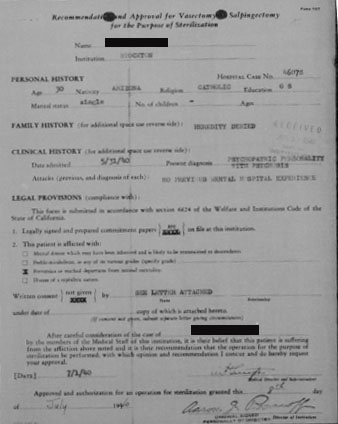
A redacted sterilization form from Stockton State Hospital. Image courtesy of Alexandra Minna Stern
While conversations between patients, parents, and doctors might be lost to us in terms of playback, they have embodied traces in the nearly 20,000 people sterilized in California between 1919 and the 1950s under eugenic sterilization laws. The 19,995 sterilization recommendations and notes, brought together under the project Eugenic Rubicon: California’s Sterilization Stories, cannot currently be made publicly available due to U.S. patient privacy laws. Important documentary films like No Más Bebés, which tells the story of Mexican-American women sterilized without consent at Los Angeles County – USC Medical Center in the 1960s and 1970s, have made it possible for us to hear accounts of such reproductive injustice first hand. But for the thousands of people sterilized between 1909 and the repeal of eugenics laws in 1979, we must find other ways to listen and to hear.
Given the privacy restrictions on working with this dataset and our concerns to care for the people who are represented therein, we (the Vibrant Lives team) felt it was important to find alternative methods that did more than de-identified and quantified graphs could do. We know all too well that we can’t recover the past “as it was.” Nevertheless, we are working to bring the emotional and intellectual power of sound and critical listening to a largely unheard history of sterilization of Latinx people. Specifically, our project prompts listeners to consider how listening fits into reparative justice for the victims of sterilization.

“Listen” by Flickr user Fe Ilya, CC BY-SA 2.0
Listening Toward under the Law
That eugenics laws and their surgical enactments played out in racialized and gendered ways is not surprising but bears repeating. For example, according to work by Alexandra Minna Stern, Nicole Novak, Natalie Lira, and Kate O’Connor, patients with Spanish or Hispanic surnames were three times as likely to be sterilized as their non-Hispanic counterparts. Those lost sounds have traces in California’s Latinx communities, both in terms of the community structures themselves, but also in terms of soundscapes that never were because of sterilization. This acoustic ecosystem in which the politics of race, gender, nation, and mental health converged in dramatic fashion is recorded only in the bodies and medical records of the patients and the 21st century communities shaped by the children, born and unborn, of these patients.
Not only are we limited to working with the textual, institutionally generated remnants of the past, we are also constrained by 21st century health and personal data privacy laws. Our archive is a set of medical records and as such this collection contains sensitive patient data that must be de-identified and used in accordance with contemporary HIPAA (Health Information Portability and Accountability Act) regulations and IRB protocols.
This means that we cannot reveal names, dates, and other identifying information regarding those who were sterilized in the first half of the 20th century. We are unable to tell individual stories of sterilization lest the individual be identified. Traditionally, historians have used fictional composites to tell such stories and our collaborator Alexandra Minna Stern used this method in her 2015 second edition of Eugenic Nation.
The HIPAA guidelines and their impact on how we tell the history of medicine raises important legal questions about how we might balance a public right to know about practices (we’d call them abuses) within state-run facilities with the need to protect patients’ rights to privacy regarding their own reproductive and mental health. In some cases, it seems as though the privacy guidelines protect the state more than they protect any individual patient. In fact, we have seen a remarkable lack of concern for these records in their discovery and transmission. The records themselves were largely abandoned when Stern discovered the microfilm reels in the 2000s. They were lost again after she returned them to the state after having made a copy. The originals are lost as far as we know.

“Archive” by Flickr user Carolina Prysyazhnyuk, CC BY-SA 2.0
Listening Toward the Past
Vibrant Lives is working not with sounds found, but with archival records found and then sonified (transformed into sound) as a way of listening toward those rooms, conversations, and procedures. In brief, this sonification entails the following steps
- Selecting a subset of the large data set (we can’t currently process the whole)
- Selecting between two and four axes of information, such as gender, race, age at sterilization recommendation, consent, or nationality
- Mapping the informational values into numerical space – sonification requires the creation of a dataset whose limits are 1 and -1 (based on how the speakers work)
This work has been done to date using two tools: Sonification Sandbox, an open source tool developed at the University of Georgia, and GarageBand, a proprietary music making tool that comes with Macintosh computers. We use Sonification Sandbox to create the score first and then turn to GarageBand because it has a greater range of instrumentation available. The sonification process is still very experimental and exploratory. Team member Jacqueline Wernimont does all of our sonifications for us and she is trained as a historian of literature and technology. While she has extensive experience within digital humanities methodologies, sonification is a new effort for us.
We have begun producing short sample tracks that allow us to enact the kind of listening toward that we’re advocating for. In the track below, we have data from the age, gender, and consent axes for the period 1940-1949. Additionally, this sample draws only from what we’ve described as “Spanish surname” patients, the vast majority of whom were American-born of Mexican descent, although they also include some other Latinx national communities.
Latinx Eugenics Sample Track
As you listen, each note represents one Spanish-surnamed person recommended for sterilization. The children, both boys and girls under 18, who were sterilized without consent are the highest notes, and the adult men who were sterilized with consent are the lowest.
Listening Toward as Ethical and Communal
Listening is always about an ethical relationship and it is particularly fraught when the effort to listen and to encourage others to listen entails hearing about a person’s most intimate health information and experiences. This is particularly true when those experiences may include trauma from unwanted surgery or other experiences.
While we might think of patient privacy as a form of care, in this instance we find ourselves wondering who these regulations actually serve. According to the updated 2013 HIPAA guidelines, personal health records are no longer considered sensitive information 50 years after death (it was previously 100 years). Preliminary estimates by our team indicate that as many as 1,000 survivors might be alive in 2016. However, while the vast majority of the people discussed in the records are no longer alive, family and friends may well be.
We respect the need for family members and friends to privacy when it comes to the health records of their loved ones. At the same time, an essential component of most restorative justice programs, like those undertaken for North Carolina eugenic sterilizations, is an articulation of the violations, which HIPAA blocks in many ways (North Carolina’s cases were revealed by investigative journalists who are not subject to HIPAA and the IRB regulations that we must adhere to as academics). As a consequence, those who might most benefit from reparations – sterilized individuals and their immediate families, including children – are likely to die before the privacy laws enable us to draw attention to the individual impacted by the racialized and gendered discrimination evident in the records.
The sonification of these records and the companion participatory performances that we facilitate allow us to intervene and share these important stories before all of the survivors and family members have passed away. We have the opportunity to drive justice-oriented processes forward while there is still time.
Consent/Non-consent Sample Track (entire population)
Vibrant Lives focuses not just on the stories but also on the people who listen to the audio. We spend time watching how our audiences participate in listening toward the history of eugenic sterilization in California. Below are images of recent presentations of this work in which we’ve incorporated both haptic (touch-based) and sonic performance.

Participants listening at a presentation at the University of Kansas. Photo by Elika Ortega.
Part of what we see here is the attentive posture of our participants – leaning in to feel a history of sterilization. The haptics are being shared with a thin, red metal wire that the participants have to touch lightly in order to not dampen the signal for others. For us, this is an effort to bring care for the experiences of others into the performance. The history of eugenics has impacted communities and we are creating communal aural and tactile experiences as a way to disrupt the notion that academic work and knowledge is a solitary endeavor.
The performance captured above is also an exercise in patience and as such expresses a willingness on the part of the participants to sit with a disturbing history. The sample people are listening to and feeling here is 100 seconds long with each note/vibration corresponding to one person who was sterilized. In most performances the participants stay for the duration of the piece, but there have been instances where people have touched a haptic piece and then walked quickly away. We can’t know why some have chosen to walk away.
 Some of those who have stayed have shared with us that they felt responsible to feel and hear each person. It’s an abstraction, to be sure, but we are intrigued by the power of listening and feeling to encourage people to not simply look and walk away. As one participant at a Michigan performance noted, the “tingling (from the haptics) lingers, it’s spooky.” Another participant at the same performance indicated that she felt “more implicated” having engaged with a multi-media experience than with a visual like a graph or chart. When asked why, she responded “I’ve felt it and will continue to remember that, but still will likely do nothing in response.”
In creating performances where participants have to care for one another and care enough about the people represented in the data to stay through a durational piece, we are working to redress the extraordinary lack of care that the records represent, both in terms of testifying to the violence done to men’s and women’s bodies and in terms of the State of California’s lack of regard for this history.
Sounds Felt, Sounds Touched

Our work is an ongoing experiment. We’ve moved from haptics along a wire, to haptic spheres that vibrate with the sonification. The image above is from one of these events this spring. We’ve retained the communal effect while transforming the embodied structure of the event. Participants now gather around, encircling the object as they listen toward a history of reproductive injustices. People still tend to lean in – to have heads lowered in a posture of intense focus. The sphere itself demands that someone cradle it and it also requires that people touch lightly once again so as to not dampen the experience for others.
We plan to expand our durational events in our next iteration known as “Safe Harbor” in which we hope to explore how to best care for those people sterilized by the state by caring for their data. In this instance we are thinking of sounds (and more) that we’ll make together with impacted communities. For this work we are particularly interested in engaging audience members in the hosting and care of the eugenics data and, by extension, the survivors.
As a way of enacting a site-specific response to both historical and contemporary human and reproductive rights violations that have occurred in the state, we plan to stage this durational event in California. We’ll begin by inviting audiences to help build and shape an empty warehouse space with us, transforming the empty space into a place of care where we can listen toward these histories. The audience will be invited to converse about the research and reflect upon conversations through making, creating, and ultimately building up our safe harbor.
We plan to listen to and co-create with impacted communities through collective making of the space. As a result, Safe Harbor will enact a cooperative improvisational process shaping socially responsive dialogue – performing, hearing, listening, documenting, and rebuilding notions of care in real time. What we hope to discover here are shared sounds of resistance, repair, and healing. Sounds that might let us listen toward the past, while also creating more just futures.
—
Featured image: “Water under 12.5 Hz vibration” by Jordi Torrents, CC BY-SA 4.0, via Wikimedia Commons
—
Vibrant Lives is a collaborative team that makes, stages, and performs as part of interactive multimedia installations. Jessica Rajko and Eileen Standley are both professors in the Dance area of the School of Film, Theater, and Dance at Arizona State University (ASU). Jacqueline Wernimont’s home department at ASU is English and she’s a digital humanities and digital archives specialist. Wernimont and Rajko are also multimedia artists/faculty working in Arts, Media, and Engineering.
The data derives from a larger project, known as Eugenic Rubicon: California’s Sterilization Stories, a multidisciplinary collaboration among Arizona State University, University of Illinois Urbana-Champaign, and University of Michigan. This larger collaboration includes historical demography and epidemiology, public health, history of medicine, digital storytelling, data visualization, and the construction of interactive digital platforms. This team is quite large, with our center of gravity residing at the University of Michigan where historian of science Alexandra Minna Stern directs the Eugenic Rubicon lab. Stern discovered the microfilms of more than 20,000 eugenic sterilization patient records in 2013. Stern and her team have created a dataset with this unique set of patient records that includes 212 discrete variables culled from over 30,000 individual documents. This resource is the first of its kind, encompassing almost one-third of the total sterilizations performed in 32 states in the U.S. in the 20th century.
—
REWIND!…If you liked this post, you may also dig:
Sound Off! // Comment Klatsch #4: Sound and The Digital Humanities, or #dhsound
EPISODE LI: Creating New Words from Old Sounds–Marcella Ernest, Candace Gala, Leslie Harper, and Daryn McKenny
Radio Preservation Task Force Conference: Sound History and the Logistics of Social Recognition-Josh Sheppard
Share this:


Current Top Posts





April 2021

January 2020

November 2019

October 2019

August 2019

April 2014

November 2017

March 2015

December 2017

October 2015
 Sounding Out!
Recent Comments