
Brasil Ao Vivo!: The Sonic Pleasures of Liveness in Brazilian Popular Culture

 After a rockin’ (and seriously informative) series of podcasts from Leonard J. Paul, a Drrty South banger dropped by SO! Regular Regina Bradley, a screamtastic meditation from Yvon Bonenfant, and a heaping plate of food sounds from Steph Ceraso, our summer Sound and Pleasure series gets even louder with Kaleb Goldschmidt‘s work on live events in Brazil. Brasil Ao Vivo! –-JS, Editor-in-Chief
—
Brazilians pray, cheer and celebrate in public and often in close physical proximity to each other. From the nearly 3 million people that flocked to Copacabana Beach to hear Pope Francis lead a mass in 2013 to the huge crowds that regularly turn out for concerts at Maracanã stadium, Brazilians earn their global reputation for large-scale public events. Of course there is Carnival in Rio de Janeiro and Salvador; the largest LGBT Pride Parade in the world held in São Paulo; and then there is football.
The relationship between large-scale public events and sound hit home as the country reacted to the national team’s humiliating loss to Germany in the semi-final round of the 2014 FIFA World Cup. The world witnessed a different kind of public outpouring as the Brazilian public mourned. Within hours of the initial shock at the lopsided score, images of Brazilian football fans weeping and screaming in the stadium and on the street became a humorous meme with music and sound playing a prominent role. By the next day, most Brazilian football observers were taking pleasure in the public spectacle of weeping fans. With the abundance of images featuring hysteria, videos mocking the intensity of the crying went viral with dramatic musical scores. One observer proclaimed : “essa capacidade de rir de nós mesmos é uma das melhores qualidades”; the capacity to laugh at ourselves is one of our best qualities. That Brazilians express all varieties of emotions and annual passages together in public for everyone to witness, even when they border on campy excess, allow for everyone to feel the pleasures of community and the power of public performance.

“Abschlussfeier Maracana Fifa WM 2014” by Flickr user Marco Verch, CC BY 2.0
All of this led me to believe that such a public culture has an effect on the aesthetics of what performance studies scholar Philip Auslander calls “liveness” in recorded music and related viral media. Auslander argues that the appeal of liveness for television broadcasts, concerts, and other stage performances allows audiences to feel the immediacy of the moment even if the presence of mediation, such as screens and on-air censorship, is obvious. The international spectacle of Brazilians emoting en masse, then, has a direct relationship with Brazilian sonic aesthetics. Nowhere, I argue, is this more prominent than in the (sometimes viral) popularity of live recordings.
That immediacy Auslander speaks of spreads to many aspects of Brazilian popular culture, including the popularity of concert DVDs and albums which are regularly listed among the most popular domestic recordings. In fact, concert records tend to be more popular than the studio albums that inspire the tour. These live albums often carry the designations Ao Vivo, live or MTV Acústico (the equivalent of the Unplugged albums popular in the United States), and they are often recorded in such a way so as to feature the interaction of the crowds. In place of the draw for authenticity (a value that permeates the MTV Unplugged recordings) is the love for community, and for experiencing big emotions together no matter how obviously they are mediated through cameras, microphones and other technology. Through the example of the continued popularity of live albums in Brazil, there is an opening for a different theorization for sounding liveness; in place of celebrating canonic performances and virtuosity, the valorization of liveness in Brazil reinforces the importance of crowds and the so-called “popular classes” at the root of the politicized singer-songwriter genre MPB or Música Popular Brasileira.
The pleasure and preference for live recordings also extends to social media. For meme chasers, a good example of this is Michel Teló’s 2011 hit “Ai Se Eu Te Pego.” The song and video were recorded ao vivo before a crowd dominated by young women. A close listen reveals that sounds of Teló’s female audience members are just as important as his voice even if his voice is only slightly louder in the mix. There is barely a moment in the recording when the audience stops making itself heard; the engineering revels in their presence. This is especially obvious during the opening seconds of the track when Teló and his audience sing “Nossa, nossa / assim você me mata / Ai, se eu te pego / Ai, ai, se eu te pego” [Wow, wow / you kill me like that / Ah, if I could get you / ah, ah, if I could get you] in unison at nearly the same volume in the mix. When the accordion and electric bass (crucial instruments for the song’s forró style) finally enter over the screaming audience, there is a noticeable break in the tension set up by the audience and Teló singing together. Their cries, like those in other live recordings, illustrate Teló’s appeal to the crowd in that moment while also allowing other listeners to imagine themselves there.
Teló’s song went viral (as of this writing, the official version currently has nearly 580 million views on YouTube and over 72 million plays on Spotify), with alternate video versions teaching the song’s dance steps and others highlighting global football stars dancing and singing along to the song. At one point Neymar, the national team’s biggest hope for World Cup victory, sang with Teló in front of a crowd. In general, Teló’s live songs easily outpace his studio recordings in terms of virality, and, I would argue, that a major part of the appeal of “Ai Se Eu Te Pego” is its provenance in a concert setting. It is just as important that the screaming throngs of women are audible as it is for those dance steps to be easy and recognizable. The liveness of the recording is so important, in fact, that the screaming audience appears as sampled snippets in the Pitbull remix. In its viral form, Teló’s song united the popularity of live spectacle with Brazil’s enthusiasm for other live events, merging concert goers with football fans.
The popularity of Teló’s live song is not an isolated incident. Look, for example, at record sales figures for all time. Two are live albums by artists who do not appear elsewhere on the list. Other albums that have sold more than 2 million copies in Brazil alone are by Roberto Carlos (Acústico MTV) and the teen pop/rock duo Sandy and Júnior (As Quatro Estações ao Vivo and Era Uma Vez… Ao Vivo). In 2011, five of the top ten albums in Brazil fit the ao vivo mode with little regard to genre: MPB stars Caetano Veloso and Maria Gadú are there alongside sertanejo artists Paula Fernandes and Luan Santana. In 2012, three of the top 20 best-sellers were live albums. Meanwhile, DVDs of concerts in Brazil continue to be strong sellers. Thus, the communal pleasure palpable on-screen translates to that experienced in the home.

“Eric Clapton – Unplugged” by Flickr user Ian Alexander Martin, CC BY-NC-ND 2.0
Compare this with the status of live records in the United States in the last few years where they have rarely seen any chart success. If anything, liveness continues in YouTube clips and Spotify Sessions but not in physical sales and downloads. This is probably because live albums for U.S. based artists are embedded with different values having to do with the rock authenticity rather than communal pleasure. These performances demonstrate the chops of the musician and valorize the concerts (and tours) as events. The double live albums from the 1970s such as as Frampton Comes Alive, Lynyrd Skynyrd’s One More From The Road, and Kiss Alive! hold a prized place in the classic rock canon, often as much for extended guitar solos rather as the screaming throngs of fans. In the late ‘80s and early ’90s live albums, especially MTV Unplugged, re-inscribed a love of liveness through acoustic instruments and songs that reached back into the roots of American popular music. Eric Clapton’s Unplugged (1992) even topped the Billboard album charts and won 6 Grammy awards including Album of the Year while other records such as Nirvana’s MTV Unplugged in New York and U2’s Rattle and Hum were multi-platinum hits. While there is the occasional top-40 live single, these songs are the exception to a genre of that has has moved liveness to YouTube rather than streaming and MP3 markets.
SO! contributor Osvaldo Oyola has noted there is a tension between the efforts recording engineers often go through to make studio recordings sound as immediate as possible, and those that call attention to the recording process. Live records replace the need to sound polished with the need to sound spontaneous, often reveling in mistakes and banter. That immediacy is something I enjoy when listening to live recordings and it has a parallel for many people who participate in the reception of major events in real time through social media.
In Brazil, audiences enjoy the immense power of participation in live events. As part of a larger work in progress I’m particularly fascinated by how this power and pleasure is mediated through the sonic experience of recordings and viral social media. Whether they are sharing tears over an international football loss or singing along to “Ai Se Eu Te Pego” Brazilians extend Auslander’s liveness by prolonging and replaying the immediacy of the crowds to experience that shared sonic moment, again and again.
—
Kaleb Goldschmitt is a Visiting Lecturer in the Faculty of Music at University of Cambridge. Her scholarly work focuses on Brazilian music, modes of listening, and sonic branding in the global cultural industries. She has published in the Oxford Handbook of Mobile Music Studies, Popular Music and Society, American Music, Yearbook for Traditional Music, and Luso-Brazilian Review and contributes to the South American cultural magazine, Sounds and Colours.
—
Featured image: Adapted from “Gloria” by Flickr user Lourenço Fabrino, CC BY-NC-SA 2.0
—
 REWIND! . . .If you liked this post, you may also dig:
Sound-politics in São Paulo, Brazil— Leonardo Cardoso
Calling Out To (Anti)Liveness: Recording and the Question of Presence–Osvaldo Oyola
Hello, Americans: Orson Welles, Latin America, and the Sounds of the “Good Neighbor“– Tom McEnaney
Share this:

Sculptural Dissonance: Hans Zimmer and the Composer as Engineer
Welcome to our new series Sculpting the Film Soundtrack, which brings you new perspectives on sound and filmmaking. As Guest Editor, we’re honored and delighted to have Katherine Spring, Associate Professor of Film Studies at Wilfrid Laurier University. Spring is the author of an exciting and important new book Saying it With Songs: Popular Music and the Coming of Sound to Hollywood Cinema. Read it! You’ll find an impeccably researched work that’s the definition of how the history of film sound and media convergence ought to be written.
But before rushing back to the early days, stick around here on SO! for the first of our three installments in Sculpting the Film Soundtrack.
– NV
—
It’s been 35 years since film editor and sound designer Walter Murch used the sounds of whirring helicopter blades in place of an orchestral string section in Apocalypse Now, in essence blurring the boundary between two core components of the movie soundtrack: music and sound effects. This blog series explores other ways in which filmmakers have treated the soundtrack as a holistic entity, one in which the traditional divisions between music, effects, and speech have been disrupted in the name of sculpting innovative sonic textures.
In three entries, Benjamin Wright, Danijela Kulezic-Wilson, and Randolph Jordan will examine the integrated soundtrack from a variety of perspectives, including technology, labor, aesthetic practice, theoretical frameworks, and suggest that the dissolution of the boundaries between soundtrack categories can prompt us to apprehend film sound in new ways. If, as Murch himself once said, “Listening to interestingly arranged sounds makes you hear differently,” then the time is ripe for considering how and what we might hear across the softening edges of the film soundtrack.
– Guest Editor Katherine Spring
—
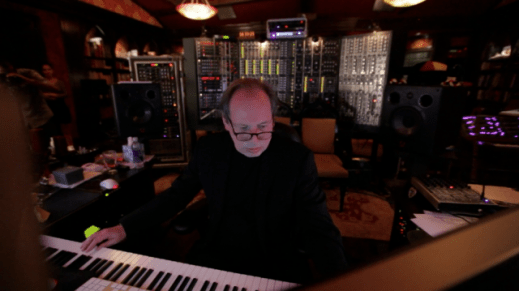
Composing a sound world for Man of Steel (2013), Zack Snyder’s recent Superman reboot, had Hans Zimmer thinking about telephone wires stretching across the plains of Clark Kent’s boyhood home in Smallville. “What would that sound like,” he said in an interview last year. “That wind making those telephone wires buzz – how could I write a piece of music out of that?” The answer, as it turned out, was not blowing in the wind, but sliding up and down the scale of a pedal steel guitar, the twangy lap instruments of country music. In recording sessions, Zimmer instructed a group of pedal steel players to experiment with sustains, reverb, and pitches that, when mixed into the final track, accompany Superman leaping over tall buildings at a single bound.
His work on Man of Steel, just one of his most recent films in a long and celebrated career, exemplifies his unique take on composing for cinema. “I would have been just as happy being a recording engineer as a composer,” remarked Zimmer last year in an interview to commemorate the release of a percussion library he created in collaboration with Spitfire Audio, a British sample library developer. “Sometimes it’s very difficult to stop me from mangling sounds, engineering, and doing any of those things, and actually getting me to sit down and write the notes.” Dubbed the “HZ01 London Ensembles,” the library consists of a collection of percussion recordings featuring many of the same musicians who have performed for Zimmer’s film scores, playing everything from tamtams to taikos, buckets to bombos, timpani to anvils. According to Spitfire’s founders, the library recreates Zimmer’s approach to percussion recording by offering a “distillation of a decade’s worth of musical experimentation and innovation.”
In many ways, the collection is a reminder not just of the influence of Zimmer’s work on contemporary film, television, and video game composers but also of his distinctive approach to film scoring, one that emphasizes sonic experimentation and innovation. Having spent the early part of his career as a synth programmer and keyboardist for new wave bands such as The Buggles and Ultravox, then as a protégé of English film composer Stanley Myers, Zimmer has cultivated a hybrid electronic-orchestral aesthetic that uses a range of analog and digital oscillators, filters, and amplifiers to twist and augment solo instrument samples into a synthesized whole.
Zimmer played backup keyboards on “Video Killed the Radio Star.”
In a very short time, Zimmer has become a dominant voice in contemporary film music with a sound that blends melody with dissonance and electronic minimalism with rock and roll percussion. His early Hollywood successes, Driving Miss Daisy (1989) and Days of Thunder (1990), combined catchy themes and electronic passages with propulsive rhythms, while his score for Black Rain (1989), which featured taiko drums, electronic percussion, and driving ostinatos, laid the groundwork for an altogether new kind of action film score, one that Zimmer refined over the next two decades on projects such as The Rock (1996), Gladiator (2000), and The Pirates of the Caribbean series.
What is especially intriguing about Zimmer’s sound is the way in which he combines the traditional role of the composer, who fashions scores around distinct melodies (or “leitmotifs”), with that of the recording engineer, who focuses on sculpting sounds. Zimmer may not be the first person in the film business to experiment with synthesized tones and electronic arrangements – you’d have to credit Bebe and Louis Barron (Forbidden Planet, 1956), Vangelis (Chariots of Fire, 1981), Jerry Goldsmith (Logan’s Run, 1976), and Giorgio Moroder (Midnight Express, 1981) for pushing that envelope – but he has turned modern film composing into an engineering art, something that few other film composers can claim.
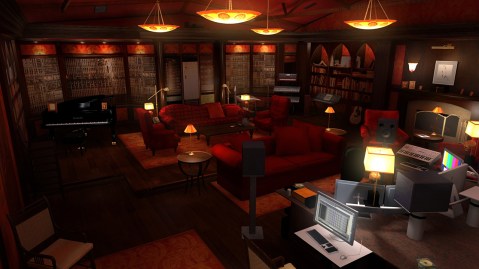
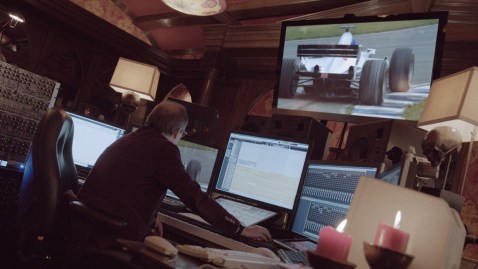
Zimmer’s studio
One thing that separates Zimmer’s working method from that of other composers is that he does not confine himself to pen and paper, or even keyboard and computer monitor. Instead, he invites musicians to his studio or a sound stage for an impromptu jam session to find and hone the musical syntax of a project. Afterwards, he returns to his studio and uses the raw samples from the sessions to compose the rest of the score, in much the same way that a recording engineer creates the architecture of a sound mix.
“There is something about that collaborative process that happens in music all the time,” Zimmer told an interviewer in 2010. “That thing that can only happen with eye contact and when people are in the same room and they start making music and they are fiercely dependent on each other. They cannot sound good without the other person’s part.”
Zimmer facilitates the social and aesthetic contours of these off-the-cuff performances and later sculpts the samples into the larger fabric of a score. In most cases, these partnerships have provided the equivalent of a pop hook to much of Zimmer’s output: Lebo M’s opening vocal in The Lion King (1994), Johnny Marr’s reverb-heavy guitar licks in Inception, Lisa Gerrard’s ethereal vocals in Gladiator and Black Hawk Down (2002), and the recent contributions of the so-called “Magnificent Six” musicians to The Amazing Spider Man 2 (2014).
The melodic hooks are simple but infectious – even Zimmer admits he writes “stupidly simple music” that can often be played with one finger on the piano. But what matters most are the colors that frame those notes and the performances that imbue those simple melodies with a personality. Zimmer’s work on Christopher Nolan’s Dark Knight trilogy revolves around a deceptively simple rising two-note motif that often signifies the presence of the caped crusader, but the pounding taiko hits and bleeding brass figures that surround it do as much to conjure up images of Gotham City as cinematographer Wally Pfister’s neo-noir photography. The heroic aspects of the Batman character are muted in Zimmer’s score except for the presence of the expansive brass figures and taiko hits, which reach an operatic crescendo in the finale, where the image of Batman escaping into the blinding light of the city is accompanied by a grand statement of the two-note figure backed by a driving string ostinato. Throughout the series, a string ostinato and taikos set the pace for action sequences and hint at the presence of Batman who lies somewhere in the shadows of Gotham.
Zimmer’s expressive treatment of musical colors also characterizes his engineering practices, which are more commonly used in the recording industry. Music scholar Paul Théberge has noted that the recording engineer’s interest in an aesthetic of recorded musical “sound” led to an increased demand for control over the recording process, especially in the early days of multitrack rock recording where overdubbing created a separate, hierarchical space for solo instruments. Likewise for Zimmer, it’s not just about capturing individual sounds from an orchestra but also layering them into a synthesized product. Zimmer is also interested in experimenting with acoustic performances, pushing musicians to play their instruments in unconventional ways or playing his notes “the wrong way,” as he demonstrates here in the making of the Joker’s theme from The Dark Knight:
The significance of the cooperative aspects of these musical performances and their treatment as musical “colors” to be modulated, tweaked, and polished rests on a paradoxical treatment of sound. While he often finds his sound world among the wrong notes, mistakes, and impromptu performances of world musicians, Zimmer is also often criticized for removing traces of an original performance by obscuring it with synth drones and distortion. In some cases, like in The Peacemaker (1997), the orchestration is mushy and sounds overly processed. But in other cases, the trace of a solo performance can constitute a thematic motif in the same way that a melody serves to identify place, space, or character in classical film music. Compare, for instance, Danny Elfman’s opening title theme for Tim Burton’s Batman (1989) and Zimmer’s opening title music for The Dark Knight. While Elfman creates a suite of themes around a central Batman motif, Zimmer builds a sparse sound world that introduces a sustained note on the electric cello that will eventually be identified with the Joker. It’s the timbre of the cello, not its melody, that carries its identifying features.
To texture the sounds in Man of Steel, Zimmer also commissioned Chas Smith, a Los Angeles-based composer, performer, and exotic instrument designer to construct instruments from “junk” objects Smith found around the city that could be played with a bow or by hand while also functioning as metal art works. The highly abstract designs carry names that give some hint to their origins – “Bertoia 718” named after modern sculptor and furniture designer Harry Bertoia; “Copper Box” named for the copper rods that comprise its design; and “Tin Sheet” that, when prodded, sounds like futuristic thunderclaps.
Smith’s performances of his exotic instruments are woven into the fabric of the score, providing it with a sort of musical sound design. Consider General Zod’s suite of themes and motifs, titled “Arcade” on the 2-disc version of the soundtrack. The motif is built around a call-and-answer ostinato for strings and brass that is interrupted by Smith’s sculptural dissonance. It’s the sound of an otherworldly menace, organic but processed, sculpted into a conventional motif-driven sound world.
Zimmer remains a fixture in contemporary film music partly because, as music critic Jon Burlingame has pointed out, he has a relentless desire to search for fresh approaches to a film’s musical landscape. This pursuit begins with his extracting of sounds and colors from live performances and electronically engineering them during the scoring process. Such heightened attention to sound texture and color motivated the creation of the Spitfire percussion library, but can only hint at the experimentation and improvisational nature that goes into Zimmer’s work. In each of his film scores, the music tells a story that is tailored to the demands of the narrative, but the sounds reveal Zimmer’s urge to manipulate sound samples until they are, in his own words, “polished like a diamond.”
—
Ben Wright holds a Provost Postdoctoral Fellowship from the University of Southern California in the School of Cinematic Arts. In 2011, he received his Ph.D. in Cultural Studies from the Institute for Comparative Studies in Literature, Art and Culture at Carleton University. His research focuses on the study of production cultures, especially exploring the industrial, social, and technological effects of labor structures within the American film industry. His work on production culture, film sound and music, and screen comedy has appeared in numerous journals and anthologies. He is currently completing a manuscript on the history of contemporary sound production, titled Hearing Hollywood: Art, Industry, and Labor in Hollywood Film Sound.
—
All images creative commons.
—
REWIND! . . .If you liked this post, you may also dig:
Fade to Black, Old Sport: How Hip Hop Amplifies Baz Luhrmann’s The Great Gatsby— Regina Bradley
Quiet on the Set?: The Artist and the Sound of a Silent Resurgence— April Miller
Play It Again (and Again), Sam: The Tape Recorder in Film (Part Two on Walter Murch)— Jennifer Stoever
Share this:


Current Top Posts





April 2021

January 2020

November 2019

October 2019

August 2019

April 2014

November 2017

March 2015

December 2017

October 2015
 Sounding Out!
Recent Comments